
Guest post by ALOK RANJAN
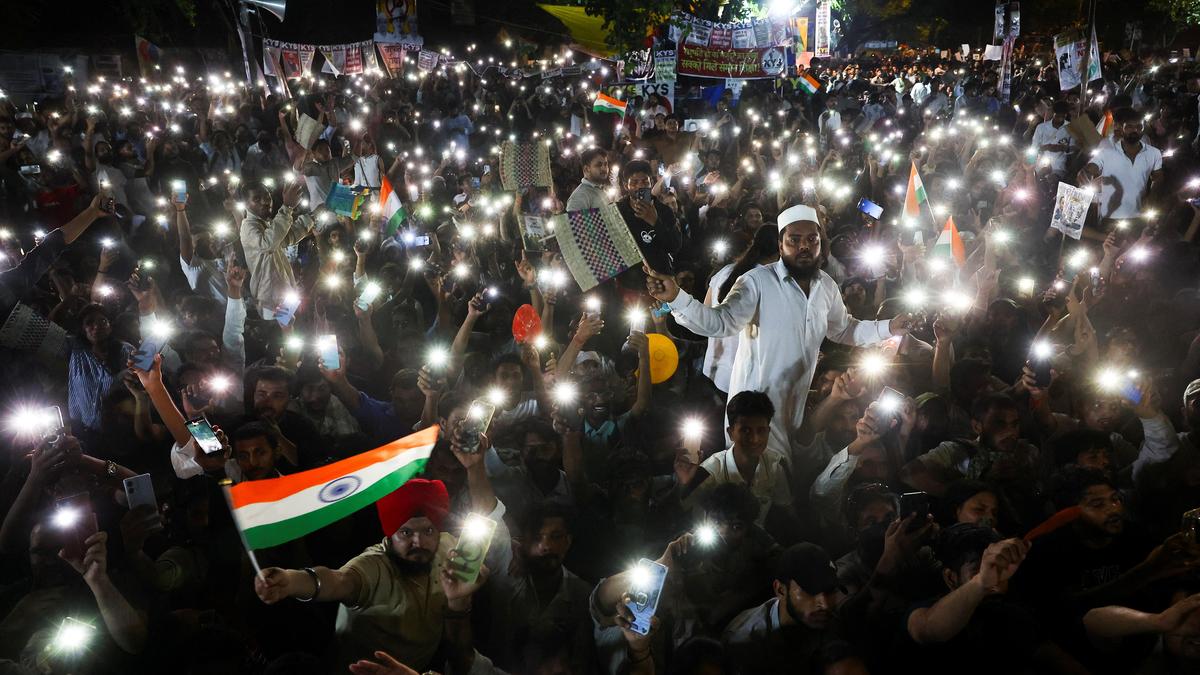
In an essay in Kafila, after the ceasefire between India and Pakistan in 2025, I had reflected on a sentiment of betrayal on social media. Then I had faintly wondered whether that sentiment could transform the online sphere towards a positive political role away from its propaganda function. After a year, an online wave fueled a political euphoria on the streets of Delhi and many other cities over a deeper systemic betrayal of the youth. The virtual and the physical spheres erupted in sync, enjoying an expression of resentment.
Being called a cockroach was a moment of recognition, even if contemptuous, for the struggling youth. Appearing as individual aspirants in exam halls and as profiles on social media, they never had a shareable identity, except as a crucial demographic for national growth and electoral outcomes. Identifying as a cockroach made it possible for a socially diverse demography to appear as a multitude sharing anxieties, with many already carrying a melancholia of diminished life opportunities. The category named a condition, even though it was aimed at subjectivity. Youth found an existential ground to share and lament. Instead of simply submitting to the category, the youth deployed it as a sign of systemic failure to ask who turned them into cockroaches. Annexing it to their inter-subjectivity, they turned the term into evidence of the betrayal by the “system”.
Obtaining the education minister’s resignation over paper leaks, the Cockroach Janata Party (CJP) protest has answered an unwarrantedly uneasy question of whether anguish can be politically and publicly expressed in its totality amidst a powerful government. It has not been an obvious proposition and shadowed the protest with cynical speculations. The false questions of whether a social media trend can evolve into a regime-changing mobilisation such as those in Sri Lanka or Nepal were not emerging solely from a contempt of the youth’s political sensibility but also from a valid presumption of the government’s refusal to engage. It seemed everything could be controlled.
This was not all groundless. The protest completed a cycle from powerlessness to power-fullness, divided by a subversive climax. It had a moment of unwanted success at its weakest point before the eventual victory. When Sonam Wangchuk’s health deteriorated, appeals by sympathetic people for him to end his fast, with a common refrain that times have changed, revealed a sheer helplessness of people at large as they did not expect the government to respond. This moment succeeded in inconveniencing people with an uncomfortable truth of their civic feebleness against a government that they thought embodied their civilisational, communal, or national power. It screened a political tragedy for voyeuristic spectators, reminding them of their own cockroach status. A circulation of this feeling is as important an offer of the protest as its endpoint. It was the climax of this disarming feeling, with Wangchuk’s removal from Jantar Mantar, which shifted the trajectory. This was the baring of people’s psychological shields, civic worth, and illusional language. The weakest point became a productive stage shorn of most previous scripts of protests. There was no foundational imagination of India or protest methods to follow when they were already exposed as exhausted. Gen Z had a language for the “changed times.” It was not borrowed from the political class, and it took them by surprise with cockroach acts. The regime had prepared for a moral strategy of hunger fast but not for the playful ridicule of its force.
Sand escaped a closed fist under the pressure it received. The fist knew its pressure; it did not know the sand. Cockroaches emptied fists of claws and animated the pervasiveness of remaining sand. They did not simply outdo the humans but injected a portion of political animality into the air. When they were named, cockroach was meant to condemn a subjectivity of nuisance – insects that contaminate smooth orders. Essentially, they were figured as individual losers creeping their way into the sanitised systems. What was not foreseen, however, was their capacity to strike a multitude with strangers who did not believe in the glory of the system in the first place. Moving together, they looked for their makers within the order, asking for a discontinuity in the cockroach laboratory, while exerting their wholeness.
The youth protest has expanded a possibility of politics amidst a hallucinating hyperpolitics. It has kept the barricades of cynicism and fear aside at the moment for a resigned citizenry to walk past them. In this sense, beyond the stubborn questions of its impact, the protest bypassed several mystiques of democratic order and postcolonial governance to fundamentally contest the nature, responsibility, and limits of state power, while making specific demands. In doing so, it has not only humbled the government but also given it a chance at democratic legitimation by humbling its persona of unyielding unilateralism. The youth claimed a democratic strength, suggesting that an electorate mandate is not people’s surrender of political voice. It meant that a government belongs to the people and is not immune to its collective will, not only as a contending force but as a watchful auditor. This is a perfect return of the gaze as a condition of a democracy. It is a guide also to the fellow citizens, as to where to see, and how. The insta-citizen will return to its place with a promise that politics can be an extension of lifestyle. On an unrelated note, the judiciary made the executive accountable by giving people a word.

