Category Archives: authoritarianism

Condemn the Displacement of the people of Ken-Betwa Interlinking: CDNP

We are publishing below a statement by the Campaign to Defend Nature and People (CDNP) condemning the attacks on the adivasis right to life and demanding cancellation of the project which will only benefit the political-contractor lobby. It also demands that the government compensate the people, and implement decentralized alternatives to make Bundelkhand water-secure, and also protect nature and livelihoods  – AN

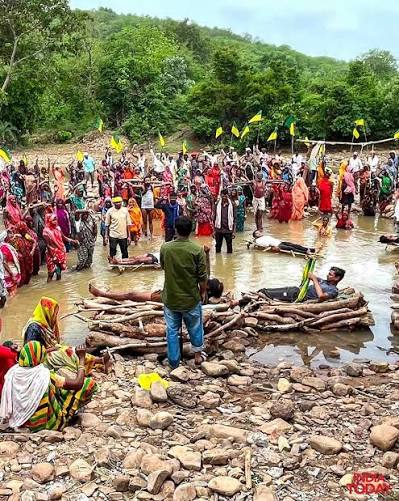
Ken-Betwa Chita andolan, image courtesy India Today

As the Chita Andolan [funeral-pure movement] of people protesting against their displacement by the Ken-Betwa river interlinking project enters its 12th day, Campaign to Defend Nature and People (CDNP) expresses its solidarity with them. We condemn the interlinked illegalities and injustices that the Ken-Betwa project has become. This is evident in the clearance given to a project that is devoid of rationale, through a deeply flawed process, and its implementation through illegal coercive displacement. Continue reading Condemn the Displacement of the people of Ken-Betwa Interlinking: CDNP

Civil Society Appeal to Sonam Wangchuk and Others on Hunger Strike at Cockroach Janata Party Protest

We are publishing below the Appeal by over 1821 artistes, writers, academics, social activists and other concerned citizens, to all friends sitting on Hunger Strike at the Cockroach Janata Party protest at Jantar Mantar, Delhi for the last 17 days to withdraw their hunger strike. The signatories have appealed to Sonam Wangchuk and all the student hunger strikers to withdraw, recognizing that this is a heartless government that does not have a conscience. They have underlined their support to the demand of the protesters for the resignation of education minister Dharmendra Pradhan, urging them to recognize that this is a longer fight and given this government’s intransigence, the need to is preserve their strength for future struggles. Please scroll down for the full list of signatories.

Dear Friends who are sitting in Hunger Strike at the Jantar Mantar, Delhi, demanding the resignation of Dharmendra Pradhan, Union Cabinet Minister for Education in the Government of India,

We, the undersigned citizens of this country, fully support your demand and are immensely grateful to you for being our voices of protest, fighting this battle against a fascist government from the frontlines. We salute your sense of purpose, the determination, and courage with which you are spearheading this movement for students and youth across the country. But we are also very concerned for your health and well-being and the impact that this indefinite hunger strike can have on all of you.

We make this appeal because we all know that this government does not have a heart or a conscience. We have seen time again how they have behaved in the most inhuman and dastardly manner with protesters be they the women wrestlers, the farmers, Father Stan Swamy, wrongly jailed who requested for a straw to drink water, or GD Agarwal the IIT Professor and environmentalist who died in Rishikesh following a hunger strike to clean the Ganga and ban hydroelectric projects. We worry that their negligence in responding to your demands will only further worsen the already fragile state of health that many of you are in.

We request you to please consider ending this hunger strike immediately in the interests of the longer and more difficult struggle ahead. This battle is a marathon not a sprint and we need you, your strength and leadership in the days to come. We are also requesting all those in Delhi to join the Cockroach Janata Party’s March to the Parliament on July 20, 2026. We hope you will understand that our appeal to you is a testament of both our unconditional love and deep respect for each one of you and what you stand for. Zindabad to your spirit.

With love,
Concerned Citizens

Anuradha Chenoy, Academic, Delhi
Jayati Ghosh, Academic, Delhi
Tanika Sarkar, Academic, Delhi
Arundhati Roy, Writer, Delhi
Nivedita Menon, Academic, Delhi
Sanjay Kak, Filmmaker, Delhi
Lalita Ramdas, Peace and Human Rights Activist, Hyderabad
Kavita Srivastava, President PUCL, Rajasthan
Madhu Bhushan, Feminist, Bangalore
Jean Dreze, Economist, Ranchi
Ratna Pathak Shah, Actor, Mumbai
Naseeruddin Shah, Performing Artist, Mumbai
Aditya Nigam, Scholar, Delhi
Arundhati Ghosh, Cultural Practitioner, Bangalore Continue reading Civil Society Appeal to Sonam Wangchuk and Others on Hunger Strike at Cockroach Janata Party Protest

CJP and us – The Mirror to the “Nation”: Puranjai

Guest Post by PURANJAI
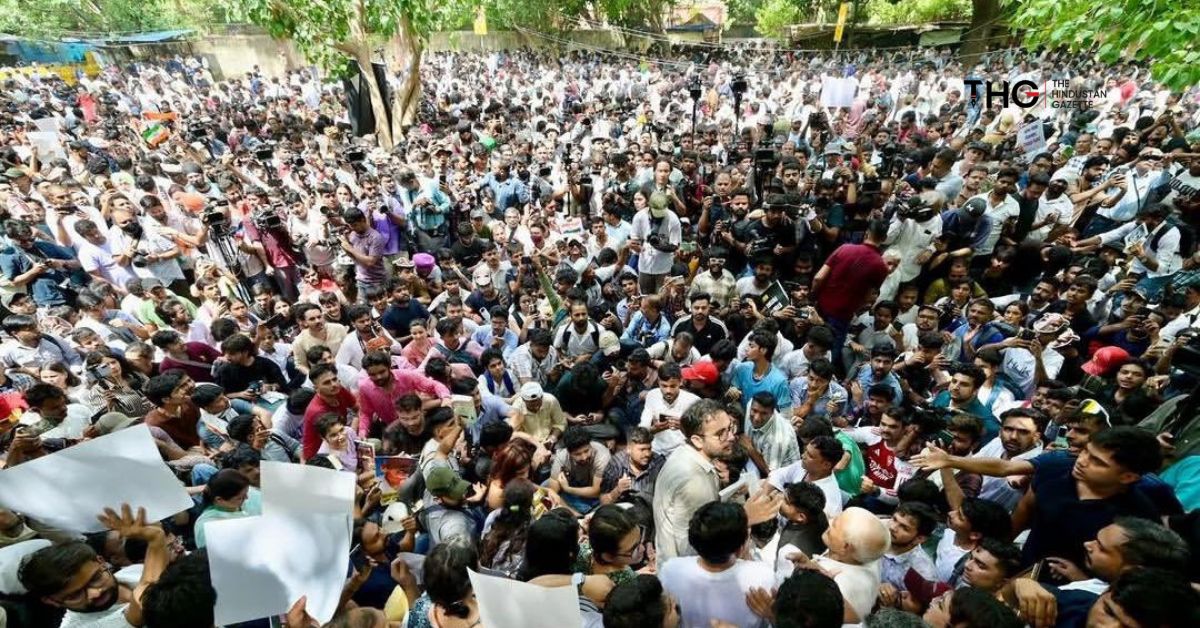
Image of June 6th protest in Delhi courtesy The Hindustan Gazette

The social media phenomenon Cockroach Janta Party (CJP) has been doing a series of protests now, its demand being the resignation of the education minister Dharmendra Pradhan. A lot of people have been writing on it, focusing on an analysis of its various features as well as the response of the state. It has opened interesting points for discussion. However, for this present space, I would be restricting myself to an analysis of the mirror it has held up to our society.

It is no secret, now that we are surviving Prime Minister Modi’s  third term that the government which quells any protest before it even really begins, gave a very tolerant treatment to the CJP organisers of as well as the protesters. While many have written their own explanations about it, I believe, considering the already initiated vilification and censorship campaign against Abhijit Dipke and the stationing of vast number of police forces at Jantar Mantar and Sansad Marg (I was there on 6 June) that the reason for such a tolerant treatment lies in numbers and content. The government could be said to be testing the translation of online resentment into physical spaces which would be a more precise gauge of the phenomenon. Without allowing the permission to even protest, it would have sent a very visible message of authoritarian tendencies.

The government couldn’t have risked denying the permission since it was being widely covered by the non-mainstream media and the middle-class was talking about it. This is in my opinion a very important aspect to note about it. The middle-class which has the necessary social capital to create narratives is very important to a government. It is this class which receives the media and political attention in moments of crisis. It is this class which is able to hegemonise empathy in a direction it sees desirable. Moreover, it does all of this without actively organising and politicising to a certain end.

This middle-class stays silent when bulldozers demolish homes of poor and the socially marginalised. Even when lakhs of names are removed from the electoral roll and subsequent attempts are being daily made to snatch citizenship of fellow human beings, it stays silent or gives active support to such actions. It stays largely regressive on the question of social justice and has a worldview of caring only for raising one’s own income levels. This section which should otherwise act as the one aggressively moving the country forward in all democratic aspects fails to do its duty to the country. It is this class residing in the strategic location of the capital and surrounding areas that the BJP could not afford to antagonise. Once it turns up in large numbers (much to the dismay of the dispensation), it chose to tolerate and perhaps might even accept the very minimum and technocratic demands in the future.

This section which is largely composed of socially privileged Hindus easily stakes claim to the ‘Nation’. The chanting of “Bharat Mata ki Jai”, “Vande Mataram”, the cricket team’s blue jersey, the A.R. Rehman version of Vande Mataram, the tricolour and above all the stress on the tool of peaceful protest; these all are symbols not created by the BJP even as it utilises these quite effectively. Today these are seen as visible symbols of nationalism (for most of which several people have been killed as well) and interestingly, their history predates the BJP’s history itself. Most of these symbols and mental frameworks are drawn from the Congress-dominated freedom struggle. It arose from a socially privileged  (and in some cases anti-Muslim) Hindu section of the population, came to occupy a hegemonic position across the country and stand in for a necessary sporting of the idea of nationalism.

This nationalism is comfortably sported by this middle-class that came to protest. Without the display of politics that challenges the establishment in some way and props up an alternative, the BJP finds it difficult to reply to this. For there are no Muslims as the face of CJP to be labelled as from Pakistan. Nor are there seemingly any “Khalistanis” to slander and arrest. Nor are there any structure-shaking demands being made by this middle-class and its CJP leadership. Till now, all the characterisations (of “exam-reform”) and the one single demand are all within the acceptable fold of nationalism that BJP is comfortable with. Yes, Ambedkar and Bhagat Singh are present in symbolic forms at the site as well, but without their radical challenge to the status-quo. It would be important to recall that the RSS-BJP has conveniently appropriated these symbols while invisibilising their message.

All of this, tells something about us constituting the middle-class. More than what it tells about the protest or the government, I believe this phenomenon displays an interesting aspect about us. Broken by caste, stunted by patriarchy and alienated by capitalism, we are not able to form an organic solidarity with the people of our country. While the social fabric of our country gets torn with every passing day, while class divide continues to dehumanise us every moment, we comfortably turn our eyes away (or perhaps some of us revel seeing these injustices continue). That we only gather together and wear the abstract concept of nationalism on our sleeves when our own economic interests are in peril is not a thing to be proud of.

Consider the revolutionary slogan of “Inquilab Zindabad” which I saw the people comfortably shouting at the site. But what is the content of this inquilab? Does it include the response to privatisation and centralisation of education, of the various caste and gender discriminations that happen in our educational spaces or even before one reaches (or not reaches) these spaces? Does it design a future for the adivasis and the Muslims? Do all of these figure in our idea of an alternative India?

Everyday, we see people getting lynched, kidnapped, tortured, maimed, discriminated against, silenced, assaulted, raped. No abstract concept of the nation is made available to these people within which they could wrap their concrete realities and thus show to the society for recognition and acknowledgement. It is really interesting to note that the tricolour and “Saare Jahan se accha Hindustan humara” did not save the protesters at Shaheen Bagh. For them was reserved the jail, the lathi, the bullet and the ultimate tag of “anti-national”. When the socially-privileged Hindus use it though, it is a different matter.

My pessimism only stretches till that of the intellect and I believe that however the past has been or the current limitations of the movement, one can transcend it if one desires. It has been long that the idea of India has been hegemonised by a select few. The far-right in India banks on it and creates an even unjust idea everyday through the mechanisms of the RSS. However, the present moment has provided an opportunity. As the establishment parties fail to provide any sustainable alternative to the status-quo, it has fallen on the people to design one. By being in dialogue with each other, the people of India can craft a democratic alternative. The government hates people talking to each other as fellow human beings. It would rather have us scrolling reels and liking the ridiculous Melody memes.

At a moment like this, physical mobilisations can be used to enter dialogue, rather than merely reducing the people to an audience which repeats outworn slogans. If one is able to imagine the protest site as something other than that of a unilinear flow of information, if one is able to design a setup other than the stage and the road, one might be able to move towards more just alternatives. By rallying around the cause of a more inclusive India, one can build solidarities that might not have been possible before. This present moment holds promise and one need not sit away from it. We must cautiously engage, if only to at least honestly try to enter a democratic dialogue with scope of emancipation. I maintain an optimism if not in the stage, at least in the people.

Puranjai is a PhD scholar at JNU

Citizens for Democracy Writes Open Letter to CJI Protesting “Cockroach” Remarks

We are publishing below the Open Letter to the Chief Justice of India, written by Citizens for Democracy

Hon’ble Chief Justice of India
New Delhi.

Esteemed Sir,

Citizens for Democracy (CFD) strongly protests your comment equating environmentalists, RTI activists and others with cockroaches and parasites

While hearing a petition filed by a lawyer seeking designation as a senior advocate, you said in the court on May 15, 2026, “There are already parasites of society who attack the system, and you want to join hands with them?… There are youngsters like cockroaches, who don’t get any employment or have any place in profession. Some of them become media, some of them become social media, RTI activists and other activists, and they start attacking everyone.”

Your comment generated heat and anger among the activists following which you tried to clarify your position the next day: “I am pained to read how a section of the media has misquoted my oral observations made during the hearing of a frivolous case yesterday. What I had specifically criticised were those who have entered professions like the Bar (legal profession) with the aid of fake and bogus degrees. Similar persons have sneaked into the media, social media, and other noble professions as well, and hence, they are like parasites. It is totally baseless to suggest that I criticised the youth of our nation. Not only am I proud of our present and future human resource, but every youth of India inspires me. It is not an exaggeration to say that Indian youth have great regard and respect for me, and I too see them as the pillars of a developed India.”

This is a lame explanation as your comment does target activists who you have presumed that if they are young, and have become activists they must have failed to get “any employment”. In short, using a context of a lawyer seeking the designation as ‘senior lawyer’ you tried to cast aspersions on all those who speak for the ordinary citizens of the country.  We wonder, if you, from the chair of a judge would accept such an explanation. It would have been proper for you to withdraw your uncharitable remarks and apologize for your inadvertence.  What was the judicial rationale behind your comment? Continue reading Citizens for Democracy Writes Open Letter to CJI Protesting “Cockroach” Remarks

The Missing Link – How the Great Democracy Robbery Was Conducted

A fundamental mistake is being made by many well-meaning people with respect to the West Bengal election results, For instance, many people are comparing the votes deleted in the farcical “SIR” exercise with the loss of roughly that same amount of votes in TMC’s “final” tally. The closeness of these two figures  – 27 lakhs in the case of deletions (under the logical discrepancy category, though the actual figure should be much higher), and the decrease in TMCs vote  – still falls far short of the BJPs 2.92 crores or so. If one goes by the “final figures” provided by the ECI, the TMC got only 2.60 crores in comparison suggesting that the BJP would have won hands down, even without “SIR”.
Of course all those trying to normalize the big fraud that elections have progressively become since 2019, intentionally or innocently,  also routine resort to such so-called “final figures”. The Godi Media is the biggest player in this heist of the public mind and it has been ably playing this role this time too.

Continue reading The Missing Link – How the Great Democracy Robbery Was Conducted

सत्य के अन्वेषी और ‘अंधेरे की आदत’ वाला समाज

…… ‘समाजवादियों ने हिन्दू राष्ट्र को किस तरह मुमकिन बनाया ?’

..समाजवादी धारा की यह परिणति भारत की वाम शक्तियों के सामने भी कुछ सवाल निश्चित ही खड़े करती है।

अगर 60 के दशक में समाजवादी धारा के अग्रणी कांग्रेस को शिकस्त देने के लिए ‘शैतान के साथ भी हाथ मिलाने को तैयार होने’ की बात रख रहे थे, पहले उपचुनावों में और बाद में राज्य विधानसभा के चुनावों में भारतीय जनसंघ के साथ मंच साझा कर रहे थे, गठबंधन कायम कर रहे थे, उन उथल पुथल के दिनों में वाम की शक्तियों का क्या रूख था ?

क्या उन्होंने गैर कांग्रेसवाद के नाम पर संघ-भारतीय जनसंघ को वैधता दिलाने वाली सियासत का उसूली आधार पर विरोध किया या नहीं ? कहीं ऐसा तो नहीं कि अस्पष्टता के चलते या urgency के भाव के चलते मौन ही रहे ,  उसी ‘सिद्धांत’ से हमकदम चलते रहे ?

क्या हमारे लिए यह आत्मपरीक्षण का विषय होना नहीं चाहिए कि आपातकाल के बाद जिन जयप्रकाश नारायण को दूसरा महात्मा कहा गया था, यहां तक कि आपातकालविरोधी संघर्ष को ‘दूसरी आज़ादी’ के नाम से महिमामंडित किया गया था, जिसने एक तरह से पहली दफा राष्ट्रीय स्वयंसेवक संघ को वैधता दिलायी, नयी  स्वीकृति प्रदान की और केन्द्रीय मंत्रिमंडल में भी स्थान दिलवाया, उस जयप्रकाश नारायण को लेकर कम्युनिस्टों का रूख क्यों बहुत अस्पष्ट रहा ?

किसी परिघटना को समझने में हमारी भूल हो सकती है, किसी व्यक्ति-संगठन की असलियत जानने में हम गड़बड़ी कर सकते हैं, लेकिन यह बात समझ से परे है कि राष्ट्रीय स्वयंसेवक संघ, उसके पीछे की फासीवादी प्रेरणाएं या स्वाधीनतापूर्व आन्दोलन तथा स्वाधीनता के बाद के आंदोलनों में उनकी निरंतर विवादास्पद भूमिका पर विस्तार से तथ्य पेश किए जाते रहने के बावजूद बाद के दिनों में क्या फौरी राजनीतिक लाभ के नाम पर उसके आनुषंगिक संगठनों के साथ जुड़ने से परहेज करने में प्रगतिशील ताकतें, वाम की शक्तियां सचेत रह पायीं ?.. ( Read the full text here : https://nayapath.in/seekers-of-truth-by-subhash-gatade/)

Principal’s endorsement of Women’s Reservation Bill on a party platform unacceptable: Statement by LSR students

Public statement by LSR students

The students of Lady Shri Ram College for Women—a large number of them filling the area outside auditorium, the corridor, the entire staircase and many even outside under the sun—started the protest not because we are against the Women’s Reservation Bill, but because the video of the Principal of the college was posted on the BJP4India official Instagram page. As a college that touts that it is apolitical and does not allow students to organise political events, the students found this extremely hypocritical. In the 15 minutes of the claimed “transparent dialogue” that happened yesterday, we were told by the Principal that she recorded the video for the Ministry of Women and Child Development and that it was posted on the BJP4India page without her consent. On further questions about if she contacted the page regarding it being posted without her consent, she said, “No”. Continue reading Principal’s endorsement of Women’s Reservation Bill on a party platform unacceptable: Statement by LSR students

India in the World – Mostly Through Lens of Iran War – Ravi Sinha

Theme :India in the World – Mostly Through Lens of Iran War

Speaker : Ravi Sinha

Abstract :
The unipolar world that came into existence at the end of the Cold War is on the way out and a new world order, potentially a multipolar one, is in the offing. This epochal change, as evidenced in the miraculous rise of China and the re-emergence of Russia on the world stage, appears to have gained acceleration with the war in West Asia in which the Iranian nation has handed an astonishingly courageous response to the aggressors. A broad framework to understand this epochal transition was presented in a study group by Comrade Ravi Sinha

Part 1 of this video contains the basic presentation followed by further elaboration of the argument in the Q/A session in Part 2.
New Socialist Initiative (NSI)

RSS at 100: Caste, Savarkar, and the real roots of RSS | The Federal

Nilanjan Mukhopadhyay speaks with Subhash Gatade

https://www.youtube.com/watch?v=tpgQi1LaRgo

In The Federal’s ‘RSS at 100’ series, Nilanjan Mukhopadhyay speaks with Subhash Gatade, author of Godse’s Children and Modinama, about the deeper social roots of the Rashtriya Swayamsevak Sangh (RSS). Gatade argues that the RSS must be understood not just through Hindu-Muslim politics, but through the caste churn in Maharashtra, the challenge posed by Jyotiba Phule’s anti-caste movement, and the predominance of Brahmin leadership within the organisation. The discussion also examines Savarkar’s influence, Golwalkar’s ideology, the RSS-Hindu Mahasabha relationship, and the strategic shift towards ‘inclusive Hindutva’ in later decades.

वीबीग्रामजी रद्द करो,  मनरेगा बहाल करो : कार्यकर्ताओं और संगठनों की मांग

[निम्नलिखित बयान साठ से ज़्यादा ऐसे संगठनों और कार्यकर्ताओं की तरफ़ से 15 फरवरी को जारी किया गया है  जिनका मनरेगा  के कार्यान्वयन से संबंध रहा है। ]

हम, नीचे दस्तखत करने वाले एक्टिविस्ट्स, जो भारत के कोने-कोने में मनरेगा मजदूरों के साथ काम करते हैं, महात्मा गांधी राष्ट्रीय ग्रामीण रोजगार गारंटी अधिनियम (मनरेगा) को खत्म करने की कड़ी निंदा करते हैं, जो माँग पर मिलने वाला काम के अधिकारका प्रोग्राम था।

हमारा मानना है कि:

– मनरेगा महाराष्ट्र की रोजगार गारंटी योजना से सीख लेकर भारी समर्थन और बातचीत के बाद शुरू किया गया था।


पहली बार हर परिवार को 100 दिन का काम मिलना पक्का किया गया था। Continue reading वीबीग्रामजी रद्द करो,  मनरेगा बहाल करो : कार्यकर्ताओं और संगठनों की मांग

SIR must be stopped until reconsidered and reworked – Jury report on public hearing in Delhi

A National Convention on Defending Universal Adult Franchise, convened by Bharat Jodo Abhiyan, the People’s Union for Civil Liberties (PUCL) and the National Alliance of People’s Movements (NAPM), took place at the Constitution Club, New Delhi, on 20 December, 2025. At this National Convention, the Special Intensive Revision (SIR) of electoral rolls being carried out by the Election Commission of India in different states of India was discussed. About two hundred persons, including many witnesses, attended the Convention and were part of the audience. We post below the report of the jury

 Conclusion of the jury:

After hearing the testimonies, the jury is of the view that the revision of electoral rolls is being carried out hastily and sometimes carelessly. The possibility of mass disenfranchisement is, therefore, real and ominous. It is imperative for the process to be fair and accurate; all eligible voters must be duly registered and should be able to exercise their right to vote. To fulfil these basic requirements, the SIR process needs to be reconsidered and reworked, and until that is done, in the interim, it must be stopped.

Jury members:  Justice Madan Lokur (Retd.), Justice A.K. Patnaik (Retd.), Ms. Pamela Philipose, Dr. Jean Drèze, Prof. Nivedita Menon (Retd.)

Report of the jury

At the National Convention, we as members of the jury heard Continue reading SIR must be stopped until reconsidered and reworked – Jury report on public hearing in Delhi

Deal With the Problem, Not the Activists; Control Polluters, Not Those Demanding Accountability! – NACEJ

The National Alliance for Climate and Environmental Justice (NACEJ) strongly condemns the raids, searches, and intimidation of climate activists Harjeet Singh and Sanjay Vashisht by Indian enforcement agencies.

Recent actions by the Enforcement Directorate (ED) and allied agencies—reportedly based on alleged violations of foreign exchange regulations, vague claims of threats to “energy security,” and unsubstantiated intelligence inputs—have been carried out without transparency or disclosure of credible evidence. Public reporting indicates reliance on anonymous official briefings, rumoured intelligence reports, and speculative allegations, with officials unwilling to come on record. Continue reading Deal With the Problem, Not the Activists; Control Polluters, Not Those Demanding Accountability! – NACEJ

India Under Modi: Shrinking Democracy, Growing Inequalities – Professor Atul Kohli

https://www.youtube.com/watch?v=XJgzRcNOytQ

Democracy Dialogues Series 42

Organised by New Socialist Initiative

Theme :

India Under Modi: Shrinking Democracy, Growing Inequalities

Speaker: 

Professor Atul Kohli

David K.E. Bruce Professor of International Affairs at Princeton University, USA

Sunday 25 th January, 2026

—————-

Abstract:

Modi’s rule in India is characterized by shrinking democracy and growing economic inequalities.  The presentation will focus both on the rise of Modi and on Modi’s ruling record.  The following points will be emphasized: growing economic inequalities under Congress governments after 1991 fractured the party’s voter base, paving the way for Modi’s rise; religious polarization and corporate power have grown simultaneously under Modi; India’s billionaires thrive amid the democratic decline; institutional checks have been eroded and the opposition has been fractured: the judiciary, media, and election bodies have failed to counter executive power; and there is little evidence to suggest a superior economic record in India after 2014: industrial growth has been sluggish, job creation minimal, and welfare spending flat.

About the Speaker: Professor Atul Kohli is a world-reknowned political scientist. He is the David K.E. Bruce Professor of International Affairs at Princeton University. His principal research interests are in the area of political economy of developing countries. He is the author of India Under Modi: Changing State and Society (with Kanta Murali), (2025); Greed and Guns: Imperial Origins of the Developing World, (2022); Imperialism and the Developing World: How Britain and the U.S. Shaped the Global Periphery (2020); Poverty amid Plenty in the New India (2012) (a Foreign Affairs Best Book of 2012 on Asia and the Pacific); State-Directed Development: Political Power and Industrialization in the Global Periphery (2004) (winner of the Charles Levine Award (2005) of the International Political Science Association); Democracy and Discontent: India’s Growing Crisis of Governability (1991); and The State and Poverty in India (1987).  He has also edited or coedited ten volumes (most recently, Business and Politics in India, 2019; and States in the Developing World, 2017) and published some sixty articles. Through much of his scholarship he has emphasized the role of sovereign and effective states in the promotion of inclusive development.

Delhi Declaration: Reject SIR, Reclaim Universal Adult Franchise

We, people’s movements, peoples’ organisations and citizens from across India, express our deep concern at the undemocratic, unconstitutional and illegal deletions of crores of voters under the guise of Special Intensive Revision (SIR) of electoral rolls. We confront the largest ever disenfranchisement in the history of any democracy. We face a challenge to the universality of the universal adult franchise — the foundational achievement of our freedom struggle.

The Election Commission of India (ECI) has weaponised a seemingly routine administrative exercise into an unprecedented and sweeping rewriting of the rules of who can be a voter.

This tectonic shift in the country’s electoral architecture was introduced without a constitutional amendment, without public or legislative debate, and without any change in the statutory rules or even the ECI’s own Election Manual. This has resulted into a double whammy for the people of India. First, the responsibility for inclusion on the voters’ list has been shifted from the State to the citizen. Second, the presumption of citizenship has been overturned. These provisions fly in the face of the letter and the spirit of our constitution, are a case of wanton abuse of law, disregard of the judicial pronouncements and the ECI’s own established norms of transparency, accountability and fairness.

The experience of Bihar stands as a stark warning. The SIR unfolded as a chaotic exercise in bureaucratic overreach that imposed impossible demands on the frontline election staff and needless misery for ordinary people. There is ample evidence that the SIR in Bihar failed every quality test of electoral roll revision: completeness, equity and accuracy. The population–elector ratio declined sharply, resulting in a net reduction of forty-five lakh names from the voters’ list. The burden of exclusions fell disproportionately on the poor, migrants, minorities and women. Meanwhile, inaccuracies in the voters list remained unresolved—duplicated entries, blank records, gibberish data and bulk voters at single addresses persisted.

Yet, instead of learning from this disaster, the Election Commission has chosen to go ahead with SIR in the rest of the country. Evidence from the second phase of SIR shows that more than eleven crore voters now face the threat of disenfranchisement—because they could not submit forms on time, or because they could not trace themselves to an arbitrarily set qualifying electoral rolls of 2002 or 2003. The burden has fallen once more on the most vulnerable, especially women, migrants, dalit, adivasis, nomadic and trans communities and the religious minorities, mainly the Muslims. Again, impossible deadlines have been imposed on inadequately trained and overburdened BLOs, leading to multiple tragic cases of their deaths and suicides.

This runs counter to the consultative and inclusive spirit that the ECI has upheld for decades
and deepens the suspicion that this mass exclusion is being carried out at the behest of the
ruling dispensation. The Election Commission faces a crisis of credibility like never before, as the lines dividing the Commission, the Government and the ruling party have been blurred.

In a democracy voters choose their government. A democracy loses all meaning if the government is allowed to choose its voters. That is the abyss the SIR is leading India into.

Therefore, this Convention demands that:

Continue reading Delhi Declaration: Reject SIR, Reclaim Universal Adult Franchise

“SIR” Is a Process of Mass Disenfranchisement

The Solution

After the uprising of the 17th June Election of 2024

The Secretary of the Writers Union Prime Minister’s Office

Had leaflets distributed in the Stalinallee the message sent out via Nagpur

Stating that the people

Had forfeited the confidence of the government

And could win it back only

By redoubled efforts. Would it not be easier

In that case for the government

To dissolve the people

And elect another? – [Courtesy Bertolt Brecht]

The way things are going with the SIR, we are heading for the regime “electing its people” – with the full participation of the Opposition parties, who despite the knowledge of the process, have become unwilling participants. Not knowing how to respond, they seem to be running around like headless chickens. “Vote Chori” and the so-called “Special Intensive Revision” (SIR) are closely tied together and though Rahul Gandhi seems to have got the import of what this means, reports suggest that RSS “sleeper cells” within and outside the Congress Party are hyperactive now, trying to undermine the campaign against vote chori. Some INDIA bloc parties have even openly distanced themselves from it. Continue reading “SIR” Is a Process of Mass Disenfranchisement