All posts by subhash gatade

Bodhgaya Bomb Blasts : Moving Beyond the ‘Usual Suspects’

I.

Encore!

Mr Praveen Swamy has ‘discovered’ the ‘usual suspects’ once again.

Narrating .'[t]he same old, depressing story of incompetence and apathy’ behind the Bodh Gaya bombings he has shared  with the readers how “[I]ndia’s police and intelligence services knew there were plots to attack the temple.” and how “.. jihadists quite publicly announced they intended to attack Buddhist targets. ..From January, government sources have told Firstpost, the Intelligence Bureau had issued several warnings pointing to heightened risks to Buddhist religious targets in India, as a consequence of anti-Muslim violence in Myanmar.” [FirstPost]

Of course, after giving enough hints about who the perpetrators could be, he has been careful enough to add – supposedly to maintain objectivity of his profession that: Continue reading Bodhgaya Bomb Blasts : Moving Beyond the ‘Usual Suspects’

Hindustan Times continues IB’s campaign to vilify Ishrat Jahan: Justice for Ishrat Jahan Campaign

On 2nd July, Hindustan Times Delhi edition carried a story with the headline “Ishrat Jahan has links with Kashmir Separatists”. The content of the story contradicted this sensational claim. Even more stunningly, the same story, sans this malicious headline, appeared in the Ahmedabad edition of the newspaper. Originally a story by the paper’s Ahmedabad correspondent, Mahesh Langa, Delhi-based correspondent Abhishek Saran added his byline and headline in the Delhi edition. It was clear what his contribution to the story was.

A letter by Shamima Kauser’s lawyer Vrinda Grover to Hindustan Times forced them to withdraw the headline and print a correction the following day. Continue reading Hindustan Times continues IB’s campaign to vilify Ishrat Jahan: Justice for Ishrat Jahan Campaign

Ishrat: Laltu’s poem

Laltu‘s poem written in 2004; published in Dainik Bhaskar in 2005.

‘इशरत’
एक 

इशरत!
सुबह अँधेरे सड़क की नसों ने आग उगली
तू क्या कर रही थी पगली !
लाखों दिलों की धड़कन बनेगी तू
इतना प्यार तेरे लिए बरसेगा
प्यार की बाढ़ में डूबेगी तू
यह जान ही होगी चली!
सो जा
अब सो जा पगली. Continue reading Ishrat: Laltu’s poem

Media manipulation on Ishrat continues: Vrinda Grover’s Protest Letter to Hindustan Times

To,
The Editor,
Hindustan Times

On the day the CBI is set to file its chargesheet in the Ishrat Jahan fake encounter case, Hindustan Times has chosen to report about it in a manner that is malicious, prejudicial and intended to manipulate public opinion. The report, “ ‘Ishrat Jahan had links with Kashmir Separatists’: CBI” by Mahesh Langa and Abhishek Sharan in the Delhi/ Ahmedabad edition of the newspaper is nothing short of defamatory. The headline attributes this ‘information’ to the CBI whereas in the text of the report, it is said that two of those killed along with Ishrat “were associated with secessionist groups in Kashmir”. Clearly, the CBI is not saying that Ishrat had any links with any group. This is a deliberate misrepresentation and a cheap trick to make connections where none exist in order to tarnish the reputation of a deceased girl who is no longer present to defend herself.  Continue reading Media manipulation on Ishrat continues: Vrinda Grover’s Protest Letter to Hindustan Times

Can The Real Shyama Prasad Mukherjee Ever Stand Up?

Image

It has been more than two years that A G Noorani’s important book ‘Article 370 : A Constitutional History of J and K’ (OUP, 2011, Pages 480) has hit the stands and has been able to clear many a confusions about the tumultuous era in post independence times pertaining to Jammu and Kashmir.

Basing himself on authentic documents, letters, memorandums, white papers, proclamations and amendments  the author, a constitutional expert himself, has not only provided new insights about the period but has also tried to bring forth an important summary of the developments then and the role played by different stakeholders. While we have been witness to a process of erosion of the article 370 today, the book underscores the politics behind its erosion, which was negotiated between Prime ministers Jawaharlal Nehru and Sheikh Abdullah and had a stamp of approval from Sardar Patel and Shyama Prasad Mukherjee.

For the  Bharatiya Janata Party (BJP), which daily invokes name of Shyama Prasad Mukherjee, founder of Bharatiya Jan Sangh – percursor to its present incarnation namely BJP – to oppose Article 370 which guarantees special status to Jammu and Kashmir – this exposure that the said Article had full approval from Mukherjee as well as then Home Minister Sardar Patel is nothing but blasphemous. Continue reading Can The Real Shyama Prasad Mukherjee Ever Stand Up?

Local Leader, National Ambitions: The Curious Case of Mr Narendra Modi

Mr Prithviraj Chavan, the present incumbent to the chief minister’s seat in Maharashtra, recently received praise from an unlikely quarter. Shiv Sena president Uddhav Thakreay in the party mouthpiece “Saamana” heaped praise on Chavan for ‘adopting a broad minded approach ..for his role in the ongoing rescue operations in disaster hit Uttarakhand.’ According to him while dispatching the relief material and a large team of officials, Mr Chavan instructed them that although ‘it is meant for people from the state stranded there, other victims should not be ignored.’

It has been reported that Maharashtra has placed two helicopters at the disposal of the Uttarakhand government and extended aid of Rs. 10 crore, and it was among the first states in the country to react quickly to the disaster. It is true that many other states have also rushed forces and material to assist people who are stranded at various places and such an hour of national calamity is normally not considered a moment of exhibiting political one-upmanship. Continue reading Local Leader, National Ambitions: The Curious Case of Mr Narendra Modi

मोदी: तिलिस्म और हक़ीकत

– सुभाष गाताडे

जुल्म

तशद्दुद

झूठ

बग़ावत

आगजनी

खूं

कर्फ्यू

फायर ….

हमने इन्हें बिरसे में दिए हैं

ये बच्चे

क्या देंगे हमको ???

(कविता: बच्चे – मुसाफि़र पालनपुरी,

‘कुछ तो कहो यारों!’ सम्पादन: आयशा खान)

1

नूरा कुश्ती की समाप्ति के बाद


सियासत में आपसी सत्ता-संघर्ष अक्सर व्यक्तियों के इर्दगिर्द सिमटते दिखते हैं। Continue reading मोदी: तिलिस्म और हक़ीकत

Public Appeal by R.B. Sreekumar , Former DGP, Gujarat

Image


1. For enfeebling the validity and credibility of evidence presented by me to Judicial & Investigating bodies and to denigrate my image, the publicity managers of the Chief Minister of Gujarat State, Shri Narendra Modi and the Sangh Parivar, are widely propagating many lies about the motive and time frame of submission of evidence by me against authors of 2002 anti-minority bloodbath. A totally blatant falsehood spread about me is that I had brought out incriminating material against those responsible for 2002 carnage and subsequent subversion of the Criminal Justice System (CJS) ONLY after my super-cession in promotion to the rank of Director General of Police (DGP) in February, 2005. This contention is utterly baseless, false, malicious and misleading.

2. The real truth in this matter is given below:-
http://dilipsimeon.blogspot.in/2013/06/public-appeal-by-rb-sreekumar-former.html

दो कठ्ठा ज़मीन : किशोर

Guest post by KISHORE

बच्चा मुसहर को सन 1986 में भूमि सुधार अधिनियम 1961 के तहत 0.26 डेसिमल (लगभग एक चौथाई एकड़) ज़मीन बिहार सरकार द्वारा दी गयी थी. इस एक्ट के तहत भूमिहीनों को ज़मींदारों से अर्जित अधिशेष भूमि दी जानी थी. बच्चा मुसहर ज़िंदगी भर सरकार द्वारा उनके नाम पर करी गयी ज़मीन पर हल चलाने को तरसते रह गए पर उन्हें अपनी ज़मीन पर कदम रखने का अवसर नहीं मिला. उन्होंने  ब्लाक, जिला और राजधानी तक ना जाने कितने दफ्तरों के चक्कर लगाये पर ज़मीन पर उनका मालिकाना हक, उस कागज़ के पुर्जे तक ही सीमित रहा.

सन 2000 में बच्चा मुसहर अपनी ज़मीन के मालिकाना हक़ के अधूरे सपने के साथ इस दुनिया से चले गए. बच्चा मुसहर को गुज़रे 13 साल बीत गए पर उनकी विधवा आज भी उस कागज़ के टुकड़े को संभाले बैठी है पर उनको ज़मीन पर कब्ज़ा नहीं मिल सका. दफ्तरों के चक्कर लगाने का सिलसिला बच्चा मुसहर के बाद उसकी विधवा और बच्चों ने भी जारी रखा पर ज़मीन की बंदोबस्ती के लगभग तीन दशकों के बाद आज भी ज़मीन उनके कब्जे में नहीं है. Continue reading दो कठ्ठा ज़मीन : किशोर

‘Who Killed my daughter Ishrat Jehan ?’ – Statement by Shamima Kauser mother of deceased Ishrat Jehan

Image

18th June, 2013

My daughter Ishrat Jehan was abducted, illegally confined and killed in cold blood by officers and men of the Gujarat police, in June 2004. She was killed as part of a larger conspiracy which had a political agenda. Ishrat’s murder was projected as an ‘encounter’ and justified by branding her a terrorist who had come with 3 other men to attack the Gujarat Chief Minister Narendra Modi. This was not the first fake encounter in Gujarat, other Muslims too had been executed in similar staged encounters, committed in the name of protecting the Chief Minster of Gujarat. Some of these other fake encounters, which are nothing but pre meditated extra judicial killings, are already under investigation and prosecution. Continue reading ‘Who Killed my daughter Ishrat Jehan ?’ – Statement by Shamima Kauser mother of deceased Ishrat Jehan

Malleswaram or Hubli 2 ?

Image

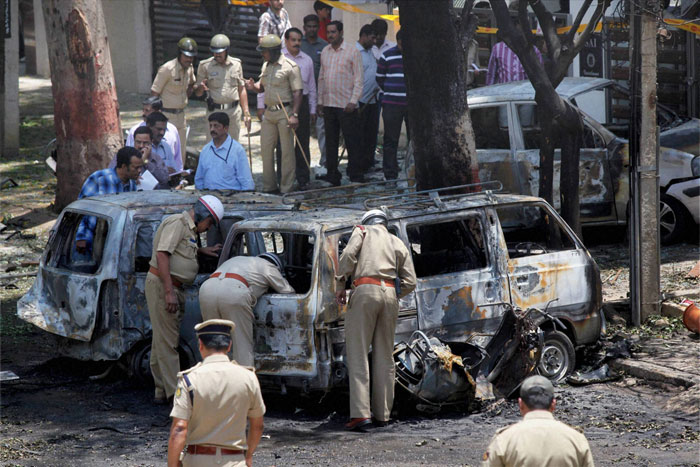
Imagine a bomb blast in a lane near the ruling party’s office just before the elections which is immediately attributed to an ubiquitous terrorist group by the powers that be. As expected the incident comes in handy not only for the news hungry 24 7 TV channels but helps the beleaguered ruling dispensation gain little breathing space bit far away from its internal squabbles and growing frustration of the people over cases of corruption and policies which have benefited only a few.

This ‘terrorist activity’ – as claimed by the home minister – propels the police machinery into action which promptly nabs within record time few of the alleged perpetrators alongwith the ‘mastermind’ who according to the police executed the cowardly act. Perhaps the matter should have ended their ‘happily’ with justice being done to the accused after a longwinding judicial process.

But a spate of fresh questions has put the whole probe in jeopardy.

Now it appears that the police in its rampant hurry has not investigated the case properly, not only leaving many loose ends but has supposedly resorted to third degree methods to extract confession from the said accused. Around a month after police claimed success in unearthing the case,  a news-item in a leading daily rather blew the lid from the lofty claims which makes it evident that despite having knowledge of the identity of the person whose SIM card was used to trigger the blast the police have not deemed it necessary even to question him as he happens to be an ‘influential RSS leader’.

Read the full article  here.

Hindutva in Karnataka: Experiments in Terror

Image

(Note: This article is a chapter of the book ‘Five Years of Saffron Rule in Karnataka’ Edited by Ambrose Pinto S.J., Manak Publications, Delhi, P. 338, 2013)

..Here it is enough to point out that Hindutva is not identical with what is vaguely indicated by the term Hinduism. By an “ism” it is generally meant a theory or a code more or less based on spiritual or religious system. But when we attempt to investigate into the essential significance of Hindutva, we do not primarily and certainly not mainly concern ourselves with any particular theocratic or religious dogma or creed..
 
 (V.D. Savarkar, Hindutva, Delhi: Bharti Sahitya Sadan, sixth edition, 1989, pp3f) Continue reading Hindutva in Karnataka: Experiments in Terror

Goodbye Asgharsaab : Remembering Asghar Ali Engineer

Image

Mera azm itna buland hai ki paraye sholon ka darr nahin

Mujhe khauf aatish e gul se hai kaheen yeh chaman ko jala na de.

(“My intentions are so high that I am not afraid of the unknown blaze

 I am afraid of the fire of the flowers lest it burn the garden  – Shakil Badauni )

 I will never forget the sips of tea I shared with Asgharsaab in a tea shop at Wardha more than a year ago. I had hardly any premonition at the time that this would be my last meeting with him. Continue reading Goodbye Asgharsaab : Remembering Asghar Ali Engineer

Sign Petition on the Custodial Killing of Khalid Mujahid

Image
Order CBI enquiry into the Custodial Killing of Khalid Mujahid
 
: Arrest the guilty Police Officers without delay

Khalid Mujahid, proclaimed by the police as one of the executors of the serial blasts that rocked UP courts in November 2007, died in police custody yesterday (18th May 2013). This young man, with no past medical record, the police claim died of sudden medical complications, on his way back to Lucknow prison, having made his appearance in court in Barabanki in connection with the serial blasts case. In 2011, a report, Torture in India, had documented how custodial killings were rampantly passed off as sudden medical complications and natural deaths (ACHR, p. 8). Continue reading Sign Petition on the Custodial Killing of Khalid Mujahid

Citizen-Students and the University: Sanjay Kumar

 Image

The proposed 4-year undergraduate degree programme of the Delhi University is being pushed through in undue haste without adequate debate and public discussion. The special emphasis on Foundation and Integrating Mind, Body and Heart courses, controversial components of the 4-year scheme, is indicative of an extra-academic zeal. The pedagogical thinking behind these courses is authoritarian and against the spirit of liberal citizenship.

Typically students under the 10+2+3 system of education in the country enter the university at the age of seventeen or eighteen. Time spent in the university helps students transition to adulthood. While there, they attain the legal age that confers citizenship rights and duties on them. The way they are treated in classes and in college and university offices; the rules of conduct they are expected to follow; and the extent and form of recognition they receive as adult citizens from the university– all have a lasting influence on how they imagine their citizenship. University life also involves informal and formal associations with other students and with teachers and staff. The form, purpose and operative principles of these associations shape the affective and cognitive behaviour of students, which partially determine the kind of public sphere they build later in life. This note discusses the recent developments in Delhi University and their implications for students from the perspective of citizenship. Continue reading Citizen-Students and the University: Sanjay Kumar

Burma – Lest We Don’t See, A Genocide Is In The Making: Bonojit Hussain

“We have to ask ourselves whether we may have over-romanticized its (Burmese pro-democracy movement within and outside of Burma) battles against the junta as a broader quest to bring pure, universal human rights to Burma, when in fact we had little evidence of a wholesale commitment to the principle of tolerance.” – Francis Wade (Thailand based Journalist and a keen observer of developments in Burma)

Since the summer of 2012 Burma has seen pogroms, massacres, riots of unprecedented scale against religious minorities, the latest being on the 30th April. Few hundreds have been killed and few hundred thousands have been rendered homeless.Much has been talked about how it is a ploy by the hardliners in the army and the post-reform government to stall further reforms. It might be true to a large extend, but the silence of the pro-democracy opposition is intriguing. While many from the “pro-democracy” camp have remained either silent or ambivalent; many others have shown that they actually belong to the ranks of fundamentalist who in the pretext of unfounded “sense of self-victimization” are fomenting a near genocidal situation in the country.  Continue reading Burma – Lest We Don’t See, A Genocide Is In The Making: Bonojit Hussain

Hefazat-e-Jamaat, Nothing Else : On the Recent Developments in Bangladesh

Image


Talibaner aar ek naam – hefazat-e-Islam!” (Another name for Taliban, Hefazat-e-Islam)               

– Slogan raised at Shahbagh square


To such a degree has Religion fuelled conflict, complicated politics, retarded social development and impaired human relations across the world, that one is often tempted to propose that Religion is innately an enemy of Humanity, if not indeed of itself a crime against Humanity. Certainly it cannot be denied that Religion has proved again and again a spur, a motivator and a justification for the commission of some of the most horrifying crimes against Humanity, despite its fervent affirmations of peace. Let us, however, steer away from hyperbolic propositions and simply settle for this moderating moral imperative: that it is time that the world adopted a position that refuses to countenance Religion as an acceptable justification for, excuse or extenuation of – crimes against Humanity.

(Wole Soyinka, Source: http://www.granta.com/New-Writing/Religion-Against-Humanity)

I

The above quote was part of a long intervention made by Wole Soyinka, Nigerian writer, recipient of the 1986 Nobel Prize in Literature, and the first one from Africa, as part of UNESCO International High Panel, in a Conference on the Culture of Peace and Non-Violence.(21 September 2012) . The immediate context for Soyinka’s speech – was the desecration and destruction of centuries old tombs of Muslim saints in Timbuktu, Mali by radical Islamist group Ansar-al Dime which had ‘discovered’ them to be unIslamic. There were rumours  that the ‘invaluable library-treasures of Timbuktu may be next.’ on their agenda. Cautioning people about the fact that “[t]he science-fiction archetype of the mad scientist who craves to dominate the world has been replaced by the mad cleric who can only conceive of the world in his own image, proudly flaunting Bond’s 007 credentials – License to Kill.” he urged leaders to “..[u]nderstand this, and admit that no nation has any lack of its own dangerous loonies, be they known as Ansar-Dine of Mali, or Terry Jones of Florida, the earlier they will turn their attention to real issues truly deserving human priority. “

One was reminded of Soyinka’s words when one was witness to the march organised by the newly emergent group Hefazat-e-Islam ( can be loosely translated as ‘Defenders of Islam’) on the streets of Dhaka, capital of Bangladesh and the consequent mayhem that followed.  Continue reading Hefazat-e-Jamaat, Nothing Else : On the Recent Developments in Bangladesh

Science and Modernity : Ravi Sinha

Guest post by RAVI SINHA

Science and modernity are widely considered among the most celebrated features of contemporary human civilization. Increasingly they are taken as the defining elements that distinguish our times from the times gone by. At such a sweeping level, there can be many other ways to characterize the contemporary. One can, for example, refer to capitalism, market, globalization, democracy or nation-states. One can also include various critiques of capitalism and the widespread resistance to its hegemonic and imperialistic avatars among the characteristic features of our times. Such characterizations, however, belong to a layer of historical reality that is more systemic than civilizational. Science and modernity, especially when taken as a correlated pair, characterize our times at a deeper level. They have, so to speak, seeped into the subterranean layers of contemporary historical reality.

On the face of it, such an assertion would appear to be far removed from the actual state of affairs in the real world. It would be rare, for example, to find a person whose beliefs and practices are fully consistent with established precepts of science. Such a search would be a fruitless endeavour, more or less, in any society on the planet. A similar anomaly is apparent in the case of modernity too. One can safely say that an overwhelming majority of humans in the contemporary world does not live by the canons or conventions of modernity. While few may be completely untouched by the laws and institutions of a modern polity or by the processes and pressures of a modern economy, most live by traditions and practices that do not sit well with basic attributes of modernity. Continue reading Science and Modernity : Ravi Sinha

Shahbag no imperialist conspiracy, Mr Umari

Image

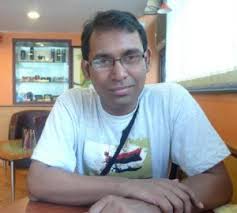
Photograph : Martyr Ahmed Rajib Haider

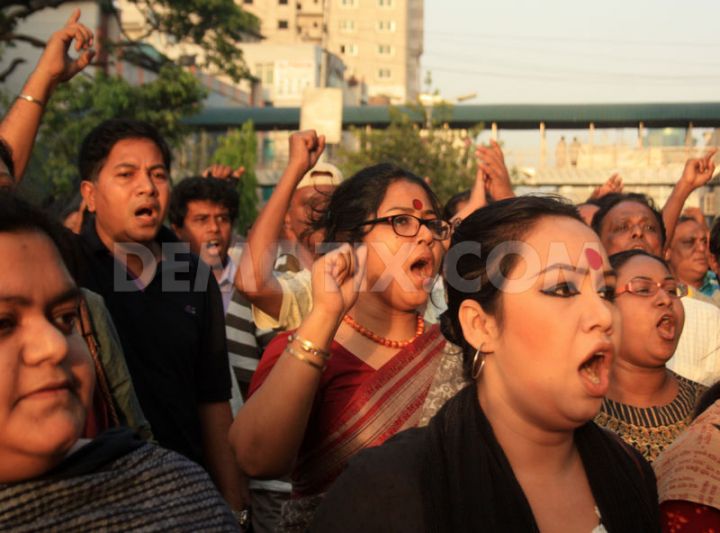
GUWAHATI: The echo of the Shahbag protest in Bangladesh was heard about 200 miles away here on Sunday with citizens, under the banner of Janamat, expressing solidarity with protesters in that country. Janamat, a Guwahati-based socio-cultural body which organised the solidarity meet here, said that the issue raised by the Shahbag protesters is relevant to India in general and Assam in particular because both the countries’ secular and democratic fabrics are threatened by communal forces.

Solidarity meet in city for Shahbag protest

TNN Apr 29, 2013, 09.35AM IST

Representatives of different Gonojagoron Mancha across the country on Friday suggested spreading its activities to grassroots level to aware people about its demands. They urged all to be united to fight against Jamaat-Shibir and move forward with a view to realising their demands …Around 300 representatives from 167 gonojagoron manchas from seven divisions attended the daylong representative conference at Senate Bhaban of Dhaka University to express their views and suggestions to strengthen the movement.

Imran H Sarkar, spokesperson for the Gonojagoron Mancha, announced a mass rally at Mymensingh on May 18 and a grand rally at Projonmo Chattar in Dhaka on May 31 at the end of the conference.

(The Daily Star, May 3, 2013)

Maulana Syed Jalaluddin Umari, President of Jamaat-e-Islami Hind, (Born in 1935), seems to be a learned man, at least that’s what his biographical details tell us. Elected for the second time as Ameer (President) of the Jamaat he is known to have ‘authored more than thirty books’ and is ‘considered an ‘authority on human rights in general, and women and Islamic family system in particular’. Interestingly, despite his long innings in social-political life and exposure to the outside world his understanding of some crucial developments in this part of the subcontinent seems to be at variance from what can be said as a general consensus around the issue.

The manner in which he and the organisation he leads reacted to the recent developments in B’desh, the emergence of what is known as Shahbagh movement – the spontaneous movement initiated by youth seeking ‘exemplary punishment to the war criminals’ and banning of ‘politics based on religion’ – is an indicative of this disconnect between what Maulana Umari and the organisation he leads thinks and what actually happened.

Continue reading Shahbag no imperialist conspiracy, Mr Umari

Islamo-fascists in Bangladesh – Whose side are you on?: Javed Anand

 Guest post by JAVED ANAND

[This piece by Javed Anand  was sent to a major daily but not published for undisclosed reasons]

Leaders and the led from a host of rightwing Indian Muslim organisations – Jamaat-e-Islami Hind (JEI), All India Muslim Majlis-e Mushawarat, All India Milli Council, All Bengal Minority Youth Federation, West Bengal Sunnat Al Jamaat Committee included – have not been sleeping well in the last several weeks. Their angst is on two counts.
One, the International Crimes Tribunal (ICT) set up by the ruling Awami League in 2009 to investigate and prosecute suspects for the genocide committed in 1971 by the Pakistan army and their local collaborators, Razakars, Al-Badr and Al-Shams during the Bangladesh Liberation War of 1971.
 
Two, the “atheist conspiracy” to banish Islam from Bangladesh that is supposedly behind the lakhs who have been thronging Shahbagh.
So far, nearly a dozen men including nine currently top-ranking leaders of the Jamaat, the largest Islamist party in Bangladesh, have been held guilty and served stiff sentences. According to the sleepy-heads, the ongoing trials are a sham, a mere cover for the ruling Awami League’s “vendetta politics” against the Jamaat and its youth wing, Islami Chhatra Shibir. That the Jamaat had any hand in the genocide is news to them. Continue reading Islamo-fascists in Bangladesh – Whose side are you on?: Javed Anand

बंगलादेशी जनउभार और भारत की मुर्दाशान्ति: किशोर झा

Kishore Jha is a development professional and is working in the field of children’s rights for the last two decades. This piece was originally published on the NSI blog.

सन २०११ में भ्रष्टाचार के खिलाफ अन्ना आन्दोलन में उमड़े हजारों लोगों की तस्वीरें आज भी ज़ेहन में ताज़ा है। उन तस्वीरों को टी वी और अख़बारों में इतनी बार देखा था कि चाहें तो भी नहीं भुला सकते। लोग अपने-अपने घरों से निकल कर अन्ना के समर्थन में इक्कठे हो रहे थे और गली मोहल्लों में लोग भ्रष्टाचार के खिलाफ नारे लगा रहे थे। इंडिया गेट से अख़बारों और न्यूज़ चैनलों तक पहुँचते पहुँचते सैकडों समर्थकों की ये तादात हजारों और हजारों की संख्या लाखों में पहुँच जाती थी। तमाम समाचार पत्र इसे दूसरे स्वतंत्रता आन्दोलन की संज्ञा दे रहे थे और टी वी देखने वालों को लग रहा था कि हिंदुस्तान किसी बड़े बदलाव की दहलीज़ पर खड़ा है और जल्द ही सूरत बदलने वाली है। घरों में सोयी आवाम अचानक जाग गयी थी और राजनीति को अछूत समझने वाला मध्यम वर्ग राजनैतिक रणनीति का ताना बाना बुन रहा था। यहाँ मैं आंदोलन के राजनितिक चरित्र की बात नहीं कर रहा बल्कि ये याद करने की कोशिश कर रहा हूँ कि उस आंदोलन को उसके चरम तक पहुचाने वाला मीडिया अपने पड़ोस बांग्लादेश में उठ रहे जन सैलाब के जानिब इतना उदासीन क्यों है और कुछ ही महीने पहले बढ़ी आवाम की राजनैतिक चेतना आज कहाँ है? Continue reading बंगलादेशी जनउभार और भारत की मुर्दाशान्ति: किशोर झा