
Tag Archives: Hindutva Supremacism

The Unending Discomfort of RSS With the Constitution

The Vajpayee government tried to change the Constitution, but lost in 2004. We must be vigilant, as a similar chorus is being raised again by Hindutva Supremacist forces.
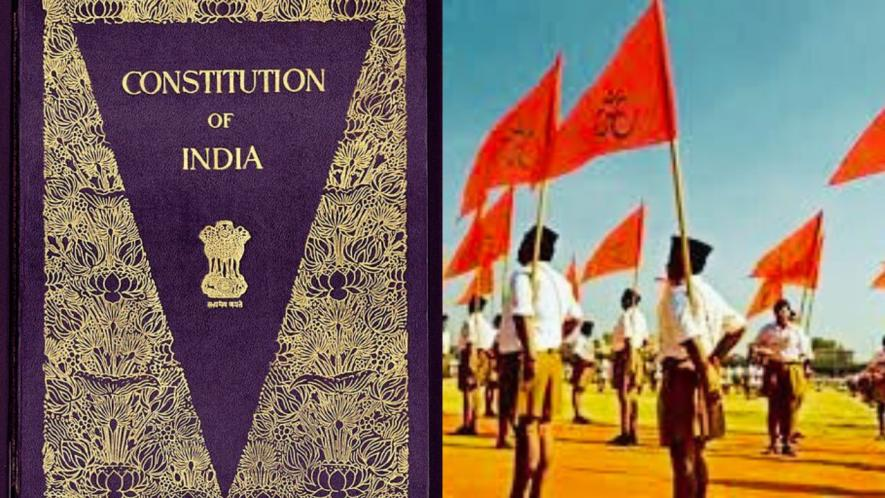
..make India an independent sovereign republic and guarantee and secure for all the people of India social, economic and political justice; equality of status and  opportunities and equality before law; and fundamental freedoms—of speech,  expression, belief, faith, worship, vocation, association and action—subject to law and public morality;

and also ensure that

adequate safeguards shall be provided for minorities, backward and tribal areas, and depressed and other backward classes.

(Excerpts of Objectives Resolution in the Constituent Assembly, moved by Pandit Nehru on December 13, 1946 and adopted unanimously by the Constituent Assembly on January 22, 1947)

It was just another press conference in the national capital.

The only difference was that it was held at the house of a member of Parliament belonging to Bharatiya Janata Party (BJP), the main opposition party then…

This was on December 25, 1992. Less than three weeks before India had witnessed one of its deeply troubling, disturbing moment in its history where a mosque, which stood for more than 500 years, had been demolished by a horde of people who had gathered there from different parts of the Country, mobilised by the forces of Hindutva supremacism.

..Swami Muktanand and Vamdeo Maharaj, who were closely associated with the Ram Mandir movement (India Today, January 31, 1993) addressed the press meet.

This Constitution is anti Hindu‘ and needs to be rejected.”We have no faith in country’s laws‘ and ‘Sadhus are above the law of the land‘.’

..The press meet ended rather abruptly.

Journalists, who had gathered there to hear something about the movement, felt cheated that what unfolded there was an anti-climax.

Little did they have a premonition that the press meet was just an opening shot and more was coming. ( Read the full text here : https://www.newsclick.in/unending-discomfort-rss-constitution)
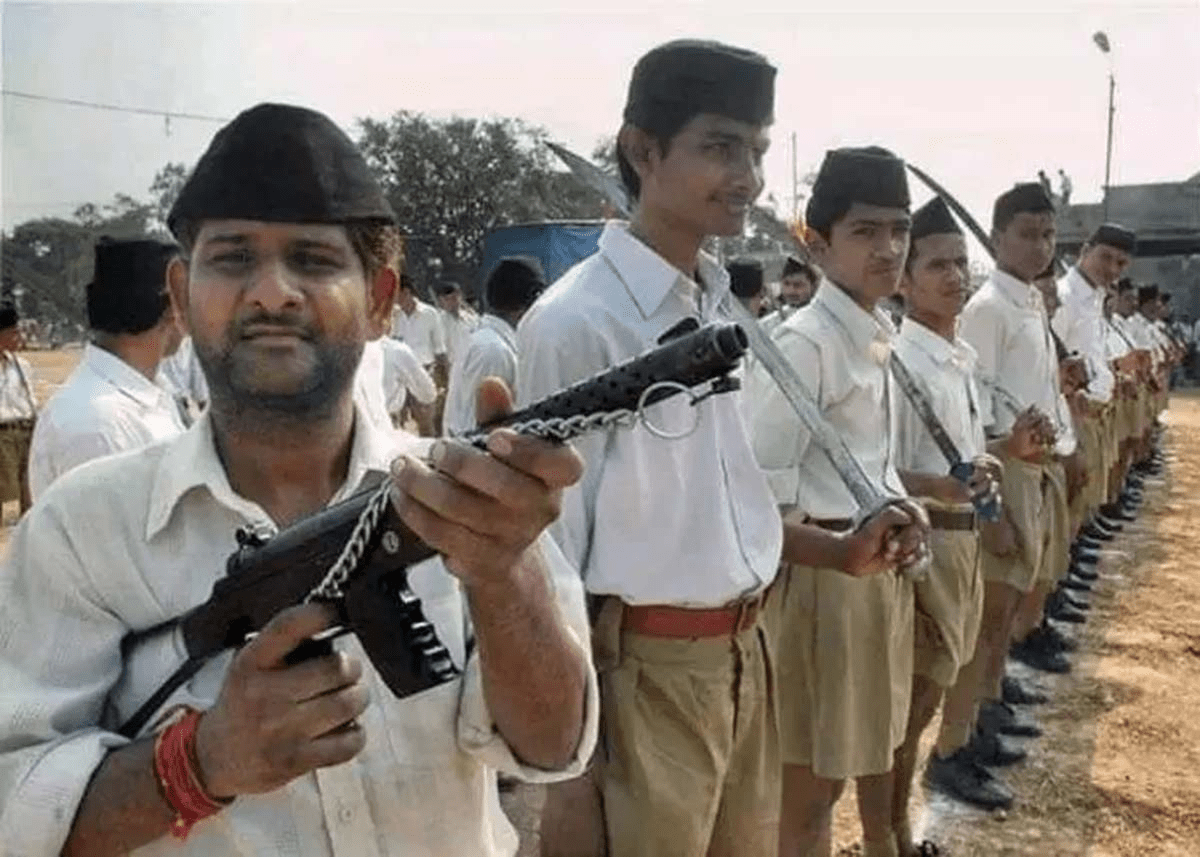
Militarising Minds, Hindutvaising the Nation | Training Future Military Leaders Imbued in Hindutva Supremacism?

How the policy of PPP (Public Private Partnership) Model in Sainik Schools is counter to all Constitutional principles and values

Representation Image

In a controversial and much reviled decision, the union government under prime minister, Narendra Modi “decided” to hand over “67 per cent of Sainik Schools to the Sangh Parivar (and its allied organisations who are self-acclaimed majoritarian and unconstitutional), BJP Politicians and allies. This investigation was undertaken by meticulous examination by the Reporter’s Collective and became public on April 3, 2024. This piece looks at the gross implications of this move.

“It’s the day of resurrection…”:

Swami Avdheshanand Giri after Pran Pratishtha ceremony in Ayodhya[1]


1.  A Memorial For a Supremo

‘Rajju Bhaiya Sainik Vidya Mandir’ Shikarpur Tehsil, Bulandshahr.

It was October 2020 when a Sainik School for boys was inaugurated in Shikarpur Tehsil of Bulandshahr District.[2] Right from Indresh Kumar, or Ram Lal, to Mahant of Junagarh Avadheshanand Giri, a seer supposed to be close to the proponents of Hindutva, many leading lights of the RSS and its frontal organisations or co-travellers of their ideology attended the high profile function.

The event made headlines for several reasons:

One, it was called the ‘first Sainik School of RSS’.

Two, a whooping sum of Rs 40 crores was supposed to be spent over it – thanks to the largesse extended by the union (Modi) government.

Thirdly, it was one of those rare occasions when RSS had moved beyond its founder member Dr Hedgewar to build memorials. Remember Rajendra Singh alias Rajju Bhaiya (1922-2003) was the first non-Brahmin and non-Maharashtrian Supremo of RSS from 1994-2000.  This Sainik School is located in the same place where he (Raju Bhaiya) was born.

Normally, an idea to start a school is met with jubilation. This one however had the opposite effect.  There were voices of concern raised by educationists, social activists as well as political leaders,

The added concern was that Vidya Bharati, the education wing of the RSS – which already runs 20,000 schools across India – would now also be running this military school although there was a clarification that this Army School will follow the CBSE curriculum and will have classes running from Class 6 to Class 12.

The same Vidya Bharatii (of the RSS’) whose stated mission is  

“To develop a National System of Education which would help building a generation of young men and women that is committed to Hindutva and infused with patriotic fervour”. [3]

Questioning the whooping sum of Rs 40 crores which would be spent over it, Akhilesh Yadav, leader of the Samajwadi {arty (SP) and former Chief Minister of UP, had, at the time, underlined that since we already have enough such institutions “[r]un by the government so where is the need for RSS to run its own army school,”[4]

He did not hide his apprehensions about what curriculum be taught there.

“RSS apparently wanted to serve its political purpose by opening the army school where the students will “probably be taught lessons in mob lynching and disrupting social harmony”.[5]

The concern expressed by many about this project could not be brushed aside easily. It is a different matter that in today’s mediatised world, things move with such a speed that the issue of a RSS run military school , the RBSVM – Rajju Bhaiya Sainik Vidya Mandir – and the attendant furore soon died down. Little did anyone carry the premonition that the founding of RBSVM was just a trailer of what lay in store: asli film abhi baaki thi‘.

( Read the full article here : https://sabrangindia.in/militarising-minds-hindutvaising-the-nation-training-future-military-leaders-imbued-in-hindutva-supremacism/)

Waiting to Become Eichmann? Unpacking the Moral Relativism of a People

“They took so much away from us that they ended up taking away our fear”
— Message scrawled on a placard in a women’s march in Spain

’How does Justice feel?’

A difficult query to answer but perhaps Bilkis Bano would be the best person to respond to it.

Yes the same Bilkis – survivor of a mass rape and the only witness to horrific massacre of her 14 relatives – when the state she lived witnessed a carnage when officially one thousand innocents perished in the communal pogrom and many thousands were displaced from their homes and were condemned to live as internal refugees.

One can still recollect her words when the highest courts of the country finally cancelled the remission of sentences to her perpetrators who had been convicted for this heinous crime. [1].

She frankly narrated her feelings before a reporter.

’It feels like a stone the size of a mountain has been lifted from my chest, and I can breathe again. This is what justice feels like.”

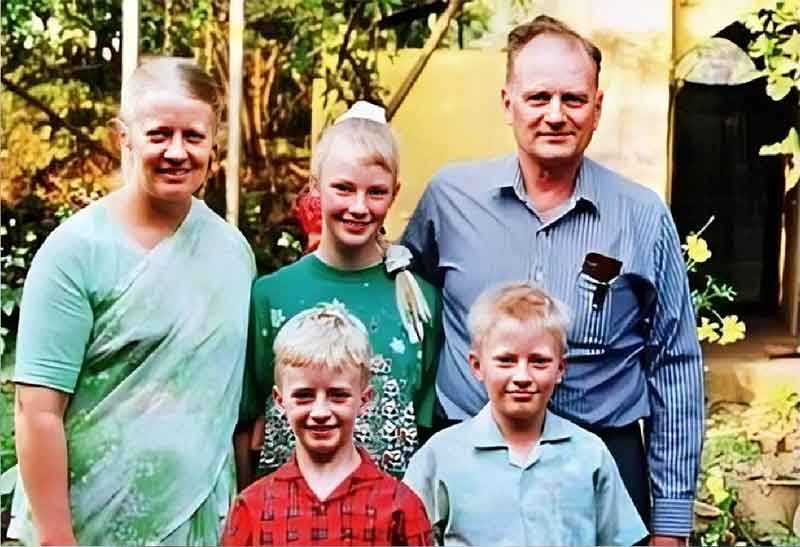
Thinking Graham Staines and his Children in times of Jubilation over Ram Temple

The life of the dead is placed in the memory of the living.

– Marcus Tullius Cicero

Politics is nothing but theology in action

– Ambedkar


Right-wing politics suffers from a common syndrome everywhere.

It never feels confident to project its own icons for the rest of the humanity, whatever might be their claims about their worldview,  it knows that its own icons are detested by a wide spectrum of people.

The easiest way it finds to overcome this lacunae is to appropriate already established icons – who  were even opposed to their world view as well  and claim them their own. In fact, it does not have any qualms in utilising dates – bearing special significance for exploited and oppressed and marginalised of the world – to put their stamp on it.

The project of Hindutva Supremacism – which yearns / strives to transform a Secular, Socialist, Democratic and Sovereign Republic into a Hindu Rashtra has perhaps achieved near perfection in this kind of politics.

No End to ‘Tamas’ ( Darkness) Around ?

One can imagine that if the plan to provoke riots before Eid in Ayodhya would have been successful, how it could have easily spilled over to the other parts of the country.

Image for representational purpose. Credit: Hindustan Times

It was the early 1970s when Bhisham Sahni, the legendary Hindi writer had penned the novel Tamas. It looks at the Hindu-Muslim riots in India in the backdrop of the Partition. Its central character is Nathu, who is Dalit and does the work of removing hides from dead animals. A local politician persuades Nathu to kill a pig; the act is later used to foment a riot in the city.

It has been more than 40 years since the novel was written, but it still resonates with today’s India as it throws light on the ‘fault lines’ of Indian society and shows the ease with which they can be weaponised.

A fortnight back, a similar attempt to provoke a riot was made in Ayodhya using a similar technique; however, prompt action by the district police averted a riot there.

( Read the full article here)

Wishful visions, dishonest tales and bitter fruit

Review of ‘Malevolent Republic : A Short History of New India’ by K. S. Komireddi

Image result for malevolent republic

‘The idea of a peace-loving, nonviolent India exists, persists, as part of a selectively constructed and assiduously cultivated national self-image in the midst of a society pervaded by social and political violence…’ argued Prof Upinder Singh, in her well-researched voluminous book ‘ Political Violence in Ancient India’ which had appeared around two years back. She had also added that pioneers of independence struggle were instrumental in creating this ‘[m]yth of non-violence in ancient India which obscures a troubled, complex heritage.’

‘Malevolent Republic’ – A Short Hisotry of New India’ by K. S. Komireddi – a commentator, critic and journalist who has written for leading western publications, reminds one of this debate. The book tries to chronicle the trajectory of post-independence India from Nehru to Modi – and does not shy away from raising uncomfortable questions which demand broader contemplation as well as deep soul searching.

( Read the full story here : https://epaper.telegraphindia.com/calcutta/2019-09-06/71/Page-11.html)