
Policy slogans are usually fragments of a sentence. Make in India. Housing for All. Swatch Bharat. What’s usually missing in the fragment is that the verb has no subject to agree with. For slogans to become statements, missions, policies and actions, someone has to make in india, keep it swachh and build the housing. The big elephant in the room is: who?
For housing, this is a particularly important challenge. The numbers are daunting: a shortage of 18.78 million housing units in 2012. Over 95% of this shortage is for low-income households that make less than Rs 2 lacs total household income per year. Taking the Ministry of Housing and Urban Poverty Alleviation’s own formula that a household can afford a house five times its annual income, this means “Housing for All” needs to make nearly 17 million houses all under Rs 10 lacs. That’s the finish line.
So: who should build this housing? Continue reading Who can build Housing for All?
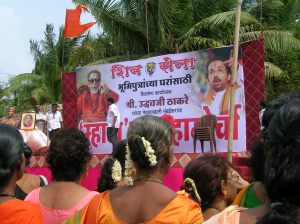 I was moving around Mumbai city on that weekend, mainly in the western suburbs. Several posters and banners were put up all over, announcing a call to a mass rally by Shiv Sena chief Uddhav Thackeray. Thackeray’s clarion call for that meeting was: “Housing for the bhoomiputra“. Bhoomiputra literally means son of the land. On an overt reading of the poster and slogan, one could conclude that the Sena is back to its advocacy of the sons of the soil theory which originally raised it to prominence in the 1960s. But when I attended the rally and noticed the people who attended it, I asked myself, so who exactly is this son of the soil that the Sena is talking about? Is it the Marathi manoos, the local underdog who the Sena argues has no social and economic space in his/her own city? If it is truly the Marathi manoos, then how do I interpret the presence of North Indian women, Bohra muslim women, perhaps even Dalit women, and many other women who I tried to mark but could not classify as either Hindu or Christian or any other particular else. Hmmm ….
  KAFILA - COLLECTIVE EXPLORATIONS SINCE 2006