
Tag Archives: India Against Corruption

Reflections on the Kafila journey : ‘We Should Learn from Them!’

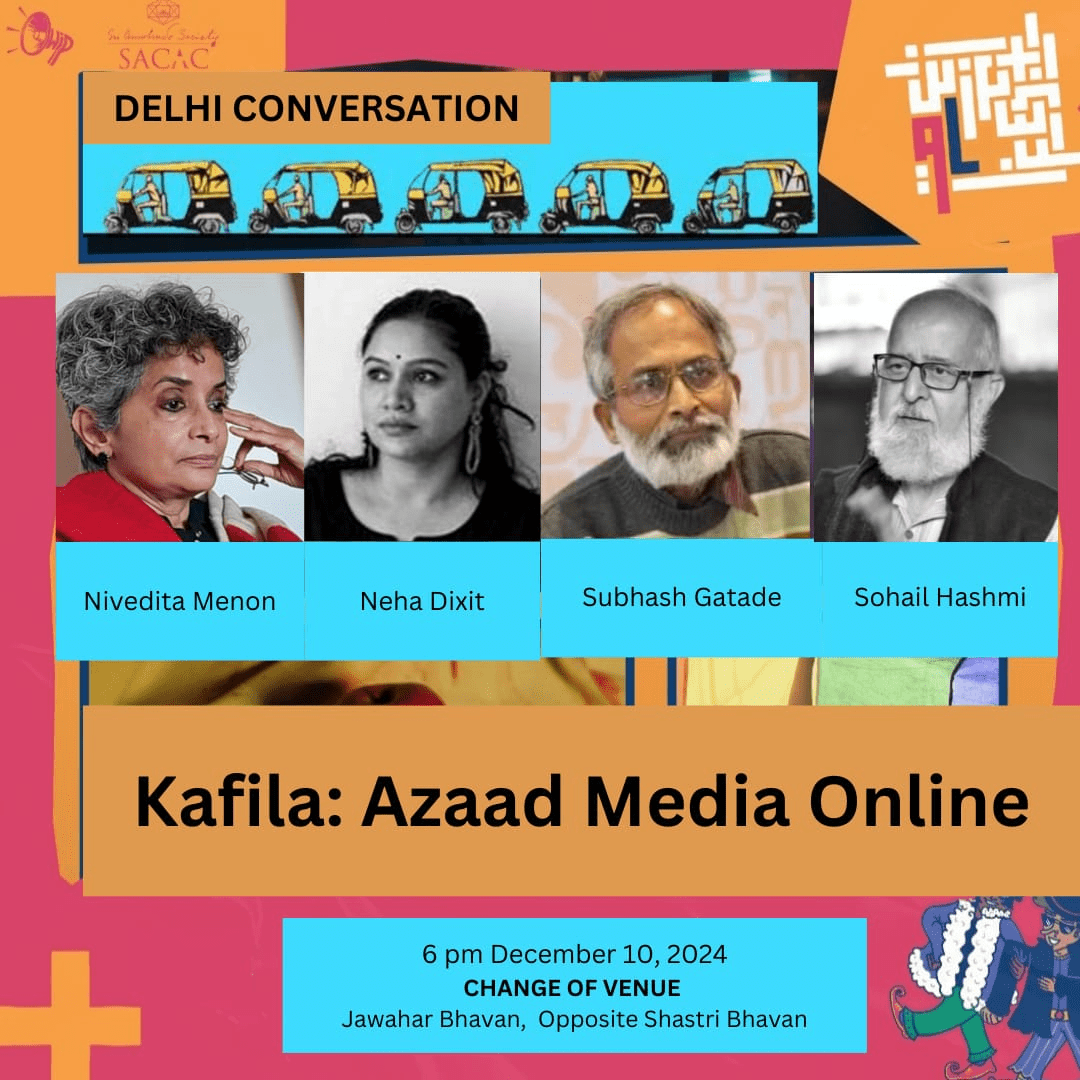
Presentation   at the panel on Kafila held as part of the W.I.P alt.FEST held in Bangalore and Delhi in  December 2024. The second post in the series can be read here and the third by J. Devika here.

They were different times.

Times when the space for debate and discussion had not shrunk as we it witness today, when stigmatisation of ‘others’ or ‘criminalisation of differences’ had not yet started; times when one had rarely heard about writers. rationalists or cultural workers coming under murderous attacks in this part of South Asia, just because they dared to speak the truth.

Perhaps it is better to begin from the beginnings.

One still remembers the very first meeting we had at CSDS, Delhi in Aditya’s room to discuss the idea of a blog and its launching. Apoorvanand was there, a young blogger Shivam Vij – was also present ( who became a ‘Guru’ of many of us ‘oldies’ for sometime, who were then taking baby steps in this virtual world of self publishing).

For me it was my first experience to be directly associated with a blog.

None of us  had any premonition that we are in for interesting times and would be helping catalyse conversations on various issues of concern among a wide spectrum of writers, activists, scholars and concerned individuals.

All of us had our own teething troubles then, in fact initially I found it extremely difficult even to upload my posts on the blog and had to take the help of a close friend in the IT sector to do it. 

What is worth underlining about Kafila

Looking back, one today feels mesmerised the way it could attract people of various shades to contribute for the blog . Thanks to the wide network of contacts of a few among us- the number of admins reached the figure of twenty two . What connected them was their unflinching opposition to communalism, capitalism, casteism, patriarchy etc and their yearning to  enhance and enrich the intellectual atmosphere in their own way and promote a culture of discussion and debate in the rest of the society.

Nirbhaya movement and the  India against Corruption campaign – popularly called as Anna Movement were the two high points when Kafila reached its peak. One can still recall Shuddho returning from a rally in Jantar Mantar and on his way back home, posting an article on the theme which used to gather scores of comments the next morning

It was a period when even the mainstream magazines, publications felt it necessary to pay attention to the debates happening there and gladly rerepublished pieces which had earlier appeared on Kafila or even referred to Kafila post. Another important facet of Kafila was that there were occasions when the views of Kafila admins themselves differed but what was remarkable that it did not create any bad blood or any rancour among us. We continued to remain friends / comrades as earlier.

Perhaps it also had its genesis in the long bonding which had emerged between many of us during various social political interventions in the capital since mid nineties. Campaigns for defence of rights of workers (Delhi Janwadi Adhikar Manch) or struggles against communalism (Aman Ekta Manch) or issue of caste (Durban Abhiyan)  etc

Anna movement was the high point also because it clearly witnessed a clear division of opinion between us – few of us were completely opposed to the movement for its politics, who felt that it was a RSS inspired movement but others were equally vehement supporters of the movement, who felt that it provided a ray of hope in those times.

Another important point was the impact it could generate across a large sections of people.

It was the year 2014 ( elections were yet to be held) and one fine morning I got a call from an officer associated with a Eurozone country that he wanted  to meet me. This gentleman – who was much familiar with Kafila – who had even read the morning article which had appeared in Kafila, felt that someone like me could provide him with necessary details and analysis of the unfolding situation and also the possibility of Modi’s coming to  power.

What one observed that influence of Kafila was not restricted to only lefts and liberals, it was also read by the Rightwing.

A close relative of mine – who was then associated with a Hindutva Rightwing organisation but had started having doubts about their project – then had shared with me about the discussion he heard in the ‘family’ office.

He heard two of the seniors talking, ‘ we should learn from Kafila, look how they write and polemicise’


The (Ir)resistible Rise of Arvind Kejriwal – Enter The ‘Outsider’

The tide is clearly turning. You know this when former critics and lampooners start talking of him as a ‘game changer’; you know this when weather-cocks turn away from the corridors of power where once they had been ensconced. You know this when rats start deserting the sinking ship.

Suddenly, everybody is talking favourably about the man from the ‘outside’ who is refusing to respect any of the established protocols of protest and politics. More startling perhaps, is the fact that in the past two days we have had senior journalists and political analysts suddenly telling us that they had known all along that there was a ‘post 1980 contract’, a secret code of silence, that never would the dynasty be attacked – indeed never would any apsiring dynasty be attacked. Everybody knew, says Dipankar Gupta in the Times of India, that the issue came up one and a half years ago – and we all do know that. Robert Vadra’s doings had already  been known. A senior BJP leader is even reported to have told a senior journalist that his party had indeed been in possession of the very same documents that Arvind Kejriwal brandished at his press conference. But, this leader went to say, “after an intense discussion, the leadership decided not to rake up the issue in Parliament even after submitting a motion in each House asking for a discussion.” Everybody knew – the parties, their leaders, the media persons, political analysts. And yet, nobody spoke out. All of them colluded, in other words, in suppressing the issue. Politicians kept silent for an understandable reason – aspiring dynasties that they are, after all. But the others? Mediapersons? Any guesses?

As someone who has been trying to understand Indian politics over the decades, I have often wondered at what I have referred to as the ‘implosion of the political’ – that is to say, the destruction of politics in the formal political domain. What is called a noora kushti in Hindustani, had come to mark our parliamentary-political grammar. Farcical walk-outs after equally farcical fire-spouting rhetorical speeches in parliament, and a happy bonhomie away from the glare of the media – that was what our politics had been reduced to.

Continue reading The (Ir)resistible Rise of Arvind Kejriwal – Enter The ‘Outsider’

Against Corruption = Against Politics: Partha Chatterjee

Guest post by PARTHA CHATTERJEE

Shuddhabrata Sengupta has done a great service by opening up the question of corruption which lies at the heart of the Anna Hazare movement but which has been, surprisingly, accepted quite uncritically as a universally known and universally condemned evil. It is actually quite puzzling how this effect has been achieved. It is a question which, I think, touches the core of the populist mobilization brought about by the Anna Hazare movement.

Think of it. Who are the beneficiaries of corruption? The entire middle class in India (lower, upper, aspirant lower to upper, whatever category one wants to use) seems to think that it is the victim of corruption. “It touches the lives of everybody”, as Nivedita Menon said in her recent piece in Kafila. But then who are the engineers, the accountants, the babus in the offices, the touts who surround the courts and the hospitals and the railway ticket counters? Aren’t they our uncles and nephews and sisters-in-law? The corrupt people of India are blood relations of those who are flocking Ramlila Maidan. But, needless to say, no one you meet there will accept that.

Continue reading Against Corruption = Against Politics: Partha Chatterjee

Hazare, Khwahishein Aisi: Desiring a new politics, after Anna Hazare and beyond corruption

Hazare, khwahishein aisi, ke har khwahish pe dam nikle
bahut nikle armaan, lekin, phir bhi kam nikle

Hazare, so many desires, that every desire takes our breath away
so many hopes, and yet so few

(with due apologies, for liberties taken, to Mirza Asadullah Khan Ghalib, sometime poet and native of Delhi)

On the ninth of april, this year,  I wrote a posting on Kafila titled – ‘At the Risk of Heresy : Why I am not Celebrating with Anna Hazare Tonight‘. A little more than four months later, I have to say I have not yet found reasons to celebrate. But I am not in mourning either. What follows is my attempt to think this through, in all its contradictory character. For once, I am not even trying to be consistent. If my argument occasionally faces two directions at once, it is probably because I feel the needs to be double faced in order to understand a double-faced moment. When all the talk is only of the need for honesty, one might want to stake a claim to being double-faced, if only for the sake of breaking the moral monotony.

Continue reading Hazare, Khwahishein Aisi: Desiring a new politics, after Anna Hazare and beyond corruption

We should be there: The Left and the Anna moment

My head has been in a whirl the past few days with a single question – how do we on ‘the Left’ manage so unerringly to be exactly where ‘the people’ are not, time after time?

At this moment I don’t mean the organized Left, for the Left parties  have been cautious about criticizing  the current upsurge; they strongly defended the right to democratic protest when Anna Hazare and his colleagues were arrested, and now have launched a Third Front initiative on the issue of corruption and the Lokpal Bill; the students’ front of CPI (ML), AISA, has been organizing militantly on the issue for a very long time now, and is very much part of the campaign.

I mean the few hundreds who form my own community, the people with whom I have organized protests and run campaigns and sat on dharna and drafted petitions;  struggled against communal violence and sexual harassment,  for queer freedom and workers’ rights, against the nuclear bomb and nuclear energy, in support of reservations and against the moves in our universities to hold up appointments to reserved posts. Many of these people I know personally, some are among my closest friends, and many more I know as part of the broad Left/secular non-party tendency in the country’s politics, where I feel most at home.

Continue reading We should be there: The Left and the Anna moment