Tag Archives: Kashmir human rights

Gautam Navlakha detained, denied entry into Kashmir: Press note from IPTK

Press Note: For immediate release
INTERNATIONAL PEOPLE’S TRIBUNAL ON HUMAN RIGHTS AND JUSTICE IN INDIAN-ADMINISTERED KASHMIR (IPTK)
www.kashmirprocess.org

From: Dr. Angana Chatterji, Convener IPTK and Professor, Anthropology, California Institute of Integral Studies; and advocate Parvez Imroz, Convener IPTK and Founder, Jammu and Kashmir Coalition of Civil Society

TRIBUNAL CO-CONVENER DENIED ENTRY INTO KASHMIR

Srinagar, May 28, 2011: On May 28, 2011, Mr. Gautam Navlakha, Convener, International People’s Tribunal on Human Rights and Justice in Kashmir (IPTK) and Editorial Consultant, Economic and Political Weekly, was stopped at Srinagar airport on his arrival from New Delhi, and asked to go back. Officials invoked Section 144 of the Code of Criminal Procedure. By the time the authorities finalized their decision regarding his return, there were no remaining flights out of Srinagar. Mr. Navlakha is being detained and taken to an undisclosed location until May 29, when he will be allowed to return home.

Mr. Navlakha is a noted public intellectual and peace activist. His denial of entry raises urgent concerns about the status of freedom of speech and movement in Kashmir. Given the egregious violence that was inflicted on people by state forces in the Summer of 2008, 2009, and 2010 in Kashmir, we are deeply concerned that state forces not suppress democratic activities in the Summer of 2011, and not isolate Kashmiris from human rights defenders that travel to Kashmir to bear witness to atrocities and speak for peace and justice.

We understand that harassment, intimidation, and threats to IPTK members or their families are acts aimed to target and obstruct the work of the Tribunal. In November 2010, Professor Richard Shapiro, an academic from the United States and life-partner of IPTK Co-convener Angana Chatterji, was denied entry into India without any charges or due process.

Earlier, in June 2008, IPTK Co-convener Pravez Imroz and his family were targeted and an explosive device was thrown at his home. Imroz has been denied a passport. In July 2008, a First Information Report charged Angana Chatterji and IPTK Co-convener Zahir-Ud-Din, then editor of Etalaat English Daily, with acting to incite crimes against the state, following his publication of an article on mass graves written by Chatterji. IPTK Liaison Khurram Parvez has been threatened and is extensively surveilled. All Tribunal communications and the movements of its members in India and abroad are monitored.

We remain gravely concerned about the physical and psychological safety and integrity of all Tribunal members. We remain gravely concerned about our ability to continue our work, and the ability of out-of-state Tribunal members to travel to Kashmir.

Gift the CBI a sheet for their next cover-up!


CALL FOR ACTION  on CBI COVER-UP!

Let us Protest against CBI cover up report on Shopian Rape and Murder case

DEMAND  JUSTICE FOR NEELOFAR AND ASIYA!

A Public Event in New Delhi on 13th December, 2010 at 4 pm in front of CBI office, Delhi.

Come and participate with one white bed sheet with the words ‘TO THE CBI – FOR YOUR NEXT COVER-UP!!!’ written in huge letters across it with the name of the organisation/individual below.

Issued by: Women against Sexual violence and State repression (WSS), Delhi

For more details contact saheliwomen at gmail dot com

Continue reading Gift the CBI a sheet for their next cover-up!

Report #1: Attack and killing on Pattan hospital premises

This is the first of a series of fact-finding reports on the recent violence in Kashmir. The fact-finding has been conducted independently by a team of BELA BHATIA, VRINDA GROVER, SUKUMAR MURALIDHARAN and RAVI HEMADRI. For a introduction to this series, see here.

View of the hospital ward ‐ staff think that Adil may have been on the bed with the red mattress when the CRPF incursion took place.

Continue reading Report #1: Attack and killing on Pattan hospital premises

Introduction: Fact Finding Team to Kashmir

This post introduces a fact finding team’s work on the recent violence in Kashmir. The contents of the report are being posted as separate posts and will be linked below as and when they’re posted.

Since June this year, the Kashmir valley has been torn by mass protests which have been met with overwhelming force by Indian security forces. Curfews and closures have been frequent, often shading into each other. No less than 111 deaths have been registered, of which a large number have been of students and youth in the age group of 8 to 25 years. There have besides, been hundreds of cases of injuries, of both protesters and those who just happened to be at the wrong place at the wrong time. An independent fact-finding team went to the Kashmir valley at the end of October to go into the totality of the situation, principally to inquire into the causes for the unconscionably large number of deaths that have occurred in the current phase of mass agitation. The team comprised of academic BELA BHATIA, advocate VRINDA GROVER, journalist SUKUMAR MURALIDHARAN and activist RAVI HEMADRI of The Other Media, a Delhi based campaign and advocacy organisation, at whose initiative the effort was organised. Each member of the team spent varying lengths of time in the valley, but in total, roughly about twenty-five person days were put in the fact-finding exercise. In groups or individually, the team met the families of almost 40 persons who had been killed since the beginning of the civil unrest. Several individuals who had suffered serious injuries were also met. The team worked out of the state capital of Srinagar, and visited villages and towns in five of the Kashmir valley’s ten districts: Baramulla in the north (Sopore and Baramulla tehsils); Anantnag (Bijbehara and Anantnag tehsils) and Pulwama (Pulwama tehsil) in the south; Badgam in the west (Chadura and Badgam tehsils) and Srinagar itself. Separate sessions were held with journalists and media practitioners, university teachers and students, doctors, lawyers and activists besides officials in the police headquarters and the civil administration. The findings of the team are being released in a series of short reports beginning with following two sections. Forthcoming reports will deal with various facets of the situation that civilians in the Kashmir valley face in a season of unabated turmoil.


Next in this series
Report #1: Attack and Killing on Pattan Hospital Premises
Report #2: Palhallan Under Siege
Report #3: Shooting the Messenger in Kashmir

India Bans US Professor from Kashmir, threatens Indian writer with sedition charges: JKCCS

A note from JAMMU KASHMIR COALITION OF CIVIL SOCIETY

November 2, 2010

On November 1, 2010, shortly after 5.10 am, Professor Richard Shapiro was denied entry by the Immigration Authorities in New Delhi. Richard Shapiro is the Chair and Associate Professor of the Department of Anthropology at the California Institute of Integral Studies (CIIS) in San Francisco. He is also the life partner/husband of Angana Chatterji, who is the Co-convener of the International People’s Tribunal on Human Rights and Justice in Indian-administered Kashmir (IPTK) and also Professor of Anthropology at CIIS. Continue reading India Bans US Professor from Kashmir, threatens Indian writer with sedition charges: JKCCS

Kashmir’s Abu Gharaib?

Two days ago, I noticed a video posted by somebody on my facebook page. It was yet another video from Kashmir. It was tagged ‘brothers please watch, sisters please do not watch’. In later incarnations of the video, posted repeatedly on Facebook sites, Youtube channels and on blogs. it was tagged ‘Indian Security Forces Kashmiri Youth to Walk Naked on Road’ or ‘Kashmir – India’s Abu Gharib (sic)’.

The video was available on Youtube on the night of 8th/9th September, 2010, before being taken down.

Notwithstanding the misspelling of Abu Gharaib in these tags, there was something compellingly accurate in the designation. What I saw, and what i have seen unfold subsequently as a response by the Indian state to the circulation of this video, makes Abu Gharaib look like child’s play. Welcome to the virtual, viral, televisual reality of the nightmare of Kashmir.

For the past several weeks, I have been watching, and forwarding, several videos uploaded on to Youtube and facebook from Kashmir. Every video that I have seen contains evidence of the brutality of the Indian state’s footprint on the Kashmir valley, and of the steadfast yet resilient courage of its people, and of the innovative use they have been making of the internet to bear witness to their oppression.

See for instance – Innocent Man being Beaten in Kashmir.

I have seen paramilitary and police personnel open fire on unarmed or stone pelting crowds, mercilessly beat up young people and children, attack doctors, patients and nurses in hospitals, smash windows of homes, steal chickens and livestock and hurl the most vulgar invectives at ordinary people. I have watched the armed might of the Indian state retreat in the face of the moral courage of the opposition it encounters on the streets of Kashmir. It doesn’t take much to find these videos. Run a search with ‘Kashmir, Stone Pelting. indian Occupation’ on Youtube. Of follow the links and uploads on the growing cluster of Facebook pages from and about Kashmir. Continue reading Kashmir’s Abu Gharaib?

Governing Kashmir: Critical Reflections on the Historical Present

Guest post by RICHARD SHAPIRO

The Indian state’s refrain to the people of Kashmir is as follows: Indian rule of Kashmir is legitimate because India is a secular democratic republic, organized by rule of law and constitutionally guaranteed human rights. As a democratic state, rule of law may be suspended for national security reasons to protect the state, and such action has been necessary in Kashmir because of cross-border terrorism and ‘separatist’ elements in Kashmir that includes armed militants. The suspension of democratic rights in Kashmir, India states, is necessary to protect India as a secular democratic republic. Elections are periodically held and touted as proof of democracy in India, but without a vibrant civil society ensuring social freedoms, electoral processes obfuscate the subjection of Srinagar to New Delhi and give Indian governance greater legitimacy than if the center took official control over the state of Jammu & Kashmir.

What is the logic of the Indian state to which Kashmiris are subjected? The people of Kashmir must be denied the rights guaranteed to citizens of India because every Kashmiri is considered a real or potential threat to India. Kashmiris are citizens of India who are denied the rights of citizens to protect the state as the guarantor of rights. Law and order demands the denial of democratic rights to the people of Kashmir. Freedom of assembly and movement, freedom of speech and expression, freedom of press, freedom of religion are the basic rights that make India a legitimate state, and it is precisely these rights that must be denied all Kashmiris because when Kashmiris exercise these rights it is considered evidence of the anti-national sentiment of Kashmiris. Continue reading Governing Kashmir: Critical Reflections on the Historical Present

Why Kashmiris should speak to Indians, not India

On 28 May this year, the Economic Times, India’s leading business daily, carried a story titled, ‘Kashmir survey finds no majority for independence’. That is a curious headline. What is ‘no majority’? Either there is majority or there is not. Robert Bradnock conducted this survey for Chatham House, a leading British think-tank, Kashmir on both sides of the Line of Control. The survey was conducted in the autumn of 2009, and the copy mentioned that 44 percent in Azad Kashmir and 43 percent in Jammu & Kashmir favoured an independent Kashmiri nation state.

Similar was the reporting of the survey in other Indian papers. They omitted some details, though. They did not mention that the survey was conducted not just in Kashmir but also the Jammu and Ladakh regions. They did not mention that even after factoring in Jammu and Ladakh, the total support for India was 21 percent and for Pakistan 15 percent. So if there was a three-way poll, the whole region’s average figure of those supporting independence (43 percent) would win hands down. Most of the rest (14 percent) favoured making the LoC a permanent border, which means sealing the status quo, something India and Pakistan came very close to doing in 2007. This 14 percent comes only from Poonch (94 percent), Rajouri (100 percent) and Jammu (39 percent).

Further, they did not mention that in the district-wise results the greatest support for independence was in the Indian side of the Valley – an astounding 95 percent in Baramulla, 75 percent in Srinagar, 82 percent in Badgam, and 74 percent in Anantnag. Pulwama and Kupwara were not surveyed. The highest support for India was 80 percent in Kargil and 67 percent in Leh, 73 percent in Udhampur and 63 percent in Kathua. In Jammu district, it was 47 percent – ‘no majority’. In Azad Kashmir, 50 percent wanted to be with Pakistan.

Now read the ET headline again. ‘Kashmir survey finds no majority for independence’. The story does not tell us what they found a majority supporting. If we have to be polite, we can say that such manipulative reporting of a detailed survey amounts to the Indian media being in denial of the fact that Kashmiris don’t want to be with India. If we have to call a spade a spade, we can say that this amounts to telling us a lie. Read More

Pushing the Kashmiri to the wall, again

[An edited, shorter version of this article by me appeared last week in The Friday Times, Lahore.]

In the first week of June, I sat at a shopfront with a group of shopkeepers of Kalarus, a small town in Kupwara district in north Kashmir. In 1999, they collected money and bought land for a martyrs’ graveyard, one of many such in Kashmir. Whenever the Indian army killed militants trying to infiltrate from Pakistan to the Indian side of the Line of Control, they would hand over the bodies to the Kupwara police, who would give it to these people to bury after the autopsy.

“Look up at the mountain peak,” said one of them, “It is snow clad all twelve months. It is the LoC, 70 kms from here. Do you think anyone would cross that wearing the traditional Kashmiri Khan dress?” And yet, most of the hundred odd bodies in the graveyard had come wearing clothes unfit for snow. And, most of them had so many bullet marks on the face that they were unidentifiable. Continue reading Pushing the Kashmiri to the wall, again

Curbs continue on Kashmir media; is it martial law in Srinagar?

Media persons stage protest at Press Enclave in Srinagar against Government’s decision to gag media. Habib Naqash/GK

Update 2 on 11 July: As was being feared, the state has begun to crackdown on Facebook users for ‘anti-India activiies’. I can already spot one Facebook account missing. Very soon they will ban eating, drinking, breathing and shitting and offer curfew passes to some for these activities.

Update: Appeals to the Indian government by the Committee to Protect Journalists and IFJ.

In a clear signal that it continues to dictate what we get to know about the ground situation in Kashmir, curbs on the local media in the Valley continue despite government claims that they have been lifted. At the same time, Delhi journalists are able to freely move around and report in Srinagar. This is yet another blatant example of how the Indian state considers Kashmir its private property and the rights of its residents are secondary. As the Delhi media continues to do the bidding of the Home Ministry, the best sources of news on what’s happening on the ground remain Twitter and Facebook. Those updating their profiles and pages with information are doing so with the apprehension of censorship, state reprisal, blocking of these sites and suspension of internet services altogether in Kashmir. Continue reading Curbs continue on Kashmir media; is it martial law in Srinagar?

Kashmir, Lies and Audio Tape

The disinformation war is underway. Kashmir’s local media has been BANNED (not censored but BANNED!) in the world’s largest democracy, and the Delhi media is being used to spread LIES.

But what is a flag march?

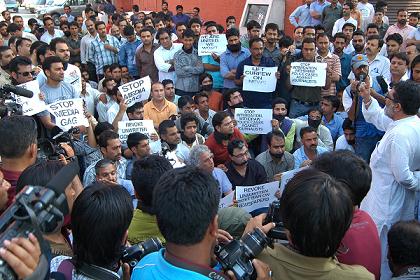
Protest not allowed, this is Kashmir

So far in 2010, ‘security’ forces have killed 32 innocent Kashmiris, sometimes not even in a protest. Far from investigating these killings and promising justice, India has banned protest in Kashmir, which is what curfew amounts to, and even the media is not allowed to function. Curfew passes have been canceled even for journalists – there were no newspapers this morning. 12 photojournalists have been beaten up. Newspapers have been BANNED!

The Delhi media reports that the army has been brought into Srinagar for an indefinite period, and that the army staged a flag march. However, what is a flag march? It can’t be a security measure to deal with terrorists because there is complete curfew. The army has been asked to strictly impose the curfew. People are dying because they are not allowed to go to hospitals. After killing 32 innocent people what does “maximum crackdown” by 1,700 Indian troops in Srinagar mean? And if not even a bird is allowed on the streets, who or what is the flag march for? Continue reading But what is a flag march?

If you’re still wondering why Kashmir is protesting and demanding azadi…

‘Mother I will make you cry today’

Dr. SYEDA HAMEED has sent us this poem

‘Mother I will make you cry today’

(On June 30th 2010, Asif Rather age nine ran out of his home in Baramulla in Kashmir to look for his older brother. As he left, he told his mother ‘I am going to make you cry today’. Minutes later he fell victim to shooting by the forces. At the time he was 150 meters from his house. – The Indian Express)

He stood at the sunlit door
A nine-year old with tousled hair
Asif Rather, student of class four,
Baramulla, 55 kms from Srinagar

‘Where is Touqeer?’
He sought his older brother.
‘Nowhere! You come back now
Here’s tea and last night’s bread
My baby, let me comb your hair’

Outside, the sounds Allah o Akbar
Chanting at once, one thousand strong Continue reading ‘Mother I will make you cry today’

IPTK Statement on Military Governance in Indian-administered Kashmir

Military Governance in Indian-administered Kashmir

STATEMENT: FOR IMMEDIATE RELEASE
Srinagar, June 29, 2010

INTERNATIONAL PEOPLE’S TRIBUNAL ON HUMAN RIGHTS AND JUSTICE IN INDIAN-ADMINISTERED KASHMIR (IPTK) | www.kashmirprocess.org


The People’s Tribunal feels morally obligated to make this statement today. Sustained alliances between local communities and IPTK have enabled us to bear witness to the escalating conditions induced by militarized governance, and the severity of psychosocial dimensions of oppression in Indian-administered Kashmir. From our work since being instituted in April 2008, from the reports and briefs we have authored, investigations we have undertaken and are in the process of completing, we find it ethically imperative to comment on the direction in which the Governments of India and Jammu and Kashmir, and the Indian Armed Forces, appear to be headed, and the consequences they will likely effect. Continue reading IPTK Statement on Military Governance in Indian-administered Kashmir