
BP Singhal: “I don’t have any problem with homosexuals. Do you?”

Photo credit: Salman Usmani

Bharatendu Prakash Singhal, 78, is a Hindutva ideologue, a retired IPS officer and a former BJP Rajya Sabha MP. On a Sunday afternoon I visited him to discuss his opposition to the decriminalization of gay sex by the Delhi High Court. He is preparing to appeal against it in the Supreme Court. Singhal explained that he wasn’t opposed to private consensual sex between same-sex adults, he didn’t want such adults prosecuted or persecuted, but he merely wanted the law to remain on paper as a deterrent. This is the transcript of a recorded interview; a much shorter, edited version has appeared in Open. Continue reading BP Singhal: “I don’t have any problem with homosexuals. Do you?”
Speaking of litigation: Anant Maringanti

Guest post by ANANT MARINGANTI

Speaking of successful litigation, one day after what some may call the makings of India’s rainbow coalition celebrated the Delhi High Court’s final verdict in the Naz Foundation case, agricultural workers in Andhra Pradesh celebrated a favorable interim order in the APVVU (AP Agricultural Workers Union) case. Judge N.Ramamohana Rao of AP High Court ignored the Additional Solicitor General’s objections and ordered that the National Rural Employment Guarantee Scheme wage rates be revised up from Rs 80 per day to the prevailing minimum wage of Rs 119 (111 and 112 in some areas) per day set by the Government of Andhra Pradesh. This will remain in force for 8 weeks. Of course, a favorable interim order does not imply that the final verdict will be favorable. But it bolsters the confidence of the contestants. It is a precious gift of time for solidarity building. And in this particular case, it will put an additional amount of a whopping Rs 31-40 per each of the 100 work days in a year in the hands of those availing work under the NREGA. It did not bring tears to the eyes, but in a general clime of judicial unresponsiveness to the claims of the poor it made many heave a sigh of relief. Continue reading Speaking of litigation: Anant Maringanti

Is the Naz Foundation decision the Roe v. Wade of India?

There are surprisingly few constitutional cases in India which have had the same symbolic power that cases like Roe v. Wade (affirming the right of abortion) or Brown v. Board of Education (dissolving racial segregation in schools) have had in the political history of the United States.  For sure, there are a  number of important constitutional cases which have contributed significantly to the democratic history of India. Kesavananda Bharati’s espousal of the basic structure doctrine, Maneka Gandhi’s introduction of due process in Art.21, but these cases  seem to have an appeal largely within the legal fraternity. They are also cases where the relief sought by the petitioners have had little to do with the final outcome of the case, and it is highly doubtful whether his Holiness Kesavananda Bharati had any investment in the long term impact of the basic structure doctrine (not to mention that Kesavananda Bharati just doesn’t roll of the tongue as easily- in terms of recall value).  Is it possible then that Naz Foundation v. Government of Delhi is the first equivalent of a case whose name conjures up the history of particular struggle, celebrates the victory of a particular moment and inaugurates new hopes for the future.

Continue reading Is the Naz Foundation decision the Roe v. Wade of India?

And that is why your neighbors don’t like you: Anurag Acharya

Guest post by ANURAG ACHARYA, student from Nepal at Jawaharlal Nehru University.

Peaceful coexistence among nations does not encompass coexistence between the exploiter and the exploited, the oppressor and the oppressed.

– Ernesto ‘Che’ Guevara

The 1800 km open border between India and Nepal has always been a matter of dispute between the two countries. While India has glorified the open border as its grace and gratitude towards a landlocked nation, Nepal has had to accept the miseries of sharing an open border with a bigger and powerful nation as a price for a trade transit. It goes without saying that whenever there has been a proposal or a debate within Nepal about the possibility of opening a trade route across the Himalayas to our north to tap the world’s largest market for Nepalese goods, it has attracted serious concerns from the South block. Bound by the unfair Indo-Nepal treaty of 1950 which prevents Nepal from independently conducting its international affairs and thwarts Nepal’s ambition to exploit the huge trade potential with China, an end to Nepal’s historical dependence on India has not materialized yet. While the treaty gives India a free hand to interfere in Nepal’s foreign affairs, citing its own domestic security, it has seriously impaired Nepal’s right to trade access, as a landlocked nation under the International Law. The treaty also stands in clear violation and entrenchment of a sovereign nation’s  right to conduct its external and internal affairs independently. However, weak diplomacy on Nepal’s part and unsympathetic attitude on the Indian side has ensured that Nepal stays dependent on India for all its exports and imports.

Continue reading And that is why your neighbors don’t like you: Anurag Acharya

Historic Mandate, Historic Turning Point or More of the Same? Gail Omvedt on Elections 2009

Guest post by GAIL OMVEDT

The 2009 Lok Sabha elections in India were projected to be a historical turning point just as the 2008 Presidential elections in the U.S. were a turning point.  But the nature of that expected turning point was very different.

Five years ago, even two years before the elections, no one in the U.S. would have expected that a “Black” man with two Muslim names and one African name could have been elected President of the United States.  Yet it happened, and it happened not simply because Barack Husain Obama ran a brilliant campaign and is proving the most effective president in dealing with the economic and social crises besetting the world today, but also because of the racial transformation the U.S. has undergone in recent decades. Continue reading Historic Mandate, Historic Turning Point or More of the Same? Gail Omvedt on Elections 2009

Why the Delhi High Court judgement on IPC 377 does extend to the rest of India

While expanding the territorial jurisdiction of high courts in such cases, the SC took cognizance of the principle contained in Article 226(2), which empowers a high court to issue directions to entities located outside its territory. [Manoj Mitta]

The Day After the Judgement

So now that we have one group of criminals less to deal with, I have a proposal: Criminalize English TV news channels.

'Debate,' the Times Now way
‘Debate,’ the Times Now way

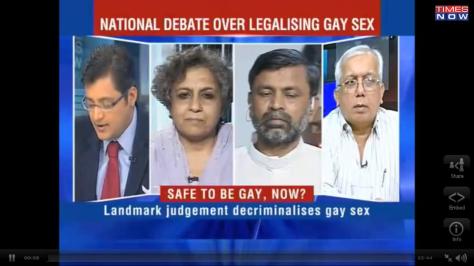
Watching Times Now yesterday after the Delhi High Court ruling on Section 377, I was overcome by a growing sense of bewilderment. I could hear Dominic Emmanuel (Director of the Delhi Archdiocese of the Roman Catholic Church) and Kamal Farooqui (Chairman of the Delhi Minorities Commission), saying quite cearly and more than once, to my surprise, that they welcome the decriminalization of homosexuality, that homosexuals should not be treated as if they were criminals. Okay, correct that – I could barely hear these statements over the insistent, aggressive and disruptive interruptions  of the anchor Arnab Goswami, who had obviously pre-set this “discussion” rigidly as a face-off between Reactionary Clerics/Minorities and Gay Rights Activists, while he himself was super hero, Anchorman. So each time they said “we welcome” etc.,  Anchorman would swoop in, bellowing, “So are you saying that they dont have rights, Sir, are you saying they should not have rights. Over to Anjali Gopalan (Naz) – Anjali, they say homosexuals should not have rights, what do you say?”

Continue reading The Day After the Judgement

“The Magic of the Human Spirit and of a Nation’s Passion”: Three Queers for the Delhi High Court!

So – here we are folks, in a historic judgement this morning, Delhi High Court has read down Section 377 of the Indian Penal Code to exclude consensual sex among adults. Congratulations to the group of tireless activists who have helped to bring this about, and congratulations to all of us who count ourselves as part of the queer community. Continue reading “The Magic of the Human Spirit and of a Nation’s Passion”: Three Queers for the Delhi High Court!

Hindu Rashtra in Delhi

(Protest by Hindutva organisations against construction of a mosque in Rohini Sector 16, Delhi…Prayer by the MUSLIMS not allowed by hindutva forces on 26.6.2009 and those who were coming for the  NAMAZ were beaten up and chased back. .. Hooligans marched in street to look out for muslims…Women also participated in large numbers..Timely intervention by the police..19 arrested……Appeal to maintain communal harmony by citizens groups.

According to reliable sources, a piece of land was alloted by the DDA to the ‘Dargah Islamiya Intezamiya Committee’ for a mosque in the area in North-West Delhi to cater to the longtime demand of the minority community. In fact people from Rohini have to either to go to Badli or Avantika, if they have to offer Namaz on anyday..

– Based on newspaper reports appearing in Rashtriya Sahara, Rojnama Sahara (27 th June 2009) and others) Continue reading Hindu Rashtra in Delhi