
It is hard to introduce E.V.R.Periyar. A good sign of the fact that his thoughts are broad based and radical is the way in which they can be used in different contexts. With each context, the description of the person also changes. For the purposes of this piece one may say, ‘he was a radical thinker who sought to question many aspects of the ‘nation’ that are taken for granted such as democracy, freedom, unity, integrity and so on’. This critique took many shapes and forms throughout his career based on his position in tamilnadu and the particularities of that history. In 1972, he reflects on the nation as it is today. And disheartening for us and even to him as he wrote these words, he stands by what he said the moment india got ‘independence’ in 1947. Continue reading Periyar on ‘independence’
Monthly Archives: January 2011
Irom Sharmila is in love
 …which in these dark times is so life-affirming:
I can spot a Khushwant Singh, a Khalil Gibran and a Chetan Bhagat in the pile of books. “Most of these books have been gifted to me by my lover,” she says. This is the first I’ve heard of a man in her life. I hesitate, but Sharmila is clearly keen to talk about him. A Britisher based in Kerala, he got to know about Sharmila after he read Burning Bright, a 2009 book on the Manipuri struggle written by Deepti Priya Mehrotra and published by Penguin. “He wrote me a letter after he read the book. We have been exchanging letters since then,” she says shyly. Continue reading Irom Sharmila is in love
Suddenly Sanyal: The Many Arrests of Narayan Sanyal
First published in The Hindu
Narayan Sanyal is a 74-year-old man with white hair parted to one side and fibromatosis in both hands. His arrest memo notes that he wears dentures, has spots on his body and smokes cigarettes. “My health is not going well, arthritis is a new thing catching up, age is telling,” he writes in a letter addressed to a ‘Dear friend V’. This letter and two others became crucial evidence in the conviction last week of Mr. Sanyal, Kolkata businessman Pijush Guha and eminent doctor and human rights activist Binayak Sen.
Behind their conviction lies a curious paradox to which the Chhattisgarh police has never given a satisfactory answer: Why was Mr. Sanyal — whose Maoist connections led to charges against the co-accused in the first place — himself never charged with sedition or conspiracy to wage war or even with belonging to or supporting an unlawful organisation until well after Dr. Sen’s arrest under those serious offences?
Continue reading Suddenly Sanyal: The Many Arrests of Narayan Sanyal
“I Am Still Alive”: Amitava Kumar
Guest post by AMITAVA KUMAR
Till a few days ago, I hadn’t heard of Aqeel Shatir. A friend sent me a link to a report in the Indian Express on December 20 about a poet who had been asked to pay for an anti-Narendra Modi remark in his anthology, Abhi Zindaa Hoon Main (I Am Still Alive). I got in touch with the reporter, in Ahmedabad, who had filed the story and soon after that spoke on the phone with Shatir.
Aqeel Shatir is his takhallus or literary alias. The name his parents gave him was Aqeel Ahmed. His ustad offered him a choice of two pen-names. One was Aazar, which means a sculptor, someone who carves beautiful forms from marble. The other was Shatir, whose literal meaning is chess-player but denotes someone who possesses cunning. Continue reading “I Am Still Alive”: Amitava Kumar
‘Snakebite or sunstroke?’: An extract from Siddhartha Gigoo’s novel, ‘The Garden of Solitude’
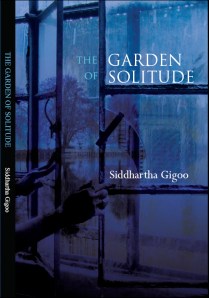 SIDDHARTHA GIGOO‘s The Garden of Solitude [Flipkart / Amazon] is the first novel in English by a Kashmiri, on Kashmir. As it starts arriving in bookstores, I am grateful to him for sharing an extract.
‘Life teaches us that there is beauty in ugliness,’ Sridar said.
Then Pamposh said something that Sridar was not prepared for.
‘Every day I lead the life of a centipede. I crawl. I lick. I hide. I sting. I wake up to the fumes of kerosene in the morning and the sting of speeding ants, feeding ravenously on the sugar spilled on the floor of the tent. It feels as if I have never had a morsel of rice for ages. I wake up hungry and go to bed hungry. I lead the life of a centipede, I crawl. All around the camp, there is stench of human excrement and waste. People wake up in the morning, hungry and muddled.
The Dead Need No Reification: Vasanth Kannabiran
Guest post by VASANTH KANNABIRAN
Kannabiran died on 30 December 2010. As per his wishes and ours, and based on previous discussions we declared that the last rites would be simple, speedy and secular. The secular part we ensured. There were no flowers, no lamps, no mantras, no ceremonies. But the clamour for progressive “traditions” was what I found troubling in the extreme. In doing away with religious orthodoxy, all we have done is replaced it with other orthodoxies. Continue reading The Dead Need No Reification: Vasanth Kannabiran
Trysts at Midnight: Calcutta, Now: Prasanta Chakravarty
This is a guest post by PRASANTA CHAKRAVARTY

[The Bangla film Sthaniya Sambaad (Spring in the Colony, 2009) was recently released. The film, by way of mapping the diurnal workings of a refugee colony in contemporary Calcutta, asks important questions about the changing cityscape, of the new, emerging world of land grabbers and fly-by-night investors and of the bemused young and old who are outside of this world and yet are sucked within its machinations. This is a conversation about education, humanities and the nature of artistry in the age of modularization—between MOINAK BISWAS, one of the directors of the film (with Arjun Gourisaria) & Reader, Film Studies, Jadavpur University, Calcutta and PRASANTA CHAKRAVARTY, Associate Professor of English, University of Delhi.]
Prasanta: Your film got a commercial release finally, which is wonderful. Among the initial reactions, in reviews, internet discussions and so forth, one notices a lot of interest in the polyvalent nature of your craft. I would like to take one particular strand of the film and probe a little: that is, its quite sharp critique of the phenomenon of vocationalization of education. This is a constant and niggling thread, right? Now, one fundamental argument for modular training, especially in humanities and social sciences, at this point, is a democratic one: that it will provide competence to a large number of the unemployed, ensure jobs and help in national growth. Continue reading Trysts at Midnight: Calcutta, Now: Prasanta Chakravarty
A curtain call for the world’s largest democracy: Neerja Dasani
Guest post by NEERJA DASANI
Please ladies and gentlemen…
A round of applause for this worthy verdict!
Please understand now:
Silence is molten. Continue reading A curtain call for the world’s largest democracy: Neerja Dasani
 KAFILA - COLLECTIVE EXPLORATIONS SINCE 2006