
All posts by Aman Sethi

A short note on National Interest

The list of things that can be done in national interest appears to grow longer every day.  While in India it can be used for anything from destroying working class housing to build stadiums to destroying tribal communities to build dams, to torturing, illegally detaining, and killing innocents under false pretences; in the US, officials and executives are coming to terms with how to deal with an “economic emergency”.

As information on Bank of America’s purchase of Merrill Lynch begins to trickle through the American financial press; news of Merrill’s larger than expected losses seems to have taken some of the sheen of BoA Chief Executive Kenneth Lewis’s knight in shining armour costume.

As reported by Reuters on Jan 16th, shareholders at BofA believe that, at $19.4 billion, Lewis not only overpaid for Merill Lynch; but Merrill’s staggering $15.3 billion dollar loss suggests that he did not do his homework on the deal.  As Dennis K. Berman notes in this morning’s Wall Street Journal, the murkiness surrounding the deal has meant that “in the past five trading days, Bank of America’s market capitalisation has dropped 45 %, wiping away a sum greater than the Merrill transaction itself.”
Continue reading A short note on National Interest

Watching and not-watching

For three days now I have tried to not watch the horror that has unfolded in Mumbai. I am un-sure what my motivations are. In the rooms around me, three televisons harmonize incessantly – talking heads on one channel blending into the sound of gunshots on another; the advertisements on the third seguewaying into the robotic chatter that emerges from the laptops scattered on couches. On my laptop’s tiny speakers, the voices appear shriller, the grenades are accompanied by static, the television guests appear more agitated. Continue reading Watching and not-watching

Lets do the things we normally do

Surfing the Wave: Chrystel beats the bubble

In 2008, Ramu Dhara bought his first house, fathered his first child, and weathered his first financial crisis.  While Chrystel Garipuy, his partner, had no role to play in the crisis and an equal role in parenthood; she is, as they both readily confess, wholly responsible for the biggest purchase of their lives: A late nineteenth century brownstone currently valued at approximately $825,000. “I was a committed renter,” explains Ramu, a user-interface design consultant who has rented all over New York City for more than 15 years, “She was the one who convinced me to take the plunge.” Continue reading Surfing the Wave: Chrystel beats the bubble

Buses, Bad Ideas and Bambi

Some say that if you give a man a long enough rope, he will eventually hang himself. Others say that when you’re in a hole; stop digging. Given the stubbornness of our friend from a 2.5 world country, chances are he will be one of the first to hang himself in a hole.  A truly horrible image that – but worry not fair readers; he can still be saved yet.

Scrolling through his latest rejoinder appears frighteningly like watching your neighbour’s child – in the other building across the road – assemble a shaky platform of poorly imagined arguments, test the strength of his rope of ignorance, throw it about his neck in an attempt to force his parents to say they are sorry for screaming at him and then, just as he is getting what he wants – HORROR. The platform is shaking, the legs are trembling, the noose is tightening, are his parents even watching? And then suddenly you can almost hear this crack that makes you want to scream STOP!!!

Continue reading Buses, Bad Ideas and Bambi

On dealing with fuss-tration

So for those of us who thought that frustrated, naive and aggressive car drivers are a caricature, Hey we at Kafila found one just for our readers.  He is loud, aggressive and fuss-trated as they come. Read on …

The wonderful thing about blogging, I am told, is that it allows everyone to publish their opinions.  At times however, forgive me for saying this, I wonder if everyone should.  My most recent reason for this harsh indictment of the blogging world, is based on this recent post titled “This is what the fuss is about (you twit)”. The title stems from a spot of witty wordplay on one of my recent posts.

The “you twit”, I might hasten to add, is not my addition. it is the author’s impression of my arguments.  While his post is reasonably, if somewhat naively, argued; his frequent abuse stems, perhaps, out of the need to get his blog read. Or maybe it is a style that is much appreciated by his readers.  I will however, thank him for his incisive – if somewhat excessively enthusiastic – critique of my work.

Continue reading On dealing with fuss-tration

The Greatest VP debate since – like ever!!!

Good morning, Good evening, to people across the globe. In our attempt to cater to our world wide audience at Kafila; we have decided – in collaboration with several heavily funded political lobbyists – to bring you a semi-realtime commentary on the first and only vice presidential debate in what promises to be the USA’s most interesting election since – like ever.

Much has been written about Sarah Palin – especially since her somewhat surprising comments on a whole variety issues – most recently her interviews with Katie Couric of CBS news. You can access two parts here and here.  Much was also made of her famous “We can see Russia from Alaska” comment.

Continue reading The Greatest VP debate since – like ever!!!

Autos anyone?

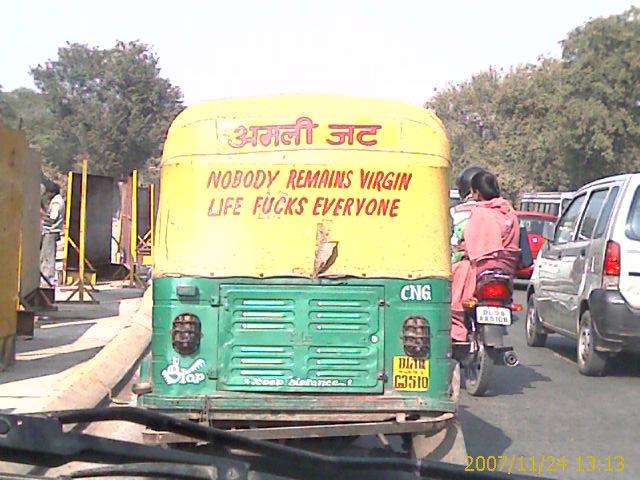
After the recent – and fascinating – debate on autorickshaws that spanned three posts and several comments, I couldnt resist putting this up once it arrived in my mailbox.  Thank you Akshaya for sending it my way.

Death of the Author(-ized)?

Or it is just another case of planning paranoia?

Although commonly understood to be a city of traders, Ravinder Singh Chowdhary*, is adamant that Delhi be understood as the abode of farmers.  Sitting adjacent to lush verdant fields of brinjal, rice, and spinach in the village Madapur Khadar in Delhi’s Badarpur Constituency, Chowdhary, explains how Delhi is paradoxically “a city of farmers.”  “From Kilokri and Kotla Mubarakpur in the South-East, to Karol Bagh in Delhi’s North-West, almost every new colony post-partition has been settled on farm land. Those settled by the Government were given water, electricity and drainage and became proper colonies; those settled by private individuals were denied these basic amenities and termed ‘illegal’ or ‘unauthorised’.”

In its most recent and controversial policy announcement, Delhi Government and the Union Ministry of Urban Development seem to take cognisance of Chowdhary’s understanding of the city’s settlements and have begun the process of issuing provisional regularisation certificates to about 1,500 unauthorised colonies that are mostly settled on agricultural land; a move that they claim will benefit approximately 40 lakh residents.
Continue reading Death of the Author(-ized)?

In the war against terror…

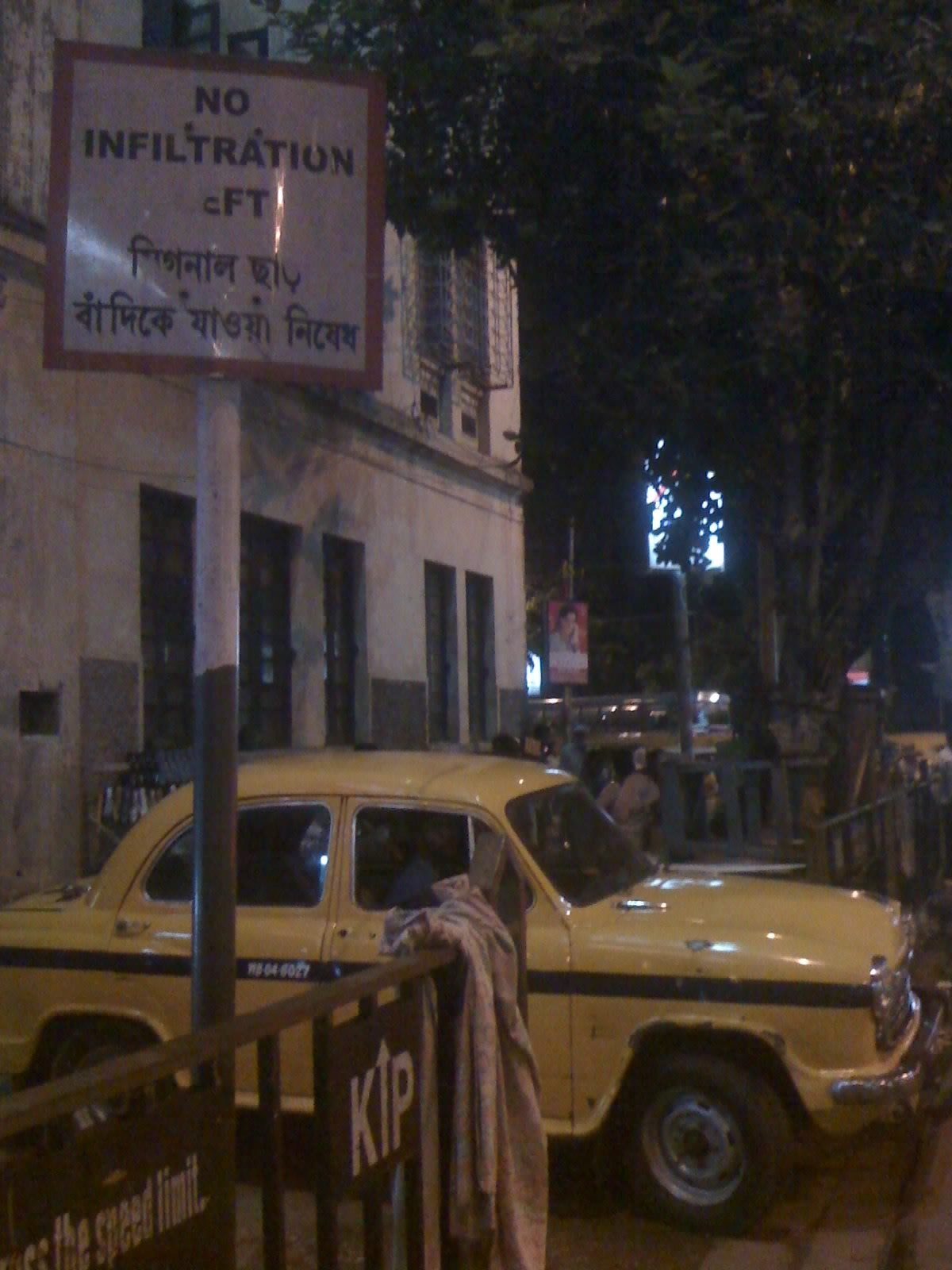
Bengal\'s war on terrorThe Kolkata Municipal Corporation does its bit ….

So what was that fuss about?

Pleased with its professionally executed hatchet job on what is probably Delhi’s first real public transport endeavour that incorporates the needs of pedestrians and cyclists apart from bus users, the press seems to have forgotten the BRTS – moving on to search for other programmes to torpedo. But what was the BRTS fuss all about? Read on …

“’Experts’ order serial rape of Delhi Roads” screamed a particularly tasteless headline, in a national paper, of an article that claimed that the entire city shall be subjected to “gang-rape by greedy contractors with the benign blessings of rootless experts and supine babus.” In another widely published English newspaper, the editor in chief spoke out fearlessly against the “brutal enforcement of licence-quota raj on our roads”, denouncing what he saw as the “cynical and expensive exercise in enforcing a new kind of ideological socialism.” In another op-ed carried by the same paper, another piece spoke out against the “elitist” nature of the same project. “The masses want to drive,” noted columnist Saubhik Chakravarthy,” So reducing road space for private vehicles is ultimately elitist.” Judging by the vicious vendetta unleashed by the mainstream press, one would assume that the mild-mannered professors of the Indian Institute of Technology, Delhi, had committed a crime against the state, rather than have designed the latest addition to the city’s mass transit system.

Continue reading So what was that fuss about?

When you cast your bread upon the waters…you get soggy bread

“The development of irrigation has outrun its administration…” noted the Chief Engineer of the Upper Ganga Canal in 1869. More recently, a series of reports on the state of India irrigation suggest quite the obverse of Colonel W.Greathed’s glum observation; that it is India’s administration, in fact, that has outrun her irrigation. Trends gleaned by compiling figures from a multitude of government sources including the Planning Commission, the Ministry of Water Resources, and the Ministry of Agriculture indicate in spite of massive public investments in dams and river basin projects over the last ten years, the area under canal fed irrigation is actually declining.

Big dams and irrigation projects remain one of the most controversial issues in India’s environment-development debates, but the latest data suggest that those backing these mega-projects might have to re-consider their positions.

Continue reading When you cast your bread upon the waters…you get soggy bread

Aman Sethi on Gajar Matar

This is something that i have been thinking of ever since Chomsky et
all brought out their series of letters on Nandigram
, left unity etc, and now Tariq Ali on Why he will
not participate in Turin Book Fair
. At such points, i imagine the
writer of the letter in an almost kung-fu posture – balanced on one
foot, maybe raised on one toe to make the stance more complete, the
other leg bent at the knee, hands in classic double punch pose. The
moment of “taking a stand”, defining his/her stance.
Continue reading Aman Sethi on Gajar Matar

Looking forward looking back

While the Bali conference is finally over, work on its roadmap is only just begun. Below, am pasting a summary of Bali prepared by the Earth Negotiations Bulletin. The full report can be found on their website: http://www.iisd.ca

A BRIEF ANALYSIS OF COP 13 & COP/MOP 3

BALI: ISLAND OF THE GODS AND BREAKTHROUGHS?

You should not be impelled to act for selfish reasons, nor should you be attached to inaction. (Bhagavad Gita. 2.47)

Marking the culmination of a year of unprecedented high-level political, media and public attention to climate change science and policy, the Bali Climate Change Conference produced a two-year “roadmap” that provides a vision, an outline destination, and negotiating tracks for all countries to respond to the climate challenge with the urgency that is now fixed in the public mind in the wake of the headline findings of the IPCC’s Fourth Assessment Report. The outline destination is an effective political response that matches both the IPCC science and the ultimate objective of the Convention; it was never intended that the Bali Conference would focus on precise targets. Instead, the divergent parties and groups who drive the climate regime process launched a negotiating framework with “building blocks” that may help to square a number of circles, notably the need to reconcile local and immediate self-interest with the need to pursue action collectively in the common and long-term interests of people and planet. The informal dialogue over the past two years has now been transformed into a platform for the engagement of parties from the entire development spectrum, including the United States and developing countries.

Continue reading Looking forward looking back

Whose woods these are….

…. I think I know?

If the latest developments at the Bali Summit are anything to go by -the answer to this question is going to become very contentious in the coming years. Armed with a mandate to cut, capture, and squester carbon; Governments, International Organisations, and private companies have been working hard at arriving at a means to bring forests under the carbon market – and possibly use carbon in forests as a tradable commodity. What this means for the future of our forests is uncertain.

There are several components that can be considered under the Forests and REDD – Reduction of emissions from Deforestation and Degraded Land in developing countries. Some of the big ones are afforestation programmes, deforestation reduction programmes, carbon capture and squestering (CCS), the rights on indigenous peoples and forest dwellers, the Clean Development Mechanism and conservation. Each carries with it an entire lexicon and phrase-ology of its own.

I mentioned in previous posts, it is one of the most interesting issues at the conference – and one I hope to deal with at length in my article for Frontline – which I shall have to work on very soon. In the meantime, jus to get interested readers up-to-speed, am appending to articles that I have written for the The Hindu. They should provide the briefest of introductions. Note that the articles correspond to standards of objectivity required in “Hard News” reportage – Shall write an opinion piece for Kafila soon. In the meantime, I would urge careful readers to read against, for, below, above and around the text.

Continue reading Whose woods these are….

REDD Salam

A week ago, I had promised a short post on the Forest Issue. As promised, here it is:

Nusa Dua: As the UNFCCC World Climate Change Conference crossed the 10,000 attendee mark , delegates braced themselves for what could be one most difficult and divisive issues of what could constitute “The Bali Breakthrough.” “The working group on Reduction of Emissions by Deforestation (and Degradation) in Developing Countries (REDD) was constituted and has begun work today,” stated UNFCCC Executive Secretary Yvo de Boer in his daily press briefing at the World Climate Change Summit today. The working group is tasked with arriving at a mechanism to incorporate deforestation reduction into the framework of the Kyoto Protocol and the carbon market.

Continue reading REDD Salam

The Shotgun and the Sniper

“The time for silver bullets has passed,” proclaimed Marc Stewart, “What we need is a Shotgun!” In his bright Bali shirt, Nike sneakers and Investment Banker haircut, Mr Stewart is the firm-handshaking, fist pumping, ever effusive all-American co-founder of Ecosecurities, a firm that specialises in developing and marketing carbon trading projects under the Clean Development Mechanism – CDM – of the Kyoto Protocol. With emission reductions under Kyoto less than a month away, Mr Stewart’s firm is looking to extend its market capitalisation to far beyond its existing 40 million USD. The Ecosecurity model functions in the following way – they find and help develop projects in the developing world that is eligible for credit credits under the CDM, and then sell the credits to firms in EU, and across the world, that are looking to meet their Kyoto targets by offsetting excess emissions against carbon credits. Firms like Ecosecurities pushed the carbon market to 30 billion dollars in 2006; and if Annex 1 agrees to further emission cuts (25-40 per cent below 1992 by 2020) the potential size of the market is open to the most optimistic hyperbole.

The “Shotgun Approach” suggested by Stewart was his response to the fact Continue reading The Shotgun and the Sniper

Kafila makes Impact at International Conference!

In perhaps a first ever “Impact Kafila” story; the event organisers at the UNFCCC Climate Change Summit at Bali 07, seem to have changed their lunch plan. Two days ago, Kafila carried an exclusive investigative breaking news type piece on how millions of rupiahs were being wasted on freeloaders who attended lunch and refreshments and slipped away before the sessions began. Our fearless reporter posed as a freeloader and purloined one free lunch, some prawn cocktails and a can of Dr Peppers Ginger Ale (it tasted pretty awful, but I could not resist the attractive packaging) before unceremoniously leaving the premises and attending a rival side session. However, the event I attended this afternoon, had no large tables covered with starched white tablecloths, no silverware polished to a dull glow, no mile long queue of people from all over the conference – in fact, no free lunch. Continue reading Kafila makes Impact at International Conference!

Day Two At Bali

Day Two at the Bali Conference sees an intensification of the “inSide Climate Change” programmes. “inSide” is the UNFCCC’s witty title for the side events and exhibits at Bali 07 and is often a good indicator of the issues that shall be on the agenda for upcoming conferences. inSide is thus a great place to hang out if you want to get a sense of the future and, if you time it right, get to free lunch on donor-body expense. Because lunch is a serious issue. Not content with making collossal amounts of money off the UN for hosting their conference, the Bali conference centre offers meals at (literally) One million Rupiyah a pop – which works out to about 10 dollars for a grubby sandwich; but the point about the side events is that they offer a glimpse into big businesses plans for our environment. And there are many. Continue reading Day Two At Bali

The Climes they are a’changin

“Much is at stake … for generations to come! We are running out of time.We are mobilising around the world. We must take strong action NOW!”

Sitting in on the press conferences of the United Nations Framework Convention on Climate Change, Bali 2007, is a bit like watching the Green version of Independence Day – that immensely forgettable film starring Will Smith. While Smith merely had to pilot a UFO deep into the heart of the alien mothership to save Planet Earth, the cast of “Mission Emission” face a far more insidious enemy:”Caaaarrrrbonnnnn!” Colorless, Odourless, and unsettlingly stable. The vast stage in the darkened Bali International Convention Centre takes the place of the “Command Room” where practically every human calamity, from the kidnapping of the US President to the end of the universe, is invariably solved in approximately one and a half hours. An array of perfectly tailored suits deliberate the myriad aspects of the “greatest challenge faced by mankind…. Ever!” Continue reading The Climes they are a’changin

Shantibangh in Lohandiguda

Finally, it was an uneven scrawl in the cryptic shorthand of a court stenographer that almost ruined Sudaram Nag’s monsoon crop. “Sudaram Nag, 50 yrs, Takraguda, Bastar. Section:107.116(b), 03-08-07.” it said; communicating to Sudaram Nag, a 50 year old rice farmer in the Bastar District of Chhattisgarh that he was hereby summoned to present himself at the Magistrate’s Court on 3 August 2007 to show cause as to why proceedings may not be initiated against him for a breach of peace under section 107.116(3) of the Criminal Procedure Code (CrPC) . Since early this year, more than 60 of Sudraman’s neighbours and fellow villagers have spent more time at the courts in Jagadalpur than tending to their fields and harvests. Their crime? Protesting against the blatant rigging of gram sabha hearings initiated to acquire 2161 hectares of fertile agricultural land for Tata Steel Limited’s greenfield steel plant in the district.

Continue reading Shantibangh in Lohandiguda