All posts by Lawrence Liang

Documented Lives: Aadhar and the Identity Effect in Kashmir: Shrimoyee Nandini Ghosh

A version of this essay appeared in the Kashmir Reader, 10 December 2013

Guest Post by Shrimoyee Nandini Ghosh

On the road to the city from Srinagar Airport, I recently saw a billboard. Beneath the radiantly beaming faces of Manmohan Singh, and Sonia Gandhi, it bore the declaration ‘One Nation. One Card. AADHAR.’ Public Service advertisements in the same cheery vein have been airing on Radio Kashmir, and the state owned TV station Doordarshan- Kashir. Its critics assert that the AADHAR (‘its not a card, just a number!’) scheme exemplifies the financialisation of citizenship (each AADHAR number will require a corresponding bank account), a regime of biometric surveillance, the creation of a database nation and an expansion of the global corporate- military-intelligence empire. But AADHAR is only the latest chapter in the largely undocumented history of India’s intimate stranglehold over Kashmir through identity documents. It is a history told anecdotally, through stories about the sinking feeling of being stopped at a barricade and rifling through empty pockets, of cold hours spent pleading on a street or at a police station, of late night rescues of hapless friends from lonely check points, of miraculously narrow escapes despite having left home without it.

Though no Kashmiri adult I know leaves home without their ID, no one can seem to pin point exactly when the carrying of a photo-identity card became mandatory. Trying to understand the basis for the practice, I asked a friend under what law it was required that every person be able to prove their identity at all times. ‘Under the gun law!’ he replied succinctly. While its legal origins are uncertain, what is quite clear is that by the early 1990s no Kashmiri male could afford to be, quite literally, caught dead without one. As my plain speaking friend explained, “the most important reason for carrying one was if you were killed, somebody would hopefully find your card and inform your family.” The ID card was the tenuous piece of laminated paper that stood between him and an unmarked grave, an unmourned death.

Continue reading Documented Lives: Aadhar and the Identity Effect in Kashmir: Shrimoyee Nandini Ghosh

Naz and its detractors: A response by Jordan Osserman

Guest Post by Jordan Osserman

Amidst the outcry of queer rage and mourning against the Supreme Court judgment has emerged a strand of skepticism (For examples See here , here and here)  from within queer circles, directed at the participants in the anti-377 campaign. These skeptics allege that the 377 organizers failed to adequately consider the impact of their activism on the most marginal queers in India (lower class/caste hijras, kothis, MSM, etc.). In the most biting version of the critique, the 377 campaign is portrayed as an elite middle class movement, fueled by foreign-funded NGOs, against a largely symbolic, immaterial enemy. 377, these critics allege, was never a central cause of LGBT oppression; a paper tiger, relatively unknown by police and Indian society writ large until middle-class queers arbitrarily put it on the agenda and invested it with symbolic meaning. To the extent that marginal sexual minorities have been represented at all, their voices have been appropriated in the service of a campaign at best irrelevant, and at worst dangerous, to their lives.

In this post, I’d like to challenge some of these claims. We can summarize the critics’ arguments as follows: 1. Section 377 has not historically targeted LGBT people, and rarely affected the lives of sexual minorities prior to the activist mobilization against it. 2. Instead of fighting 377, activists should have prioritized campaigns which would concretely benefit LGBT people, particularly the most marginalized. Alternately, if the 377 campaign had to go forward, the legal strategy and organizing should have been more inclusive. 3. The “liberal outrage” against 377 may be as much to blame for violence justified in the name of the law as the Supreme Court’s decision. For, now that queer activists and the Indian media have popularized the notion that the Supreme Court has “re-criminalized homosexuality,” homophobes have become aware of a new weapon with which to target sexual minorities. I will attempt to address these interlinked arguments in their respective order, before drawing some final conclusions about activism and organizing.

Continue reading Naz and its detractors: A response by Jordan Osserman

Naz and Notional Equality: Aman


 A guest post by Aman finds fault with the Supreme Court’s reasoning on equality

In Suresh Kumar Koushal and another v. Naz Foundation and others (Naz), the Supreme Court notes that, ‘It is relevant to mention here that the Section 377 IPC does not criminalize a particular people or identity or orientation. It merely identifies certain acts which if committed would constitute an offence. Such a prohibition regulates sexual conduct regardless of gender identity and orientation.’ By concentrating on the acts and not people, it is perhaps tries to convince us (and perhaps itself) that this is not a debate about homosexuality. However, the short-sightedness of the Supreme Court in discounting how these ‘acts’ are so fundamentally connected to a group’s orientation/identity is clear; it does exactly what it says it’s not doing (i.e. criminalize a particular people or identity or orientation).

The text of section 377 is facially neutral and applies to all people but it is not very difficult to see that the provision impacts homosexuals. As mentioned earlier, the so called ‘unnatural acts’ are the only ways homosexuals can have sex. This obviously implies that it is the homosexuals who have to continue bearing the stigma of being a criminal. The symbolic effect of branding homosexuals as criminals was evinced by the Delhi High Court when it said that provisions like these add to the reasons for homosexuality being treated as bent, queer, repugnant, deviant and perverse, leading to further marginalisation of the homosexuals. What could have been an attempt by the Indian judiciary to bring down one of the obstructions for integration, has become an enforcement of a dominant notion of ‘natural’ sex which will naturally lead to concealment of true identity of many people who are anyway struggling in the society to prove that they are normal.

Continue reading Naz and Notional Equality: Aman

Size does matter your lordships – A letter to the Supreme Court: Siddharth Narrain

SIDDHARTH NARRAIN based on his legal and extra legal expertise arrives at the conclusion that size does matter

A LETTER TO YOUR LORDSHIPS

Your Lordships have called us, LGBT Indians, a “miniscule minority”. Never mind that statistically we constitute at least four per cent of the population, which are over four million people. Your Lordships say that there are only 200 persons impacted by section 377 over the last 150 years. Never mind that there are millions of LGBT persons who have been under the shadow of this law over the last 150 years, discriminated against, blackmailed, harassed, outed to their families, driven to suicide, forcibly married, diagnosed as mentally ill, raped, assaulted, and disinherited.

Your Lordships say we are a “miniscule minority”. Since you are so fond of dictionaries, lets flip one open.

Miniscule: The adjective miniscule is etymologically related to minus, but associations with mini have produced the spelling variant miniscule. Continue reading Size does matter your lordships – A letter to the Supreme Court: Siddharth Narrain

No Going Back: Siddharth Narrain

no going back


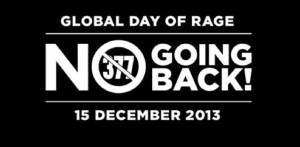
No Going Back

The Supreme Court’s decision in Suresh Kumar Kaushal v Naz Foundation has re-criminalized millions of LGBT persons, putting their lives at risk and subjecting them to the threat of violence, harassment and arrest. Despite this loss in court, we should not see this as a defeat. It is not a defeat because the mood of the country has changed, rising up in anger against prejudice masquerading as law. The public backlash against this decision has caught even LGBT activists by surprise. It is not a defeat because finally voices from the political establishment of this country have come out in support of LGBT rights. The top leadership of the Congress party, Cabinet Ministers, and spokespersons across the political spectrum have spoken out against the judgment. The BJP’s official stance supporting 377 appears out of step with reality, and there is a section of the party that does not support this view.

It is not a defeat because parents of LGBT persons have rallied around their children in this hour of crisis. It is not a defeat because friends, colleagues, students, teachers, and classmates have been shaken up by the injustice of this moment. The outrage and anger, the public show of solidarity and small gestures of support, has been overwhelming. The 377 judgment is not a defeat because commentators across the political spectrum have criticised the logic of the judgment. It is not a defeat because the legal community including the Advocate General of this country has questioned the rationale of this decision. Described as a judgment devoid of humanity and compassion, the Supreme Court’s decision has prompted many comparisons – A.D.M. Jabalpur, A.K. Gopalan, Mathura, Gian Kaur,  Dred Scott, Plessy, and Bowers. It is not a defeat because this judgment has spawned a new generation of activism.

The Supreme Court’s decision has emboldened the human rights movement in this country, brought together diverse groups on a common platform. The Delhi High Court’s 2009 judgment affirmed the constitutional rights of millions of Indian citizens. The Supreme Court verdict has reversed this, but it can never erase that moment of freedom from our past. The mood of this country has changed. Public discourse has changed. People have changed. The law must change. There is no going back.

In cities across the world, people are mobilizing protests against the judgment. Join the Global Day of Rage on Sunday, 15th December.

https://www.facebook.com/events/1374294672825321/

Contempt of Citizens: Mayur Suresh

MAYUR SURESH   finds the Supreme Court guilty of contempt (of citizens)

Contempt: – The word ‘contempt’ comes from the Latin word “contemptus” and much like its modern counterpart, is the feeling that a person or a thing is worthless or deserving scorn.

Contempt is a feeling that is often felt by Lesbian, gay, bisexual and transgender people in India. It’s been meted out to LGBT people equally by the British who aimed to civilise us, and those today who seek to ‘preserve our culture’. An 1838 report on the Draft Penal Code called homosexual acts a “revolting subject” and said that the “frequency” of homosexuality in India “remained a stain on this land.” In 1934, the High Court of Sindh called a man who had consensual sex with another man “a despicable specimen of humanity”. Not to be left behind, those appellants who approached the Supreme Court reserved the choicest of contemptuous words for LGBT people in India: “disgusting”, “filthy”, “delinquents”.

Continue reading Contempt of Citizens: Mayur Suresh

Crimes of Unreason: Danish Sheikh

A post on the cowardly judgment of the Supreme Court by DANISH SHEIKH. I term it a cowardly decision because if it had said that we are homophobic then it would at least have been admirable for its honesty if not for its belief. It instead chooses to mask its homophobia with crimes of unreason

Now you’re legal – Now you’re not!

With the ease of a particularly sadistic magic trick, a 98 page document has sent millions of LGBT individuals time-warping back into pre-2009 criminality. If there were any constitutional justifications for this act, they are not to be found lurking in the pages of this shockingly poorly reasoned decision. The Supreme Court has taken a chainsaw to one of the most beloved court decisions of our time, and surgically extracted everything that made it such an important verdict. Besides, of course, that little side business of equal-moral-citizenship granting. A broader walkthrough the shoddiness of the judgment can be found  here, (http://kafila.org/2013/12/12/we-dissent-siddharth-narrain/) I’m presently looking at some of the more egregious of its violations. Continue reading Crimes of Unreason: Danish Sheikh

We Dissent: Siddharth Narrain

A preliminary walk through the unreason of the Supreme Court in the 377 judgment by SIDDHARTH NARRAIN

We hope to see many more pieces which exposes the judgment for what it is- an example of judicial non application of mind. I have also written a short piece looking at the judgment in the context of the Mandela moment

The Supreme Court’s decision in Suresh Kumar Kaushal & Another v. Naz Foundation & Others is an unprecedented ruling, deciding to turn the clock back to pre-July 2009, when LGBT persons were criminalized by section 377 of the Indian Penal Code. On close reading, the judgment is based on a narrow and blindfolded interpretation of the law, ignoring the momentous changes in society and notions of morality that India is witnessing. Further, the judgment, in many parts, relies on shaky precedent, does not explain the logic of its conclusions, and is surprisingly dismissive of substantial evidence that was placed before it. Continue reading We Dissent: Siddharth Narrain

Of Gandhi and a Godfatherly Copyright Offer- Part 2: Shamnad Basheer and Lawrence Liang

This is the second part of an earlier post in which we refuted the claims made by the International Federation of Reproduction Rights Organisation about the ongoing copyright case filed against Delhi University and Rameshwari Photocopy Services. A group of students (ASEAK) and academics (SPEAK) have separately impleded themselves in the suit.

Gandhi, Karan Johar and Cafes?

The FRRO recycles the insidious idea that the cost to students of paying the license fee for course packs would be the equivalent of an ‘evening in a student café’. This naïve assumption could be the result of watching too many Karan Johar films in which all Indian campuses look like Riverdale and all students wear Gucci and Nike. Click here for a contrary perspective

For sure, there are a number of rich Indian students who probably spend way more on cafes than they do on books (forgive them father for they know not what they do). But when we think of articulating copyright norms, what kind of student should serve up as our policy addressee? The urban upper middle class creamy layer student who constitutes but a miniscule proportion of the totality or ones from lower economic strata that constitute the vast majority?

Continue reading Of Gandhi and a Godfatherly Copyright Offer- Part 2: Shamnad Basheer and Lawrence Liang

Of Gandhi and a Godfatherly Copyright Offer: Shamnad Basheer and Lawrence Liang

In an op-ed in the Hindu, we highlighted an egregious copyright law-suit slapped against Delhi University and its photocopier by leading foreign publishers. The IFFRO (International Federation of Reproduction Rights Organisation) and its partner organisations which collect moneys on behalf of publishers issued a response to this piece, expectantly touting the virtues of acquiring a copyright license from them.

Unfortunately, owing to space constraints, we could only offer a pithy rebuttal to their response in the Hindu.

Below is a more elaborate version of our rebuttal.

(For those who came in late, here is a short jingly version of what this law suit is really about)

For those interested in tracking the case, see updates on SpicyIP

An Irrefusable Offer:

In their response, the IFRRO and its counterparts once again offer the option of a tantalizingly cheap copyright license, repeatedly stressing the “reasonableness” of their offer.

Continue reading Of Gandhi and a Godfatherly Copyright Offer: Shamnad Basheer and Lawrence Liang

The Official Emergency Continues – The Ordinance on Sexual Assault: Pratiksha Baxi

Guest post by PRATIKSHA BAXI

The reform of rape law, which was not a priority for more than two decades, seems more like a 20-20 match now. The spectacle of judicial reform has all the elements of cinematic imagination built into it—violence, voyeurism, repression, tears, scandal, redemption and betrayal. We are all consumers and participants of this judicial spectacle. We veer between manic hope and dark despair as we are left conjecturing how this theatre of judicial reform will enact equality and dignity for survivors of sexual assault. The latest twist in the tale is the introduction of an ordinance, following the Justice Verma Committee (JVC) report.

Continue reading The Official Emergency Continues – The Ordinance on Sexual Assault: Pratiksha Baxi

Delhi Gang Rape – Understanding the Structure of Violence: Esha Shah

Guest post by ESHA SHAH

The social, political and legal debates that have followed the gruesome incident of gang rape in Delhi on 16 December – including the debates on the recently published report of Justice Verma Commission widely hailed for its revolutionary character – have not sufficiently engaged with the structure of violence perpetrated in the act of brutality. In forging the solidarity against the suffering, there is a popular tendency to externalise the act of barbarity causing this suffering as demonic and hence out of this world. For instance, one of the posters in the protests that followed the incident read “your suffering is my suffering” – in the same poster it was demanded that those who caused this suffering were narpishach and should be hanged. The pain of the victim is shared collective pain, but the brutality of the act is certainly not the shared collective responsibility. In the preliminary remarks below I want to argue that we need to revise the nature of power asserted in the act of brutality, and in doing so we need to not only convert the demonic caricatures as flesh and blood human beings produced by this world but also to embed their acts into deep-rooted structures of violence in our society.

Continue reading Delhi Gang Rape – Understanding the Structure of Violence: Esha Shah

Corruption and Political Correctness: A Severe Case of Intellectual Laziness: Meera Ashar

Guest post by MEERA ASHAR

Ashis Nandy has been called, rather, accused of being, many things—sociologist, historian, political theorist, public intellectual, philosopher, psychoanalyst, leftist, centrist, right wing, Dalit, Christian, Brahmanical, casteist (he describes himself, more poetically, as an intellectual street fighter and reason buster)—but ‘politically correct’ has never been one of them.

This time, Nandy’s political incorrectness has cost him more than before. As in the past, he has been attacked by politicians and the popular media for presenting his analysis of social phenomena—for doing his job well. The response of the Indian intelligentsia to Nandy’s threatened arrest by the right wing government of Gujarat in 2008 was markedly different from the response now. The difference this time, of course, is that Nandy has not offended the right people. He is seen to have betrayed the marginalized. This time, he has been unfashionably politically incorrect. The similarity between the two episodes is the ‘freedom of speech’ brigade, which has dutifully stood by Nandy. But I shall turn to them later.

Continue reading Corruption and Political Correctness: A Severe Case of Intellectual Laziness: Meera Ashar

A Guide to Infantalising and Trivialising the Public sphere

It is no  coincidence that Salman Rushdie who remains the poster child of the censorship debate in India begins his celebrated Midnight’s Children with the twin image of the birth of a child and that of a nation. The rest of the novel traces the intertwined stories of the child’s growth with the political history of independent India. But if one were to extend this allegory taking into account the kind of public sphere that seems to exist in India 65 years after independence there seems to be something amiss about this metaphor of birth and subsequent growth into maturity. A strange malaise pervades the public sphere in India today, where it seems almost as if we have turned the natural cycle of growth around and the children of midnight appears to suffer from the malady of the protagonist in David Fincher’s film “The Curious case of Benjamin Button” where a man is born a mature adult but ages backwards and slowly slides into infantile regression. If we were to consider the unreasonable response to Ashis Nandy’s talk at the Jaipur literary festival as one in a long continuum of such cases where individuals are hounded for hurting sentiments of communities, the Indian public sphere sadly appears as a weak and sickly child suffering from irony deficiency. Continue reading A Guide to Infantalising and Trivialising the Public sphere

The Verma Committee: Alchemizing anger to hope: Arvind Narrain

ARVIND NARRAIN has an op-ed in today’s Hindu about the Justice Verma Committee. This is a longer version of the article

The public discourse post the brutal rape of Nirbhaya has witnessed a persistent degrading of the public discourse. Having been subjected to crudely offensive remarks by members of the political establishment, right from belittling a serious movement for equality as led by  ‘painted and dented ladies’ to ostensibly sympathetic responses which belittle women who have suffered a serious violation of their bodily integrity as nothing  more than ‘zinda laash’, we finally have a document authored by a Committee set up by the state which honours Nirbhaya.

The Verma Committee Report most fundamentally alters the public discourse on crimes against women by placing these crimes within the framework of the Indian Constitution and treating these offences as nothing less than an egregious violation of the right to live with dignity of all women. What is particularly moving and inspiring about the Report is that it does so by placing the autonomy and indeed the sexual autonomy of women at the very centre of its discourse.

Continue reading The Verma Committee: Alchemizing anger to hope: Arvind Narrain

Photographs from Ejipura Demolition : Mirno R. Pasquali

Mirno Pasquali  is a photographer who has been documenting the EWS evictions in Ejipura Bangalore. Gautam Bhan has written about the evictions here

I spent the past few days photographing in the Ejipura slum which has been the focus of many activists working here in Bangalore. This has been my first attempt at documenting these types of issues, and being a foreigner has made it particularly interesting. I hope to have done so in a way that is fair, unbiased and ultimately insightful.

A number of activist have referred me to this forum as an intellectual space to post stories, issues and ultimately begin a dialogue about a number of different topics. I am happy to have found a place to place these photographs, and I hope doing so will aid to this goal.

Please feel free to use them for any publication, write up or other purposes. I only ask for acknowledgement and the passing along of my contact information.

mirno.pasquali@gmail.com

http://indiathough.blogspot.com

Mobile (+91) 8197862434

Jan 23 morning 060

Continue reading Photographs from Ejipura Demolition : Mirno R. Pasquali

Aaron Swartz, R.I.P: Swaraj Paul Barooah

Reposting a tribute by Swaraj Paul Barooah which originally appeared on Spicy IP to Aaron Swartz. Aaron Swartz hung himself on January 11th 2013 and had been facing extensive legal charges for having downloaded 4 million articles from JSTOR which he intended to  make available for free online

aaron-swartz


Some of us in India may not have heard of Aaron Swartz, a 26 year old activist who was heavily involved in copyright policy issues and issues surrounding technology freedom. He committed suicide on Jan 11th, 2013 and his story is a sad one which is certainly worth sharing. However, what’s also important to note, are the circumstances which may have led his eventual suicide.

While it cannot be confirmed, it appears that his arrest and indictment for charges of downloading academic papers from MIT and JSTOR resulting in possible jail time of over 50 years and 4 million dollars in fines may have been the cause. JSTOR apparently had dropped the charges, but the US government continued the case and racked up a total of 14 counts of felony against him. (Note: it is unclear whether MIT pursued the charges or not). Clearly he was seen as very troublesome by the government and his online activism must’ve had a lot to do with that.
Continue reading Aaron Swartz, R.I.P: Swaraj Paul Barooah

Fettering the fourth estate: Free Speech in 2012

Fettering the Fourth Estate: Free Speech in 2012

A report of the Free Speech Hub of the Hoot.org

The year 2012 ended with a Kannada TV reporter, Naveen Soorinje, in jail for more than fifty days after the Karnataka High Court denied him bail. Mangalore-based Soorinje, was incarcerated from November 7, 2012 after police charged him under the UAPA and under the Indian Penal Code (IPC) for reporting on the raid on a homestay party by a Hindu fundamentalist group in July. Soorinje’s bail application was rejected on December 26.

The same month, a television journalist, Nanao Singh, was shot dead in a police firing in Manipur.

In 2012, India was a grim place for free speech. It recorded the death of five journalists. Another 38 were assaulted, harassed or threatened.    There were 43 instances of curbs on the Internet, 14 instances of censorship in the film and music industry, and eight instances of censorship of content in the print medium. Continue reading Fettering the fourth estate: Free Speech in 2012

We must resist the cunning of judicial reform: Pratiksha Baxi

Guest Post by PRATIKSHA BAXI

The death of the 23 year old woman following the brutal gangrape rape and assault on a moving bus on 16 December 2012 at a hospital in Singapore early this morning leaves all of us in states of deep mourning. This is a political death. Rape and murder of women is political violence against all women, whether or not, the political class recognises and accepts this. In the course of the last two weeks, many body blows have been endured. We felt a body blow after the political death of the 17-year-old gangrape victim in Patiala who took her life after she was humiliated and pressurised to compromise. The numbing list of such political violence continues.

We have seen the emergence of many kinds of publics. There have been many speeches and writing against the emergence of a retributive public, where the cry for death penalty or castration became a vocabulary of protest, also especially since the media initially focussed largely on this demand. Yet in the last few days there has been a perceptible shift from the focus on forming a retributive public moving towards a passionately reasoned and informed public on what the government needs to do to be accountable to rape survivors, and indeed, to all of us who reject the rape cultures in India.
Continue reading We must resist the cunning of judicial reform: Pratiksha Baxi

Merry Copyright to you – A jingle for the Oxford v. Rameshwari Case

A group of publishers (Oxford and Cambridge University Press and Francis & Taylor) have sued Delhi University & its agent, Rameshwari Photocopy Service for compiling short extracts from different textbooks into a digest for students to use as part of their study (commonly referred to as “course packs”).

Naturally, students, teachers and even authors of these text books have protested this aggressive law suit, particularly since this is perfectly acceptable under the Indian Copyright Act, which allows for “fair use” and permits any reproduction of copyrighted works, so long as it is done in the course of educational instruction.


This is not mala fide use, nor is anyone selling these ‘course packs’ for profit. Publishers going after students, many of them from economically disadvantaged communities, despite the high cost of textbooks, really begs the question – whither our constitutionally guaranteed fundamental right to education? Continue reading Merry Copyright to you – A jingle for the Oxford v. Rameshwari Case

Can the Love of Justice be Assassinated?: Arvind Narrain and Saumya Uma remember Shahid Azmi

Guest post by ARVIND NARRAIN and SAUMYA UMA

Progressive lawyers, social activists and academics have invested much time in trying to puzzle out what is the progressive potential of law. Sometimes, answers to deep philosophical questions emerge from a single life. Shahid Azmi’s life   (1977-2010) exemplifies one answer to this perennial question. It was a life which took to the legal profession with the objective of using  law as a shield and tool in the quest for justice. It was also a life which was tragically cut short, when Shahid Azmi was assassinated  at the  age of thirty three.

Continue reading Can the Love of Justice be Assassinated?: Arvind Narrain and Saumya Uma remember Shahid Azmi