Category Archives: Frontiers

Kashmir: A “No-Peace” Political Initiative

Guest post by ANGANA CHATTERJI

The 8-point Plan, New Delhi’s political initiative to address the crises in Kashmir, attests to the parallel and incommensurate realities of the sovereign and the subjugated, the Indian state and the Kashmiris.

The 8-point Plan renders obvious New Delhi’s limited comfort zone. The Plan is not an overture to healing the reality of suffering and outrage inside Kashmir. Rethinking militarization and military governance is not the priority. The ambition is to manage Kashmiris and to keep the disarray concealed from the international gaze.

New Delhi announced its 8-point Plan on September 25, 2010, following the visit to India-ruled Kashmir of a 39-member All Party Delegation from New Delhi led by Union Home Minister Palaniappan Chidambaram, and parallel to the 65th Session of the United Nations General Assembly meetings in New York City. That Defence Minister Arackaparambil Kurian Antony did not accompany the All Party Delegation was indicative of New Delhi’s mood.

Continue reading Kashmir: A “No-Peace” Political Initiative

Let Delhi have its thali

Guest post by HILAL MIR

During the convention, Azadi the only Way, at LTG auditorium on Thursday, a potbellied man was standing on the aisle, listening intently to the speech of professor of history at Jadavpur University Sugata Bhadra. The man, I reckon, might be easily burdening earth with nearly 130 kilograms of his fair, north Indian bulk.  The professor was stripping the Indian state to its bare minimum and the audiences clapped. The man could stand it no more. I soon found out his voice was equally weighty, and gravelly—a cross between Shatrugan Sinha and Kulbushan Kharbanda. Quite audibly he said jis thali ma khatey hai usi main chaid kartey hain. In Bollywood films this saying condemning treachery is reserved for domestic helps who fall in love with the pretty daughters of their employers. Here, the context was different. A Maoist sympathizer was sharing the dais with a Kashmiri pro-freedom leader who was sharing the dais with a Sikh secessionist who was sharing the dais with a Naga human rights defender…A veritable thali of secessionism and dissent indeed. No wonder Arnab Goswami was hysterical. Continue reading Let Delhi have its thali

Azadi: The Only Way – Report from a Turbulent Few Hours in Delhi

Dear Friends,

I was present and speaking a few hours ago at a meeting titled ‘Azadi: The Only Way’ on the situation in Jammu and Kashmir, organized by the Committee for the Release of Political Prisoners at the Little Theatre Group in Delhi yesterday (21st October). I was not present from the beginning of the meeting as I was traveling from another city, but can vouch for what occurred from around 4:30 pm till the time that the meeting wound up, well after 8:00 pm in the evening.

The meeting took place in the packed to capacity auditorium of the Little Theatre Group on Copernicus Marg at the heart of New Delhi. Several speakers, including the poet Varavara Rao, Prof. Mihir Bhattacharya, Sujato Bhadra, Gursharan Singh, Mr. Shivnandan (?) an activist from Jammu, Professor G.N.Saibaba, Professor Sheikh Showkat Hussain – Professor of Law, Srinagar University, the journalist Najeeb Mubaraki, Dr. N. Venuh of the Naga Peoples Movement for Human Rights, the writer Arundhati Roy and myself spoke at the meeting. (I may be missing out some names, for which I apologize, but I was not present for a part of the meeting, at the very beginning) The climax of the meeting was a very substantive and significant speech by Syed Ali Shah Geelani of the Hurriyat Conference (G), which spelt out the vision of liberation (Azaadi) and Justice that Syed Ali Shah Geelani held out before the assembled public, of which I will write in detail later in this text.

Continue reading Azadi: The Only Way – Report from a Turbulent Few Hours in Delhi

Kashmir: A Time for Freedom

Guest post by ANGANA CHATTERJI
First published on 25 September 2010 in Greater Kashmir

“Freedom” represents many things across rural and urban spaces in India-ruled Kashmir. These divergent meanings are steadfastly united in that freedom always signifies an end to India’s authoritarian governance.

In the administration of brutality, India, the postcolony, has proven itself coequal to its former colonial masters. Kashmir is not about “Kashmir.” Governing Kashmir is about India’s coming of age as a power, its ability to disburse violence, to manipulate and dominate. Kashmir is about nostalgia, about resources, and buffer zones. The possession of Kashmir by India renders an imaginary past real, emblematic of India’s triumphant unification as a nation-state. Controlling Kashmir requires that Kashmiri demands for justice be depicted as threatening to India’s integrity. India’s contrived enemy in Kashmir is a plausible one – the Muslim “Other,” India’s historically manufactured nemesis. Continue reading Kashmir: A Time for Freedom

We are all Kashmiris! Or at least should be!: Dibyesh Anand

Guest post by DIBYESH ANAND

Dibyesh Anand is Associate Professor at Westminster University and writes on majority-minority relations in China and India

Democracy is as much an idea, as it is a political system. An idea for which millions have given life and even more have been killed. When non-democratic or quasi-democratic states suppress people, it is a shame, but when established democracies kill their own citizens for exercising their legitimate right to protest, it is a bigger tragedy. Bigger because it is not only men and women who die, but also the hope that democracy offers a humane and representative form of government at least for its own people.

This is the hope that is dying in the world’s largest democracy as the security forces continue to kill unarmed protestors every day for the last two months in Indian controlled Kashmi. Till date, more than a hundred, mostly young men and children, have been killed by those who are supposed to be the protectors. Evidence of torture, gratuitous killings, and sheer brutal dehumanisation of ordinary people are in abundance and yet the Indian state responds by threatening action against those who reveal the evidence and against forums (such as facebook, youtube) that allow these to be made public. There is no sense of humility, regret or introspection. No promise of impartial inquiry and strict punishment for the law-enforcers who kill and maim with impunity. Not even A of an apology.

Continue reading We are all Kashmiris! Or at least should be!: Dibyesh Anand

Kashmir’s Abu Gharaib?

Two days ago, I noticed a video posted by somebody on my facebook page. It was yet another video from Kashmir. It was tagged ‘brothers please watch, sisters please do not watch’. In later incarnations of the video, posted repeatedly on Facebook sites, Youtube channels and on blogs. it was tagged ‘Indian Security Forces Kashmiri Youth to Walk Naked on Road’ or ‘Kashmir – India’s Abu Gharib (sic)’.

The video was available on Youtube on the night of 8th/9th September, 2010, before being taken down.

Notwithstanding the misspelling of Abu Gharaib in these tags, there was something compellingly accurate in the designation. What I saw, and what i have seen unfold subsequently as a response by the Indian state to the circulation of this video, makes Abu Gharaib look like child’s play. Welcome to the virtual, viral, televisual reality of the nightmare of Kashmir.

For the past several weeks, I have been watching, and forwarding, several videos uploaded on to Youtube and facebook from Kashmir. Every video that I have seen contains evidence of the brutality of the Indian state’s footprint on the Kashmir valley, and of the steadfast yet resilient courage of its people, and of the innovative use they have been making of the internet to bear witness to their oppression.

See for instance – Innocent Man being Beaten in Kashmir.

I have seen paramilitary and police personnel open fire on unarmed or stone pelting crowds, mercilessly beat up young people and children, attack doctors, patients and nurses in hospitals, smash windows of homes, steal chickens and livestock and hurl the most vulgar invectives at ordinary people. I have watched the armed might of the Indian state retreat in the face of the moral courage of the opposition it encounters on the streets of Kashmir. It doesn’t take much to find these videos. Run a search with ‘Kashmir, Stone Pelting. indian Occupation’ on Youtube. Of follow the links and uploads on the growing cluster of Facebook pages from and about Kashmir. Continue reading Kashmir’s Abu Gharaib?

India and the Kantipur Saga

New Delhi is ranged against not only Nepal’s biggest political party but also its largest media house.

First published in The Hindu, 2 September 2010

The Indian Embassy in Kathmandu is in the middle of a controversy. It stands accused, yet again, of ‘gross interference’ and ‘attacking press freedom in another country’, and faces censure from a parliamentary committee, politicians across the spectrum, and civil society groups. Last week, sections of the media, including Kantipur television which is a part of the larger Kantipur group, reported that a product of Dabur Nepal was substandard and contained harmful substances. On August 27, the embassy said, “Indian joint ventures have informed the embassy they have been approached by such media houses for advertisement and are being threatened with negative publicity if those requests are not met.” It termed the news reports as ‘baseless adverse publicity against products of such ventures’ and said such allegations in the past had proven to be false.

Organisations representing media owners, which included the Kantipur publisher, immediately condemned the statement, said media is free to choose its content, and cautioned the embassy to ‘respect diplomatic norms and values of press freedom’. The embassy reacted again, saying the statement by media organisations would have been more credible if backed by a condemnation of unethical practices adopted in eliciting advertising revenue from Indian joint ventures. Since then, the Parliament’s international relations and human rights committee has instructed the government to seek a clarification from the Indian envoy for the embassy’s statements and termed it as blatant interference in free press.

Continue reading India and the Kantipur Saga

Governing Kashmir: Critical Reflections on the Historical Present

Guest post by RICHARD SHAPIRO

The Indian state’s refrain to the people of Kashmir is as follows: Indian rule of Kashmir is legitimate because India is a secular democratic republic, organized by rule of law and constitutionally guaranteed human rights. As a democratic state, rule of law may be suspended for national security reasons to protect the state, and such action has been necessary in Kashmir because of cross-border terrorism and ‘separatist’ elements in Kashmir that includes armed militants. The suspension of democratic rights in Kashmir, India states, is necessary to protect India as a secular democratic republic. Elections are periodically held and touted as proof of democracy in India, but without a vibrant civil society ensuring social freedoms, electoral processes obfuscate the subjection of Srinagar to New Delhi and give Indian governance greater legitimacy than if the center took official control over the state of Jammu & Kashmir.

What is the logic of the Indian state to which Kashmiris are subjected? The people of Kashmir must be denied the rights guaranteed to citizens of India because every Kashmiri is considered a real or potential threat to India. Kashmiris are citizens of India who are denied the rights of citizens to protect the state as the guarantor of rights. Law and order demands the denial of democratic rights to the people of Kashmir. Freedom of assembly and movement, freedom of speech and expression, freedom of press, freedom of religion are the basic rights that make India a legitimate state, and it is precisely these rights that must be denied all Kashmiris because when Kashmiris exercise these rights it is considered evidence of the anti-national sentiment of Kashmiris. Continue reading Governing Kashmir: Critical Reflections on the Historical Present

Why Kashmiris should speak to Indians, not India

On 28 May this year, the Economic Times, India’s leading business daily, carried a story titled, ‘Kashmir survey finds no majority for independence’. That is a curious headline. What is ‘no majority’? Either there is majority or there is not. Robert Bradnock conducted this survey for Chatham House, a leading British think-tank, Kashmir on both sides of the Line of Control. The survey was conducted in the autumn of 2009, and the copy mentioned that 44 percent in Azad Kashmir and 43 percent in Jammu & Kashmir favoured an independent Kashmiri nation state.

Similar was the reporting of the survey in other Indian papers. They omitted some details, though. They did not mention that the survey was conducted not just in Kashmir but also the Jammu and Ladakh regions. They did not mention that even after factoring in Jammu and Ladakh, the total support for India was 21 percent and for Pakistan 15 percent. So if there was a three-way poll, the whole region’s average figure of those supporting independence (43 percent) would win hands down. Most of the rest (14 percent) favoured making the LoC a permanent border, which means sealing the status quo, something India and Pakistan came very close to doing in 2007. This 14 percent comes only from Poonch (94 percent), Rajouri (100 percent) and Jammu (39 percent).

Further, they did not mention that in the district-wise results the greatest support for independence was in the Indian side of the Valley – an astounding 95 percent in Baramulla, 75 percent in Srinagar, 82 percent in Badgam, and 74 percent in Anantnag. Pulwama and Kupwara were not surveyed. The highest support for India was 80 percent in Kargil and 67 percent in Leh, 73 percent in Udhampur and 63 percent in Kathua. In Jammu district, it was 47 percent – ‘no majority’. In Azad Kashmir, 50 percent wanted to be with Pakistan.

Now read the ET headline again. ‘Kashmir survey finds no majority for independence’. The story does not tell us what they found a majority supporting. If we have to be polite, we can say that such manipulative reporting of a detailed survey amounts to the Indian media being in denial of the fact that Kashmiris don’t want to be with India. If we have to call a spade a spade, we can say that this amounts to telling us a lie. Read More

Dear Chattisgarh Police, Are You Mad?

Javed Iqbal of The New Indian Express on being targeted by the Chattisgarh Police as being on the side of the Maoists:

A High Court lawyer from Mumbai was in Dantewada a few days ago and had gone to the police station to speak to the police and understand the ground realities of Dantewada. SSP Kalluri accused him of being a Naxalite informer, and had him locked up in the police station. He was eventually let off the same evening, visibly shaken, after some frantic phone calls.

The very fact that the Chhattisgarh police would rather target civil society activists, opposition party workers and journalists than investigate the Maoists, is explicit proof of their incompetence. A kind of fascinating wife-beating syndrome, where they can’t get the Maoists, so the insecure, frustrated police will go after soft targets like journalists, activists and opposition party members.

They arrested CPI party workers for the attack on Audesh Singh Gautams home, and adivasi CPI leader Manish Kunjam confirmed the same. He, himself, has no police security. It was withdrawn by the police months ago even though there have been numerous threats to his life. He has been openly critical of the Salwa Judum that roams around Bastar, armed to its teeth, and has spoken up against corporate land grab, supporting and helping to organize the anti-displacement movements across Bastar.

Now, according to the police press release that implicated Lingaram Kodopi, Nandini Sundar, Medha Patkar and Arundhati Roy, I’ve been mentioned as someone who had gone with the Maoists, ‘videographing’ their failed assassination attempt on Audesh Singh Gautam.

Forget that they police don’t know the difference between a ‘photographer’ and a ‘videographer’. Forget that the police don’t know that at 1:00am there’s no light, and videography and photography is useless. And I believe the Maoists have infra-red cameras? Why? Because they’re ‘infra-red’? [Read the full post]

In Kashmir, everyone’s losing the plot: Peerzada Aashiq

Guest post by PEERZADA AASHIQ

Everyone is losing its plot in Kashmir — be it separatists, mainstream political parties, New Delhi or Pakistan. The biggest losers in the unarmed but stone-laden street uprising are Pakistan and separatists.

The failure of Pakistan in shifting paradigm of new realities in Kashmir can be gauged from its dwindling influence over separatists’ spectrum. It failed to unite fractured separatists to its 1992-like unified forum politics despite placing in half-a-dozen interlocutors between warring factions of the All Parties Hurriyat Conference led by Sayed Ali Shah Geelani and Mirwaiz Umar Farooq.

Its influence over separatists’ spectrum has been wavering and waning. It was after former Pakistan President Pervez Musharraf pick-and-choose policy that saw separatists cocooning and ensconcing their politics as per the public mood in Kashmir. If Musharraf’s four-point formula convinced moderate Mirwaiz Umar Farooq, many hard-liners like Sayed Ali Shah Geelani and United Jehad Council chief Sayed Salahuddin rejected it. Continue reading In Kashmir, everyone’s losing the plot: Peerzada Aashiq

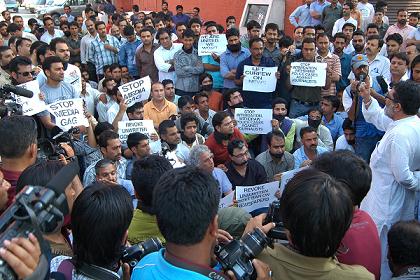
Curbs continue on Kashmir media; is it martial law in Srinagar?

Media persons stage protest at Press Enclave in Srinagar against Government’s decision to gag media. Habib Naqash/GK

Update 2 on 11 July: As was being feared, the state has begun to crackdown on Facebook users for ‘anti-India activiies’. I can already spot one Facebook account missing. Very soon they will ban eating, drinking, breathing and shitting and offer curfew passes to some for these activities.

Update: Appeals to the Indian government by the Committee to Protect Journalists and IFJ.

In a clear signal that it continues to dictate what we get to know about the ground situation in Kashmir, curbs on the local media in the Valley continue despite government claims that they have been lifted. At the same time, Delhi journalists are able to freely move around and report in Srinagar. This is yet another blatant example of how the Indian state considers Kashmir its private property and the rights of its residents are secondary. As the Delhi media continues to do the bidding of the Home Ministry, the best sources of news on what’s happening on the ground remain Twitter and Facebook. Those updating their profiles and pages with information are doing so with the apprehension of censorship, state reprisal, blocking of these sites and suspension of internet services altogether in Kashmir. Continue reading Curbs continue on Kashmir media; is it martial law in Srinagar?

But what is a flag march?

Protest not allowed, this is Kashmir

So far in 2010, ‘security’ forces have killed 32 innocent Kashmiris, sometimes not even in a protest. Far from investigating these killings and promising justice, India has banned protest in Kashmir, which is what curfew amounts to, and even the media is not allowed to function. Curfew passes have been canceled even for journalists – there were no newspapers this morning. 12 photojournalists have been beaten up. Newspapers have been BANNED!

The Delhi media reports that the army has been brought into Srinagar for an indefinite period, and that the army staged a flag march. However, what is a flag march? It can’t be a security measure to deal with terrorists because there is complete curfew. The army has been asked to strictly impose the curfew. People are dying because they are not allowed to go to hospitals. After killing 32 innocent people what does “maximum crackdown” by 1,700 Indian troops in Srinagar mean? And if not even a bird is allowed on the streets, who or what is the flag march for? Continue reading But what is a flag march?

If you’re still wondering why Kashmir is protesting and demanding azadi…

‘Mother I will make you cry today’

Dr. SYEDA HAMEED has sent us this poem

‘Mother I will make you cry today’

(On June 30th 2010, Asif Rather age nine ran out of his home in Baramulla in Kashmir to look for his older brother. As he left, he told his mother ‘I am going to make you cry today’. Minutes later he fell victim to shooting by the forces. At the time he was 150 meters from his house. – The Indian Express)

He stood at the sunlit door
A nine-year old with tousled hair
Asif Rather, student of class four,
Baramulla, 55 kms from Srinagar

‘Where is Touqeer?’
He sought his older brother.
‘Nowhere! You come back now
Here’s tea and last night’s bread
My baby, let me comb your hair’

Outside, the sounds Allah o Akbar
Chanting at once, one thousand strong Continue reading ‘Mother I will make you cry today’

IPTK Statement on Military Governance in Indian-administered Kashmir

Military Governance in Indian-administered Kashmir

STATEMENT: FOR IMMEDIATE RELEASE
Srinagar, June 29, 2010

INTERNATIONAL PEOPLE’S TRIBUNAL ON HUMAN RIGHTS AND JUSTICE IN INDIAN-ADMINISTERED KASHMIR (IPTK) | www.kashmirprocess.org


The People’s Tribunal feels morally obligated to make this statement today. Sustained alliances between local communities and IPTK have enabled us to bear witness to the escalating conditions induced by militarized governance, and the severity of psychosocial dimensions of oppression in Indian-administered Kashmir. From our work since being instituted in April 2008, from the reports and briefs we have authored, investigations we have undertaken and are in the process of completing, we find it ethically imperative to comment on the direction in which the Governments of India and Jammu and Kashmir, and the Indian Armed Forces, appear to be headed, and the consequences they will likely effect. Continue reading IPTK Statement on Military Governance in Indian-administered Kashmir

Mohamad Junaid: What Does the Chatham House Poll in Kashmir Tell Us?

Guest post by MOHAMAD JUNAID

The Chatham House poll conducted in the autumn of 2009 in Jammu, Ladakh, Kashmir and Azad Kashmir has revealed an interesting pattern of opinions held across these regions on issues ranging from the perception of major problems people face to effective solutions to the Kashmir issue and the best means to achieve them. Robert Bradnock, under whose supervision the poll was conducted, however presented the results somewhat shoddily leading to confusion over the real import of the opinion poll. This confusion has prompted media in India and Pakistan to portray the polls selectively or in a self-serving manner, largely reflecting their nationalist stances on the Kashmir question. The poll, in reality, points to some interesting developments in Kashmir and indicates a way toward an eventual, mutually agreeable solution.

Consistent with every other poll on the issue, Chatham House poll has shown again that an overwhelming number of people (74—95 percent) in Kashmir region demand independence. This figure comes as no surprise because the support for independence for Kashmir over accession to Pakistan has been steadily growing over the last 20 years. This feeling is more concretely reflected in the fact that most Kashmiris (more than 90 percent) support withdrawal of Indian troops from Kashmir, while a similar figure (around 80 percent) want Pakistan to withdraw its troops from Azad Kashmir. Along with demilitarization, there is a clear demand for de-weaponization (more than 80 percent) and an end to militant violence (around 90 percent) in the Kashmir region. The Line of Control in its present form is uniformly rejected in both Kashmir and Azad Kashmir. Continue reading Mohamad Junaid: What Does the Chatham House Poll in Kashmir Tell Us?

‘The Moral Obligation of Indian Civil and Political Society’: Rekha Chowdhary on Fake Encounters in Kashmir

Guest post by REKHA CHOWDHARY

With another incident of fake encounters in Kashmir, it is a moment of introspection for the political and civil society of India. For all those who are proud of Indian democracy, it is a moment to reflect as to how this democracy fares for the people in Kashmir. It is important to note that democracy does not remain limited to the electoral choices and the extent and intensity of competition in the formation of government – it also involves the political and civil rights of people. Even when democracy has been restored in Kashmir in its procedural form and is kicking in the form of intensely competitive politics, its substantive effect is missing. The right to life is the minimum that is provided by any democracy, the range of rights however goes much beyond this and involves the basic civil liberties as well. However, the way the hapless innocent persons were cruelly murdered in Nadihal in north Kashmir and declared as militants – it is the denial of the minimum. It is not only the murder of three people, it is also the murder of Indian democracy! Continue reading ‘The Moral Obligation of Indian Civil and Political Society’: Rekha Chowdhary on Fake Encounters in Kashmir

Holy Cow: Jyoti Rahman on Indophobia in Bangladesh

I am grateful to JYOTI RAHMAN, a Bangladesh-focused blogger, for contributing this guest post

Once upon a time, slaughter of cow was a major political issue in Bengal. There was a clause about it in the Bengal Pact — an agreement which, if implemented, could have avoided partition. And now, six decades after partition, there is a thriving trade in cows from India to Bangladesh. A recent LA Times article reports:

Continue reading Holy Cow: Jyoti Rahman on Indophobia in Bangladesh

‘An acceptance of Israel’s legitimacy does not imply an acceptance of all that it does’: Amitav Ghosh

Given the long discussion on an earlier post on this subject, I think it is important to post here Amitav Ghosh’s long, persuasive response to the campaign that requested him not to accept the Dan David Prize. I’m taking the liberty of copying this response from here.

May 14, 2010

Dear Signatories to the letter of May 7:

I am sorry I have been slow to respond to your letter expressing disappointment in my decision to to accept the Dan David prize. I will attempt to do so now. Continue reading ‘An acceptance of Israel’s legitimacy does not imply an acceptance of all that it does’: Amitav Ghosh

Tactical Retreat?

The Maoist ‘postponement’ of the general strike has drawn diverse reactions. Ruling parties have projected it as a victory of democracy, constitutionalism, and law and a massive defeat for the Maoist ‘politics of blackmail’. Sections of the media and civil society that had urged the Maoists to pull back feel it is a result of popular pressure exerted by the peace rally on Friday morning. And while some Moist leaders and cadre are reported to be confused, demoralized, and angry at the leadership for letting go, others are hopeful that this will pave the way for an agreement on peace and constitution.

The responses are naturally shaped by one’s own location on the political spectrum. But what it ignores is that there is a complex set of factors that led to the Maoist decision. The non-Maoist euphoria also glosses over the fact that the strike was not the problem; it was only a symptom of the problem. And while the strike is off for now, those underlying issues remain unresolved.

The Maoists made four miscalculations. Continue reading Tactical Retreat?