Category Archives: Sex

Godmen and Conmen

Why the Criticism of Religion Should Now Come On The Agenda

The foundation of irreligious criticism is: Man makes religion, religion does not make man.

Religion is, indeed, the self-consciousness and self-esteem of man who has either not yet won through to himself, or has already lost himself again. But, man is no abstract being squatting outside the world. Man is the world of man – state, society. This state and this society produce religion, which is an inverted consciousness of the world, because they are an inverted world. Religion is the general theory of this world, its encyclopaedic compendium, its logic in popular form, its spiritual point d’honneur, its enthusiasm, its moral sanction, its solemn complement, and its universal basis of consolation and justification. It is the fantastic realization of the human essence since the human essence has not acquired any true reality. The struggle against religion is, therefore, indirectly the struggle against that world whose spiritual aroma is religion.

– Karl Marx, Introduction to A Contribution to the Critique of Hegel’s Philosophy ofRight

I.

Sheltering fugitives from the law, laundering money, ‘arranging’ for government contracts, solving your financial woes or even bumbing off a pesky blackmailer – tasks which are normally associated with D company or their local level clones are today not their sole preserve. Spiritual gurus of the day who are a dime a dozen in this country have emerged as powerful challengers to their monopoly. And not only the newly emergent Sadhus, who are recent entrants in the sprawling spiritual bazaar, but even the old ones also seem deeply emersed in this morass of crime and corruption.

One can easily notice that hardly had the discussion around Icchadhari baba alias Shivmurat Dwivedi, who ran a prostitution racket which spanned many states, with his clientele reaching powerful bureaucrats and politicians, has died down, a sting operation by a leading channel has brought forth the different skills developed by the leading lights of this profession.
Continue reading Godmen and Conmen

An Open Letter to the Democratic and Progressive Groups and Individuals in Aligarh Muslim University and Other Universities in India to Demand Justice for Dr.Siras

To sign this statement, click here

The unforeseen death of Dr Srinivas Ramachandra Siras (Reader and Chair of Modern Indian Languages at Aligarh Muslim University) and the circumstances surrounding it have thrown us into a web of shock, despair and great concern. As an academic community, there are a number of questions that we need to ask and address.

The role of the Aligarh Muslim University authorities in this incident has been nothing short of condemnable. The invasion of Dr Siras’ privacy, the subsequent authoritarian impulse to suspend him and the complete lack of sensitivity by the administration has been outrageous. It has created anxiety about our vulnerability to the exercise of arbitrary powers. The use of such surveillance is not simply a threat to our freedom to make life choices (and sexual choices); it also leads to “self-discipline” due to fear of transgressing majoritarian norms. Continue reading An Open Letter to the Democratic and Progressive Groups and Individuals in Aligarh Muslim University and Other Universities in India to Demand Justice for Dr.Siras

While we thank A.P.Shah, some reflections

The text below was written as an email on many LGBT lists in India. Followed by the text of the email are a few after thoughts on the email itself and the reaction to it.

Dear all,
It’s been interesting to watch all the reactions to A.P.Shah’s unfair retirement. This has been from various quarters including the LGBT community.
One must admit, among all the communities whose lives his judgments have attempted to change, we have been rather vocal in thanking him profusely. This is a good trend to set in general as sometimes I feel others working on various issues whose work has been vindicated rather literally by him have not taken the time out to do an analysis and express their gratitude towards the existence of a judge like him, in the otherwise difficult judiciary in this country. This might make a difference to him. He is hurt by the judiciary which he dedicated his life to which has now slighted him through opaque, undemocratic processes, thus going against all that he stands for and what the judiciary claims to stand for. So am glad we are doing this! Continue reading While we thank A.P.Shah, some reflections

Inaugurated: The Malabar Moral Police!

The dastardly attack on the eminent writer Paul Zachariah by the DYFI in the CPM fortress of Payyanur in north Kerala on 10 January has been roundly condemned across the political spectrum in Kerala. Zacharia was heckled and abused at a literary seminar organized by a publisher for  criticizing the moral policing  practiced by the official left in Kerala. He condemned the recent DYFI-PDP joint ‘moral action’ against the Congress leader Rajmohan Unnithan and a Sewa Dal leader which, according to the the DYFI leadership, were ‘provocative’. Zacharia was accosted by a gang of men when he was about to leave Payyanur and openly threatened. He was told that such talk was not permitted in the left bastion of Payyanur; when the threat did not produce the desired reaction, they resorted to physical intimidation, and relented only after the intervention of the organizers who are CPM sympathizers, and other writers present there. The day after, prominent leaders in the CPM, including the Chief Minister and the Minister for Education, condemned the action. Continue reading Inaugurated: The Malabar Moral Police!

Notes on Comfort: Akhil Katyal

This is a Guest Post by AKHIL KATYAL

To make our point let us begin with a story of a salon. It might have all the necessary noise of being new and first-of-its-kind but finally it is quite an unremarkable story. Of ‘NYC’ in Hauz Khas market in Delhi. It sells itself as India’s first LGBT salon. Its owner S. Mehta recently filled up all possible online LGBT forums with its ads, mass mailed on to Delhi list serves and dropped tiny text-ads into unwitting facebook groups, robustly selling it as the latest asset of Delhi’s LGBT community. I am not quite interested in how an otherwise 7 month old – some say not-doing-too-great – business venture is viably repackaged as a LGBT paradise in the wake of the Delhi high court judgment. After all, post the repeal of Sec. 377 in July we are only to expect more of this happening around us, more spectacles of the pink rupee. Nor am I presently interested in how a reigning sense of an LGBT community is proffered by such spectacular announcements of things shared – be it historic events or commercial joints, shared among few or many – but instead, I am interested in the all too common rhetoric that this salon uses in its publicity. A rhetoric that is becoming so widespread as to become almost commonsensical and this is the rhetoric of comfort.
Continue reading Notes on Comfort: Akhil Katyal

Tatte Girao, Hijra Hattao: Satya Rai Nagpaul

This guest post was sent to us by  SATYA RAI NAGPAUL, Transman, Cinematographer, Founder Member: SAMPOORNA: A Network for Asian & Diasporic Asian Trans Persons.

‘Tatte Girao, Hijra Hattao’ was written in response to Farrukh Dhondy’s article ‘The male eunuch & other chromosomes’ in The Asian Age newspaper, August 29th, 2009.  The Asian Age did not publish Satya’s response, and so it has been circulating on relevant e-lists for a while.


Caster Semenya’s record breaking run in the Berlin World Athletic Games this August, not only raised doubts in the organisers about her ‘real sex”, but back home, has precipitated our very own Mr Farrukh Dhondy’s jounalistic activism to save our boys from falling into any possible sexual/gender ambiguity.
His prescription: Get ‘the apparatus’ and you shall be a ‘man’!

If the medical and legal communities were not enough, we have now to fight our so called “progressive” journalists who write columns about ‘so called eunuchs’, who their medical friends tell them ‘were not eunuchs at all’.

The transphobia, gender essentialism and high moral ground in Mr Dhondy’s article couldn’t have been more naked. What appears throughout the article as his well meaning and sympathetic concern, finally reveals its true face in that last draconian sentence: ‘Make hijras history’. How could the corporeal realities of the hijra be so lost on a journalist [and one who is himself a minority, being a parsi, as stated in his article] that he can wish for the wiping out of an entire way of life? Instead of espousing their human rights, he wishes them not to exist at all?!

Mr Dhondy’s statement that all hijras suffer from Cryptorchidism, and that it is a simple medical procedure that will make men out of them, not only reveals his journalistic smugness but also that he has been completely absent from all discourses on sex/gender emerging ever since the years of the second world war. The binary conceptualisation of sex/gender is long dead in cutting edge academia and even the medical sciences have begun to open out their sex/gender categories to the new conceptualisations.
Continue reading Tatte Girao, Hijra Hattao: Satya Rai Nagpaul

Interview with Ins Kromminga, German intersex activist and artist

Below are excerpts from an interview I did with a fascinating artists and activist who initiated a process in me, simple and obvious, and yet complicated and hardly ever embarked upon- vis-a-vis the politics of gender and sexuality. Ins has challenged the routine of the politics we engage in and the world view we sometimes unintentionally take for granted and thus make static, Hoping for an engaging discussion on the issues Ins lays out below.

Also, something to think about: how we write articles in popular media about difficult, unspoken of issues to just put them out there. To bring about some visibility but at the cost of some of the complexity? Sometimes visibility even at the cost of compromise on our politics of how we speak of pain and pleasure in all our lives and in the context of the frameworks of oppression? I see myself having done this below in my fleeting account of Ins’s life and work. How then do we engage with the mainstream media and find the language to articulate complexities approachably and regularly? It’s the eternal question but lets ask it again because, as we all know, we have to. :) Continue reading Interview with Ins Kromminga, German intersex activist and artist

Anand Jon wants to be tried in India – I would too, if I were him

Fashion designer Anand Jon has been sentenced by a Los Angeles court to 59 years in prison for violent sexual assault on seven young women, some of them under-age. His defence tried to move for a mistrial on the grounds that one of the jurors had contacted Jon’s sister during the trial, but a new trial was not granted by the judge. The concerned juror delivered a “guilty” verdict along with the other 11 jurors in the case.

A month ago, his sister Sanjana had pleaded with the Indian government to extradite him as he would not get a fair trial in the US, being Indian. She claimed then, and did so again after the verdict on September 1, that Jon is a victim of racist discrimination.

Would Anand Jon have been acquitted of such charges in an Indian court? Almost certainly, yes. In a justice system in which alleged rapists are routinely acquitted for “lack of evidence” and proven rapists given a reduced sentence because of their youth and the promising life ahead of them, Sanjana is right to insist that he be tried in an Indian court. In an Indian court, the testimony of women who had willingly gone to his home on the promise of jobs in the fashion business, and then claimed they were raped, would be dismissed out of hand. Especially if the women are white. Gratuitous references to “western women” and their supposed attitudes to sex, pepper judgements and statements by officials on rape in India.

Continue reading Anand Jon wants to be tried in India – I would too, if I were him

‘It will lead to the commodification of homosexuals’

(I had conducted this interview while working on a story on the Delhi High Court judgement on the 377 case. While that story didn’t materialise, I thought I should post this interview now.)

PURUSHOTHAMAN MULLOLI is general secretary of the Joint Action Council, Kannur-India (JACKINDIA) which intervened in the Section 377 case in the Delhi High Court. In an interview he explains his opposition to the case.

What is JACKINDIA? Continue reading ‘It will lead to the commodification of homosexuals’

Rakhi Sawant Ka Swayamvar!

“Yeah yeah, take a good show and spoil it by theorizing” said my labour lawyer/bollywood-gossip-junkie flat mate. All I said was that I thought Rakhi Sawant Ka Swayamvar was an “Interesting phenomenon that comments on the articulations of the notion of marriage within the context of fixed notions of culture among upper middle class north Indian families and within that the tropes of gender, normativity and melodrama! And so I should write about it on Kafila”.

Her comment wasn’t entirely unjustified.

The way in which one watches these shows in itself raises a range of questions. The show has taken over my life as of now. The final decision of who she will marry will be made soon and the restlessness and anxiety about it is immense and requires effort to contain. Continue reading Rakhi Sawant Ka Swayamvar!

Teachers and Academics Against 377

University teachers, researchers and academics from all over India issued a strong statement in support of the recent Delhi High Court judgement decriminalizing consensual sex among adults and challenged the legitimacy of “religious leaders” to speak for the whole of society.

180 signatories from institutions and universities in Allahabad, Calicut, Peechi, Punalur, Thiruvananthapuram, Kottayam, Sonipat, Goa, Jammu, Nanded, Mumbai, Pune, Pondicherry, Kolkata, Ahmedabad, Baroda, Chennai, Chandigarh, Delhi, Bangalore, Hyderabad, Guwahati and Shillong endorsed a statement that said:

Continue reading Teachers and Academics Against 377

धारा 377, यौनिकता और नेहरू – संतानोत्पत्ति से परे

[अगर आप मोज़िल्ला फायरफ़ॉक्स के ज़रिए नेट देखते हैं तो पढ़ते वक़्‍त फ़ॉंट बढ़ाने के लिए Ctrl + का इस्‍तेमाल करें]

धारा 377 अब स्वेच्छा से यौन संबंध बनाने वाले समलैंगिकों पर लागू नहीं होगी. दिल्ली उच्च न्यायालय के इस निर्णय ने भारतीय समाज की नैतिकता की परिभाषाओं की चूल हिला दी है. फैसला आने के बाद हिन्दू , मुस्लिम और अन्य धार्मिक समूहों के कई नेताओं ने इसे खतरनाक बताया है और इसके खिलाफ उच्चतम न्यायालय तक जाने की धमकी दी है. कुछ तो जा भी चुके हैं। सरकार को भी कहा जा रहा है कि वह इस फैसले को चुनौती दे. अब तक के सरकार के रुख से ऐसा कुछ नहीं लग रहा कि वह इस दबाव के आगे झुकेगी.

फैसला ऐतिहासिक है. इसका सबसे महत्वपूर्ण पहलू यह है कि यह एक विशेष संविधान को स्वीकार करके अपने-आपको एक राष्ट्र-राज्य के रूप में गठित करने वाले जन-समुदाय के रहने-सहने और जीने के तौर-तरीकों को निर्णायक रूप से उसके पहले के सामाजिक आचार-व्यवहार से अलगाता है. यह आकस्मिक नहीं है कि न्यायाधीश ने अपने फैसले के लिए जिन राष्ट्रीय नेताओं के दृष्टिकोण को आधार बनाया , वे हैं जवाहरलाल नेहरू और भीमराव  अम्बेडकर.  नेहरू औपनिवेशिक शासन से मुक्ति के बाद एक नए भारत के लिए आवश्यक  नैतिक और सांस्कृतिक बुनियादी तर्क खोजने की कोशिश कर रहे थे. इस खोज में सब कुछ साफ–साफ दिखाई दे रहा हो, ऐसा नहीं था और हर चीज़ को वे सटीक रूप से व्याख्यायित कर पा रहे हैं, ऐसा उनका दावा भी नहीं था. नेहरू के जिस वक्तव्य को फैसले में उद्धृत किया गया है, उसमें  भी शब्दों की   जादुई ताकत के  उल्लेख करने के साथ यह भी कहा गया है कि वे पूरी तरह से एक नए समाज की सारी आकांक्षाओं को व्यक्त कर पाने में समर्थ नहीं. वे निश्चितता से भिन्न विचार और मूल्यों के एक आभासी लोक की कल्पना करते हैं. राजनेता का विशेष गुण माना जाता है, फैसलाकुन व्यवहार. नेहरू, इसके बावजूद कि एक तानाशाह बन जाने के लिए उनके पास सारी स्थितियां थीं , हमेशा इससे बचते रहे कि चीज़ों को साफ-साफ और  अलग-अलग खाचों में डाल दिया जाए.
Continue reading धारा 377, यौनिकता और नेहरू – संतानोत्पत्ति से परे

Right Hand, Wrong Hand

I have two daughters, born 1984 and 1988. As they grew up we noticed that both of them were ambidextrous but gradually the 84 born started favouring her right hand over the left but the 88 born did the exact reverse. She began to rely more and more on her left hand to do things like eating, opening doors, picking up things, writing etc,things that “normal” people including my elder daughter do with their right hand.

A couple of interfering neighbours tried telling us to ‘teach’ our daughter to do things properly and not to eat or touch ‘saraswati’ with her dirty hand. Luckily we told these busy bodies to mind their own business and let her be. Continue reading Right Hand, Wrong Hand

Why I Feel For B.P. Singhal

In the aftermath of the Delhi High Court judgement reading down Section 377, the initial euphoria and celebration is now being increasingly met with an equally strong backlash. Some of this has of course come from the religious right of all denominations (Hindu,Muslim, Sikh, Isayi Apas mein sab bhai bhai), the army, politicians, conservative commentators in the press. Underlying much of the oppositions seems to be a sense that somehow the decriminalization of homosexuality is going to turn everyone gay, a sentiment that sounds bizarre to us.

But now that I have been thinking about this I think I am beginning to understand the fear that is articulated in this “homosexuality-as-contagious-virus” position. Because in one sense they are right. In his post Lawrence speaks of the radical politics of impossibility – the change in the law suddenly makes possible a new set of imaginary possibilities that we could not dream of hitherto. And so BP Singhal and Dominic Emmanuel and everyone else who is saying that the presence of the law performs a stellar function against the rise of a virtual army of gay people and must remain on the books, even if, and indeed especially because, it is never used against actual real gay people, have a point. Continue reading Why I Feel For B.P. Singhal

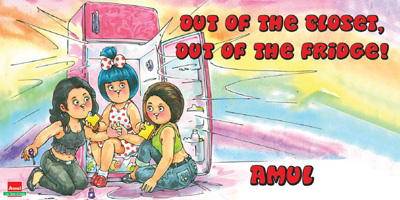
The Amul girl comes out of the closet

Via amul.com
Via amul.com

BP Singhal: “I don’t have any problem with homosexuals. Do you?”

Photo credit: Salman Usmani

Bharatendu Prakash Singhal, 78, is a Hindutva ideologue, a retired IPS officer and a former BJP Rajya Sabha MP. On a Sunday afternoon I visited him to discuss his opposition to the decriminalization of gay sex by the Delhi High Court. He is preparing to appeal against it in the Supreme Court. Singhal explained that he wasn’t opposed to private consensual sex between same-sex adults, he didn’t want such adults prosecuted or persecuted, but he merely wanted the law to remain on paper as a deterrent. This is the transcript of a recorded interview; a much shorter, edited version has appeared in Open. Continue reading BP Singhal: “I don’t have any problem with homosexuals. Do you?”

Is the Naz Foundation decision the Roe v. Wade of India?

There are surprisingly few constitutional cases in India which have had the same symbolic power that cases like Roe v. Wade (affirming the right of abortion) or Brown v. Board of Education (dissolving racial segregation in schools) have had in the political history of the United States.  For sure, there are a  number of important constitutional cases which have contributed significantly to the democratic history of India. Kesavananda Bharati’s espousal of the basic structure doctrine, Maneka Gandhi’s introduction of due process in Art.21, but these cases  seem to have an appeal largely within the legal fraternity. They are also cases where the relief sought by the petitioners have had little to do with the final outcome of the case, and it is highly doubtful whether his Holiness Kesavananda Bharati had any investment in the long term impact of the basic structure doctrine (not to mention that Kesavananda Bharati just doesn’t roll of the tongue as easily- in terms of recall value).  Is it possible then that Naz Foundation v. Government of Delhi is the first equivalent of a case whose name conjures up the history of particular struggle, celebrates the victory of a particular moment and inaugurates new hopes for the future.

Continue reading Is the Naz Foundation decision the Roe v. Wade of India?

Why the Delhi High Court judgement on IPC 377 does extend to the rest of India

While expanding the territorial jurisdiction of high courts in such cases, the SC took cognizance of the principle contained in Article 226(2), which empowers a high court to issue directions to entities located outside its territory. [Manoj Mitta]

The Day After the Judgement

So now that we have one group of criminals less to deal with, I have a proposal: Criminalize English TV news channels.

'Debate,' the Times Now way
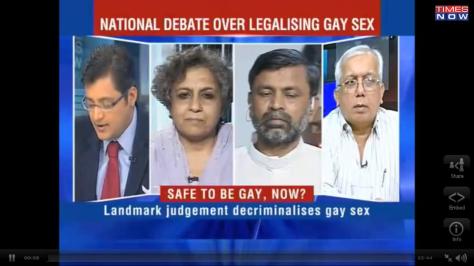
‘Debate,’ the Times Now way

Watching Times Now yesterday after the Delhi High Court ruling on Section 377, I was overcome by a growing sense of bewilderment. I could hear Dominic Emmanuel (Director of the Delhi Archdiocese of the Roman Catholic Church) and Kamal Farooqui (Chairman of the Delhi Minorities Commission), saying quite cearly and more than once, to my surprise, that they welcome the decriminalization of homosexuality, that homosexuals should not be treated as if they were criminals. Okay, correct that – I could barely hear these statements over the insistent, aggressive and disruptive interruptions  of the anchor Arnab Goswami, who had obviously pre-set this “discussion” rigidly as a face-off between Reactionary Clerics/Minorities and Gay Rights Activists, while he himself was super hero, Anchorman. So each time they said “we welcome” etc.,  Anchorman would swoop in, bellowing, “So are you saying that they dont have rights, Sir, are you saying they should not have rights. Over to Anjali Gopalan (Naz) – Anjali, they say homosexuals should not have rights, what do you say?”

Continue reading The Day After the Judgement

“The Magic of the Human Spirit and of a Nation’s Passion”: Three Queers for the Delhi High Court!

So – here we are folks, in a historic judgement this morning, Delhi High Court has read down Section 377 of the Indian Penal Code to exclude consensual sex among adults. Congratulations to the group of tireless activists who have helped to bring this about, and congratulations to all of us who count ourselves as part of the queer community. Continue reading “The Magic of the Human Spirit and of a Nation’s Passion”: Three Queers for the Delhi High Court!

“Two friends who have but one life”: Hope from the 19th century

I came across this delightful piece of information in the historian K P Padmanabha Menon’s History of Kerala (vol.3, AES reprint,2001, pp.498-500) which was written in the early 20th century. He quotes from “a paper published in the Madras Review (vol.2, p.250)”; we do not know which year this was published, but there is good reason to think that it was in the early 20th century. The paper is about a truly exciting institution – ‘marriage’ which produced not a heterosexual conjugal couple, but a same-sex  (male) couple bound by ‘friendship’! Continue reading “Two friends who have but one life”: Hope from the 19th century