
I came across this delightful piece of information in the historian K P Padmanabha Menon’s History of Kerala (vol.3, AES reprint,2001, pp.498-500) which was written in the early 20th century. He quotes from “a paper published in the Madras Review (vol.2, p.250)”; we do not know which year this was published, but there is good reason to think that it was in the early 20th century. The paper is about a truly exciting institution – ‘marriage’ which produced not a heterosexual conjugal couple, but a same-sex (male) couple bound by ‘friendship’! Continue reading “Two friends who have but one life”: Hope from the 19th century
Category Archives: Sex
On the Eve of Pride. Are We Going the Right Way: Akhil Katyal
This is a guest post by AKHIL KATYAL
Topicality is a homage one pays to the short-term memory that the new media both triggers and complains against in its customers. In the long-term of course, where trend is all important, the topical is only a category of the banal. But it is under the shelter of such a necessary topicality – the topical is always necessary – that I hope to sneak in a scandal.
Everyone is talking about the queer pride marches that are going to happen in four cities in India at the end of this month. Most liberal reportage is obviously supportive, if not triumphant. For these cities themselves, it is seen as a step into a liberal urban culture which tolerates, even enjoys difference. All the talk about the ‘gay community’ or ‘lgbt community’ that the Indian media – and the activists – have been dabbling in for at least a decade now, seems to be reaching its logical climax: the community is expressing itself. Every city seems to have its own pet lgbt community or at least aspires to.
Continue reading On the Eve of Pride. Are We Going the Right Way: Akhil Katyal
Afghan Women Protest New Law on Home Life
About 300 Afghan women, facing an angry throng three times that number, walked the streets of Kabul on Wednesday to demand that Parliament repeal a new law that introduces a range of Taliban-like restrictions on women, and permits, among other things, marital rape.
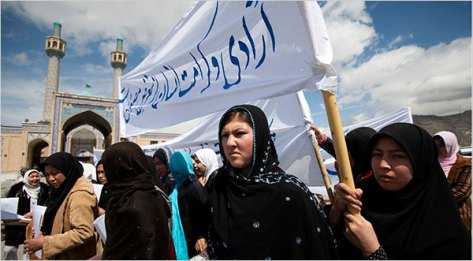
‘The young women stepped off the bus and moved toward the protest march just beginning on the other side of the street when they were spotted by a mob of men.’
‘”Get out of here, you whores!” the men shouted. “Get out!”….It was an extraordinary scene. Women are mostly illiterate in this impoverished country, and they do not, generally speaking, enjoy anything near the freedom accorded to men. But there they were, most of them young, many in jeans, defying a threatening crowd and calling out slogans heavy with meaning.’ Read the full story by Dexter Filkins here.
[Courtesy: SACW]
Dignifying Jade Goody, or, What Jade Goody actually connotes: D. Parthasarthy
guest post by D. PARTHASARTHY
When newspaper columnists become self-righteous, it is usually because they see a good way of capturing reader interest by moralizing about an issue. After all, tabloids around the world regularly make fortunes by generating a false sense of moral outrage and indignation through stories of the indiscretions and ineptitudes, sufferings and misfortunes of celebrities and of not so famous people. It is a sign of irony as well as an indication of the way in which neo-liberal capitalist media works, that the consequences of alienation engendered by an individualist ideology is fodder for sensationalist reporting, but also a tool for mobilizing collective conscience against alienated individuals, and for preventing communities from understanding the real reasons for alienation.
Continue reading Dignifying Jade Goody, or, What Jade Goody actually connotes: D. Parthasarthy
Apocalyse Now: A Swamp Rises to Swallow the Rock of the Faith
From the outside it is hard to tell. The glory of Kerala’s mighty Catholic Church, it appears, has weathered many a tsunami. The communists tried in 1958; they tried in 2006-07 too. Each time, the Church brushed off the challenge, transmogrifying itself, almost miraculously, into a murderous majoritarian tsunami in defense of theism that swept away the Unbelievers into the depths of hell. Again, the Church proved that the malicious schemes of Syrian Christian dissenters, puny individuals, Education Ministers in communist-led ministries — Joseph Mundassery then, M.A.Baby now — shall be foiled by the hand of God. Thus in 2006-07 too, the power of Faith burgeoned, once again, into a tremendous cyclone which swept the Unbelievers’ dastardly designs off the face of our Fair and Promised Land, Kerala. Continue reading Apocalyse Now: A Swamp Rises to Swallow the Rock of the Faith
Caste/gender in a poem by Varavara Rao
I’m posting below a poem by Varavara Rao and a response to it by Rochelle Pinto. Comments and debate welcome, but trolls will strictly not be allowed regardless of caste and gender! Comments are regulated here by a disclaimer to maintain sanity. Not repeating your position ad nauseum helps, unless you desperately want to have the last word.
Merit
by VARAVARA RAO
Lucky
You are born rich
To say in your language
“Born with silver spoon in the mouth”
Your agitation sounds creative
Our agony looks violent
Continue reading Caste/gender in a poem by Varavara Rao
A Hundred Years to Valentine’s Day
The Manglore-style of violence against women is clearly not the style of the politically powerful guardians of sexual morality in Kerala. But maybe the style is more or less redundant over here: there are very few pub-going local (or local-looking) women over here. How convenient for us women of Kerala that we Malayalees live in social arrangements that insist on sexual segregation in public spaces and institutions.
This is of course related to the particular history of gender and spatiality that unfolded between the mid-19th and 20th centuries in Kerala.Spatial categories have always underwritten caste and gender exclusion in Malayalee society. Take for instance, the derogatory term chanthapennungal (‘market women’) that refers to women who get their way through loud and vociferous argument – who work for their livelihood in market-space and reject feminine modesty. The chanthapennu is the very antithesis of taravattil pirannaval (‘she who was born in an aristocratic homestead’). Thus the woman whose daily life and labours involves traversing spaces outside the domestic and the familial is forever poised at the brink — she is who may, at any instant, collapse into being chantappennu.In traditional Malayalee society, family spaces were named by caste and constructed through caste practices and gender norms. For instance, the Brahmin home was referred to as Illam or Mana; the Nair homestead as Taravadu or Idam.In other words, a generalized notion of domestic space housing the family was absent. Indeed, the observance of spatial regulations was often taken to be crucial in shaping feminine moral qualities found characteristic of the aristocracy — and hardly vice-versa.
Pink Panties – With Love to Muthalik
Today is Valentine’s day and it is only befitting of the changing times that the Ram Sene chief Pramod Muthalik and his cohorts should receive huge consignments of pink chaddies. Responding to the call of the ‘Consortium of Pub-Going, Loose and Forward Women’, pink chaddies, we are told, “kept pouring into the Sene office all through the day. The parcels came mainly from Punjab, Rajasthan, Mumbai, Bangalore and Kerala”, according to reports.

Many of us who wanted to be part of the open and vigorous demonstration of love but couldn’t, would like to send many more panties to the members of this monkey gang (Ram’s sena was after all, Hanuman’s!). And wherever we are, we will drink in pubs and make merry. Muthalik, you will always remain in the hearts and minds of all the ahle-junoon-i-ishq. Har ghoont sharaab ke saath tujhe yaad karenge…Aakhir kaun hai is duniya mein tere siva, jise jalaane ke liye ek bosa-e-gul, ek chaddi ya ek ghoont sharaab bas kaafi hai? Hamaare halaq se utri har ghoont teri chita ki aag hogi goya…
Will we overcome? Pramada Menon
This is a guest post by PRAMADA MENON
Sundays are days for doing nothing much. Often I sit in front of the television and surf and watch many, many movies until all the story lines start merging into one. It’s fun because it does not require you to think. If one switches on a news channel, the chances are that you will start to splutter like mustard seeds in oil, since there is so much to splutter about – Nirmala Venkatesh, a member of the central government’s National Commission for Women, was put in charge of a three-member panel to investigate the attack on the women at a pub in Mangalore at 4pm in the evening. The way she sees it, Venkatesh is supposed to have said, women have the right to enjoy themselves but should also recognize societal limits. As part of her inquiry, she said, she plans to meet with the attackers, the bar owner and the families of the young women to see whether their parents
allowed them to go out to pubs every night at midnight. “My personal advice: Women should be very careful,” she said. “I can’t just roam after midnight.”
On moral policing
Some people are trying to organise creative protests against moral policing on Valentine’s Day. You may want to join them. Continue reading On moral policing
Yeh To Bada Toing Hai!
It seems the I & B ministry doesn’t like chocolate. Specifically it doesn’t like women nibbling the posterior of a chocolate covered man. The new ‘Dark Temptations’ Axe deodorant ad has been recently banned by the ministry for being indecent, vulgar and suggestive and thus violating Rule 7 (8) of the Advertising Code prescribed under the Cable Television Act, which says, ” Indecent, vulgar, suggestive, repulsive or offensive themes or treatment shall be avoided in all advertisements.”
Personally I can take chocolate or leave it….
“Indecent”, “vulgar”, “repulsive” and “offensive” I understand as ideas, at least notionally. It’s the “suggestive” I don’t get.
When you’re OUT, you’re IN
Since Gay is in, currently, for the Indian media, Sonali Gulati, film-maker, out lesbian and gay rights activist, knows what it is to be hotly pursued for sound-bites. She has posted on youtube a recorded conversation with a reporter from IBN 7 pressing her for her take on a “lesbian” issue. Her quiet , insistent questioning reduces him to confused gibberish, but more importantly, makes the point that “lesbians” are no more and no less newsworthy than straight people – At one point she asks him, “Agar yeh ek heterosexual couple ke saath ho jaata, tab aap kis se comment lete?”
(If this had happened with a heterosexual couple, then to whom would you have gone for comments?)
Meaning of course, that any and every heterosexual would not be considered “expert” enough to comment on any and every heterosexual issue. The bemused reporter starts all over again with his insane drivel – he simply does not get it. Can she really be giving up an opportunity to appear on television? Naaah.
But go on – listen to Sonali.
Moral police in OUR autos!
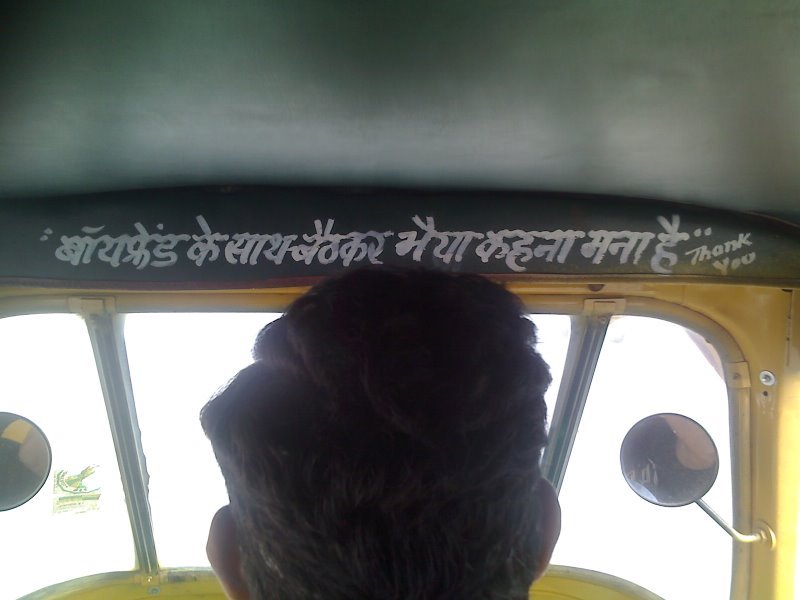
“It is forbidden to sit with your boyfriend and claim he is your brother”
My sister sent me this one…
Judging Women
The honourable judges of the honourable judiciary are on an honourable roll…
Anuradha Roy of Permanent Black sent out the following:
On the 9th of February 2008, remarks by two eminent judiciary members the Chief Justice of Karnataka, Cyriac Joseph and State Human Rights Commission Chairperson Justice S.R.Nayak, stating that immodest dressing was the cause of increasing crimes against women were reported in the press.
The Hon’ble Chief Justice further elaborated his statement by mentioning that “Nowadays, women wear such kind of dresses even in temples and churches that when we go to places of worship, instead of meditating on God, we end up meditating on the person before us” and that the “provocative dresses that women wear in buses” put the “men travelling in the buses” in awkward situations and hence “women must dress modestly.”
The Chairperson, State Human Rights Commission, speaking on ‘Human Rights and the Lawyers Role’, gave his opinion on the Mumbai New Year molestation issue, when two women had their dresses torn off by a mob
of men outside a nightclub: “Yes, men are bad… But who asked them (the women) to venture out in the night…Women should not have gone out in the night and when they do, there is no point in complaining that men touched them and hit them. Youth are destroying our culture for momentary satisfaction.”
Anuradha sent this out without comments. I understand her mood. I’m done too. No witty commentary, no smart asides. I’m just plain exhausted.
Charu Gupta on Om Shanti Om and Saawariya
Like many other lovers of Bollywood cinema, I too was caught up since October this year in the countdown to the battle of all battles, with the release of Om Shanti Om (OSO) and Saawariya on 9 November 2007. Reams have been written, debated and analysed on the two films in newspapers, television networks, and everyday discussions. They have been depicted as films catering to very different sensibilities, and representing vastly diverse forms. The verdict seems to have declared both as average films, though OSO seems to be faring better than Saawariya at the box office. I enjoyed the first half of OSO particularly and thought Saawariya as a film with great form, but not much content.
However, as a fan of Bollywood popular cinema, what struck me most was one striking similarity between the two films. I thought both the films offered great visual pleasure and feast for the female spectators, where the spectacular and stylish nude male bodies and images of both Ranbir Raj Kapoor and Shahrukh Khan, though very different from each other, were the prime objects of desire and erotic spectacle. Both OSO and Saawariya have urban heroes, whose bodies are produced and carved, rooted in providing a voyeuristic visual treat especially to most straight women and gay men. The identity of both the heroes in these films in centrally tied to the consumption of their nude bodies by the viewer. The films in some senses signify the coming of age of a new genre of Bollywood cinema, where it is not so much the female body but the male body which circulates and is on display, offering a sexualised imaginative anatomy. They also signify that the language of discourse of Hindi films has undergone a dramatic post modernist change in its conception of desire, where most of it is conducted not through the soul but through the body. There is no central heart, but a decentring of emotions at play here. In the recent past too, nude male bodies of Hrithik Roshan and Salman Khan have been offered to the viewer. It perhaps is also a reflection of the fact that more and more women are crowding the cinema halls and form at times the major chunk of spectatorship, and they are a vital part of the cinematic experience.
Another Supreme Court
Even as our own dearly beloved Supreme Court repeatedly shows contempt of the people by handing over tribal lands to corporations and urban spaces to mall developers, the judges across the border seem to be on a radically different track. As is well known by now, the initial dismissal of Chief Justice Iftikhar Choudhary by General Musharraf – an action that launched a million mutinies – was at least partly to punish him for his order preventing the sale of Pakistan Steel Mills to a private group.
As the democratic upsurge in Pakistan carries on unabated, here is a lesser known story, sent to me about a month ago by Nighat Said Khan (better known as Bunny) Women’s Action Forum activist. It is an eye-witness account of the hearing in June 2007, in the Supreme Court of Pakistan, on the appeal by the ‘she-couple’, as a story in Dawn dubbed them, seeking dismissal of a High Court decision sentencing them to three years’ imprisonment for perjury. Not only is the order by the Supreme Court exemplary for its commitment to individual rights, Bunny’s account highlights the extraordinary sensitivity and awareness shown by both the lawyer representing the couple, Babar Awan, and the judges hearing the case.
If this is Pakistan’s judiciary, no wonder the general is a little lost in his labyrinth…
Over to Nighat Said Khan.
Does the ‘girl-child’ exist?
Does the ‘girl-child’ exist? What is it other than empty officialese, a smoke-screen that obscures, almost erases, little girls and the dismal little lives most of them lead? The ‘skewed sex-ratio’ has become a fetishized object for policymakers and governments in India, and improving those numbers a goal in itself. In the pursuit of good-looking sex-ratios, the minister for women and child development has come up with one alarming scheme after the other.
Earlier this year, Renuka Chowdhury announced a government scheme to open centres where people can abandon unwanted daughters rather than aborting them. Can you imagine the girl-children growing up in these doomed institutions? What fates can they expect, unwanted by their parents and kept on by the State only to boost sex-ratios? Chowdhury said at the time that the government was treating the drop in sex-ratio as an issue of national emergency. She also said that through this scheme, the government would “at least ensure that the gene pool is maintained”! In effect, these institutions would be collections of little girls unwanted by all but the census-takers, dropping by periodically to correct the skewed sex-ratio with a quick look at the office records.
Queer Images
Sunil Gupta is a renowned photographer whose work over the last three decades has spanned images of the body, migration, exile, HIV and sexuality. He also has a lot to say about the need for an art history centred on sexuality. See his work on www.sunilgupta.net. Also, see his jointly curated exhibit, autoportraits, as part of The Nigah QueerFest ’07. Details at www.thequeerfest.com.
Sunil’s work will come out in a book by Yoda Press in 2008. I had a chance to speak to Sunil recently for an interview that was published in Time Out Delhi. Excerpts:
G: Today, Sunil, you are known as a photographer who has a significant body of work on sexuality, and especially on gay and lesbian lives. How did sexuality first enter your work?
S: I moved to Canada from Delhi when I was 15. I arrived in September, 1969, literally a month after the Stonewall uprising in New York, so you could feel the effects of gay liberation everywhere. I went to a very liberal junior college. Everyone came out then. So being gay was very cool, unlike being Indian which was not cool at all. There were no Indians around me at the time. I started shooting gay news items for a fledgling campus newsletter. Those were my first photographs on sexuality. We were trying to find positive images in those early days. It was about taking happy picture of people happily being gay to counter all the negative imagery around us. Continue reading Queer Images
A Modest Proposal to End All Controversies on Freedom of Expression in India
(apologies for cross posting on Commons Law and Reader List)
As we know well by now from the freedom loving sentiments (that are expressed loudly and frequently) by all sections of the guardians of social order in India, (that is Bharat, that is Hindustan), the real reason why certain insignificant documentary independent and student films, contemporary art exhibitions in university campuses and performances are banned, and their heinous perpetrators arrested has to do with the general populations right to sleep undisturbed each night and not to see anything other than cricket matches, news about cricket matches, election analyses, kaun banega crorepati, Abhishek Bacchan’s wedding, and yoga on TV.
Why should anyone in their right mind want to see, read, listen to or even think about anything else?
Consider the folly that some students in Kottayam have recently contemplated, making a film on of all things ‘Homosexuality’ .
Both of these moves have been met with swift and timely responses. The offending students in Kerala have been expelled by the Christian educational institutition where they were enrolled, and the offending art student in Vadodara, one Chandramohanm has been arrested by the local police at the urging of Hindutva minded citizens.
There are only two things we need to learn from incidents of this nature. The first is as follows –
Actually, all that people need to do is to insist that only the self appointed guardians of public morality (of all stripes and shades) have the right to appear in any broadcast, exhibition, film or other forms of mediated communication. We need every channel to broadcast morally cleansed reality TV all the time. How else will this nation boldly venture where none other has gone before – into that heaven of bliss and freedom known as ennui for the billions.
Continue reading A Modest Proposal to End All Controversies on Freedom of Expression in India
Cows, Women and Hindu Manhood
Life in Modi’s Gujarat
Gujarat is calm. And is on the march. Every village of the state is a Jyotigram. Narmada water is flowing in abundance in the canals quenching the thirst of Gujaratis. “Was not Surat flooded a few months back and did not the people of Gujarat suffer?” I ask my driver. “No, was not Narendrabhai there to take care of everything,” he replies. How can anything go wrong when Narendrabhai is keeping watch!
Narendra Modi, you see, does not have a family and he works round the clock, we are informed. I find Modi smiling down at us benevolently from the digital billboards that dot Ahmedabad. There is no escaping his firm developmental smile. “The man has impressive qualities. Gujarat is bound to forge ahead under this workaholic chief minister. A citizen may have doubts of his secularism, but even his enemies don’t doubt his competence,” writes Gunawant Shah, a popular Gujarati columnist.

