Tag Archives: Aadhar

Beware of Aadhaar – A Warning on India’s Biometric Identity Model: Statement by Organizations and Concerned Individuals
Following is a statement issued on 10 December 2025, by over 50 organizations and 200 plus individuals on the reported adoption of the “Aadhar model” by some other countries.

We, concerned Indian citizens and organisations, are alarmed to note that efforts are being made to promote biometric identity systems similar to Aadhaar in other countries.

Aadhaar is India’s unique identity number, linked with a person’s biometrics (fingerprints, iris and photograph as of now). The number was rolled out with fanfare from 2009 onwards. The use of this number, and of Aadhaar-based biometric authentication (ABBA), was promoted to the hilt by the Indian government in close collaboration with the IT industry. Aadhaar was supposed to be voluntary, but it quickly became clear that living without it would be very difficult for most. Today, it is as good as compulsory. Most social benefits are out of reach without Aadhaar.

Aadhaar was rolled out in an explicitly “evangelistic” mode from day one. In recent years, it has been projected as a grand success by its promoters. Their friends in high places (like Davos, the World Bank, and the B&M Gates Foundation) are on board. There is an attempt, partly successful already, to project Aadhaar as a model and “export” it to other countries. Continue reading Beware of Aadhaar – A Warning on India’s Biometric Identity Model: Statement by Organizations and Concerned Individuals
No your lordship, everybody opposing Aadhar is not following an“NGO line”: Baidik Bhattacharya

Guest post by BAIDIK BHATTACHARYA

We live in strange times. A judge in the country’s Supreme Court believes anyone challenging the government’s decision to impose Aadhar-based surveillance regime is following an “NGO line.” Another judge wonders in the court whether “one nation one identity” is not the necessary path forward. Soon, one wonders, if any opposition to surveillance, and any resistance to being spied upon by the state, will be deemed anti-national not only by the government but also by our top judiciary.

Since the hearings on the various anti-Aadhar pleas are being heard in the Supreme Court, and since such inconsiderate observations are being made regularly, let us look at a few problematic aspects of the biometry-based Aadhar idea itself—not only the technical glitches and possible misuses (of which there are many), but the central philosophy that underlines the state’s eagerness to bring every citizen under one biometric identity.

Continue reading No your lordship, everybody opposing Aadhar is not following an“NGO line”: Baidik Bhattacharya

Aadhar Card- is it an intrusion into privacy? Mrinal Sharma

Guest Post by MRINAL SHARMA

The Supreme Court passed an order dated 11th August 2015 declaring that it is not mandatory for the citizens to obtain Unique Identity Number popularly known as Aadhar Card. This order was passed in the light of the petitions which arose against the interim orderpassed by the Supreme Court in September 2013, which stated that ‘no person should suffer for not getting the Aadhaar card in spite of the fact that some authority had issued a circular making it mandatory.’ The petitioners contended that the Aadhar Card scheme involved collection of personal information of the citizens including fingerprints and iris scan, which is capable of being misused. Though the Apex Court’s order declared that the production of Aadhar card is not necessary to draw benefits vested to the citizens (except for getting PDS, kerosene and LPG distribution) butthe court didn’t answer two crucial questions involved in the matter at hand, which it referred to a larger bench of at least 5 judges to decide. One, whether the information collected under this scheme invades person’s right to privacy and two, whether right to privacy is a fundamental right? However judgment of the larger bench is still awaited, I would like to address the two issues that are posted to the larger bench. Continue reading Aadhar Card- is it an intrusion into privacy? Mrinal Sharma

Bus Porters’ Petition for Aadhaar – A Political Analysis: Tarangini Sriraman

Guest post by TARANGINI SRIRAMAN

IMG_20140407_180321

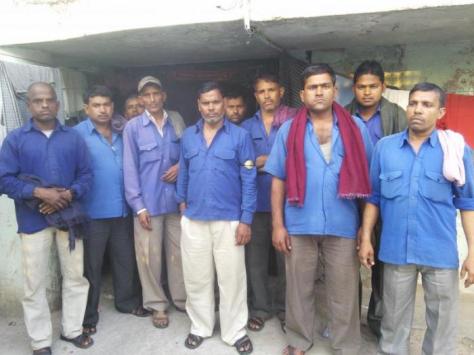
Porters at ISBT  (Image courtesy DNA)

Barely six years into its introduction, the Aadhaar project, otherwise known as the Unique Identification (UID) project has been studied and critiqued extensively – its promises to strengthen welfare delivery, curb corruption, exorcise ghost beneficiaries from government databases, initiate financial inclusion and enhance intra-governmental coordination have been enthusiastically received in certain corporate and technocratic circles and skeptically, if not scathingly viewed in other academic and journalistic quarters. The liberties this far-advanced project has taken with individuals’ privacy and its failure to acquire a statutory basis (even as enrollment drives continue unabated) have justly attracted severe censure. And until recently, the surreptitiously mandatory nature of the project – where welfare entitlements were linked to the possession of numbers – was cause for alarm. The Supreme Court judgment in 2013 challenging this mandatory linkage between Aadhaar and subsidies/entitlements may have slowed down processes of the number’s proliferation as an exclusive proof.

However, since the new government at the Centre took over, newer uses and linkages are being imagined. How indispensable the Aadhaar will be to such schemes and entitlements only time can tell: cases in point the Jan Dhan Yojana (JDY) and the linkage of the Aadhaar with the passport. As new linkages appear in place of the old, the new government is urging all of us to walk boldly into the embrace of biometric identification that will, to a certain extent, at least, pervade public transactions (for some) and their very socio-economic chances of welfare support (for most others).  It was against this conceptual and empirical backdrop (so competently elucidated by the various scholars, lawyers and journalists following this project) that I decided, as part of my work on a larger book project, to speak with a migrant community in Delhi about their Aadhaar-related experiences – did they wish to get these numbers, if so why?

For these purposes, I picked a community of bus coolies or porters in North Delhi most of whom were migrants from different parts of the country and who stayed in a makeshift residence on the premises of the bus terminal. Continue reading Bus Porters’ Petition for Aadhaar – A Political Analysis: Tarangini Sriraman

Documented Lives: Aadhar and the Identity Effect in Kashmir: Shrimoyee Nandini Ghosh

A version of this essay appeared in the Kashmir Reader, 10 December 2013

Guest Post by Shrimoyee Nandini Ghosh

On the road to the city from Srinagar Airport, I recently saw a billboard. Beneath the radiantly beaming faces of Manmohan Singh, and Sonia Gandhi, it bore the declaration ‘One Nation. One Card. AADHAR.’ Public Service advertisements in the same cheery vein have been airing on Radio Kashmir, and the state owned TV station Doordarshan- Kashir. Its critics assert that the AADHAR (‘its not a card, just a number!’) scheme exemplifies the financialisation of citizenship (each AADHAR number will require a corresponding bank account), a regime of biometric surveillance, the creation of a database nation and an expansion of the global corporate- military-intelligence empire. But AADHAR is only the latest chapter in the largely undocumented history of India’s intimate stranglehold over Kashmir through identity documents. It is a history told anecdotally, through stories about the sinking feeling of being stopped at a barricade and rifling through empty pockets, of cold hours spent pleading on a street or at a police station, of late night rescues of hapless friends from lonely check points, of miraculously narrow escapes despite having left home without it.

Though no Kashmiri adult I know leaves home without their ID, no one can seem to pin point exactly when the carrying of a photo-identity card became mandatory. Trying to understand the basis for the practice, I asked a friend under what law it was required that every person be able to prove their identity at all times. ‘Under the gun law!’ he replied succinctly. While its legal origins are uncertain, what is quite clear is that by the early 1990s no Kashmiri male could afford to be, quite literally, caught dead without one. As my plain speaking friend explained, “the most important reason for carrying one was if you were killed, somebody would hopefully find your card and inform your family.” The ID card was the tenuous piece of laminated paper that stood between him and an unmarked grave, an unmourned death.

Continue reading Documented Lives: Aadhar and the Identity Effect in Kashmir: Shrimoyee Nandini Ghosh

Casting a backward glance after a court order – the UID project: Usha Ramanathan

Guest Post by USHA RAMANATHAN

On September 23, 2013, the Supreme Court ‘s directed that “no person should suffer for not getting the aadhaar card in spite of the fact that some authority had issued a circular making it mandatory”. Reacting to an argument of Mr Anil Divan, Justice Puttaswamy’s counsel, the judges added that “when any person applies to get the Adhaar Card voluntarily, it may be checked whether that person is entitled for it under the law and it should not be given to any illegal immigrant”. The order regarding making the UID mandatory  was made in the context of the questionable legality of the project, and the instructions being issued, as it has been in Maharashtra, that  teaching and non-teaching staff and judges of the High Court would not get their salaries unless they have a UID. The latter part of the order on `illegal immigrants’ echoes those who wanted, and got, an amendment to the Citizenship Act in 2003 authorising the creation of a National Register of Citizens. This was inherently illogical and opportunistic; for, the rhetoric of threat from the outsider drew upon the Kargil standoff in 1999, when it was Pakistan that was seen as sending in terrorists who needed to be identified and dealt with, but the politics of the day made the migrant from Bangladesh the `threat’. The Home Minister of the day saw them in every shadow. The UID project is a part of this enterprise.

The UID Project, with Mr Nandan Nilekani at its helm, has developed ambitions of its own in the four years since it was set by executive notification. In these four years, what observers and analysts have seen of the project has produced disturbing questions around what constitutes identity and how it will be established: [1]

Continue reading Casting a backward glance after a court order – the UID project: Usha Ramanathan

Aadhaar – What next after the SC ruling? Kalyani Menon-Sen

Guest Post by KALYANI MENON-SEN

Poor Mr Nilekani. Just when everything was going swimmingly for him – adulatory interviews in the foreign press, tantalising rumours of a Congress ticket for the 2014 polls, lots and lots of votes on a poll to select the Greatest Living Indian – comes another well-aimed spanner in his works from that bunch of litigacious Jokers who have been playing rasta roko with his Batmobile for some time now.

The Supreme Court ruling of 23rd September is curt and unequivocal – a) two other challenges to Aadhar in the High Courts of Chennai and Mumbai to be clubbed with this one and heard by a Constitution Bench; b) an immediate freeze on linking Aadhar to benefits under social schemes; and c) a direction to tighten up the registration process to make sure that only Indian citizens are enrolled.

Every line of this ruling is a painful blow for Aadhar. It’s bad enough that the Court has taken seriously the charge that Aadhar violates Constitutional rights. The implication that there are serious errors in the registration process is even worse, and pulls the plug on one of the main arguments in support of the UID  – that it will stop leakages in government schemes by weeding out bogus beneficiaries. Worst of all is the decoupling from the “Apna Paisa Apne Haath bandwagon. If the UPA decides not to  jettison the cash transfer scheme – its big-ticket strategy for the 2014 polls – it will find a way to keep it going without Aadhar. Whether or not this strategy pays off, Aadhar will be the loser. Continue reading Aadhaar – What next after the SC ruling? Kalyani Menon-Sen

Do you know why Aadhaar is NOT compulsory: Ram Krishnaswamy

This is a guest post by Ram Krishnaswamy For the last three years activists opposing Aadhaar/UID have argued that it can lead to communal targeting, can aid illegal migrants, can invade privacy, is unconstitutional, does not have parliamentary approval, is illegal, etc. Yet all such objections and more have been successfully stonewalled by UIDAI and UPA leaders.

Further, Aadhaar is not compulsory and so such allegations are considered invalid. The middle and upper class Indians have remained silent about the UID debate, as it does not affect them in the least. The long lines of persons stretching before UID enrollment centers must be proof, then, of the popularity of this concept.

Nandan Nilekani and UIDAI Director General R.S Sharma have repeatedly told the nation that UID, now called Aadhaar, is not mandatory. Yet, over a period of time, they say, it could become ubiquitous, if service providers insist upon it compulsorily, in order to receive their services. To quote UIDAI Chairman, Nandan Nilekani, “Yes, it is voluntary. But the service providers might make it mandatory. In the long run I wouldn’t call it compulsory. I’d rather say it will be come ubiquitous.”

Continue reading Do you know why Aadhaar is NOT compulsory: Ram Krishnaswamy

The lives of documents: on the sorrows of AADHAR: Rijul Kochhar

This is a guest post by Rijul Kochhar

Combining field and event, camp is in effect spatial practice.[…] Camps are spaces where states of emergency or legal exception have become the rule. [They offer] the setting for the normative permanence of a suspended rule of law.

~Charlie Hailey, Camps: A Guide to 21st Century Space

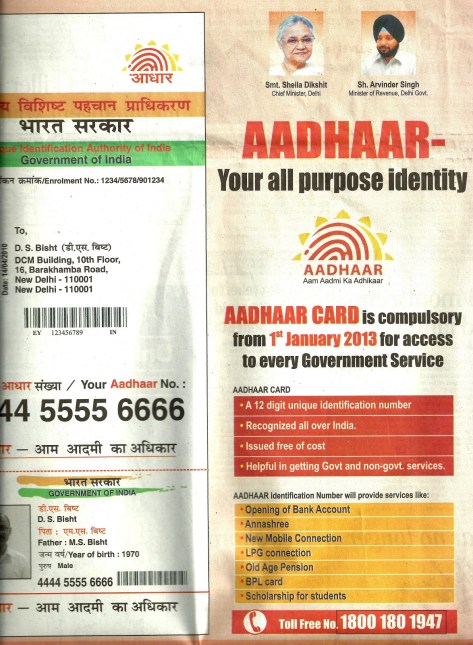
Delhi govt advert compulsory aadhar

The story of Aadhar is not unknown—a new, cutting edge piece of documentary practice jack-booted for this 21st century, it seeks to cull out fraudulent persons tied to dubious places or circumstances (words like ‘ghosts’, ‘fakes’, ‘frauds’, ‘duplicates’ abound in its context). Paeans to the powers of biometrics have been sung from numerous citadels of power—the project’s uniqueness lies in its capacity to channel biological anatomy to a singular fantasy of individually-determined (and fixed) citizenship; its ability to weed out duplication and duplicity in favour of fool-proof individuality; its promise to identify seamlessly; its realization of that ultimate bureaucratic fantasy that seeks to eliminate the noisiness of personhood and the messiness of individual lives by inaugurating a system of identity constructed and at once accomplished through a 12-digit number tied to the bedrock of fingerprints and iris-scans. These seductive powers of identity and technology, long wished for by visions and bureaucratic pursuits of rationality, contrast against fears of the invasion of privacy, the dangers of centralising data, and the abuse of powers and of information by functionaries of government, as well as—by no means less important—prospects of technological malfunction in the field of civic services or anatomical recalcitrance.

Continue reading The lives of documents: on the sorrows of AADHAR: Rijul Kochhar

Aadhar/UID is Against Equality and Democracy: Moiz Tundawala

Guest Post by Moiz Tundawala

After the suppression of the 1857 Mutiny and the British take over of Delhi, Mirza Ghalib was once asked by a military official whether he were Muslim or not. Ghalib is said to have quipped: “Only half Muslim; I drink wine but refrain from swine.” For me, this ripost evinces a flippant disdain for modern forms of rule which essentialize persons and groups purely based on certain attributes which are deemed definitive and prioritized over others. As far as Ghalib’s case was concerned, the idea may have been to find out based on his religious identity if at all he could pose problems for the newly established colonial regime. In later years, this policy, which African intellectual Mahmood Mamdani has recently termed ‘define and rule’, gradually became integral to governmental practices in most parts of the modern world; today, populations are ever so readily classified and enumerated based on empirically observable characteristics in order to make them amenable to effective government. The Aadhaar project of the Unique Identification Authority of India clearly falls within the gamut of such practices, marking a transition to modernity in a radical break from the past. So my reservations with it are just the same as those with any other modernity inspired programme wherein personal and collective identities are reduced to a somewhat arbitrarily determined bare essence which may have no real connection with lived experiences of fuzzy and contextually constructed identities.

Continue reading Aadhar/UID is Against Equality and Democracy: Moiz Tundawala

The Unique Identity of a Standing Committee – The UID in Parliament: Taha Mehmood

This long guest post by TAHA MEHMOOD, who has been independently  researching surveillence, biometrics and identification techonologies for a long time dissects the discussion and discourse around the Unique Identification Database scheme of the Government of India

  1.   The Discreet Charm of UID

The January 2012 issue of The Economist, a magazine published from London, has an article on India’s national ID card scheme, titled, The Magic Number. The article focuses on how UID is progressing. The  brave hero of the story is of course Nandan Nilekani and villain is ‘India’s stubborn home minister, P. Chidambaram,’ who ‘is now blocking a cabinet decision to extend the UID’s mandate, which is needed for the roll-out to continue’. According to the unnamed author of the article, ‘Indian politics hinge on patronage—the doling out of opportunities to rob one’s countrymen. UID would make this harder. That is why it faces such fierce opposition, and why it could transform India.’ This article appeared in The Economist days after the report of Standing Committee of Finance was released. What went on in the deliberations of this standing committee?

Continue reading The Unique Identity of a Standing Committee – The UID in Parliament: Taha Mehmood

The Biometricwallah

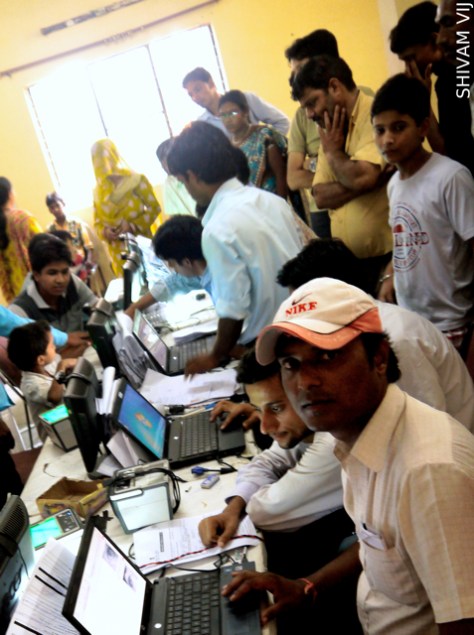
Contrary to what his name suggests, Bechu Lal Yadav, 29, isn’t a seller of goods. He is a recordist of identity. He is amongst a new breed of technical professionals that have come up overnight – the Biometricwallahs.  Continue reading The Biometricwallah

A Critical Primer on India’s UID: Simi Chacko and Pratiksha Khanduri

This guest post by SIMI CHACKO and PRATIKSHA KHANDURI is the full text of a booklet released in August 2011. A .pdf version of the booklet (41 pages, 304 KB) can be downloaded here.

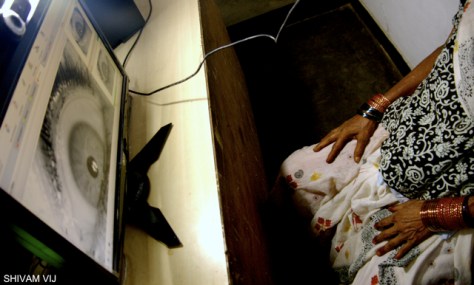
A citizen gets her iris scanned for a UID 'Aadhar' card in Delhi.

Introduction

A. UID: The Basics

B. The Enrolment Process

C. Benefits of UID

D. Concerns: Biometrics, Privacy, Data security, Surveillance

Continue reading A Critical Primer on India’s UID: Simi Chacko and Pratiksha Khanduri

On the fuzziness of Personal Identity: UIDAI and the national identity card of India: Taha Mehmood

Guest post by TAHA MEHMOOD

I – The spread of Identity cards in Southasia:

An identity card virus seems to be spreading across south-Asia. The pathogen emerged long ago in 1971, when Pakistan established a paper based personal identity system. !971 was also the year when Pakistan was engaged with India in a military conflict which led to the creation of Bangladesh. In 1972, a year later, the Department of Registrations of Persons located at Colombo, Sri Lanka, was entrusted with the responsibility of issuing a national identity to citizens who were over sixteen years of age. In 1972 the name of the island was changed from Ceylon to Sri Lanka and Tamil Tiger leader Velupillai Prabhakaran formed the Tamil New Tigers (TNT), which later became LTTE or Liberation Tigers of Tamil Eelam. The state of Sri Lanka was at war with LTTE for the next three decades. Nothing new happened on the national identity card front for the next two decades. Continue reading On the fuzziness of Personal Identity: UIDAI and the national identity card of India: Taha Mehmood