Tag Archives: Anna Hazare

Some Thoughts from Ramlila Maidan

This slideshow requires JavaScript.

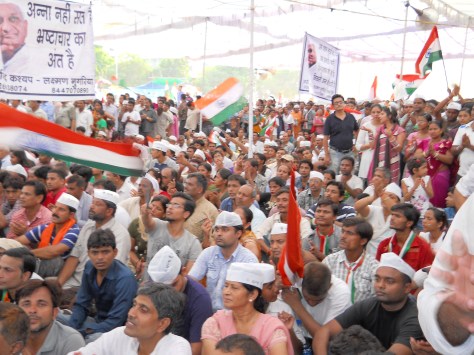
Some people at Ramlila Maidan

This slideshow requires JavaScript.

What is right-wing about the anti-corruption movement? – Saroj Giri

Guest post by SAROJ GIRI


A draft for discussion

A ruling class contradiction is being played out as anti-corruption movement. It is however politically articulated as ‘a movement of the people’ with possibly a space for the left to intervene. Can the tide be turned against the right-wing upper classes?

“What we are witnessing (the anti-corruption movement) is nothing short of a revolution. Only on two earlier occasions in recent memory such grand scale people’s participation was recorded. The first was under Loknayak Jayaprakash Narayan in mid-seventies. The second was during the Ayodhya movement, in the early nineties, propelled by L K Advani’s historic Rath yatra.” This is the RSS Organiser magazine (August 21-28, 2011).

“The anti-corruption movement must resist repression in every form and align itself with the struggles for democratic transformation in India. Only then can it defeat the UPA Government’s efforts to defend corruption and unleash repression, and expose the BJP’s false claims of championing democracy and resisting corruption.” This is the CPIML Liberation (ML Update, 07-13 June 2011)

Continue reading What is right-wing about the anti-corruption movement? – Saroj Giri

The People

Not enough people are asking what is motivating people to go to Ramlila Maidan in such large numbers. People like Ghazala Jamil and Anish Ahluwalia are not asking this question because for them the whole thing is an elite, middle-class conspiracy that is anti-Dalit, anti-OBC, anti-Muslim, anti-justice, anti-equality, anti-peace, anti-love and anti-sex.

These saviours of the marginalised, the poor and the vulnerable make the point that Anna Hazare’s means are showing contempt for the people by not letting people’s chosen representatives delay anti-corruption measures. They are making the point that unless Anna Hazare’s movements takes up issues of land reforms and justice for Gujarat’s Muslims, he should not be supported.  Continue reading The People

Three Questions to Friends

I have been taking my time to reflect on the positions that have emerged in the fairly polarised debate on the on-going anti-corruption struggle in Delhi. I take very seriously the questions raised by critics on the right-wing inclinations evident in the movement’s leadershi, but I think it is both a strategic mistake and a disawoval of responsibility on the part of those of us on the left of the political spectrum to stay out of it. We should engage with the movement from the inside, strategically and persistently, and this means thinking afresh on the means by which we may support the larger binding issue with clear awareness of the risks involved. In this connection, I want to raise three questions:

First, when did we start to be so reluctant to acknowledge the fact that any civil social movement is bound to be contaminated by regressive positions and ideologies and so we cannot avoid thinking of ways of participating in them guided by awareness of the risks? I have recently been trying to collect narratives remembering the fourth national conference of the Indian women’s movement held at Kozhikode, Kerala, in 1990. The participants who spoke to me often pointed to a contrast between the dominant left parties who opposed the conference from the outside, and many, many groups who participated in the conference fully, but raised sharp criticisms which were quite like those of the former. They remarked that these critics were listened to with considerable respect because they were inside, unlike the dominant left.The participant who mentioned this, a well-known radical activist here, still remembers their arguments vividly. Another participant remembered sharp disagreements between urban feminists and rural participants on the question of justice to rape victims. While the former were opposed to the ‘solution’ of marrying the victim off to the rapist, a senior participant from a rural area who spoke up approved of it. This was shocking and unexpected to the urban feminists, but then purity of positions wasn’t, apparently, an overwhelming concern then — and at that place.

Continue reading Three Questions to Friends

Beyond ‘Middle Class’ and ‘Corruption’: Jeebesh Bagchi

Guest post by JEEBESH BAGCHI

I have been thinking that If we drop “corruption” and “middle class”  we may find some other way to understand what we sense unfolding from Ramila grounds and television studios.

The term middle class has bloated so much that it now holds within it Narayan Murthy to Shekhar Gupta via Nandan Nilekani to a student in Sonepat to all people in this list and on facebook.  And on the other hand corruption seem to have bloated much further in which commissions from infrastructure deals (in lakhs of crores), commissions for arms deals, someone delaying papers, to admission costs, to a hawker buying some uninterrupted time in the street (20 rupees) is all melted down.

Could one start from some other point? Continue reading Beyond ‘Middle Class’ and ‘Corruption’: Jeebesh Bagchi

New Trade Union Initiative on Anti-Corruption Struggle

We are reproducing below a statement issued by NTUI

NTUI Statement On the Fight Against Corruption

Workers’ life and work experiences are very different from those of the middle class and the ruling elite; so is their experience with corruption. For the middle class, corruption is a mechanism to accelerate government procedures in the public or private sectors. For the working class, corruption deepens their experience of subordination. Instances of corruption that are directly experienced by the working people are the result of the unequal power relations that govern workers’ daily interaction with public institutions and is therefore contributing to a sense of distrust and loss of faith in these institutions. There can be little doubt that corruption affects the working class disproportionately more than it affects economically more privileged sections of society.

Continue reading New Trade Union Initiative on Anti-Corruption Struggle

Tired of Democracy? – Gail Omvedt

This guest post comes from  GAIL OMVEDT

Why are such masses of people (apparently: in our village some came out for a morcha organized by the Maharashtra Navnirman Samiti) following Anna Hazre, when it is now clear that his Lokpal is an authoritarian, centralized and undemocratically pushed proposal?

Several articles, including those by Arundhati Roy and Aruna Roy, have made this clear by now.  I can find only one point to disagree with in the otherwise excellent article by Arundhati:  that, like the Maoists, the Jan Lokpal Bill seeks the overthrow of the state.  It does not.  The movement wants to keep the state, in an even more centralized form, but replace its current rulers with a new set.  And Ranjit Hoskote’s comment that “Anna Hazare’s agitation is not a triumph of democracy [but] a triumph of demagoguery” deserves to be remembered.  The increasingly authoritarian, even fascist forms of activities are disturbing even many of its supporters.

Continue reading Tired of Democracy? – Gail Omvedt

The office of the Jan Lokpal and some thoughts on Nivedita Menon’s post: Anish Ahluwalia

Guest post by ANISH AHLUWALIA

The Jan Lokpal

A problem lies at the very core of Anna Hazare’s anti corruption campaign. This campaign wishes to march ahead by defining ‘corruption’ in the narrowest possible sense. Monies illegally made by politicians, members of judiciary, babus while remaining dreadfully silent on corporations, upper middle classes, middle classes who form the bulk of bribe payers…

Continue reading The office of the Jan Lokpal and some thoughts on Nivedita Menon’s post: Anish Ahluwalia

A Great Opportunity, A Serious Danger: A Statement

A Statement Issued by some individuals and friends in social movements

The Anna Hazare situation invites two common reactions: many dismiss it as a middle class driven “urban picnic”; and others, notably the mainstream media, describe it as just short of a revolutionary movement to establish “people’s power.” The same divide exists among progressives and those concerned with social change. Strategies differ on the basis of where one stands on this divide. The problem, however, is that neither of these reactions fully reflects the reality of what is happening.

Continue reading A Great Opportunity, A Serious Danger: A Statement

Anna’s ‘Second Azadi Movement’ via Satyakam and Rang De Basanti

At first Anna reminded me of this very unreasonable, uncompromising, ‘dry honest’ (a delicious Indianism, I guess) character of Satyakam in the eponymous film created by Hrishikesh Mukherjee in the late Sixties. He is so pathologically and pathetically honest that he does not even borrow the chair from the office downstairs when his boss, Sanjeev Kumar visits him. Dharmendra climbs stairs to meet Sanjeev Kumar at his residence only after having finished his work.

Transposed in the current scenario, the equation would be something like this:

Sanjeev Kumar = any one of us; Anna = Dharmendra. Historically of course we know that only Gandhi could be Gandhi, and not even Nehru could ever aspire to that special position in the people’s hearts even while we remind ourselves that a whole mass of little (good, bad, ugly) Gandhis contributed to the making of the one and only, most famous, Gandhi. Continue reading Anna’s ‘Second Azadi Movement’ via Satyakam and Rang De Basanti

Why Jai Karan supports Anna Hazare

Jai Karan in The Times of India

My own feelings about the Anna Hazare movement are mixed, or you could say confused. I like the way the movement is bringing an arrogant government to its knees, and though I don’t know if their version of the Lokpal Bill is the best way to fight corruption, I appreciate how they have exposed the UPA’s farce of a bill. I get the point that fellow-travellers Nivedita Menon and Aditya Nigam are making about democracy and political movements, but as one unit of ‘the people’, I don’t see why I should support a movement just because it is popular. Perhaps it is my elitism and naivete and cynicism. Or perhaps I’m just confused by now. The taste of the pudding is in the eating, and I’d like to see where this takes us.

While I sort out my confusion, I see a message on Facebook, attributed to Anu Ramdas, that says:

Continue reading Why Jai Karan supports Anna Hazare

If only there were no people, democracy would be fine…

This post has been jointly written by Nivedita Menon and Aditya Nigam

At Ramlila Maidan

We went to Ramlila Maidan yesterday, the four of “us” considerably swelling the numbers of about a lakh and a half of people there by 6.30 pm, when we left. They were either sitting inside, milling about outside all around its walls, or pouring in having walked from India Gate.  (Is the media exaggerating the numbers? In our opinion it is underestimating them considerably).

Continue reading If only there were no people, democracy would be fine…

A Case for Fractured Solidarities and Skepticism: Ghazala Jamil in response to Nivedita Menon on Anna Hazare

Guest post by GHAZALA JAMIL

On August 17 at 5:30 in the morning I sat up to follow the latest developments on Hazare front (for sleepless nocturnal souls like me it helps that Ramzan are on). Logged into my facebook account and found that I have been labelled ‘a cynic’ for my status updates and posts on Hazare mobilisation. Got into a facebook ‘discussion’ argument with a friend abroad (All my homesick friends abroad have been smelling wafts of the ‘Arab Spring’ in all this).

Continue reading A Case for Fractured Solidarities and Skepticism: Ghazala Jamil in response to Nivedita Menon on Anna Hazare

We should be there: The Left and the Anna moment

My head has been in a whirl the past few days with a single question – how do we on ‘the Left’ manage so unerringly to be exactly where ‘the people’ are not, time after time?

At this moment I don’t mean the organized Left, for the Left parties  have been cautious about criticizing  the current upsurge; they strongly defended the right to democratic protest when Anna Hazare and his colleagues were arrested, and now have launched a Third Front initiative on the issue of corruption and the Lokpal Bill; the students’ front of CPI (ML), AISA, has been organizing militantly on the issue for a very long time now, and is very much part of the campaign.

I mean the few hundreds who form my own community, the people with whom I have organized protests and run campaigns and sat on dharna and drafted petitions;  struggled against communal violence and sexual harassment,  for queer freedom and workers’ rights, against the nuclear bomb and nuclear energy, in support of reservations and against the moves in our universities to hold up appointments to reserved posts. Many of these people I know personally, some are among my closest friends, and many more I know as part of the broad Left/secular non-party tendency in the country’s politics, where I feel most at home.

Continue reading We should be there: The Left and the Anna moment

NAPM Extends Support to Anti-Corruption Movement and Demand for an Effective Lokpal

[The statement was issued by the National Alliance of People’s Movements on 14 August. Much has happened since then – the arrest of Anna Hazare – accopanied by silence and often ridicule poured by the radical elite, but in the face of what is perhaps one of the most widespread mass movements in India after Independence. Over the past few days, we have been witness to innumerable demnstrations and marches in almost every colony in Delhi – where no TV camera ever reached or was even expected to when the ‘real’ action is going in in central Delhi. Contrary to the general propaganda and even our own earlier impression, this is no more simply a middle class movement. I am reproducing it here, somewhat belatedly, because it still touches on some of the post important points at issue in the ongoing struggle. – AN]

Anna Hazare Ji and manyothers across India will be starting their fast from August 16th in Delhi demanding an effective Lokpal. NAPM supports the people’s movement for a corruption-free India and urges the citizens of the country to plunge into this struggle. NAPM, along with other organisations is holding relay fast, human chains, public meetings and other programmes, in Chennai, Pune, Mumbai, Narmada Valley, Hyderabad, Guwahati, Bhubaneshwar, Bangalore, Mysore, Mou, Balia, Allahabad, Muzzafarnagar and other places. We urge our members and supporters to join this call and challenge the corrupt and defensive governments at the Centre and the states.

We strongly disapprove of the way in which government has been trying to put severe restrictions on holding peaceful protests in the capital, and Delhi Police under the garb of implementing the Supreme Court’s Guidelines is imposing unnecessary conditions on protests, as it did early this month on SANGHARSH anti-land acquisition protest, AISA-DYF anti-corruption protest and others. For an independent democratic country like ours, imposition and insistence on police permission and strict guidelines for holding peaceful protests and Sataygraha seems completely contradictory and only shows shrinking spaces for democratic freedom of expression and curb on fundamental rights of its citizens.

Continue reading NAPM Extends Support to Anti-Corruption Movement and Demand for an Effective Lokpal

The Lokpal- NCPRI approach: the right to differ

In the midst of the overwhelming focus on Anna Hazare and the campaign around a bill that lacks consistency or clarity, both legal or ethical, below is a letter from Aruna Roy drawing our attention to an alternative approach to the Lokpal. It is an existing process for us to partake in, agree, disagree and/or rally behind.

Click here for more information on this alternative.

A letter from Aruna Roy

We write to you on a matter of mutual and common concern, the
Lokpal bill, now in Parliament. The context of this letter is
explained below.When the Joint Drafting Committee of the Lokpal was working on the Jan
Lokpal ,  the NCPRI had written to the Chair, Shri Pranab Mukherjee,
and the co-chair Shri Shanti Bhushan, enquiring about the TORs and the
process of and participation, in public consultation. Both assured us
that there would be formal public consultation. It did not happen.

When the government bill went to cabinet with the intention of placing
it in the monsoon session of parliament, the NCPRI decided to make its
position known. The NCPRI is continuing with its deliberations and
consultations and has  prepared an approach paper and a set of
principles for circulation. This is a work in progress.

The belief in consultations and discussion is the reason why we write to you. Continue reading The Lokpal- NCPRI approach: the right to differ

Onwards to the Independence of the Corrupt!

Let us pledge this 15th of August, that we will tirelessly work towards the independence – nay dictatorship – of the corrupt. We must tirelessly fight every attempt to raise  corruption as an issue – by gullible people who do not understand that corruption is not a real issue. We will not allow such people to be misled by demagogues and fascists who are  interested only in power – even if they do not show their hunger for power by contesting elections. Indeed, precisely because they do not contest elections.

Is the new mantra of democracy? How else do we understand the deafening silence on the series of dictatorial measures adopted by the government, on the part of all those who have been vocal, indeed strident, in their attack on the Anna Hazare movement? It is one thing to be opposed to the Anna Hazare movement but the silence – from parties as well as intellectuals, democratic rights groups and self-righteous editorial commentators of the Indian Express – on the desperate measures being adopted by one of the most corrupt governments ever, is inexplicable. It is as if the only threat to democracy today comes from a group of people who want to raise their voice in civil disobedience against public money being looted by elected representatives acting at the behest of powerful corporate interests.

First the Delhi Police simply refused permission to Anna Hazare and the India Against Corruption fast. Then they asked them to hold their protest in Burari! That is to say on the border of Haryana. This was but another way of disallowing it. Then they came out with a novel idea – a set of preconditions that include an undertaking that there will not be more than 5000 people and that the fast will be wound up in three days. Clearly, no self-respecting set of protestors will agree to such conditions and so ‘Team Anna’ refused to sign the undertaking.

Continue reading Onwards to the Independence of the Corrupt!

Parliamentary Sovereignty or an Active Citizenry? V. Krishna Ananth

Guest post by V. KRISHNA ANANTH*

The political class, cutting across the spectrum, is now being haunted by a spectre. Anna Hazare has captured the imagination of a cross section of the people and his campaign is certainly gathering support. It remains to be seen if this support translates into a movement on the streets and more so against the state machinery that is threatening to pull all the stops. The people have shown such courage in the past. That is another matter.

Team Anna’s decision to go ahead with protests against the draft Lok Pal Bill, as approved by the Union cabinet, has spurred a debate. The proponents of the draft bill as well as sections in the political arena who claim to oppose the Government are united against another round of fast by Anna Hazare; they call it blackmail and an attempt to usurp Parliament’s power to legislate. They also claim that the principles of democracy shall not be sacrificed.

A number of them are on record that the draft proposals are subject to amendments and that the power to propose amendments and decide on them shall rest with the elected representatives of the people. It is another matter that the Prime Minister, who heads the cabinet, qualifies as a representative of the people only because membership of the Rajya Sabha is considered as good as being a member of the Lok Sabha to remain a minister under Article 75(5) of the Constitution. In any case, the fact is that Dr. Manmohan Singh has claimed, in an affidavit, that he is ordinarily a resident of Assam! We all know the truth but that too is besides the point.

Continue reading Parliamentary Sovereignty or an Active Citizenry? V. Krishna Ananth

Democracy, Populism and the ‘Middle Class’: The Return of ‘Anna Hazare’

[This is a considerably expanded version of an article that was published in Himal May 2011. It is being re-published, elaborated and updated, in the context of the farcical draft of the Lokpal Bill roduced by parliament and the threatened round 2 of the movement. – AN]

Corruption – a Systemic Affair?

Let me start with an ’emperor’s new clothes’ kind of question: What is a systemic understanding of ‘corruption’? What is a political understanding about corruption as opposed to say, a touchy-feely ‘moral’ problem? Yes, some of these phrases are straight from Arundhati Roy’s ‘When Corruption is Viewed Fuzzily’, published in the Indian Express on 30 April. But my question is not directed only at her. She represents – at least on this issue – a much wider consensus among sections of the radical intelligentsia.

Roy herself has left nothing to the imagination as to what she means:

“Among the millions of understandably furious people who thronged to Jantar Mantar to support Anna Hazare and his team, corruption was presented as a moral issue, not a political one, or a systemic one — not as a symptom of the disease but the disease itself. There were no calls to change or dismantle a system that was causing the corruption. Perhaps this was not surprising because many of those middle-class people who flocked to Jantar Mantar and much of the corporate-sponsored media who broadcast the gathering, calling it a “revolution” — India’s Tahrir Square — had benefited greatly from the economic reforms that have led to corruption on this scale.”

To her, the system that lies at the root of corruption is embodied in the ‘economic reforms’, which have led to corruption on this scale. I have no way of measuring the scale – though I might be inclined to agree with her that in my living memory, I have not seen so much compressed into such little time-space – from CWG to l’affaire Niira Radia to Adarsh Housing scam and the Bellary brothers – not to speak of the daily corruption in land acquisitions that dot the landscape of the country. Nonetheless, I do remember that something like the Bofors scandal or the ‘irresistible rise’ of Dhirubhai Ambani – all predate the ‘economic reforms’. And of course, I will not even try to mention the innumerable cases of corruption from Nagarwala onwards – including political corruption that led to big mass movements in Gujarat and Bihar in the 1970s. Those were the days when Mrs G proclaimed that ‘corruption is a global phenomenon’. To me saying corruption is systemic and must be analyzed ‘politically’ (whatever that means), sounds pretty much the same.  So, if neo-liberalism is responsible for corruption, how do we explain the instances mentioned above? How do we understand the great socialist states which secreted corruption from every pore? What does a ‘systemic analysis’ of corruption really tell us?

However, Arundhati Roy was making this point, it seems to me, not in order to analyze the phenomenon of corruption but to comment on the Anna Hazare movement and its ‘character’:

“When corruption is viewed fuzzily, as just a touchy-feely “moral” problem then everybody can happily rally to the cause — fascists, democrats, anarchists, god-squadders, day-trippers, the right, the left and even the deeply corrupt, who are usually the most enthusiastic demonstrators.”

Continue reading Democracy, Populism and the ‘Middle Class’: The Return of ‘Anna Hazare’

The Middle-class and the State: Shashank Kela

Guest post by SHASHANK KELA

These fragmentary reflections on the historical relationship between the middle-class and the state may help to place the brouhaha over Anna Hazare in a fresh perspective.

No one celebrates capitalism quite as enthusiastically as your average (well, all right, above average) Marxist historian. Few conservative encomiums on the subject have the lapidary elegance of Perry Anderson’s Lineages of the Absolutist State, or the remorseless logic of Robert Brenner’s celebrated paper on the origins of capitalism.[1] This line goes back all the way to Marx in whose work praise of capitalism and execration of its effects are perpetually balanced.

Capitalism’s motor is the bourgeoisie or the middle-class. Its ancestors – the burghers of the medieval west European town and large landowners in the countryside – transformed the crisis of feudalism into opportunity with the help of the state. The result: mercantilism, enclosures, poor laws; the reorganization of agriculture on rational, commercially profitable lines. The cumulative effect of these developments was to extinguish avenues of subsistence hitherto available to the poor, throwing them on the market as sellers of their labour. Continue reading The Middle-class and the State: Shashank Kela