Tag Archives: Chhattisgarh

On Torture and Testimonies

I was going to write out a reply to the comments on Shuddha’s post, Kashmir’s Abu Gharaiab, but thought I would expand it into a larger post.

I’d like to make clear that I have been to Kashmir only once – and that too for a few hours in the aftermath of the earthquake, so if anyone writes back saying, “I should see the ground reality in Kashmir”; I concede that point straight off the bat.  I should see the ground reality in Kashmir; we all should.

However, over the last eight months, I have had the opportunity to interact very closely with central paramilitary forces like the BSF and CRPF in the course  of their deployment in Chhattisgarh, where I work. Many of the men conducting anti-Maoist operations in Chhattisgarh have served in Kashmir and the North-East theatres.

Over the last three days, I and a reporter from the Times of India have been working on a story in which a group of adivasis from two villages in Chhattisgarh’s Kanker district have accused the BSF of torturing a number of young men and women from their respective villages by beating them and also administering electric shocks.

Continue reading On Torture and Testimonies

Crossed Wires: Intelligence and Counter-intelligence in Chhattisgarh

On May 16 this year, adivasis, attending the weekly Sunday bazaar at Unchapur in Chhattisgarh’s Rajnandgaon district, found six corpses stretched out on the main thoroughfare of the village. In a note placed on one of the bodies, the CPI (Maoist) took responsibility for executing the six villagers for succumbing to “the lure of money” and serving as “police informers”.
The Rajnandgaon killings are a manifestation of the escalation of the confrontation between Maoist cadres and security forces in Chhattisgarh. As the scope of the conflict has widened from purely armed engagement to the disruption of intelligence networks, the Maoists and security forces have both enlisted civilian support for intelligence gathering. This has made the adivasis targets in a war being fought in their name.

Women become targets; SPOs issue gag orders

Ever since Mukram hit the news, there has been a sure and steady attempt to cut-off access to the areas surrounding the Chintalnar Camp.

In the meantime, sources who helped me and a reporter from Tehelka access the villages are worried about their safety. SPOs in Chintalnar have reportedly threatened to “take action” against villagers who help the press.

The following is a recent article for The Hindu that has provoked some of the backlash against the press.

A series of shots rang out in the night far beyond the barricaded perimeter of the Central Reserve Police Force camp here in Chhattisgarh’s Dantewada district. For a few minutes, the sentries on duty returned fire before their guns, and the ones that sounded in the distance, fell silent.

By morning, the adivasi settlements around the camp had emptied, the villagers wary of being caught and questioned by the CRPF’s morning patrol. “Everyone is hiding in the forests,” said a villager from Markaguda, a village about two km from the camp, “I expect we shall be beaten up this morning.”

Mukram violence worsens; adivasi girls allege rape


Two sisters live in a clearing in the forest about 10 km beyond the abandoned houses and empty yards of Mukram village in Chhattisgarh’s Dantewada district. A third young girl cowers in the courtyard of her aunt’s house in neighbouring Tokanpalli. Between 14 and 18 years of age, Kose, Rame and Hidme (names changed) say they fled their homes in Mukram after they were sexually assaulted by Special Police Officers of the Chhattisgarh Police on May 22 this year.
“We can’t return to Mukram,” said Rame, “If they [the SPOs] find us again, they said they would cut my body into pieces and bury it in cement and no one would ever find it.”

Mukram slips into a vortex of violence

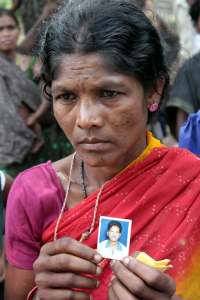
Aimla Rame holds up a picture of her husband Aimla Nanda who disappeared after a police raid in Mukram. Photo: Aman Sethi/ The Hindu

Mukram: Rumours swirling around Mukram suggest that this adivasi village in Chhattisgarh’s Dantewada district may soon be abandoned. “There is talk of going to Orissa or Andhra [Pradesh],” said a prominent adivasi leader with familial ties to Mukram, “It could happen in as little as a week. Villagers say there is too much pressure from both, the Maoists and the Police.”
A mid-sized village of about 100 houses, Mukram shot to prominence as the site where an ill-fated company from the 62nd Battalion of the Central Reserve Police Force (CRPF) rested on the night of April 5 this year.  At dawn on April 6, the company was ambushed by about 300 armed cadres of the Communist Party of India (Maoist), resulting in the death of 76 security force members.
In a statement released after the attacks, the CPI (Maoist) praised the efforts of Comrade Rukhmati, a Maoist commander and Mukram resident, who was killed in the ambush. On May 11, The Hindu reported the death of Kunjam Suklu, a Mukram resident who, his family members allege, was beaten to death by the CRPF in a fit of retaliatory rage.

Death of villager mired in controversy

Sukma: Chhattisgarh police confirmed the death of Mediyum Bandhi, a 27
year old adivasi from Aitpal village, in the Sukma police station in
Chhattisgarh’s Dantewada district. Police claim they shot Bandhi
as he tried to escape from the lock-up. Bandhi was shot three times in
the back with a Self Loading Rifle (SLR).

Bandhi’s death comes three days after an explosion, triggered by the
Communist Party of India (Maoist), killed 15 civilians and 16 members
of the security forces.  Many of the policemen killed were Special
Police Officers based out of Sukma.

According to Sukma police, Bandhi, 27, and Podiyam Kosa, 25,
were apprehended on Wednesday morning from Aitpal
village as they were wanted in a number of criminal cases including
murder.  The two villagers were first taken to Gadiras police
station for questioning and then brought to Sukma as Gadiras does not
have a lock-up.

The Maoist Killings Once Again

The news of  killing of more than 40 people travelling in a bus  blown by a blast in Dantewada is only a new chapter in the  book of brutalities that is  being scripted in Chhatisgarh and other parts of India in the name of ‘the People’. Six people were found slain in Rajnandgaon just a day before this blast. A day before that four villagers were killed in Bengal  because they were thought be close to the CPM and were labeled as informers. Two days before these killings in Bengal, two villagers who were Gram Rakhis were killed in Orissa. This list does not include the death of 6 Para Military persons in Chhatisgarh who were killed a land mine detonated by the Maoists in Chhatisgarh.

Are these operations  a response to the Operation Green hunt launched by the government? Or are they part of the Protracted  People’s War that is being carried out by the purest revolutionaries of our earth who do not waver and shiver at the sight of blood? Or, as some friends caution us  from rushing to any conclusion, as Shuddhabrata Sengupta has done, are they “ ‘ false flag operations’ conducted by some rogue elements of the state machinery” or directly endorsed by the state ? How are we to know who is the perpetrator of these crimes? Do we wait for a statement from the Maoists and if they deny their involvement, launch an investigation to find out the real culprit? It took nearly a month for the Maoists to officially own the attack which extinguished the lives of 76  CRPF men. The Maoist leadership congratulated the bravery of its combatants who had achieved the feat of eliminating a whole company of Indian para military force.
Continue reading The Maoist Killings Once Again

Arms and the Maoists

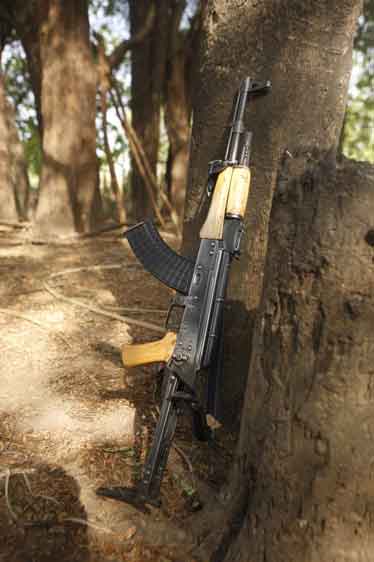
Ramana's AKS series Kalashnikov Rifle. A variant of the AK-47, the 'S' references the 'Skladnoy' or 'folding' metallic shoulder stock. Photo: Ishan Tankha/Open Magazine
In 1988, Ravula Srinivas paid Rs 100,000 for a black-market AKS series Kalashnikov rifle with a light-wood finish and a folding metal shoulder stock.  On April 6 this year, the same rifle was pressed into service in an ambush that killed 75 members of the Central Reserve Paramilitary Force and one Head Constable of the Chhattisgarh police in Chhattisgarh’s Dantewada district.
In the intervening years, Ravula has grown from a young student from Warangal into Ramana, Secretary of the South Bastar Regional Committee of the CPI (Maoist) and chief architect of the April 6 attack; unchanged by the years, the rifle has never left his side.
On April 14, The Hindu was offered access to Maoist leaders Ramana and Ganesh Ueike. in the Jagargunda forests in Dantewada.  The visit offered a rare, though by no means comprehensive, insight into how the CPI (Maoist) sources, maintains and distributes weapons among its cadres.

School’s Out in Chhattisgarh, (But the Force is in!)

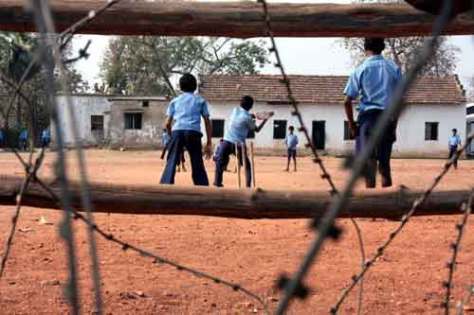
School’s out! In Kerlapal, Dantewada, battle-weary soldiers of the B Company of the 2nd Battalion of the Central Reserve Police Force peer over barbed-wire fences as skinny schoolboys in sky-blue shirts play cricket. The force has occupied the senior school and with it the basketball court and part of the playing field; but the game must go on.
As paramilitary troops pour into Chhattisgarh to fight the Maoists, the absence of military barracks has forced soldiers and children to share the only concrete structures in the countryside — the village school.

A Believer’s Obeisance: Soumitra Ghosh

SOUMITRA GHOSH is with the National Forum of Forest Peoples and Forest Workers (NFFPFW). A guest post received via Dilip Simeon

Does the Outlook article [by Arundhati Roy] tell us anything new? The Maoists have built a dream world in Dandakaranya, and the gun has heralded that dream. The Green Hunt is meant to shatter this dream, period…Apart from good anecdotes, there’s no political analysis of the movement, and the problematique of the Maoist movement was cursorily mentioned.

It seems rationality is banished. You oppose Green Hunt means that you see in the Maoists an unending series of dreamers and visionaries, and the making of a new world order. She doesn’t even bother to be historical, the history is what her contacts tell her.

What is utterly unacceptable is this woolly-headed,mushy and journalistic portrayal of a political movement. The Maoist movement was never,and won’t be a ‘adivasi’ movement,in the sense we use the term to describe a range of social movements.

Continue reading A Believer’s Obeisance: Soumitra Ghosh

The Day of Long Knives

Gachanpalli: Stories of the “Operation” reverberate along the path from the Andhra Pradesh border to Gachanpalli, a village deep in forests of Chhattisgarh’s Dantewada district. Villagers along the 35 kilometre stretch of broken track, bombed-out schools, and graves, still speak of the day when security forces swept through their fields and killed 12 men.

Testimonies collected from the villages of Gachanpalli, Gattapad and Palachalam in the Konta block in Dantewada claim that at least 12 of the 30 people killed during a security operation in September 2009 were innocent villagers with no links to the Maoists.  If true, the allegations point to a concerted attempt at dissimulation on the part of Chhattisgarh’s security forces.

The Plot thickens: more petitioners show up

The Gompad case gets murkier. Gachanpalli is another village mentioned in the same case I have been writing about for some time now. I visited the village this week to find a similar pattern where villagers vanish without really telling anyone where they are going and suddenly show up in the Supreme Court in New Delhi.
Given the matter is sub judice, I’ll refrain from any theorizing at this point.
a.
Gachanpalli: A frayed umbrella, a half filled bottle of cooking oil and two shopping bags stuffed with clothes constitute the unlikely tombstone that marks Kowasi Ganga’s grave.  “It’s the sum total of his worldly possessions,” says his grandson Kowasi Muye, “It’s a Muria tradition.”
Kowasi Ganga, 75, died on September 17 2009. Muye’s last memory of his grandfather is of Ganga dying dead outside their home.  He had been stabbed multiple times.

“Police killed them” say the villagers

I have been following the Gompad case for the past month and a half, and have been surprised at every turn.  The issue is centred on the deaths of 12 villagers on October 1 2009 in Chhattisgarh.  The matter is currently sub judice – so I would prefer not to comment on what I think happened, but this is my most comprehensive piece on the issue till date.

a.

GOMPAD: A charred wooden stake and three graves are all that remain of the Madavi family in this remote village in Chhattisgarh’s Dantewada district.

“Madavi Kanni was lying face down in front of the burnt house,” said an eyewitness. “She had been slashed with a sword and shot in the chest.” The bodies of her father, Madavi Bajar, her mother Madavi Subbhi and her 12-year-old sister Madavi Mutti, were found under a tree, 50 metres away.

Testimonies collected by The Hindu from Gompad allege that a composite force of Adivasi special police officers and security force regulars appeared on the outskirts of the village in the early hours of October 1, 2009. “We ran away when we saw the force,” said the witness, speaking on condition of anonymity. “We found the bodies when we returned.”
Continue reading “Police killed them” say the villagers

Vote! Or else…

In Lingagiri, it didn’t take long to tally the results of the recently concluded panchayat elections. On January 31 this year, a sum total of four people voted in this remote village in Chhattisgarh’s Bijapur district. The polling booth opened on time, the polling officers were present, and then the force arrived.
Pujari Rajamma, 35, was combing her hair in her courtyard. “I was getting ready to walk down to the polling office, when the uniformed men stormed in,” she said. “They checked my fingers for the voting mark.” When they didn’t find it, they beat her with sticks. The bruises are still visible on Rajamma’s back; she can barely move her swollen left arm.

Green Hunt: The Anatomy of An Operation

An operation is underway in Central India, but no one really knows what it is. Variously described as a media myth, a comprehensive hearts and minds strategy, and an all-out offensive by paramilitary forces and the state forces along the borders of Chhattisgarh, Jharkhand, Andhra Pradesh and Maharashtra, Operation Green Hunt has become a shoebox of news clippings, police reports, public demonstrations and armed encounters.

Depending on the definition, Green Hunt either began in July 2009, September 2009 or November 2009. Speaking off record, senior policemen confirmed that the intensification of “search and comb” operations in Chhattisgarh began as early as July last year. In September 2009 the press reported on the progress of “Operation Green Hunt”: a massive 3 day joint operation in which the central CoBRA force and state police battled Naxal forces in Dantewada. Continue reading Green Hunt: The Anatomy of An Operation

The police detain 3 more in Gompad case

Konta: The mystery surrounding the killing of nine Adivasis in Gompad village in Dantewada district in October last year is deepening, with the Chhattisgarh police detaining three more witnesses to the incident and restricting all access to the area on the pretext of Operation Green Hunt.

Operation Green Hunt is a catch-all phrase, used by the police and media alike, for all major anti-naxal offensives since July 2009.

As previously reported by The Hindu, the Chhattisgarh police have assumed total control over the movements of Sodi Sambho – one of several witnesses in a Supreme Court petition that alleges that the 9 civilians were killed by the security forces.

On Friday, armed policemen and Special Police Officers (SPO) lined the length of the highway from Dantewada town to Konta, the block headquarters closest to Gompad, stopping vehicles and questioning commuters. Travelling with local journalists Anil Mishra of Nayi Duniya and Yashwant Yadav of Navbharat, this correspondent was repeatedly detained along the route and told that Gompad village was out of bounds as a major anti-naxal operation was underway. Non-journalists were, however, let through.

Continue reading The police detain 3 more in Gompad case

Where is Sodi Sambho?

Raipur: Sodi Sambho was last seen in public on January 3 this year, when the Chhattisgarh Police intercepted her as she was en route to Delhi to receive treatment for a bullet wound.

Since then, neither the press nor her lawyer has been able to access her.

Ms. Sambho is a key witness in a petition filed in the Supreme Court which alleges that security forces fired upon and killed nine Adivasis in a ‘sanitisation operation’ at Gompad village, Dantewada district on October 1 2009.

Continue reading Where is Sodi Sambho?

A Journey Into the Dark: Arati Chokshi

This is a Guest Post by ARATI CHOKSHI.

[Chhattisgarh and Dantewada have been in the news for quite some time now, as matters have reached a climax with the state on its anti-Maoist offensive after the near-failure of its stratgey to prop up Salwa Judum as a counter-insurgency outfit. All intermediate spaces stand wiped out now. Recently, Himanshu Kumar of the Vanvasi Chetna Ashram had planned a padayatra in Dantewada and around that time, a team of women’s and human rights organization visited the area apprehending trouble. This a report of that team’s experiences.]

It was night by the time we set out. Four jeeps sped carrying 39 women of diverse age, class, caste, religion, faith, ideologies, from ten states across the nation, and representing 20 women’s and human rights organisations. We sped from Raipur to Dantewada, on wide, smooth highways on a common journey, as part of our campaign to address the alarming reports of sexual violence and repression of women by the State, that were emerging, particularly from Dantewada, in Bastar region of Chhattisgarh. We were headed there both to get a first hand account and to show solidarity with victims of heinous crimes, who defying all threats and intimidation had managed to come forth and lodge complaints against their assailants – in this case, the State. This journey was to be an enquiry – a personal exploration and examination of the truth- of dark, dangerous, secret whispers that managed to trickle out from Dantewada and ooze into wider consciousness – tales of tortures, horror, and barbaric acts that our representatives, our own protectors and security forces meted out on a particular collective us, the weakest, most vulnerable, the voiceless adivasis of Bastar.

Over the next 22 hours, we were to find that our journey had become the goal, revealing to us far more from State’s desperate attempt to hide, than in our wanderings and talkings in Dantewada. In hindering us, we found how the State had repressed civil liberties of its citizens, how democratic spaces had vanished and how the authoritarian subjugation by the State had muted all voices – not just of protest, but of even posing a question.
Continue reading A Journey Into the Dark: Arati Chokshi

Naagbanton, Binayak Sen and Kampala Declaration

Patrick Barigbalo Naagbanton is a well-known human rights activist. Born in Rivers State, Nigeria, he trained as a journalist before working as a trade unionist at the Port Harcourt factory of the Union Dicon Salt PLC, where he was elected chairman of the workers union, Maritime Workers Union of Nigeria (MWUN). He was eventually fired for campaigning for improvement in working conditions. Naagbanton recruited many workers to join human rights/pro-democracy groups like the Civil Liberties Organisation (CLO), Campaign for Democracy (CD), and Committee for the Defence of Human Rights (CDHR). Naagbanton served as a board member of Civil Liberties Organisation (CLO), representing the Niger Delta region of Nigeria. He also worked with the Environmental Rights Action (ERA) and Friends of the Earth Nigeria (FOEN), documenting, researching and campaigning against human rights and environmental degradation in Nigeria. In recognition of his role in promoting and defending victims of rights abuse in Nigeria, Naagbanton received the Indianapolis University Human Rights Award in 2001; and in 2002, the Rivers State branch of the CLO conferred on him the Saro-Wiwa Award for human and environmental rights defender.
Continue reading Naagbanton, Binayak Sen and Kampala Declaration

Reflections on Revolutionary Violence

In the last one year, I have often found myself going back to a conversation I had had with a Maoist ideologue. As it happened, it was he who started interrogating me about my stand on violence. ‘So, you have become a Gandhian?’ he demanded. I must confess I was a bit taken aback, not quite able to figure out the context of this poser. ‘What do you mean by Gandhian’, I kind of mumbled. Pat came his reply: ‘Well you have been making some noises lately about Maoist violence, haven’t you?’ Suddenly it all became clear. Through this ridicule, he was trying to appeal to that part of me that still remained marxist – presumably now buried in some remote past – and to resurrect it against my ostensible ‘non-marxist’, ‘liberal’ present (for which ‘Gandhian’ was some kind of a short hand code). I found myself at a loss of words. Does a criticism of the mindless and nihilistic violence of the Maoists make one a Gandhian? Is there no space left between these two polar positions? The conversation did not go very far that day but has kept coming back to me ever since.

Continue reading Reflections on Revolutionary Violence

Maoist disruption of the non-violent Human Shields movement in Chhattisgarh

[We are posting below a statement issued by some of us on the Maoist threats and intimidation in Chhattisgarh and its most recent manifestation in relation to the human shields programme of the Vanvasi Chetna Ashram. It is a distressing but undeniable fact that, by and large, the civil liberties and democratic rights movement has fought shy of condemning Maoist violence. This is a matter of deep concern as the absolutely undefensible, nihilistic violence perpetrated by the Maoists violates all tenets of the great revolutions of the twentieth century that they themselves swear by. Despite their subsequent degeneration (after coming to power), neither the Chinese revolution nor the Vietnamese (the Russian, of course happened without a single shot being fired) made a cult of violence. Never, in any case, did they use violence against defenseless civilians. In fact, revolutionaries have been known to court defeat and annihilation, rather than kill ordinary people – whenever they were presented with the choice between the two. The perverse cult that targets ordinary, unarmed civilians simply in order to have its way can only be seen as, to say the least, a kind of Left-wing Fascism. – AN]

We, the undersigned, are distressed to learn that a peaceful movement in the conflict-ridden Dantewada district, Chhattisgarh to help villagers return to their land has been disrupted by the Communist Party of India (Maoist). The villagers had been displaced earlier by the state-sponsored Salwa Judum campaign that began in 2005 and has resulted in horrific violence against ordinary villagers in the area. Continue reading Maoist disruption of the non-violent Human Shields movement in Chhattisgarh