Tag Archives: Internet Censorship in India

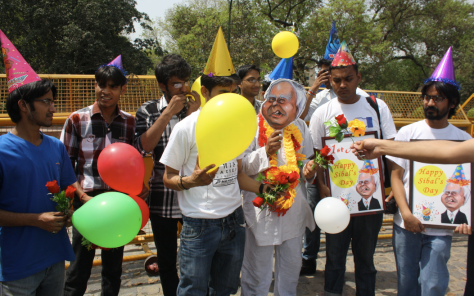
Happy Kapil Sibal’s Day

Aseem Trivedi is a cartoonist in Kanpur. Or was. He has, for some months, been a full-time activist against internet censorship in India. As 2011 was turning into 2012, the Maharashtra police got his domain registrar to suspend his domain, http://cartoonsagainstcorruption.com, which was in support of the Anna Hazare-led Lokpal movement. His website wasn’t blocked, but the domain name suspended – the equivalent of shutting down a printing press. This was done in no time, and he wasn’t given an opportunity to defend his content. This was done thanks to the IT Rules 2011, a simple FAQ about which can be found here. Today, 1 April, Trivedi celebrated “Kapil Sibal’s Day,” calling the Communications minister the fool that he is. In the image below, taken at Delhi’s Rajghat today, Trivedi is standing on the extreme right. For more on Trivedi’s campaign, see http://www.saveyourvoice.in.

Hindi Press Release:

पुलिस प्रशासन के अवरोध के बावजूद राजघाट पर मनाया गया सिब्बल्स डे, पहुचे ब्लोगर्स और सोशल एक्टिविस्ट
1 अप्रैल के दिन पर राजघाट पर सेव योर वाइस की टीम ने आईटी मिनिस्टर कपिल सिब्बल को प्री सेंसरशिप पर दिए गए उनके बयानों के लिए  मूर्ख दिवस की शुभकामनाएं दीं. राजघाट परिसर में बड़ी संख्या में पुलिस बल, आईबी, सीआईडी और सीबीआई के लोग मौजूद थे और सेव योर वाइस के सदस्यों को बापू की समाधि पर जाने से रोका गया. केवल कुछ गिने चुने लोग ही चुपचाप राजघाट पर पहुच पाए. पुलिस ने पूर्व अनुमति होने के बावजूद सिब्बल दिवस का आयोजन नहीं होने दिया. कारण पूछने पर उच्चस्तरीय आदेशों का हवाला दिया गया और कहा गया कि उन्हें पीएमओ . और आईटी मिनिस्ट्री से आदेश दिए गए हैं. काफी गहमागहमी के बाद टीम के सदस्य राजघाट के बाहर समता स्थल पर एकत्र हुए.  Continue reading Happy Kapil Sibal’s Day

How India made it easy for everyone to play internet censor: A primer from SFLC.in

This FAQ has been put out by the Delhi-based SFLC.in

The Central Government notified the Information Technology (Intermediaries Guidelines) Rules, 2011 in April, 2011.  The rules which seek to control the intermediaries end up controlling the actions of users. As these rules attempt to cover a wide range of activities through a duplicate, complicated structure, neither the industry nor the end users are able to understand the boundaries of their rights and duties.

This FAQ aims at making these rules easy to understand and at sensitising the beneficiaries to the problems that the rules raise.

Who are intermediaries? Continue reading How India made it easy for everyone to play internet censor: A primer from SFLC.in

How India Makes E-books Easier to Ban than Books (And How We Can Change That): Pranesh Prakash

Without getting into questions of what should and should not be unlawful speech, this guest post by PRANESH PRAKASH chooses to take a look at how Indian law promotes arbitrary removal and blocking of websites, website content, and online services, and how it makes it much easier than getting offline printed speech removed.

Banning E-Books is Trivially Easy
E-Books Are Easier To Ban Than Books, And Safer
Contrary to what Mr. Sibal’s recent hand-wringing at objectionable online material might suggest, under Indian laws currently in force it is far easier to remove material from the Web, by many degrees of magnitude, than it is to ever get them removed from a bookstore or an art gallery. To get something from a bookstore or an art gallery one needs to collect a mob, organize collective outrage and threats of violence, and finally convince either the government or a magistrate that the material is illegal, thereby allowing the police to seize the books or stop the painting from being displayed. The fact of removal of the material will be noted in various records, whether in government records, court records, police records or in newspapers of record.

By contrast, to remove something from the Web, one needs to send an e-mail complaining about it to any of the string of ‘intermediaries’ that handle the content: the site itself, the web host for the site, the telecom companies that deliver the site to your computer/mobile, the web address (domain name) provider, the service used to share the link, etc. Under the ‘Intermediary Guidelines Rules’ that have been in operation since 11th April 2011, all such companies are required to ‘disable access’ to the complained-about content within thirty-six hours of the complaint. It is really that simple.
Continue reading How India Makes E-books Easier to Ban than Books (And How We Can Change That): Pranesh Prakash

Invisible Censorship – How India Censors Without Being Seen: Pranesh Prakash

Guest post by PRANESH PRAKASH

The Indian government wants to censor the Internet without being seen to be censoring the Internet. This article by Pranesh Prakash shows how the government has been able to achieve this through the Information Technology Act and the Intermediary Guidelines Rules it passed in April 2011. It now wants methods of censorship that leave even fewer traces, which is why Mr. Kapil Sibal, Union Minister for Communications and Information Technology talks of Internet ‘self-regulation’, and has brought about an amendment of the Copyright Act that requires instant removal of content.

Power of the Internet and Freedom of Expression
The Internet, as anyone who has ever experienced the wonder of going online would know, is a very different communications platform from any that has existed before. It is the one medium where anybody can directly share their thoughts with billions of other people in an instant. People who would never have any chance of being published in a newspaper now have the opportunity to have a blog and provide their thoughts to the world. This also means that thoughts that many newspapers would decide not to publish can be published online since the Web does not, and more importantly cannot, have any editors to filter content. For many dictatorships, the right of people to freely express their thoughts is something that must be heavily regulated. Unfortunately, we are now faced with the situation where some democratic countries are also trying to do so by censoring the Internet. Continue reading Invisible Censorship – How India Censors Without Being Seen: Pranesh Prakash

Why ban just a Facebook page when you can erase a holy book or two (or more)?

Following in the wake of the declarations of the well known Internet idiot, who doubles as the honorable minister of telecommunications of the Union of India, an esteemed additional civil judge of a Delhi court has also decided to issue an ex-parte order commanding Social Media networks, Facebook and Youtube to remove 21 (or is it 22?) ‘objectionable’ websites that ‘offend religious sentiments’.

This has been done in response to please entered by a ‘journalist’, a certain Mr. Vinay Rai, and a certain Mufti Aijaz Arshad Qasmi, who also delivers online fatwas on a variety of subjects, ranging from the very intimate to the magnificently cosmic. It is wonderful to behold the learned court acting with such sensitivity to the joint plea of two honorable Hindu-Muslim worthies. Hindu-Muslim-Sikh-Isai – busybodies of every stripe seem to have little other work to do than police and control what can and cannot be said online, shown in a film, performed in a play or depicted in an art work. And our ‘secular’ civil society, and the lower ranks of the judiciary faithfully acquiesce to their every demand. Continue reading Why ban just a Facebook page when you can erase a holy book or two (or more)?

The Absurd Tyranny of iSibal: Vrinda Gopinath

Guest post by VRINDA GOPINATH

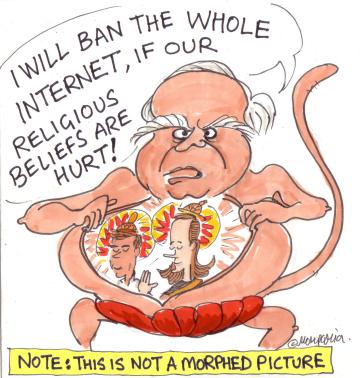
by Hemant Morparia

Well, Information and Technology Minister Kapil Sibal’s prickly suggestion to pre-screen content on social networks like Google, Facebook and Twitter, has invited such derision from the internet world that it has given him a tag to his name – Idiot Sibal. For iSibal, it’s not his status on Facebook that should bother him, but the ruinous unmasking of the minister in status-anxiety New Delhi. Sibal, after all, prides himself in belonging to the elite movers and shakers of the Capital – educated, connected, and gold card holder of the Stephen’s Old Boys Network. For the status seekers, this is a world of privilege and entitlement, cosmopolitanism and tolerance.

Now you would wonder what came over the blue-stockinged Technology Minister to make such an ill-thought out statement. Sibal’s liberal snobbery is not always what it seems to be, for there is a lurking autocratic and despotic streak, even archaic at times, that has surfaced time and again. And it is this aspect that has largely been ignored in the bedlam over his latest decree to social network companies.

Continue reading The Absurd Tyranny of iSibal: Vrinda Gopinath

What Kapil Sibal does not understand: the internet

A  few days ago a friend asked me if I knew someone who had the ability and inclination to help out a certain department of the central government with using social media. My friend did not name who the prospective employer was, but clearly, with even Digvijay Singh on Twitter, the Congress party is worried about social media. No surprise that this should happen in a year when the UPA government’s popularity has taken a nose-dive.

The New York Times revealed on 5 December that Kapil Sibal summoned Facebook officials and showed them a Facebook page that allegedly maligned Congress president Sonia Gandhi and said that this was unacceptable. While HRD officials refused to reveal much in that NYT copy, they must have realised that shit has hit the fan, because the next morning’s Indian Express the spin doctoring was clear: there was now a mention of allegedly derogatory pictures of Prophet Mohammed along with the Prime Minister and the Congress President (who are no doubt as sacred in his books as Prophet Mohammed).By the time he held his press conference yesterday, it became about things that Hurt Our Religious Sentiments. On the 19th anniversary of the Babri Masjid demolition, it is very interesting to see a Congress minister using religion to cover up power politics.  Continue reading What Kapil Sibal does not understand: the internet

Kapil Sibal is an Idiot

I urge you to write KAPIL SIBAL IS AN IDIOT as your Facebook status message, use the hashtag #IdiotKapilSibal on Twitter, and write a blog post with the above title, because there may soon be a day when he may prevent you from doing so.

The New York Times reports:

The Indian government has asked Internet companies and social media sites like Facebook to prescreen user content from India and to remove disparaging, inflammatory or defamatory content before it goes online, three executives in the information technology industry say.

Top officials from the Indian units of Google, Microsoft, Yahoo and Facebook are meeting with Kapil Sibal, India’s acting telecommunications minister, on Monday afternoon to discuss the issue, say two executives of Internet companies. The executives asked not to be identified because they are not authorized to speak to the media on the issue.

[…]

About six weeks ago, Mr. Sibal called legal representatives from the top Internet service providers and Facebook into his New Delhi office, said one of the executives who was briefed on the meeting.

At the meeting, Mr. Sibal showed attendees a Facebook page that maligned the Congress Party’s president, Sonia Gandhi.  “This is unacceptable,” he told attendees, the executive said, and he asked them to find a way to monitor what is posted on their sites. [Link]

Continue reading Kapil Sibal is an Idiot

Your government is removing your YouTube videos and you don’t even know about it

After reporting Google Transparency Tools’ latest revelations about how much India asks Google to delete content and pass government agencies private user data, Firstpost writes, “To put all this in its proper perspective, Indians still enjoy robust Internet freedom – and occasionally even an excess of freedoms…” And then it goes on to compare internet freedom with China, assuring all is well with the world.
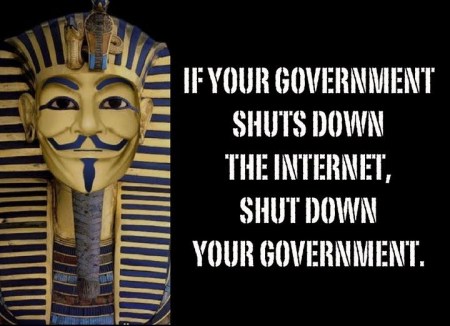
There is no such thing as excess freedom. There is a way to deal with the “scurrilous postings and videos” the article talks about. It’s called the law.

I write an article in a newspaper that is seen as “scurrilous”. The offending party will go to court. The court will decide if it is scurrilous enough to violate the law of the land (be it defamation, libel, or whatever) and summon me. I get a chance to defend myself. Continue reading Your government is removing your YouTube videos and you don’t even know about it

The Day India Will Shut Down the Internet

Sounds alarmist? Perhaps. But under the IT Amnedment Act of 2008, the Government of India gave itself the power to do so. The Economic Times reports: Continue reading The Day India Will Shut Down the Internet

Here’s what India’s Communications and IT Minister thinks about online freedom

Kapil Sibal said the following at a conference on social media in Delhi recently:

We’ve seen the power of the medium in the last six months or so seeking to perform a transformational role, but in the absence of a balance… this is really the danger of sites like these. What happens in the process is that all kinds of opinion get both elicited and taken forward, without the necessary wherewithal, and there’s a great danger, because this, I believe, is a part of freedom of speech. Continue reading Here’s what India’s Communications and IT Minister thinks about online freedom

Updated: Get Ready for India’s Blogger Control Act

Sanchar Bhawan, office of the Ministry of Communications and Information Technology in New Delhi

The Internet in India is regulated by the Information Technology Act (2000) to which amendments were passed in 2008 and in 2009 the IT (Amendment) Act 2008 was passed. The Ministry of IT has now gotten down to notifying additional rules for the Act. Amongst the set of rules is one specifically for cyber cafes, about which I’ll write another post, and there’s one on ‘due diligence on intermediaries’. Intermediaries in the context of internet means that if you post any comment on this blog, I am legally responsible for your comments too. Intermediary liability is a favourite tool of internet censorship by repressive regimes the world over.

To those familiar with Indian laws, this will appear to be routine stuff, the sort of laws that regulate newspapers, for instance, or freedom of expression in India in general. However, three main problems here: one, the over-emphasis on blogs and bloggers, indicating the government’s anxiety over controlling blogs; two, the vagueness and vast scope of the reasons for which the government can block websites; and three, the utterly regressive move of introducing ‘intermediary due-diligence’, a favourite tool of repressive regimes against bloggers.

It is interesting that while “Blogs” and “Blogger” are defined in the Definitions section of this rule, the words aren’t used in the rules per se. In other words, they had blogs in mind while making the rules. These rules, if notified, will basically be India’s Blogger Control Act.

Continue reading Updated: Get Ready for India’s Blogger Control Act

Updated: Crazy internet censorship time in India, again

Update: Please see bottom of the post for several updates.

*

“Shivam!” Nikhil Pahwa of Medianama called this morning. “It’s 2006 all over again. They’ve blocked Typepad.” I instantly knew what this meant. They’ve done this at least twice before, the fellas at CERT-IN. In 2003, 2006 and now 2011.

Typepad.com is a blogging service, much like Google Blogger (Blogspot.com) or WordPress.com that this site, Kafila.org runs on. Now. Airtel users who go to Typepad.com find this:

Users of most ISPs can see this, but government-owned MTNL has ironically not caught up :) Continue reading Updated: Crazy internet censorship time in India, again