
Yesterday, in a corner of Delhi-NCR known as Keshopur, a 22-year old sewage worker breathed his last, a final tortured breath inhaled inside a part of the vast network of sewage pipelines that map the city in their own cartography of waste. The pipeline was owned by the Delhi Jal Board, so its function was not simply to transport sewage, but to transform it into potable water through a portion of the pipeline that resembles a septic tank – a portion known as the ‘digester’.

That Vinay Sirohi, 22-year old contract worker with the Delhi Jal Board, who got married last year and had taken up part-time employment to help him get through college, lost his life in a part of the sewage pipeline called the ‘digester’ imparts something so grotesquely apposite to this tragedy that one almost doesn’t want to think about it. One often doesn’t, of course. One has the option of of flipping the page of the newspaper, of resting one’s eyes on more life-affirming images – English Premier League, Bollywood, Modi-Cameron Cameron-araderie…even Kejriwal’s homely navy-blue sweater and baggy trousers are a pleasant distraction. Anything that tells us that life as it was meant to be – humans wearing a clean sweater and trousers with a sofa to sit on after their stomachs and minds are fed and sated – is better than the thought of a body inside a pipe under the city. When I tried to save the image that you see above, the caption read djb_body_759. I don’t want to think about what that caption means. Does it mean the 759th body found inside the DJB’s sewage network? Does it mean the 759th body to have been recovered by the police this year, 2015? Does it mean the 759th body to have died in sewage pipelines across the country, or ever?
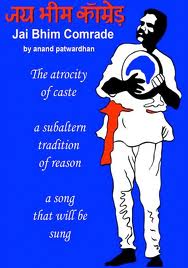 How many murdered Dalits does it take to wake up a nation? Ten? A thousand? A hundred thousand? We’re still counting, as Anand Patwardhan shows in his path-breaking film Jai Bhim Comrade (2011). Not only are we counting, but we’re counting cynically, calculating, dissembling, worried that we may accidentally dole out more than ‘they’ deserve. So we calibrate our sympathy, our policies and our justice mechanisms just so. So that the upper caste killers of Bhaiyyalal Bhotmange’s family get life imprisonment for parading Priyanka Bhotmange naked before killing her, her brother and other members of the family in Khairlanji village in Maharashtra, but the court finds no evidence that this may be a crime of hatred – a ‘caste atrocity’ as it is termed in India. Patwardhan’s film documents the twisted tale of Khairlanji briefly before moving to a Maratha rally in Mumbai, where pumped-up youths, high on testosterone and the bloody miracle of their upper caste birth are dancing on the streets, brandishing cardboard swords and demanding job reservations (the film effectively demolishes the myth that caste consciousness and caste mobilisation are only practised by the so-called ‘lower castes’). Asked on camera about the Khairlanji murders, one Maratha manoos suspends his cheering to offer an explanation. That girl’s character was so loose, he says, that the entire village decided to teach her a lesson.
 KAFILA - COLLECTIVE EXPLORATIONS SINCE 2006