दिल्ली पहुँचने के बाद और 26 जनवरी से पहले, ऊपरी तौर पर सरकार ने किसान आन्दोलन की राह में कोई रोड़े नहीं अटकाए और किसान आन्दोलन को दबाने की रणनीति दबी-ढकी थी। परन्तु अब सरकार खुल कर किसान आन्दोलन को दबाने का प्रयास कर रही है। न केवल आन्दोलनकारियों का बिजली पानी बंद किया जा रहा है और उन पर पथराव प्रायोजित किया जा रहा है बल्कि आन्दोलन स्थल तक पहुंचने के रास्ते भी बंद किये जा रहे हैं। इन्टरनेट जो आज झूठी ख़बरों के साथ साथ जानकारी का भी मुख्य स्रोत बन चुका है, बल्कि आज जीवन की बुनियादी ज़रूरत बन चुका है उस पर भी आन्दोलन स्थलों के आसपास के इलाकों में रोक लगा दी गई है। यहाँ तक की आन्दोलनकारियों द्वारा कोई रूकावट न डाले जाने के बावजूद, रेलगाड़ियों के मार्ग परिवर्तन किये जा रहे हैं या रेल सेवा बंद की जा रही है जिस से न केवल आन्दोलनकारी किसानों या उन के समर्थकों को परेशानी हो रही है अपितु आमजन भी परेशान हो रहा है। ऐसा प्रतीत होता है कि सरकार किसान आन्दोलन से बिलकुल बेपरवाह है।
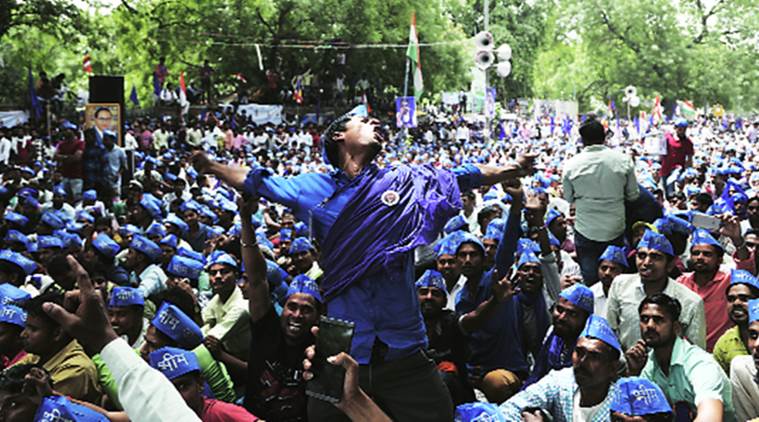
Even as the state government’s repression on Bhim Army continues, most of its leaders still in jail and some forced to leave Saharanpur, a committee has been formed for the defense of Bhim Army. (For background information, please see the ‘Note on Bhim Army’, appended at the end of this post, which carries links to informative videos as well). A group of activists and committed lawyers have been following up the legal struggle practically at their own expense – which at the moment involves getting the arrested activists, including the founder-President Chandrashekhar out of bail as the topmost priority. Some of the activists have started getting bail many still remain, including just ordinary people simply picked up by the people and framed by the police as Bhim Army activists.
However, getting the jailed activists out on bail is simply the first step in a long battle. The deliberate campaign of vilification that has been going on about Bhim Army has tried to paint the organization as ‘antinational’ and ‘instigators of violence’ who apparently have ‘Naxalite’ connections. Even though none of this could be substantiated and thus brought by the police into their charges against the jailed activists, the campaign of demonization has nevertheless continued through some sections of the media. Needless to say, such misleading campaign is meant to incite popular feelings against such groups who have been working mainly for education and self respect among the Dalit population in their area. Such a campaign of vilification cannot but affect the chances of wining the legal battle as well. It also ends up driving people who may have initially been sympathetic to their cause by sowing doubts about them in the popular mind.
It is with this concern in mind that a large number of citizens from different walks of life have come together to form the Committee for the Defense of Bhim Army, in order to mobilize all possible support for the embattled activists.
The Committee for the Defense of Bhim Army has been constituted comprising the following members from different walks of life:
Coordinators: Pradeep Narwal and Sanjeev Mathur
Treasurers: Presenjit Gautam and Nakul Singh Sawhney
Anand Teltumbde, Civil rights thinker and activist, Mumbai
Jignesh Mewani, Rashtriya Dalit Adhikar Manch
Kancha Ilaiah, Political scientist, thinker and writer, Hyderabad
Chandrabhan Prasad, Dalit thinker
Radhika Ramaseshan, Senior journalist with Business Standard
Harsh Mander, Human rights activist and Director, Centre for Equity Studies, Delhi
Syeda Hamid, Former member, Planning Commission
Om Thanvi, Senior journalist, former editor, Jansatta
Sambhaji Bhagat, Cultural activist, Maharashtra
Meera Velayudhan, Academic, Centre for Development Studies, Trivandrum
Martin Macwan, Social activist, Gujarat
Ratan Lal, Academic, Hindu College, Delhi University
Sachin Mali, Cultural activist
Sheetal Sathe, Cultural activist
S.R Darapuri , Former IPS officer, social activist
Colin Gonzalves, Lawyer
Anand Patwardhan, Film maker
Anil Chamadia, Journalist
Subhash Gatade, Writer and social activist
Akram Hassan, Social activist, Shamli
Surender, Dalit youth activist, Delhi University
N. Sukumar, Academic, Delhi University
Rehana Adib, Social activist, Saharanpur
Banojyotsna Lahiri, Academic and independent researcher
Mohammad Zeeshan Ayyub, Actor
Amar Singh, SC/ST Trade Union, Delhi University
Dr. Mahesh Chandra, Bhim Army
Sanjay Tegwal, Bhim Army
Zakia Soman, Bharatiya Muslim Mahila Andolan
Presenjit Gautam, Jati Todo Manch, Ghaziabad
Pradeep Narwal, Dalit youth activist, Jawaharlal Nehru University
Saroj Giri, Academic, Delhi University
Tushar Parmar, IRS
Sanjeev Mathur, Journalist
Nakul Singh Sawhney, Film maker
Praveen Verma, Research scholar, Delhi University
Aditya Nigam, Academic, Centre for the Study of Developing Societies, Delhi
[ Even as the repression on students in universities, continues, the BJP regimes in Rajasthan and Haryana have attacked peaceful assemblies of young workers in the National Capital Region (NCR). This calls for widening and deepening the resistance against the Modi regime, whose fascist character is now nakedly visible. When the state starts hunting down workers and students at the same time, it is time for workers and students (and their friends) to stand united together and resist the repression by all means necessary and possible. We are posting below an account by Nayan Jyoti, a young activist, of the violence unleashed by the BJP governments in Rajasthan and Haryana, in collusion with factory managements, using the brute force of armed police and hired thugs in the last few days, with the hope that it will add crucially to our understanding of what exactly is going on in India.The Modi regime is in a deep crisis, and the only way the BJP (both at the centre and at the provincial levels) knows how to respond is through violence. Modi is the best student of Indira Gandhi in Indian politics, and he is following totally in her footsteps, invoking exactly the same ‘Anti-National’ tag, especially in terms of the way she led up to the declaration of the emergency in 1975. Things are different now, but also very similar. This is the beginning, as the author of this post says, of an undeclared emergency. The difference between a declared and an undeclared emergency appears at the moment to be only a formality. It is time we saw through the veil of this formality.]
We #standwithJNU and raised our united voices against State repression and witch-hunt of students for #righttodissent since 9th February. On 18th February, more than 15,000 people said so clearly in Delhi and pointed out that this has directly followed in a coordinated manner more recently from the institutional murder of Rohith Vemula in HCU by the anti-Dalit administrations under influence of the BJP, and right-wing attack on FTII students to completely control freedom of thought and expression earlier and the murder of progressive intellectuals by right-wing groups in recent times.
As this terrorizing and silencing of progressive voices, students and intellectuals goes on by both the BJP government and its police-administration from the top and the RSS vigilante groups on the streets, another much more brutal crackdown on thousands of workers has just happened and continues in the Haryana-Rajasthan border.
“Is it a crime to work in a democratic and peaceful way for the empowerment and development of Adivasis”?
– Adivasi Mahasabha Gujarat & People’s Union for Civil Liberties, Gujarat.
Mr. Avinash Kulkarni and Mr. Bharat Pawar, activists of long-standing repute, have been working relentlessly for the rights of the Adivasis of Gujarat, over the past 15 years. Based in Ahwa, Avinash and Bharat have been actively involved on issues pertaining to the empowerment and development of Adivasis, through the Dangi Lok Adhikar Samiti and the Dangi Mazdoor Union, in Dang district. Avinash and Bharat have played a significant role in the struggle for the Forest Rights Act and for people’s rights to use, manage and control forests and forest resources as part of the leadership of Adivasi Mahasabha Gujarat, both in the advocacy and struggle that brought about the Forests Rights Act and the monitoring of its implementation across the Adivasi areas of Gujarat. It is a well known fact that they have always worked for democratic and peaceful means of securing the rights and entitlements of the Adivasis and have stood by non-violent means of working for social change.
In the afternoon of 21st March, 2010, about 2 P.M Avinash was picked up by Dy. S. P. Shri Patil under the pretext of questioning and took him to an undisclosed location, without giving any information to his family members or colleagues as to where they were taking him or giving him the right of contacting his advocate. Bharat Pawar also was detained the same evening in a similar fashion by policemen from the DSP office of Ahwa, Dangs. This is a clear violation of Justice D. K. Basu Guideline of Supreme Court. Continue reading Arrests of Activists in Gujarat→
 KAFILA - COLLECTIVE EXPLORATIONS SINCE 2006