
Guest post by VIDHYA A

Image courtesy Subcontinental wind
In a statement issued on April 16th 2018, the Ministry of Home Affairs (MHA) claimed that the ‘National Policy and Action Plan’ to combat Left Wing Extremism (LWE) is ‘a multi-pronged strategy involving security and development related measures’[1]. This new policy, apparently in place since the NDA government came to power at the centre, claims to have ‘zero tolerance towards violence coupled with a big push to developmental activities so that benefits of development reached the poor and vulnerable in the affected areas’[2]. The statement talks of substantial improvement in the LWE scenario by indicating reduced incidents of violence over the last four years. Within a week of this statement to the press, several Maoists are killed in an alleged encounter in Gadchiroli district of Maharastra and, then, in Bijapur district of Chhattisgarh[3]. The Maharashtra state police immediately issued press notes and organised a press conference on April 24th declaring the operation an unmitigated success. A week later, Chhattisgarh police did the same. Even as the death count of Maoists kept rising, the police claimed that none of their personnel, primarily the elite C-60 force in Maharashtra and the Central Reserve Police Force (CRPF), were seriously injured let alone killed in action.
Continue reading Disinheriting Adivasis – The Gadchiroli Game Plan: Vidhya A
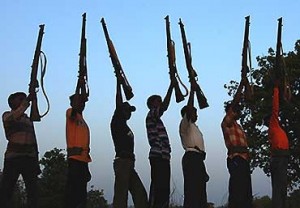 The Supreme Court has held that the use of extra-legal armed forces in Chhattisgarh is unconstitutional. Responding to a PIL filed by Nandini Sundar, Ramachandra Guha and E.A.S. Sharma, the court’s decision turns on the nature of the Salwa Judum and the appointment of special police officers under the Chhattisgarh Police Act. But if it were a judgment that had merely ruled on the technicalities, it would have been a welcome and competent order, but would have missed its moment of constitutional greatness. This judgment attains such greatness by virtue of its deft combination of insightful legal analysis, the articulation of a moral vision of constitutionalism and development and its sharp invocation of rhetoric (in the best sense of the term) and fiction to buttress its arguments.
 KAFILA - COLLECTIVE EXPLORATIONS SINCE 2006