All posts by Shivam Vij

Shivam Vij is a writer and journalist based in New Delhi.

Kashmir: A Time for Freedom

Guest post by ANGANA CHATTERJI
First published on 25 September 2010 in Greater Kashmir

“Freedom” represents many things across rural and urban spaces in India-ruled Kashmir. These divergent meanings are steadfastly united in that freedom always signifies an end to India’s authoritarian governance.

In the administration of brutality, India, the postcolony, has proven itself coequal to its former colonial masters. Kashmir is not about “Kashmir.” Governing Kashmir is about India’s coming of age as a power, its ability to disburse violence, to manipulate and dominate. Kashmir is about nostalgia, about resources, and buffer zones. The possession of Kashmir by India renders an imaginary past real, emblematic of India’s triumphant unification as a nation-state. Controlling Kashmir requires that Kashmiri demands for justice be depicted as threatening to India’s integrity. India’s contrived enemy in Kashmir is a plausible one – the Muslim “Other,” India’s historically manufactured nemesis. Continue reading Kashmir: A Time for Freedom

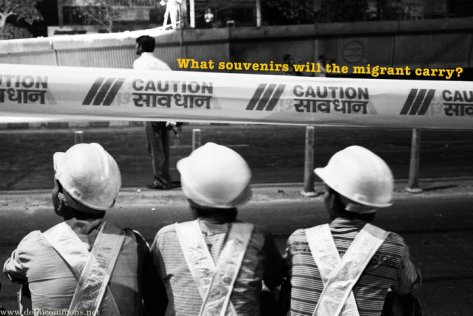
Commonwealth Postcards

This and other postcards, expressing what many Delhi residents feel about the Commonwealth Games, have been put out by Delhi Commons (Facebook). They are available at Sarai CSDS (North Delhi), People Tree (Central Delhi) and Yodakin Bookstore, Hauz Khaz Village (South Delhi).

Ramzan in Jamia Nagar

It is Ramzan time in Jamia Nagar – municipal workers clean the streets and line it with chuna lime, bakeries are piled high with sewain, and halwais have begun preparing the special iftar food. The police are busy too, but residents can comfort themselves with the thought that it is only to regulate traffic in the congested lanes. As the clock ticks towards iftar, the road from the Jamia Milia Islamia University towards Batla House is made one-way: the way in, to help the rushing crowd reach home in time, picking up fruit and pakwan (snacks) on the way.

The residents’ relationship with the police here is notoriously complicated. Until 2007, Jamia Nagar only had a police post, but during Ramzan that year a policeman was accused of desecrating the Quran, and the dispute led to the police post turning into a full-fledged police station. In 2008, it was during Ramzan that the police engaged alleged bomb-plotters in a firefight, an “encounter” that’s widely regarded to have been fake. A few weeks later, a jeepful of Noida policemen in plainclothes attempted to kidnap a local man, but residents poured out and chased them away. Continue reading Ramzan in Jamia Nagar

On torture in India and China

Guest post by FAHAD MUSTAFA

On 31st May, the Chinese government released guidelines that banned the admissibility of evidence obtained under torture in criminal convictions. This came a few weeks after the revelation of the seemingly bizarre, yet not completely uncommon, case of Zhou Zuohai.  Zhuo was released after being imprisoned for 11 years in Shanqqi, on charges of murder, when his alleged victim was found alive in his village. He was imprisoned on the basis of his confession of the crime.  A couple of days after he was released the authorities admitted that the confession was obtained under torture. Zhuo described his beatings: the pouring of chilli water in his eyes, the bursting of firecrackers over his head, and how he thought he would not survive. When he said what he was expected to say, the torture stopped, and he was convicted.

Lawyers, police, and governments in most countries, including China, understand that torture is counterproductive in extracting evidence. Indeed, China has issued several directives earlier to say that evidence under torture is unacceptable. As in the case of Zuohai, most confessions of this sort are false or misleading, and are given only to make the immediate suffering stop. Why then do police forces continue to use torture or the threat of it as a means to extract evidence? Continue reading On torture in India and China

Governing Kashmir: Critical Reflections on the Historical Present

Guest post by RICHARD SHAPIRO

The Indian state’s refrain to the people of Kashmir is as follows: Indian rule of Kashmir is legitimate because India is a secular democratic republic, organized by rule of law and constitutionally guaranteed human rights. As a democratic state, rule of law may be suspended for national security reasons to protect the state, and such action has been necessary in Kashmir because of cross-border terrorism and ‘separatist’ elements in Kashmir that includes armed militants. The suspension of democratic rights in Kashmir, India states, is necessary to protect India as a secular democratic republic. Elections are periodically held and touted as proof of democracy in India, but without a vibrant civil society ensuring social freedoms, electoral processes obfuscate the subjection of Srinagar to New Delhi and give Indian governance greater legitimacy than if the center took official control over the state of Jammu & Kashmir.

What is the logic of the Indian state to which Kashmiris are subjected? The people of Kashmir must be denied the rights guaranteed to citizens of India because every Kashmiri is considered a real or potential threat to India. Kashmiris are citizens of India who are denied the rights of citizens to protect the state as the guarantor of rights. Law and order demands the denial of democratic rights to the people of Kashmir. Freedom of assembly and movement, freedom of speech and expression, freedom of press, freedom of religion are the basic rights that make India a legitimate state, and it is precisely these rights that must be denied all Kashmiris because when Kashmiris exercise these rights it is considered evidence of the anti-national sentiment of Kashmiris. Continue reading Governing Kashmir: Critical Reflections on the Historical Present

Godhra, arson, terrorism, stone-pelting, Dalits and Muslims, and other such issues in village Lehna

A fact-finding report released today by PUCL Uttar Pradesh

Fact Finding Report on the murder of MNREGA and labour activist Shri Hari Lal, Village Lehna, Block Manjhanpur, District Kaushambhi on 15.08.2010

A fact finding committee to investigate the incident was formed with the following: members

  1. Mr. S.R.Darapuri, Retired IPS, Vice President UP PUCL.
  2. Mrs. Arundhuti Dhuru, Consultant to Commissioner Right To Food Committee of Supreme Court.
  3. Mr. Ram Kumar, Vice President UP PUCL.
  4. Mr. Jawed Rasool, Dyanmic Action Group.
  5. Dr. Nisha Srivastav, Professor  (Deptt. of Economics ), Allahabad University .
  6. Mr. Rajni Kant Rai, HRLN, Allahabad .
  7. Mrs. Bindu Singh, Convener UP Right To Food Campaign .
  8. Mr. Sanjay Singh, convenor, Parmarth, Oriye, Jalaun

The committee visited the site of incident in village Lehna  on 21.08.10 .The fact finding committee met the family members of the late Hari Lal, other residents of the village, and workers and officials of Voice of People’s (VOP). The committee also met the district magistrate and spoke to the superintendent of police. The following facts about the incidents came to light through this enquiry:

Background to the Incident

The main issue behind this incident was of MNREGA and payment of labour wages. According to the available evidence, a pond was dug in the village by 250 labourers from the panchayat quota of MNREGA in April, May and June 2007. However, the gram pradhan, Tirath (Dhobi), did not pay the labourers full wages. The gram pradhan is a mere puppet in the hands of a former gram pradhan, Bassan, and his son Fateh and a criminal named Nakkan. Continue reading Godhra, arson, terrorism, stone-pelting, Dalits and Muslims, and other such issues in village Lehna

Why Kashmiris should speak to Indians, not India

On 28 May this year, the Economic Times, India’s leading business daily, carried a story titled, ‘Kashmir survey finds no majority for independence’. That is a curious headline. What is ‘no majority’? Either there is majority or there is not. Robert Bradnock conducted this survey for Chatham House, a leading British think-tank, Kashmir on both sides of the Line of Control. The survey was conducted in the autumn of 2009, and the copy mentioned that 44 percent in Azad Kashmir and 43 percent in Jammu & Kashmir favoured an independent Kashmiri nation state.

Similar was the reporting of the survey in other Indian papers. They omitted some details, though. They did not mention that the survey was conducted not just in Kashmir but also the Jammu and Ladakh regions. They did not mention that even after factoring in Jammu and Ladakh, the total support for India was 21 percent and for Pakistan 15 percent. So if there was a three-way poll, the whole region’s average figure of those supporting independence (43 percent) would win hands down. Most of the rest (14 percent) favoured making the LoC a permanent border, which means sealing the status quo, something India and Pakistan came very close to doing in 2007. This 14 percent comes only from Poonch (94 percent), Rajouri (100 percent) and Jammu (39 percent).

Further, they did not mention that in the district-wise results the greatest support for independence was in the Indian side of the Valley – an astounding 95 percent in Baramulla, 75 percent in Srinagar, 82 percent in Badgam, and 74 percent in Anantnag. Pulwama and Kupwara were not surveyed. The highest support for India was 80 percent in Kargil and 67 percent in Leh, 73 percent in Udhampur and 63 percent in Kathua. In Jammu district, it was 47 percent – ‘no majority’. In Azad Kashmir, 50 percent wanted to be with Pakistan.

Now read the ET headline again. ‘Kashmir survey finds no majority for independence’. The story does not tell us what they found a majority supporting. If we have to be polite, we can say that such manipulative reporting of a detailed survey amounts to the Indian media being in denial of the fact that Kashmiris don’t want to be with India. If we have to call a spade a spade, we can say that this amounts to telling us a lie. Read More

Murder of an activist

This report comes from KK ROY

MNREGA Fighter and leader of Voice of People (VOP) Hari Lal of District Kaushambi, U.P. has been killed in broad day light at 12.00 Noon in his village Lahna, Block Manjhanpur district Kaushambi on independence day, 15 August 2010 at the instance of the corrupt Gram Pradhan Tirath Lal by the contract killers. Thousands of members of the VOP and other organisation gathered in the village and made militant protest, burnt the houses of the killer. A heavy contingent of armed police lead by District Magistrate, Superintendent of Police, Circle Officers and SHOs of various police stations entered into the village and let loose the reign of terror over the villagers, women and children. Two FIRs has been lodged against the leaders and members of the VOP including the common villagers. The leader of VOP Parvez Rizvi has been named in both the FIRs. One FIR has been lodged u/s 307, 322, 334, 352, 147, 148, 149 IPC and 7 Criminal Amendment Act in which 5 persons have been named and the second FIR has been lodged u/s 353, 336, 506, 427, 352, 436, 392, 147, 148, 149 IPC and 7 Criminal Amendment Act. Both the FIRs have been lodged by police andin both the FIRs VOP leader Parvez Rizvi has been named. Continue reading Murder of an activist

Pushing the Kashmiri to the wall, again

[An edited, shorter version of this article by me appeared last week in The Friday Times, Lahore.]

In the first week of June, I sat at a shopfront with a group of shopkeepers of Kalarus, a small town in Kupwara district in north Kashmir. In 1999, they collected money and bought land for a martyrs’ graveyard, one of many such in Kashmir. Whenever the Indian army killed militants trying to infiltrate from Pakistan to the Indian side of the Line of Control, they would hand over the bodies to the Kupwara police, who would give it to these people to bury after the autopsy.

“Look up at the mountain peak,” said one of them, “It is snow clad all twelve months. It is the LoC, 70 kms from here. Do you think anyone would cross that wearing the traditional Kashmiri Khan dress?” And yet, most of the hundred odd bodies in the graveyard had come wearing clothes unfit for snow. And, most of them had so many bullet marks on the face that they were unidentifiable. Continue reading Pushing the Kashmiri to the wall, again

Dear Chattisgarh Police, Are You Mad?

Javed Iqbal of The New Indian Express on being targeted by the Chattisgarh Police as being on the side of the Maoists:

A High Court lawyer from Mumbai was in Dantewada a few days ago and had gone to the police station to speak to the police and understand the ground realities of Dantewada. SSP Kalluri accused him of being a Naxalite informer, and had him locked up in the police station. He was eventually let off the same evening, visibly shaken, after some frantic phone calls.

The very fact that the Chhattisgarh police would rather target civil society activists, opposition party workers and journalists than investigate the Maoists, is explicit proof of their incompetence. A kind of fascinating wife-beating syndrome, where they can’t get the Maoists, so the insecure, frustrated police will go after soft targets like journalists, activists and opposition party members.

They arrested CPI party workers for the attack on Audesh Singh Gautams home, and adivasi CPI leader Manish Kunjam confirmed the same. He, himself, has no police security. It was withdrawn by the police months ago even though there have been numerous threats to his life. He has been openly critical of the Salwa Judum that roams around Bastar, armed to its teeth, and has spoken up against corporate land grab, supporting and helping to organize the anti-displacement movements across Bastar.

Now, according to the police press release that implicated Lingaram Kodopi, Nandini Sundar, Medha Patkar and Arundhati Roy, I’ve been mentioned as someone who had gone with the Maoists, ‘videographing’ their failed assassination attempt on Audesh Singh Gautam.

Forget that they police don’t know the difference between a ‘photographer’ and a ‘videographer’. Forget that the police don’t know that at 1:00am there’s no light, and videography and photography is useless. And I believe the Maoists have infra-red cameras? Why? Because they’re ‘infra-red’? [Read the full post]

In Kashmir, everyone’s losing the plot: Peerzada Aashiq

Guest post by PEERZADA AASHIQ

Everyone is losing its plot in Kashmir — be it separatists, mainstream political parties, New Delhi or Pakistan. The biggest losers in the unarmed but stone-laden street uprising are Pakistan and separatists.

The failure of Pakistan in shifting paradigm of new realities in Kashmir can be gauged from its dwindling influence over separatists’ spectrum. It failed to unite fractured separatists to its 1992-like unified forum politics despite placing in half-a-dozen interlocutors between warring factions of the All Parties Hurriyat Conference led by Sayed Ali Shah Geelani and Mirwaiz Umar Farooq.

Its influence over separatists’ spectrum has been wavering and waning. It was after former Pakistan President Pervez Musharraf pick-and-choose policy that saw separatists cocooning and ensconcing their politics as per the public mood in Kashmir. If Musharraf’s four-point formula convinced moderate Mirwaiz Umar Farooq, many hard-liners like Sayed Ali Shah Geelani and United Jehad Council chief Sayed Salahuddin rejected it. Continue reading In Kashmir, everyone’s losing the plot: Peerzada Aashiq

Curbs continue on Kashmir media; is it martial law in Srinagar?

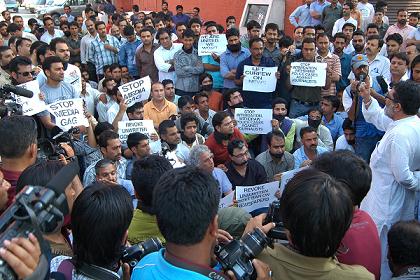
Media persons stage protest at Press Enclave in Srinagar against Government’s decision to gag media. Habib Naqash/GK

Update 2 on 11 July: As was being feared, the state has begun to crackdown on Facebook users for ‘anti-India activiies’. I can already spot one Facebook account missing. Very soon they will ban eating, drinking, breathing and shitting and offer curfew passes to some for these activities.

Update: Appeals to the Indian government by the Committee to Protect Journalists and IFJ.

In a clear signal that it continues to dictate what we get to know about the ground situation in Kashmir, curbs on the local media in the Valley continue despite government claims that they have been lifted. At the same time, Delhi journalists are able to freely move around and report in Srinagar. This is yet another blatant example of how the Indian state considers Kashmir its private property and the rights of its residents are secondary. As the Delhi media continues to do the bidding of the Home Ministry, the best sources of news on what’s happening on the ground remain Twitter and Facebook. Those updating their profiles and pages with information are doing so with the apprehension of censorship, state reprisal, blocking of these sites and suspension of internet services altogether in Kashmir. Continue reading Curbs continue on Kashmir media; is it martial law in Srinagar?

Kashmir, Lies and Audio Tape

The disinformation war is underway. Kashmir’s local media has been BANNED (not censored but BANNED!) in the world’s largest democracy, and the Delhi media is being used to spread LIES.

But what is a flag march?

Protest not allowed, this is Kashmir

So far in 2010, ‘security’ forces have killed 32 innocent Kashmiris, sometimes not even in a protest. Far from investigating these killings and promising justice, India has banned protest in Kashmir, which is what curfew amounts to, and even the media is not allowed to function. Curfew passes have been canceled even for journalists – there were no newspapers this morning. 12 photojournalists have been beaten up. Newspapers have been BANNED!

The Delhi media reports that the army has been brought into Srinagar for an indefinite period, and that the army staged a flag march. However, what is a flag march? It can’t be a security measure to deal with terrorists because there is complete curfew. The army has been asked to strictly impose the curfew. People are dying because they are not allowed to go to hospitals. After killing 32 innocent people what does “maximum crackdown” by 1,700 Indian troops in Srinagar mean? And if not even a bird is allowed on the streets, who or what is the flag march for? Continue reading But what is a flag march?

If you’re still wondering why Kashmir is protesting and demanding azadi…

‘Mother I will make you cry today’

Dr. SYEDA HAMEED has sent us this poem

‘Mother I will make you cry today’

(On June 30th 2010, Asif Rather age nine ran out of his home in Baramulla in Kashmir to look for his older brother. As he left, he told his mother ‘I am going to make you cry today’. Minutes later he fell victim to shooting by the forces. At the time he was 150 meters from his house. – The Indian Express)

He stood at the sunlit door
A nine-year old with tousled hair
Asif Rather, student of class four,
Baramulla, 55 kms from Srinagar

‘Where is Touqeer?’
He sought his older brother.
‘Nowhere! You come back now
Here’s tea and last night’s bread
My baby, let me comb your hair’

Outside, the sounds Allah o Akbar
Chanting at once, one thousand strong Continue reading ‘Mother I will make you cry today’

Living the Lesser Life

Guest post by SHRIYA MOHAN

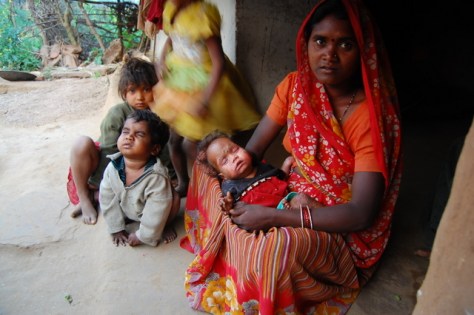
A Mawasi tribal mother with 2 out of four of her children severely malnourished

Long ago Bhagavan called all the tribes of mankind for a feast. On one side he put rice, dal, vegetable and meat curry for the Hindu. On the other side he put chapattis ghee and sugar for the Baiga and Gond. As they were about to eat, a rat ran across the floor. Since Bhagavan had provided no meat for the Baiga and the Gond, they all chased the rat so they could add it to their feast. But they couldn’t catch it. When they came back they found that the Hindus had taken away all their chapattis, ghee and sugar and there was nothing left for them. Then Bhagavan dropped water into the pot in which the rice had been boiled and gave it to them. “This is paige”, he said. “And you will eat it forever.”

– Verrier Elwin, The Baigas, 1939 Continue reading Living the Lesser Life

A conversation in Sopore and other stories

The street that connects that Malaknag and Chheni Chowk areas of Islamabad/Anantnag in south Kashmir. Photo by Nasir Patigaru, via Facebook, posted on 27 June.

Which Indian has not heard of General Dyer? General Dyer opened fire on unarmed protesters. Hundreds died, the figures are disputed between Indian and British version to this day. A commission of enquiry was set up by the English. General Dyer told the Hunter Commission, “I think it quite possible that I could have dispersed the crowd without firing but they would have come back again and laughed, and I would have made, what I consider, a fool of myself.” Continue reading A conversation in Sopore and other stories

Three poems by Meir Wieseltier

Guest post by ADITYA SARKAR

Here are three poems by a remarkable Israeli dissident poet Meir Wieseltier. Over and above anything else, they’re beautiful poems, but they might also have something to say about the recent attacks of Gaza and the West Bank, even though they address much earlier events and times If nothing else, they might be a reminder that the kinds of issues related to Israel/Palestine that have been discussed on Kafila and elsewhere are in no sense new – each poem seems absolutely contemporary, even though they were written in 1973, 1978 and 1986 respectively. They might remind readers that far from being a ‘tragic mistake’, as the BBC and other liberal apologists have it, the attack on the flotilla represents the mainstream, indeed the only, dimension of Israeli state policy.

The last of the three poems was actually reprinted in The Nation on 15 April 2002, four days after the Israeli massacre of Palestinians at Jenin, which killed fifty people – another absolutely typical act of ‘Israeli self-defense’ that most accounts blank out. Continue reading Three poems by Meir Wieseltier

IPTK Statement on Military Governance in Indian-administered Kashmir

Military Governance in Indian-administered Kashmir

STATEMENT: FOR IMMEDIATE RELEASE
Srinagar, June 29, 2010

INTERNATIONAL PEOPLE’S TRIBUNAL ON HUMAN RIGHTS AND JUSTICE IN INDIAN-ADMINISTERED KASHMIR (IPTK) | www.kashmirprocess.org


The People’s Tribunal feels morally obligated to make this statement today. Sustained alliances between local communities and IPTK have enabled us to bear witness to the escalating conditions induced by militarized governance, and the severity of psychosocial dimensions of oppression in Indian-administered Kashmir. From our work since being instituted in April 2008, from the reports and briefs we have authored, investigations we have undertaken and are in the process of completing, we find it ethically imperative to comment on the direction in which the Governments of India and Jammu and Kashmir, and the Indian Armed Forces, appear to be headed, and the consequences they will likely effect. Continue reading IPTK Statement on Military Governance in Indian-administered Kashmir

Kashmir: The Hidden Occupation

Guest post by YASMIN QURESHI

Yasmin Qureshi grew up as a member of India’s Muslim minority before moving to the San Francisco Bay Area. She is a social justice activist who traveled to Palestine in 2007 and to Kashmir last year. This article is a reflection on her trip to Kashmir.

I wanted to go to Kashmir ever since I visited Palestine in 2007. There are many similarities in the nature of the occupation as well as the struggles, both being nearly 63 years old.

One difference is that while Israel is seen as an external occupying force in Palestine, the Kashmir issue is considered an “internal” matter or a conflict between Pakistan and India, and the voice of Kashmiris is often lost. As a result, there are fewer international organizations monitoring the region, and little information about the extent and impact of the occupation gets out.

A layoff from my company in August 2009 gave me the opportunity to visit the region, called “a paradise on earth” by Mughal emperor Shah Jahan. The unanimous message I heard as I traveled and spoke to journalists, taxi drivers, pony riders, waiters, students and teachers was that they want “azadi,” independence from the occupation by India. Continue reading Kashmir: The Hidden Occupation