Category Archives: Frontiers

Celebrating Faiz

2011 marks the birth anniversary of one of Southasia’s greatest poets, Faiz Ahmed Faiz. Centenary celebrations are planned in Pakistan, India and Bangladesh throughout this year. The Southasian magazine Himal has brought out in its January 2011 issue a set of six articles on Faiz. A note accompanying the issue reads:

Over the course of human history, intellectuals and artists have helped broaden the scope of citizenship and the nebulous contours of citizen rights. Southasia is no exception. Despite its colonial past and internal fault-lines, it can boast of extraordinary individuals who have stood up against tyranny and reaffirmed the innate strength of the human spirit. Continue reading Celebrating Faiz
Justice for Aasia Bibi; Speedy Trial of Salman Taseer’s Killers: New Socialist Initiative, Delhi

Statement from the NEW SOCIALIST INITIATIVE, Delhi

History is said to be made when humanity has tried to break asunder forces of unreason, irrationality, bigotry, intolerance and reaction which keep reappearing in newer forms in its onward journey. But what can one say when it tries to do the exact opposite, or prefer to go back on the path undertaken.

Pakistan, a country of 170 millions, stands at a similar juncture today.  Continue reading Justice for Aasia Bibi; Speedy Trial of Salman Taseer’s Killers: New Socialist Initiative, Delhi

Would the secession of South Sudan be good for Africa?

On January 6th, it is almost certain that a referendum in South Sudan will lead to a vote to secede from the rest of the country, thus paving the way to the formal inauguration of Africa’s 54th sovereign state. The vote comes after many years of discord between Sudan’s Arab-and-Muslim north and its black, animist and Christian south, and civil war in which almost 2m have died. Thus, divorce seems the only option in Sudan’s case. However, many in Africa, including the African Union, which has long inveighed in principle against secessionist tendencies in Africa, worry that it could set a trend that encourages other self-determination movements on the continent, potentially causing instability and worse. Others argue that the right of all peoples to self-determination must be allowed to hold good. In these terms, would the secession of South Sudan be good for Africa?

Well, you can cast your vote here.

See also: Celebrations across south as millions flock to polling stations.

Anees Ahmed Ganai, 17

And that’s only one of 115, only from one year of many years.

The Logical Urges of Sedition

[An edited version of this article by me has appeared in the November-December 2010 issue of Conveyor, a magazine published from Srinagar.]

On 22 October 2010, there was a public seminar in Delhi, titled “Azadi: The Only Way”. I did not plan to attend it as I had important work that day. However, a day before the event, it was announced that the keynote speaker would be none other than Syed Ali Shah Geelani. How could one not go to hear what the man of the moment had to say?

I reached late, when two speakers had already spoken, Kashmiri Pandits had already created a scene, even getting into a physical fight with some Kashmiri Muslims. As I entered the precincts of the Little Theatre Group auditorium, I met Delhi University student Suvaid Yaseen who showed me a small cut in his hand, caused by the fisticuffs with the Pandits. Some of the Pandits had been taken away by the Delhi Police and detained for a few hours, many others still inside the auditorium. The auditorium was full of cries of “Hum kya chahtay? Azadi!” To hear that in central Delhi rather than Srinagar’s Lal Chowk is a little incredible. But it had happened before, on 7 August, at Jantar Mantar, the only place in the capital of the world’s largest democracy where protest is allowed. At Jantar Mantar too, Pandits were being restrained by the Delhi Police. Continue reading The Logical Urges of Sedition

Noor Sahab in Horror Land: Gowhar Fazili

Guest post by GOWHAR FAZILI

Some old memories came to mind when Noor Mohammed Bhat, a college lecturer in Kashmir got arrested for asking in an examination, “Are the stone pelters real heroes? Discuss.”

I studied at Burn Hall, a missionary school in Srinagar. In the mid-‘80s, they would make us recite the national anthem in the morning assembly on one of the week days. Interestingly, while the little kids would do as they were told, the ‘big’ ones who had just crossed their sixth grade, would for some strange reason go off tune so that Jana Gana Mana… would start sounding like “Jaaaaaanaooauea maaaoAAAonaa gaooooOOnaannNNaaaA…”, like it were a sound coming out of an audio tape that was stuck or a damaged gramophone record! This bad behaviour invited corporal punishment. Shah Sir and Mohinder Sir (P.T. Masters) used to lurk behind the assembly and surreptitiously appear and whip on our legs at lightning speed. They would lash at the whole queue in a single run and be gone before we knew it. While the tune in the queue that was being freshly hit would get restored, the queues furthest from the P.T. Masters would go really off the tune! They would keep running about madly like this from one end to another but the cycle (orchestra) would continue till the whole song was over. It used be maddening for them. Though they were quite ferocious if one were to encounter them in person, (having been used regularly to instil fear and maintain ‘discipline’) somehow as a collective, we dared them in this manner week after week and year after year. Continue reading Noor Sahab in Horror Land: Gowhar Fazili

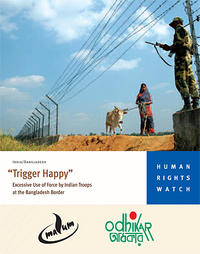
“Trigger Happy”: An HRW Report on the ‘Excessive Use of Force by Indian Troops at the Bangladesh Border’

HUMAN RIGHTS WATCH has released an 81-page report that documents the situation on the border region, where both Bangladesh and India have deployed border guards to prevent infiltration, trafficking, and smuggling. They found numerous cases of indiscriminate use of force, arbitrary detention, torture, and killings by the security force, without adequate investigation or punishment. The report is based on over 100 interviews with victims, witnesses, human rights defenders, journalists, and Border Security Force and Bangladesh Rifles’ (BDR) members. You can read the report here and download it here (.pdf). Given below are the report summary and recommendations.

Continue reading “Trigger Happy”: An HRW Report on the ‘Excessive Use of Force by Indian Troops at the Bangladesh Border’

Declaration of the Independence of Cyberspace

Governments of the Industrial World, you weary giants of flesh and steel, I come from Cyberspace, the new home of Mind. On behalf of the future, I ask you of the past to leave us alone. You are not welcome among us. You have no sovereignty where we gather.

No, that is not someone’s clever response to the attacks on WikiLeaks. It was written fourteen years ago.

The article by John Perry Barlow of the Electronic Frontier Foundation was quoted by Operation Payback which has done some great things recently! And Barlow says, “The first serious infowar is now engaged. The field of battle is WikiLeaks. You are the troops.” The MasterCard story of course runs deeper.

Operation Payback is the brainchild of pro-piracy hacker group 4chan, which incidentally has a Bollywood connection!

Sinister designs behind Muharram ban in Kashmir: Zafar Mehdi

Guest post by ZAFAR MEHDI

Muharram, the month of epic action, has announced its arrival. Black banners symbolizing grief are fluttering around. A pall of gloom has descended. 1500 years later, the lessons of Karbala continue to be the beacon of inspiration for strugglers of truth and righteousness. Muharram, contrary to perception, is not an event, episode or chapter in history. It is a philosophy, a concept, a movement. As centuries roll by, the great uprising of Husain(as), the beloved grandson of Holy Prophet (saww), continues to drive believers to hurl defiance at the forces of evil. The final call Imam gave to humanity still lingers in the minds of millions of Muslims around the world. It teaches that notwithstanding the inadequacy of numbers, if you run down the gauntlet backed by the staunch faith in the Almighty, triumph will be yours.  Continue reading Sinister designs behind Muharram ban in Kashmir: Zafar Mehdi

Xonzoi Barbora interviews Kyaw Zwa Moe on the elections in Burma

Many thanks to XONZOI BARBORA for contributing to Kafila our first podcast. This podcast is an interview of Burmese journalist KYAW ZWA MOE. The interview was originally conducted for Panos Radio South Asia on 6 November 2010. Please allow a moment for the audio player to load on your screen.

Burma’s elections, like its new flag, constitution and capital, is part of an inventory of an elaborate make-over for the military junta that runs the country. This make-over has the tacit support of Burma’s powerful neighbours — China, India and Thailand — who cast covetous eyes on the oil, gas and mineral resources of the country. The elections that took place on November 7, 2010 was one designed to entrench the military in civic life and also provide a reasonable ground for big donor agencies to intervene in administration. Even as the National League for Democracy (NLD) boycotted the elections, other democratic forces were rendered powerless by the junta’s stranglehold over the electoral process. It reserved seats for itself; circumvented the electoral process in places where it thought it would lose and simply made it too expensive for its opponents to contest. Continue reading Xonzoi Barbora interviews Kyaw Zwa Moe on the elections in Burma

Why is WikiLeaks doing what it’s doing?

The answer may lie in this poster they’ve put out:


Julian Assange explains The WikiLeaks Manifesto, and reveals more about WikiLeaks here.

Report #3: Shooting the Messenger in Kashmir

This is the third of a series of fact-finding reports on the recent violence in Kashmir. The fact-finding has been conducted independently by a team of BELA BHATIA,VRINDA GROVER, SUKUMAR MURALIDHARAN and RAVI HEMADRI. For an introduction to this series, see here.

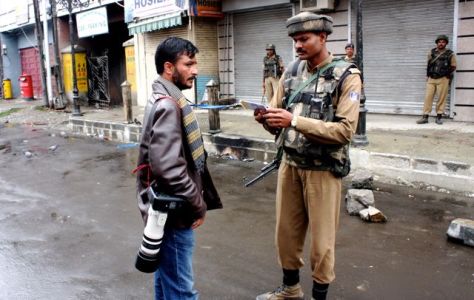
Daily movements for news gatherers has become an ordeal with few security personnel willing to recognise their legitimate role

Continue reading Report #3: Shooting the Messenger in Kashmir

Report #2: Palhallan Under Siege

This is the second of a series of fact-finding reports on the recent violence in Kashmir. The fact-finding has been conducted independently by a team of BELA BHATIA,VRINDA GROVER, SUKUMAR MURALIDHARAN and RAVI HEMADRI. For an introduction to this series, see here, and also see the first report.

Broken windows in Palhallan testify to a widely used strategy of intimidation

Continue reading Report #2: Palhallan Under Siege

Revisiting Obama’s Visit: Suvrat Raju

Guest post by SUVRAT RAJU

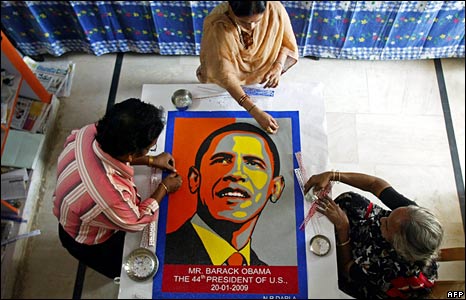
January 2009: Indian artist Darla Nageswara Rao (left) has used more than 33,000 coloured stickers on his portrait of Barack Obama. The work has taken 160 hours to complete.

Although the Indian media collectively swooned on President Obama, and breathlessly informed its audience about how many rooms he had booked at various five-star hotels, there was surprisingly little discussion on two key questions. What is Obama’s foreign policy record? Moreover, what impact will his visit have on most Indians?

Continue reading Revisiting Obama’s Visit: Suvrat Raju

Dilemmas of ‘Right of Nations to Military Occupation’: A Response to Rohini Hensman

Dear Rohini,

Apologies for taking the liberty of writing a separate post to respond to yours. I am doing so as a separate post not only because this response is rather too long for the comments space, but also because I have been wanting to address the issues you have raised. The issues are not new; I have been hearing them ad nauseaum since 2008, when the Kashmiri demand for independence from India took on a renewed momentum. In your post you bring in various external contexts – such as Rosa Luxemburg and the Sinhala-Tamil conflict. I am grateful that you do so, because it is always useful to learn from history and not repeat history’s mistakes. However, there are other recent histories of conflict and conflict resolution you don’t talk about, but which many Kashmiris are aware of – Kosovo, East Timor, Northern Ireland. Some new countries are being formed as we speak!

Also, there is history and context in Kashmir too, which you don’t go into. Your post talks more about LTTE than about Kashmir. Here, I will try to stick to Kashmir in responding to you.

Photo credit: Shivam Vij Continue reading Dilemmas of ‘Right of Nations to Military Occupation’: A Response to Rohini Hensman

October 27, 1947: Dakota in my dell: Sameer Bhat

Guest post by SAMEER BHAT

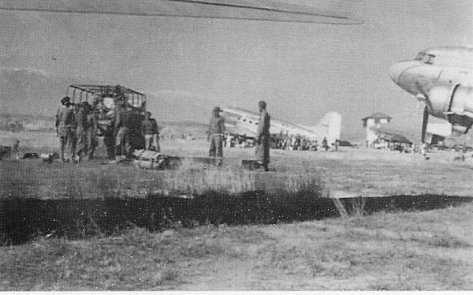
Dakotas at Srinagar airfield, October 1947

Continue reading October 27, 1947: Dakota in my dell: Sameer Bhat

Report #1: Attack and killing on Pattan hospital premises

This is the first of a series of fact-finding reports on the recent violence in Kashmir. The fact-finding has been conducted independently by a team of BELA BHATIA, VRINDA GROVER, SUKUMAR MURALIDHARAN and RAVI HEMADRI. For a introduction to this series, see here.

View of the hospital ward ‐ staff think that Adil may have been on the bed with the red mattress when the CRPF incursion took place.

Continue reading Report #1: Attack and killing on Pattan hospital premises

From New York, a letter to fellow Kashmiris

Guest post by MOHAMAD JUNAID

Dear fellow Kashmiris,

I’m writing this letter from New York, a place far away, yet so close to everything. This city can make you forget, by filching reality away from you. But it also reminds you perpetually, by bringing you close to a different reality, through the pain and suffering of others. There are exiled specimens from all over the world here (yes, mostly those permitted to come to the US). There are Irish and Greeks, escapees from famines and wars. There are Jews from Germany and Germans from Russia, ones who survived persecution. There are Latinos from El Salvador, Peru, Guatemala, and Bolivia, who fled Western-backed dictatorial regimes in their countries in the 1970s and 80s. There are Africans who narrowly missed genocide in Southern Sudan. There are Kurds from Turkey, and Berber from North Africa, driven out of their lands by years of conflict. And, then there are African Americans, who were forcibly brought hundreds of years before to slave for their White masters, and who, despite recent claims of dawning of an age of “post-racial America,” are still groveling at the bottom of the socio-economic heap. Their stories tell a similar conclusion: The world is shrinking for small nationalities and powerless minorities. Continue reading From New York, a letter to fellow Kashmiris

India Bans US Professor from Kashmir, threatens Indian writer with sedition charges: JKCCS

A note from JAMMU KASHMIR COALITION OF CIVIL SOCIETY

November 2, 2010

On November 1, 2010, shortly after 5.10 am, Professor Richard Shapiro was denied entry by the Immigration Authorities in New Delhi. Richard Shapiro is the Chair and Associate Professor of the Department of Anthropology at the California Institute of Integral Studies (CIIS) in San Francisco. He is also the life partner/husband of Angana Chatterji, who is the Co-convener of the International People’s Tribunal on Human Rights and Justice in Indian-administered Kashmir (IPTK) and also Professor of Anthropology at CIIS. Continue reading India Bans US Professor from Kashmir, threatens Indian writer with sedition charges: JKCCS

Minutes of the seminar on ‘Azadi: The Only Way’

(Shuddhabrata Sengupta has written eloquently his account of the day-long seminar, ‘Azadi: The Only Way’. The seminar was organised by the Committee for the Release of Political Prisoners. Given below are CRPP’s minutes of the seminar. You can also see, on YouTube, two short videos showing the ruckus that some Kashmiri Pandits created before Syed Ali Shah Geelani was to speak (1, 2). Also on YouTube, in two parts (1, 2), is Arundhati Roy’s speech, for which some want her booked for sedition. Those on Facebook can also see most of SAS Geelani’s speech (1, 2, 3). A small part of Geelani’s speech is on Youtube, here. Those hurling abuses at Roy and Geelani would do well to read this text, see these videos, and engage with these ideas intellectually, instead of asking for individuals to be jailed and persecuted.)

Continue reading Minutes of the seminar on ‘Azadi: The Only Way’

GQ Boy’s platinum pain

Guest post by HILAL MIR


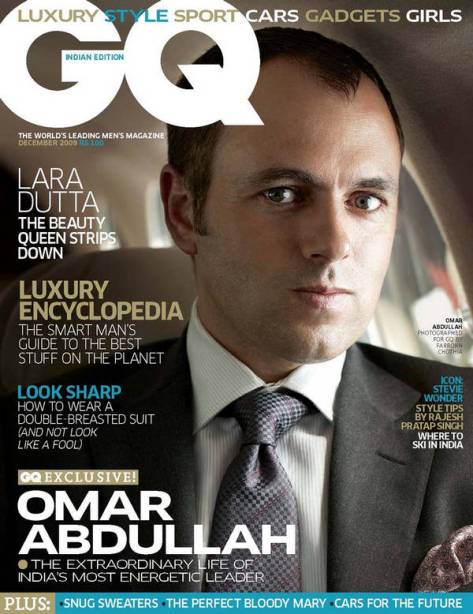
There are various divisions of pain the different classes of people feel in Jammu and Kashmir. Like those bank credit cards which classify customers according to precious metals—Platinum, Gold, Silver—pain is a class thing. For example, when PDP veteran Muzaffar Hussain Baig, after making a long convoluted speech in the Jammu and Kashmir Assembly, said Omar Abdullah’s name figured in the list of the people who used their authority to sexually exploit girls, the junior Abdullah was transformed into a character from a Greek tragedy.

Continue reading GQ Boy’s platinum pain