Category Archives: Identities

A Face Towel in Allahabad, 1984

(Published with the title, The Actor’s Studio, in Outlook, Volume XLIX, No. 41, October 19, 2009.)

The late prime minister V.P. Singh’s memoir Manzilon se Zyaada Safar has an interesting episode pertaining to Amitabh Bachchan’s political baptism in Allahabad in 1984. The episode is not so much an event as it is an image. An image, which by its very opacity, by its presentation of a mask where we would normally expect to meet a face, continues to exercise a certain strange power. V.P. Singh, who was at that time the president of the UP state Congress party, recalls seeing Bachchan (whom he did not know of, he says, as he did not watch films) for the first time with his face “…covered in a towel”. Ever since I have read this, I can no longer see Amitabh Bachchan, not even retrospectively, without his face-towel on.

Rajiv Gandhi and his close advisors had decided that fielding Bachchan in the Lok Sabha elections for the Allahabad seat was a winning proposition. Bachchan was a friend, an Allahabad lad who had a cathartic place on the national stage and a decisive influence on the hairstyles and angst of millions. Continue reading A Face Towel in Allahabad, 1984
Violence in Consumerism’s Own Country

As the stories of the DHRM and those of the successful negotiations with which the Chengara land struggle has ended continue to unfurl in the Malayalee media, contradictory messages about Dalit political struggle continue to reverberate in Kerala. Dalits have been markedly reserved about the outcome of the talks with which the land struggle at Chengara has ended. Laha Gopalan, the leader and chief negotiator, has openly declared that the settlement was a hurried one, and that he agreed to it mainly out of fear of violence, given that the divisions have been created among the landless people at Chengara, whose patience has worn thin. Meanwhile, the DHRM’s violence continues to offer opportunities for potshots at Dalit politics. The Kerala Chief Minister, for instance, issued ‘warnings’ against ‘identity politics’ on Gandhi Jayanti, as if ‘identity politics’ were the same as ‘violence’.

Continue reading Violence in Consumerism’s Own Country

A postcard from Bombay for Raj

Don’t think it’s a good idea and you’ll do it one of these days. Do it today! Go to your nearest post office, buy a postcard and address it to Raj Thackeray. Don’t be abusive, write a peace message, and when you write the MNS office address, write BOMBAY instead of Mumbai. And shoot it off today! If you like the idea, buy more than a few postcards and give them to friends.

Details here.

More on Murder from Kerala

These are happy days in which everyone in Kerala wants too settle the land dispute at Chengara. A happy consensus between the Left and the Right seems to be growing there, after the Congress leader of the Opposition, Oommen Chandy, decided to take on Godfathership of the land struggle. The very language of the struggle had changed – interestingly, from ‘we are landless squatters’ to ‘we are settlers’! Now, it is well-known in Kerala that these terms have had different sorts of political associations – ‘squatter’ with the Left, and ‘settler’ with (largely) the Right. Indeed, this was inevitable perhaps, given the fact that the New Left didn’t look very keen on ‘squatters’. However, it is clear that neither dalit or tribal organisations are going to be part of the negotiations towards the final package –today’s newspapers report that prominent tribal and dalit leaders have protested against the state’s reluctance to negotiate with them. It would be very convenient for both the Left and the Right to delegitimize – indeed criminalize – tribal and dalit organizations. And what luck that precisely that boon has been granted to them by the sudden eruption of a ‘lower-caste terrorist group’ (according to the police), the ‘Dalit Human Rights Movement’!

Continue reading More on Murder from Kerala

Right to Read Campaign

Right to Read Campaign – Problem Statement

Millions of Indians are unable to read printed material due to disabilities.
There are technologies available which can help them read print if the
material is converted into an alternate format such as large print, audio,
Braille or any electronic format. While the Indian constitution guarantees
the “right to read” as a fundamental right, the copyright regime does not
permit the conversion of books into accessible formats for the benefit of
persons with print impairment, as a result of which a “book famine” is
created. International conventions that India is a party to specifically
require India to amend its copyright laws for the benefit of persons with
disabilities and to make available information and material to persons with
disabilities on an equal basis as others. Publishers also do not make books
available in accessible formats as a result of which less than 0.5% of books
are available in accessible formats in India. As a result persons with print
impairments get excluded from the education system and it impacts their
career choices. In addition to this, there are no national Policies or
action plan to ensure that publications in accessible formats in all Indian
languages are available to persons with print disabilities all over the
country.

Objectives of the Right to Read Campaign

·    To accelerate change in copyright law
·    To raise public awareness on the issue
·    To gather Indian support for the Treaty for the Blind proposed by
the World Blind Union at the World Intellectual Property Organisation
(WIPO).

This campaign is part of the global Right to Read Campaign of the World
Blind Union.

As part of the campaign we are creating audio visual clips of eminent
persons, celebrities etc. supporting the Campaign. If you know any eminent
persons, celebrities etc. who are willing to support the campaign do mail me
(rahul.cherian@inclusiveplanet.com) so that we can arrange for their
testimony to be recorded. Your support is vital for the success of this
campaign. More details will follow.

Engaging Nepal: some difficult questions

India can continue to let its suspicion of the Maoists be the over-riding objective of its Nepal policy or seek to play a pro-active role in engineering the kind of consensus it has done since 2005.

First published in The Hindu yesterday.

Indian Foreign Secretary Nirupama Rao arrives in Kathmandu on her maiden visit today, at a time when Nepal is grappling with its most serious and prolonged political crisis since the peace process began. India has to make certain difficult policy choices, reconcile the contradictions between its stated aims and actions, determine whether it remains committed to the process it helped facilitate, and use its leverage accordingly.

The fragile Madhav Nepal-led ruling coalition faces a severe crisis of legitimacy and a belligerent Maoist opposition. The Maoists have boycotted the legislature-parliament, paralysing government business to the extent that the budget has not yet been passed. They have demanded a house discussion on President Ram Baran Yadav’s “unconstitutional action” over-riding the Maoist government’s decision to sack the then Army Chief General Rukmangad Katawal in early May — a demand rejected by the other parties in government who see no wrong in what the President did. The Maoists have also launched a street movement, with the slogan of instituting “civilian supremacy” and a “Maoist-led national government.” Continue reading Engaging Nepal: some difficult questions

Ultra Violet:A feminist blog

I came across this blog a couple of months ago, and have been wanting to bring it to the attention of kafila-readers who may not have visited it yet. Always something interesting and provocative going on there.

Its self-definition:

Ultra Violet is a place for Indian feminists.
It’s a place for sharing stories and views and questions. It’s a place for exploration, opinion and information (not necessarily in the order). It’s a place where we can come together to understand what other feminists around the country–or around the world–are saying…
Ultra Violet does not represent any school, wave, organization, institution or categorization. We do not belong in a box. We do not huddle together in a tank. We do not fly in formation like a flock of geese. We are all free people, approaching feminism from different locations, backgrounds and personalities…

Reading Land and Reform in Pakistan

A number of activists from the South Asia Solidarity Initiative (SASI) in New York have initiated a reading group on South Asia.  The notes below are the first in a series of commentaries following reading discussions that some members of the reading group hope to post on Kafila.  This is an attempt to broaden the discussions and in the process make it a productive dialogue to understand developments in the region and deepen our solidarity.

Reading Land and Reform in Pakistan

— Svati Shah, Prachi Patankar and Ahilan Kadirgamar

“…any strategy to stem the tide of Taliban-Al Qaida led militancy cannot ignore the issue of land rights…. Any reforms that revalue and formally recognize the local management of common property resources, therefore, will elevate the authority of tribal leaders over religious clerics or TAQ militants.”
Haris Gazdar, ‘The Fourth Round, And Why They Fight On: An Essay on the History of Land and Reform in Pakistan’

Given the escalation of a multifaceted war in Pakistan, and given our own commitment to a peace with justice in South Asia, we have started reading and discussing issues of importance in Pakistan and South Asia more broadly.  This inquiry is informed by the alarming and rapidly changing situation in Pakistan, and by an interest in interrogating the category ‘South Asia’ itself.  While all are agreed that the term ‘South Asia’ is indispensable, we wonder how ‘South Asia’ could be used to describe more than a region or a set of places outlined by shared borders. We wonder how we can move beyond the limitations of finding historical unity in South Asia primarily through the lens of British colonialism?  We wonder how we could describe the political unities and potential solidarities of ‘South Asia’ in this moment?  We find it particularly helpful to approach these questions by seeing common issues in the region relating to labour, land and the role of the state in societies in South Asia.  At the same time, we want to move away from the received notions of South Asia, whether they be the statist conceptions of SAARC, South Asia as seen by the US State Department or, for that matter, as a region defined by area studies.

Continue reading Reading Land and Reform in Pakistan

Remembering Rajani and Re-Reading The Broken Palmyrah

I am posting below a much longer version of an article that is published in Himal SouthasianThe Broken Palmyrah is out of print, but the entire book is on the UTHR(J) website.

Remembering Rajani and Re-Reading The Broken Palmyrah

September this year many will remember Rajani Thiranagama, a feminist, an activist, a Marxist, a scholar, a doctor and a teacher assassinated twenty years ago on September 21st, 1989.  Among the reasons for her assassinations was the publication of that profoundly grounded work, The Broken Palmyrah, which she co-authored with three other academics from the Jaffna University.  While we commemorate the life and work of Rajani at a time when the war has come to an end, in many ways the Palmyrah is still broken.  It is in this context that I return to that inspiring work, which has much to teach us, in particular for those of us belonging to the younger generations of activists after Rajani.  Inspiring, for despite the worst cruelties of war, it carried a message of hope, an analysis of possible ways forward and faith in the resilience of ordinary people. Continue reading Remembering Rajani and Re-Reading The Broken Palmyrah

Expert Committee on Metadata and Data Standards for Personal Identification

There has been considerable debate on the politics of the Unique Identification. It is claimed that the ID card will not be a citizenship card, and the government expert committee has just released a document with the standards for identification. It would be good if we could have some people who could interpret this data for us and what it means for people concerned with the long term impact of the UID

Draft Person ID Codification

http://egovstandards.gov.in/public-review/egscontent.2008-09-04.3708808455/at_download/file

Generic Data Elements-

http://egovstandards.gov.in/public-review/meta-data-and-data-standards-for-application-domains/egscontent.2007-07-26.5506235821/?searchterm=Generic%20Data%20Elements-%20Final.xls

Teachers and Academics Against 377

University teachers, researchers and academics from all over India issued a strong statement in support of the recent Delhi High Court judgement decriminalizing consensual sex among adults and challenged the legitimacy of “religious leaders” to speak for the whole of society.

180 signatories from institutions and universities in Allahabad, Calicut, Peechi, Punalur, Thiruvananthapuram, Kottayam, Sonipat, Goa, Jammu, Nanded, Mumbai, Pune, Pondicherry, Kolkata, Ahmedabad, Baroda, Chennai, Chandigarh, Delhi, Bangalore, Hyderabad, Guwahati and Shillong endorsed a statement that said:

Continue reading Teachers and Academics Against 377

‘My friends have always urged me to come out’

These situations haven’t changed much. My identity is still a threat to me. It may effect my promotions, appraisals, friendships and relationships. I live every moment of my life in this fear. I feel that there will be many like me who will be leading such dual lives… we deceive ourselves, trying to hide our identities.

No, that’s not another post about 377 on Kafila. It’s about something else, on a fantastic new blog that you should immediately add to your feedreader.

Right Hand, Wrong Hand

I have two daughters, born 1984 and 1988. As they grew up we noticed that both of them were ambidextrous but gradually the 84 born started favouring her right hand over the left but the 88 born did the exact reverse. She began to rely more and more on her left hand to do things like eating, opening doors, picking up things, writing etc,things that “normal” people including my elder daughter do with their right hand.

A couple of interfering neighbours tried telling us to ‘teach’ our daughter to do things properly and not to eat or touch ‘saraswati’ with her dirty hand. Luckily we told these busy bodies to mind their own business and let her be. Continue reading Right Hand, Wrong Hand

A Tale of Two Encounters – Dehradun and Batla House: Jamia Teachers Solidarity Group

We publish below a statement from Jamia Teachers Solidarity Group, formed after the “encounter” at Batla House in Jamia Nagar, Delhi. For background information on this issue, see Some questions about the Delhi encounter; A little less melodrama, a lot more forensics; Shame is a revolutionary sentiment.

Jamia Teachers’ Solidarity Group extends its heart-felt condolences to the family of Ranbir Singh, the youth who was killed in a police encounter in Dehradun last week. This encounter again brings to the fore the trigger happy ways of the Indian police who kill and torture for medals and promotions. We demand exemplary punishment for the guilty policemen. Continue reading A Tale of Two Encounters – Dehradun and Batla House: Jamia Teachers Solidarity Group

Historic Mandate, Historic Turning Point or More of the Same? Gail Omvedt on Elections 2009

Guest post by GAIL OMVEDT

The 2009 Lok Sabha elections in India were projected to be a historical turning point just as the 2008 Presidential elections in the U.S. were a turning point.  But the nature of that expected turning point was very different.

Five years ago, even two years before the elections, no one in the U.S. would have expected that a “Black” man with two Muslim names and one African name could have been elected President of the United States.  Yet it happened, and it happened not simply because Barack Husain Obama ran a brilliant campaign and is proving the most effective president in dealing with the economic and social crises besetting the world today, but also because of the racial transformation the U.S. has undergone in recent decades. Continue reading Historic Mandate, Historic Turning Point or More of the Same? Gail Omvedt on Elections 2009

The Day After the Judgement

So now that we have one group of criminals less to deal with, I have a proposal: Criminalize English TV news channels.

'Debate,' the Times Now way
‘Debate,’ the Times Now way

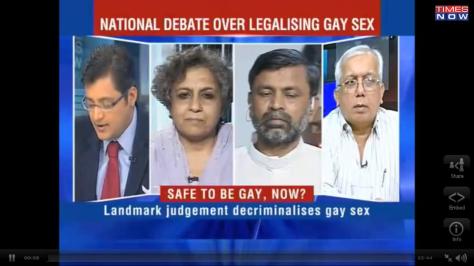
Watching Times Now yesterday after the Delhi High Court ruling on Section 377, I was overcome by a growing sense of bewilderment. I could hear Dominic Emmanuel (Director of the Delhi Archdiocese of the Roman Catholic Church) and Kamal Farooqui (Chairman of the Delhi Minorities Commission), saying quite cearly and more than once, to my surprise, that they welcome the decriminalization of homosexuality, that homosexuals should not be treated as if they were criminals. Okay, correct that – I could barely hear these statements over the insistent, aggressive and disruptive interruptions  of the anchor Arnab Goswami, who had obviously pre-set this “discussion” rigidly as a face-off between Reactionary Clerics/Minorities and Gay Rights Activists, while he himself was super hero, Anchorman. So each time they said “we welcome” etc.,  Anchorman would swoop in, bellowing, “So are you saying that they dont have rights, Sir, are you saying they should not have rights. Over to Anjali Gopalan (Naz) – Anjali, they say homosexuals should not have rights, what do you say?”

Continue reading The Day After the Judgement

“Two friends who have but one life”: Hope from the 19th century

I came across this delightful piece of information in the historian K P Padmanabha Menon’s History of Kerala (vol.3, AES reprint,2001, pp.498-500) which was written in the early 20th century. He quotes from “a paper published in the Madras Review (vol.2, p.250)”; we do not know which year this was published, but there is good reason to think that it was in the early 20th century. The paper is about a truly exciting institution – ‘marriage’ which produced not a heterosexual conjugal couple, but a same-sex  (male) couple bound by ‘friendship’! Continue reading “Two friends who have but one life”: Hope from the 19th century

Reservations for Women: ‘Am I That Name?’

[I am posting here the chapter from my book – Recovering Subversion. Feminist Politics Beyond the Law – that I referred to in response to demands for references on my previous post on the WRB.  I do apologize to those (including fellow-kafilaites!) who may rightly feel I have said enough on the topic.

The title of this chapter is a tribute to Denise Riley’s question “Am I that name?” referring to the label “Woman.” Am I That Name? Feminism and the Category of ‘Women’ in History Minneapolis, University of Minnesota Press, 1988].

When the Women’s Reservation Bill (WRB) first appeared as the 81st Amendment Bill in 1996, proposing to reserve 33% of seats in Parliament for women, it burst into public discourse full-blown as a “women’s” (indeed, a feminist) issue, and continues to be debated largely in terms of women’s rights. It is becoming increasingly clear however, that the questions thrown up by the timing of the Bill and the responses to it cannot be understood solely within the framework of women’s rights. This chapter attempts to relocate these questions in a complex matrix of political identities in order to realize their full significance. I also argue that the debates around the Bill reveal a more fundamental set of questions about the issues of citizenship, representation, and the subject of feminist politics.

Continue reading Reservations for Women: ‘Am I That Name?’

And aren’t OBC women “women”? Loud thinking on the Women’s Reservation Bill

The career of the Women’s Reservation Bill in Parliament since it first appeared in 1996 as the 81st Amendment Bill, has been striking for the high drama and rhetoric of women’s rights that has accompanied it, the passionate opposition to the proposed 33% reservation for women in Parliament, generally being characterised by its supporters as anti-women and patriarchal. However, if we try to organize the welter of arguments that have been flying around for 13  years, we would find that while the proponents of the measure certainly base their claims on the idea of gender justice, the opposition to the Bill does not come from an anti-women position.  Rather, the latter arguments stem from either

1) a generally anti-reservation position (which I am not interested in here) or

2) a claim that reservations for women should take into account other disempowered identities within this group – that is, the “quotas within quotas” position, which says that there should be reservation within the 33% for OBC and Muslim women. (The 22.7% reservation for SC/ST women would come into operation automatically.)

In other words, the sharp opposition to the Bill cannot simply be dismissed as anti-women. Continue reading And aren’t OBC women “women”? Loud thinking on the Women’s Reservation Bill

Faith, religion, ritual, identity, dogma – how do I understand this?

I walked into Anjali’s  house. She lives in one of the Rehabilitation and Resettlement colonies in Bombay which were developed to provide housing for slum dwellers and railway slum dwellers affected by the creation of roads infrastructure in Mumbai. Her house is a one-room tenement. She has created a litte bedroom space by placing a large showcase unit which separates the living room and the bedroom. I sat down to talk with her when my eyes fell on the Mecca-Medina mosque photograph which was placed on the wall facing her kitchen, above her newly purchased washing machine. For a moment, I was not sure if I had seen correct. Then, while continuing the talking, I glanced carefully again. It was the Mecca-Medina mosque photograph which is usually found in the homes of Bohra Muslims, Shias, Iranis and Sunnis as some kind of a visible mark of religion or show of faith and practice (or perhaps something else, I am not sure). I was both intrigued and amused. Continue reading Faith, religion, ritual, identity, dogma – how do I understand this?

To RSS with Love: The Real Story of 2009 Elections

If news reports are to be believed, the RSS has come out with the most classic analysis of the 2009 election verdict: Advani did not enthuse the Hindus. [Read carefully: He could but he did not. A small boy, kal ka chhokra, Varun Gandhi had to lead the way!] Only a shade better than the West Bengal CPM claiming that they lost because Karat and the central leadership withdrew support to the UPA…as if they themselves – or Nandigram had nothing to do with it! Or the Kerala CPM claiming that it was due to chief minister Achuthanandan that they lost – Achuthanandan the agent of the bourgeoisie who ‘roared with laughter’ when the party was losing the elections! Or Sitaram Yechury claiming that UPA won because they claimed the credit for NREGA and Forest Rights Act which ‘we had forced them to enact’ – but ‘we’ lost! Amazing stuff, these elections and even more amazing, the post-election antics. But today’s topic is not the CPM. For, the real story is the RSS and BJP love story that is once again on the rocks.

RSS spokesperson MG Vaidya was forthright: “The BJP must reflect Hindu nationalism or else it is free to remain as any other party not associated with the Sangh… What’s wrong if people have gathered the impression that the BJP uses the Ram temple issue only for political gains?… The mainstream in this country is Hindu and the RSS is engaged in unifying Hindus. The BJP or any other owing allegiance to the Sangh must reflect this philosophy in its deeds.”

Continue reading To RSS with Love: The Real Story of 2009 Elections