Category Archives: Violence/Conflict

People’s Watch Over Parliament: Bekhauf Azadi Campaign

20130220-235633.jpg

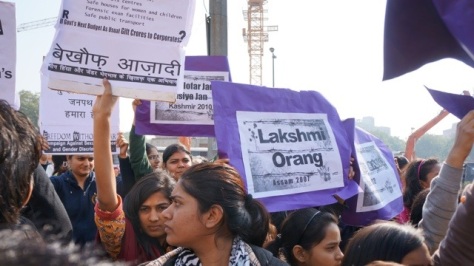
  • Protestors at the ‘Freedom Parade’ Rally of the Bekhauf Azadi Campaign, New Delhi, 26 January, 2013

Guest Post by Bekhauf Azadi (Freedom Without Fear) Campaign.

People’s Watch Over Parliament: February 21, 1st Day of the Budget Session, Jantar Mantar
Gather in large numbers – 12 PM onwards at Jantar Mantar, New Delhi.
Are Our Lawmakers Ready to Listen to the Voice of the Movement Against Sexual Violence?

Continue reading People’s Watch Over Parliament: Bekhauf Azadi Campaign

Capital Punishment – An Agenda for Abolition: Yug Mohit Chaudhry

This is (a slightly modified) text of the second Shahid Azmi Memorial Lecture, delivered at the Indian Law Institute on 9 February 2013 by advocate YUG MOHIT CHAUDHRY. The lecture and its topic had been scheduled days in advance, but co-incidentally, Mohd. Afzal Guru was hanged in the morning of the day of the lecture. The Shahid Azmi Memorial Lecture has been instituted by his friends, comrades and students, who want to keep alive the memory of his inspiring work. Advocate was shot dead in his office on 11 February 2010, at the age of 32. At the time of his murder, Shahid was fighting several terrorism cases, including of those falsely accused in the Malegaon blasts and the 26/11 Mumbai attacks.You can read tributes to Shahid Azmi in Kafila archives by Mahtab Alam, Arvind Narrain and Saumya Una, and Susan Abraham.

In Furman v. Georgia (1972), where the U.S. Supreme Court struck down the death penalty, Justice Marshall said that if citizens were fully informed about how people are sentenced to death, they would find capital punishment shocking, unjust and unacceptable. However, research on the death penalty and public awareness of the exact nature of the death penalty have been the most neglected areas in the abolition campaign in India. The last three challenges to the constitutionality of the death penalty in India were rejected by the Supreme Court, inter alia, on the grounds that there is no empirical data to support the abolitionists’ claims. Unfortunately, the situation has not changed at all, and even now there is hardly any research on this subject. Therefore, the highest priority in any abolition campaign is to produce empirical research on the death penalty. That, and doing our utmost to stop each proposed execution and, failing that, to make it as difficult as possible for the state to carry out an execution, adopting all legal, political and social means at our disposal.   Continue reading Capital Punishment – An Agenda for Abolition: Yug Mohit Chaudhry

I love the winter in your eyes: Uzma Falak

Guest post by UZMA FALAK

Winter of my eyes
took flight
Did you see?
These are not the same eyes
colors of which you would patiently decipher
sitting under the sun
for hours
gray dreams refusing to dissolve
in waters of Lethe. Continue reading I love the winter in your eyes: Uzma Falak

On bloodlust: notes towards four imminent executions: Rijul Kochhar

Guest post by RIJUL KOCHHAR

[This June 19, 1993 photo shows Veerapan aides Simon (front row, second from left) and Madaiah (fourth from left) among other landmine blast accused. Courtesy The Hindu/PTI.]
[This June 19, 1993 photo shows Veerapan aides Simon (front row, second from left) and Madaiah (fourth from left) among other landmine blast accused. Courtesy The Hindu/PTI.]

Into my heart an air that kills
From yon far country blows:
What are those blue remembered hills,
What spires, what farms are those?

That is the land of lost content,
I see it shining plain,
The happy highways where I went
And cannot come again.

~A.E. Housman

ज़िन्दगी और मौत ऊपर वाले के हाथ हैं जहापनाह, उसे ना आप बदल सकते हैं न मैं, हम सब तोह रंग-मंच की कठपुतलियाँ हैं, िजनकी डोर उपरवाले की उँगलियों मे बंधी हैं: कब, कौन, कैसे उठेगा, कोई नहीं बता सकता.

~Anand (1971)

I write in an evening shrouded in anticipation, but it is an anticipation of death.

Continue reading On bloodlust: notes towards four imminent executions: Rijul Kochhar

Talk Hindutva, Sell Narcotics?

Curbing Freedom of Press: The Karnataka Way

ImageA 10-member group allegedly assaulted a staff member of Kannada daily Karavali Ale at Kulai here on Wednesday night.According to B.V. Seetaram, director and chairman of Chitra Publications, which publishes the paper, Harish Putran (36), office assistant, was attacked when he was waiting near Vishnumurthy temple to catch a bus back home.He was hit with iron rods and wickets and chased by the attackers, Mr. Seetaram said. Mr. Putran managed to save himself by hiding behind a shop.

Mr. Seetaram suspected the involvement of a rightwing group in the attack. He said Karavali Ale published a report on Wednesday alleging the rightwing group’s involvement in the sale of narcotics in the city. Copies of the newspaper were burnt and some vendors were threatened against selling the Wednesday’s edition, he said.Mr. Putran has been admitted to a private hospital. A complaint has been filed with the Surathkal police.

(Karavali Ale employee attacked : Staff Correspondent, The Hindu – Mangalore, February 7, 2013)

It has been a ‘happening’ week. Celebrations around one billion rising held in different parts of the world.Soni Sori acquitted in four cases. Dr Sunilam and two of his associates getting bail from Jabalpur high court after spending three months in Bhopal jail. More than two hundred intellectuals, activists writing to President of India about the manner in which Afzal Guru was hanged.  Interestingly in the melee of news certain troubling developments in south of Vindhyas have not got enough attention they deserve. And they concern the curbing of media by majoritarian elements with due connivance of the people in power. Continue reading Talk Hindutva, Sell Narcotics?

PUCL statement on the President’s rejection of the mercy pleas of four Veerappan associates

Press release put out on the evening of 16 February by the PEOPLE’S UNION FOR CIVIL LIBERTIES

CHENNAI: The PUCL strongly condemns the rejection by the President of India of the commutation petitions of Simon, Meesakara Mathayan, Bilavendran and Gnanaprakasam. Equally condemnable is the action of the Prison Authorities of Belgaum Central Prison, Karnataka who in the morning of 13.2.2013 merely intimated orally to the convicts of the rejection of their mercy petitions without giving them the written orders of rejection. In sharp contrast, signed acknowledgements of receipt have been obtained from all 4 convicts! Continue reading PUCL statement on the President’s rejection of the mercy pleas of four Veerappan associates

‘Death penalty in India is a legal lottery’

Justice Ajit Shah says that it has been proven beyond doubt that death sentence does not serve as a deterrent against crime; the reason why two third of the world has abolished it all together. He explains the bizarre nature of how the death sentence in India is judge centric and how under the same set of circumstances, some have received the death sentence, while others have been given life and still others acquitted. Death sentence is judge centric with many judges having a history of doling out death penalties and other being kind. Death sentence is thus nothing but a ‘legal lottery’ where if you are lucky you get a lenient judge you survive, else you end up at the gallows. He talks about the caste and class connection to death sentence, where the lower castes and lower classes are usually the ones sent to the gallows because they cannot afford proper legal aid. He says that this discriminatory nature renders death penalty unconstitutional and that there is the need for a larger debate on the same.  Continue reading ‘Death penalty in India is a legal lottery’

When the Indian nation’s ‘conscience’ was satisfied: Gazala Peer

Guest post by GAZALA PEER

CRPF personnel stand guard at the martyrs' graveyard in Srinagar,preventing entry. The graveyard has a new empty grave, that of Afzal Guru. A similar empty grave waits for Maqbool Bhat, also buried in Tihar jail. Photo credit: Mukhtar Khan/Associated Press
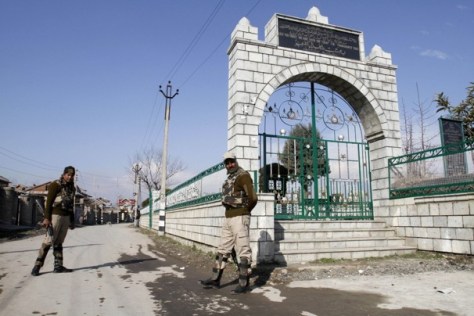
CRPF personnel stand guard at the martyrs’ graveyard in Srinagar, preventing entry. The graveyard has a new empty grave, that of Afzal Guru. A similar empty grave waits for Maqbool Bhat, also buried in Tihar jail. Photo credit: Mukhtar Khan/Associated Press

People who mourn under siege are not supposed to write. We cry and beat our chests. Kashmiris have long faced such predicaments, always forced to find alternatives for everything. Anything that is normal and fair is denied to them! Like a fair trial, for instance. I am not sure if everybody knows Mohd. Afzal Guru’s story. I am not sure if I can be fair to him, but whatever I could gather from legal documents, commentaries and articles, is summarised here. Continue reading When the Indian nation’s ‘conscience’ was satisfied: Gazala Peer

Health professionals and sexual assault – some resources from CEHAT

These are some resources available from Centre for Enquiry into Health & Allied Themes (CEHAT)

Role of Health Systems in Responding to Sexual Assault – Frequently Asked Questions

What is the role of Health Professionals in responding to survivors of sexual assault?

Health professionals have a dual role to play in responding to survivors of sexual assault. Firstly, they are required to provide medical treatment and psychological care to survivors as sexual assault has short and long-term physical and psychological effects. Secondly, the health professional  is required to perform a ‘medico-legal examination’. This entails accurate documentation, examination, collection of  forensic evidence and provision of a medical opinion related to the assault, which can serve as evidence in the
court of law.

Read the rest of this manual here.

Links to more resources for health professionals dealing with sexual assault


Lessons from Delhi and Dhaka: Nagesh Rao and Navine Murshid

Guest post by NAGESH RAO and NAVINE MURSHID

Photo credit: AFP/Getty Images

In the early hours of Saturday morning, a secret execution was carried out by the Indian government. Afzal Guru, a Kashmiri, was put to death for his alleged involvement in the 2001 attack on the Indian Parliament. Afzal’s family in Kashmir were cruelly denied a last visitation. They were informed that the Indian President had rejected his mercy petition, and of his imminent execution, by mail—the letter reached Afzal’s wife Tabassum two days after he was executed and buried in an unmarked grave inside Tihar Jail.

Meanwhile, across the border in Bangladesh, hundreds of thousands of Bangladeshis from all walks of life have occupied Shahbag Square near Dhaka University, outraged that a notorious war criminal might walk free after having been spared the death penalty by the Bangladeshi International War Crimes Tribunal. Abdul Quader Mollah, leader of the right-wing Islamist party Jamaat-i-Islami, and convicted of multiple counts of rape, torture and murder, was photographed flashing a victory sign as he left the court. Continue reading Lessons from Delhi and Dhaka: Nagesh Rao and Navine Murshid

‘In the land of Buddha and Gandhi, death penalty has no place’: 83 feminist activists

This public statement was put out on 13 February by a group of 83 feminist activists; names of signatories at the end.

We, women from various organizations in India, condemn the hanging of Afzal Guru in Tihar Jail early on the morning of 9.2.2013.

The tearing hurry and secrecy with which Afzal Guru was hanged, accompanied by the flouting of all established norms by not giving his family their legal right to meet him before taking him to the gallows, clearly indicates that there were political considerations behind taking this step. More shameful is the explanation of the Home department that the wife and family of Afzal Guru were intimated of the hanging by a mail sent by Speed Post and Registered Post. Decency and humanity demanded that the Union Government give prior intimation to the family and an opportunity to meet him. Such surreptitious action of the government also deprived the family of Afzal Guru to right to seek legal remedy. Continue reading ‘In the land of Buddha and Gandhi, death penalty has no place’: 83 feminist activists

A letter of protest to the President of India against the execution of Afzal Guru: JTSA

This letter, signed by 202 citizens whose names are given at the end, has been put out by the JAMIA TEACHERS SOLIDARITY ASSOCIATION

To,
The Hon’ble President of India

Respected Sir,

We write to you in deep anguish, despair but in outrage as well. Afzal Guru was hanged on Saturday (9th February 2013) in secrecy. We have been told – after the hanging – that you rejected the mercy petition filed by Guru’s wife Tabassum, on 3rd February. We believe that you made a grave error in rejecting the mercy petition. If you had perused the trial records and the lengthy documentation put together over the years by lawyers and civil rights activists, or even the Supreme Court judgement which sentenced Afzal to death, you would have known, that his guilt was never established beyond reasonable doubt. The fact that the Court appointed as amicus curiae (friend of the court) a lawyer in whom Afzal had expressed no faith; the fact that he went legally unrepresented from the time of his arrest till his so-called confession, the fact that the court asked him to either accept the lawyer appointed by the Court or cross examine the witness himself should surely have concerned you while considering his mercy petition. Continue reading A letter of protest to the President of India against the execution of Afzal Guru: JTSA

What Afzal Deserves: Chandan Gomes

20130212-185109.jpg

Guest post by CHANDAN GOMES

Ever since the news of Afzal Guru’s execution broke out on the 9th, I have witnessed my personal space descend into a state of chaos. I woke up that morning to a number of emails/facebook messages by friends requesting me to join them at Jantar Mantar to protest against Guru’s execution. Many called that particular protest farcical, some even going to the extent of labelling these young men and women as traitors. Battle lines were drawn and a country stood divided. The more I thought about the execution, the more it saddened me. I could see myself and people like me (the ordinary citizens of this great nation) as pawns in a game of ugly power play, waiting to be sacrificed at the altar of ‘opportune moment’. Continue reading What Afzal Deserves: Chandan Gomes

राष्ट्रवादी न्याय से करुणा की विदाई

“अगर हम ‘लोकतांत्रिक सरकारों के छिपे इरादों और गैरजवाबदेह खुफिया शक्ति संरचनाओं की जांच करने और उन पर सवाल उठाने से इनकार करते हैं तो हम लोकतंत्र और मानवता, दोनों को ही खो बैठते हैं.” पत्रकार जॉन पिल्जर का यह वाक्य आज हमारे लिए कितना प्रासंगिक हो उठा है! हमें नौ जनवरी को खुफिया तरीके से अफज़ल गुरु को दी गयी फांसी के अभिप्राय को समझना ही होगा. काम कठिन है क्योंकि इसे लाकर न सिर्फ़ प्रायः सभी संसदीय राजनीतिक दल एकमत हैं बल्कि आम तौर पर देश की जनता भी इसे देर से की गई सही कार्रवाई समझती है.

नौ जनवरी के दिन के वृहत्तर आशय छह दिसम्बर जैसी तारीख से कम गंभीर नहीं क्योंकि इस रोज़ भारतीय राज्य ने गांधी और टैगोर की विरासत का हक खो दिया है.अगर अब तक यह साबित नहीं था तो अब हो गया है कि भारत की ‘संसदीय लोकतांत्रिक राजनीति’ का मुहावरा उग्र और कठोर राष्ट्रवाद का है. और राजनीतिक दलों में इस भाषा में महारत हासिल करने की होड़ सी लग गयी है.

Continue reading राष्ट्रवादी न्याय से करुणा की विदाई

The Languages of Sexual Violence: Anupama Mohan

Guest post by ANUPAMA MOHAN

I teach a big word in my critical theory classes: phallogocentrism. It is the idea that our societies are centred by the phallus and language (logos) and is a word that often scares, perplexes, and disturbs my students, but I unpack it using an example. In English, the word seminal, which means something important and path-breaking, derives from “semen” and in contrast, the word hysterical or hysteria, which is a word that has for long been associated with peculiarly female physical and mental disorders (and often used for recommending women’s confinement), derives from “hystera” or the womb. What does such loading of the language – what a 20th century Russian thinker, Mikhail Bakhtin, called the formation of the verbal ideological world  – in terms of the perspective, validation, and supremacizing of one gender over the other do to/in our varied lives? Think of the word vanilla that, at least since the 1970s, has meant the ordinary and bland: its etymology derives from the Latin word for vagina (vaina) or “little vagina” for the pods of the plant that reminded someone of women’s genitals. The word porcelain – a thin, fragile kind of clay – too comes from the word for “cowrie shell” whose Italian links to porcella or young sow (a female pig) for someone recalled the shape of a piglet’s orifice. One more: the word amazon which refers to a legendary race of female warriors and has come to mean a strong woman derives possibly from many sources: from the Classical Greek a-mazos or breastless to the Iranian *ama-janah or “virility-killing” – a meaning that interprets the idea of women’s strength as both a mutilation of her physical self and/or as a threat to men. Continue reading The Languages of Sexual Violence: Anupama Mohan

The Day Afzal Died: Nirmalangshu Mukherji

Guest post by NIRMALANGSHU MUKHERJI

There are days in which streaks of hope shine through dark clouds of misery. The 9th of February, 2013, was such a day.

The day broke with the news that the noose of the Indian state had finally seized the throat of Mohammad Afzal Guru after years of careful conspiracy. With ill-concealed admiration, the television screens reported the military swiftness, the secrecy, and the perfection with which a nuclear-powered state with one of the largest armies in the world escorted an unarmed, hapless Kashmiri to the gallows, performed its rituals, and pulled the bolt. As the murder was officially videographed with full legal sanction, the body was kept dangling for thirty minutes before it was pulled down and immediately buried in an ‘unmarked’ grave, protected by layers and layers of impenetrable walls. The case of Afzal Guru was thus brought to a ‘closure’. So hoped the state. Continue reading The Day Afzal Died: Nirmalangshu Mukherji

Two Encounters with the Right Wing: Anonymous

Guest post by an ANONYMOUS student of DU who is afraid, not of the Right Wing, but of the university administration. We can be very proud of our democracy.
I
I have never been so scared of being a minority before. Today I saw two Kashmiris (a girl and a boy) being chased by a mob in what was to be a silent protest. I don’t know when and what circumstances will bring me to running from a mob to save myself. No one deserves to live in fear. Not me, not the two Kashmiris, not even a fiend.
Said a friend who witnessed the saffron mob at Jantar Mantar.
Today, no one can tell me that India is democratic, that India is secular. Today no one can tell me that India is free. Today I saw a glimpse, just a glimpse of what Hindutva truly is, and it was terrifying.
I went to Jantar Mantar for a silent protest against the hanging of Afzal Guru and for the abolition of capital punishment. We reached a little late, and by the time I reached, the number of people had reduced considerably. Why? Because the police had rounded up and detained a bus-full of protesters, mostly Kashmiri, and taken them to the police station.
When we got out of the metro station, all I could hear was cries of Bharat Mata ki Jai interspersed with Pakistan Haye Haye.
Bharat Mata ki Jai, because a man has been hanged. Not for his crimes, if they even exist, but for his identity.
Bharat Mata ki Jai, as we murder Indian Muslims, because that is our idea of nationalism. Continue reading Two Encounters with the Right Wing: Anonymous

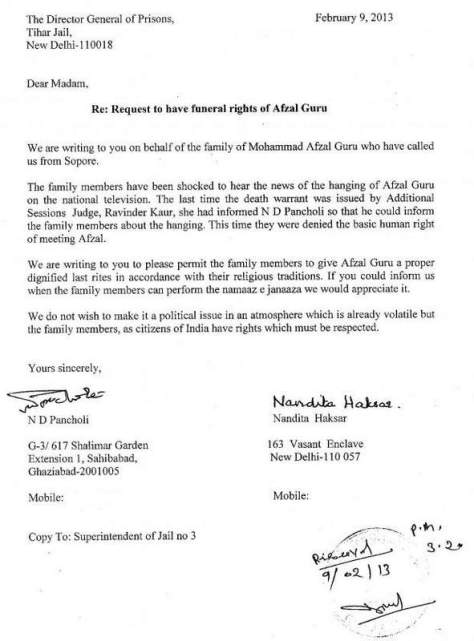
Afzal Guru’s family demands his body

Do we have the right to a peaceful protest?: Warisha Farasat

Guest post by WARISHA FARASAT, who was present at the peaceful Jantar Mantar protest against the execution of Afzal Guru

We have been finally denied even the basic right to a peaceful protest. Two incidents over the last week have proven that only the right wing Hindutva groups have the right to protest in this country; the unbridled right to disrupt all other peaceful protests; and to ensure that the civil liberties groups are pushed even further against the wall. Two days ago, a peaceful student protest against Narendra Modi’s speech at Delhi University was met with brutal response, which has been reported extensively. Today, as Shuddhabrata Sengupta has poignantly pointed in his earlier post there were peaceful silent protests against the secretive hanging of Afzal Guru, and also for the abolition of the death penalty from the criminal statute books at Jantar Mantar. But what unraveled thereafter was shameful. The police watched and participated while young and brave University students, several of them Kashmiri, were beaten up. I saw young women with scarves, which were seen as a marker of their identity being targeted, groped, beaten, humiliated, abused, and finally arrested. Other respected civil liberties activists, lawyers, and even journalists were abused, kicked, beaten, and their faces blackened. Continue reading Do we have the right to a peaceful protest?: Warisha Farasat

Four statements on the execution of Afzal Guru

Statement from the PEOPLE’S UNION FOR CIVIL LIBERTIES

The PUCL condemns the hanging of Afzal Guru in Tihar Jail early in the morning (9.2.2013) today.

The tearing hurry with which Afzal Guru was hanged, accompanied by the flouting of all established norms by not giving his family their legal right to meet him before taking him to the gallows, clearly indicates that there were political considerations behind taking this step. More shameful is the explanation of the Home department that the wife and family of Afzal Guru were intimated of the hanging by a mail sent by Speed Post and Registered Post. Decency and humanity demanded that the Union Government give prior intimation to the family and an opportunity to meet him. Such a surreptitious action of the government also deprives the family of Afzal Guru to right to seek legal remedy.

PUCL also condemns the repressive stand of the Delhi police in not allowing a group of people who were protesting against the hanging and detaining them in police stations. We are equally concerned by reports that right-wing goons were permitted by the police to use violence against the protestors. PUCL asserts the right of citizens to dissent and express their opposition to capital punishment in a peaceful manner. Continue reading Four statements on the execution of Afzal Guru

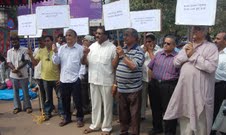
Peaceful Protest Against Afzal Guru’s Execution at Jantar Mantar Broken Up by Right Wing Goons and Delhi Police

This slideshow requires JavaScript.

A small group of citizens, mainly young people from different universities in Delhi, and people associated with civil rights groups and initiatives, had gathered at Jantar Mantar in New Delhi this afternoon at 1:00 pm to express their protest against the execution by hanging of Afzal Guru at 8:00 am this morning in Tihar Prison.

The protest was dignified and entirely peaceful. It was interrupted suddenly when a large mob gathered and began heckling the protestors. I was present there, and I clearly heard this mob of young men hurl, unprintable abuses at the men and women who were peacefully protesting against the execution of Afzal Guru. Some of them wore saffron scarves that clearly identified them as being the storm troopers of the far right. They repeatedly chanted violent and incendiary slogans which included the following – “shoot them all”, “kill the traitors”. These alternated with patriotic chants. I have never seen a more nakedly bloodthirsty exhibition of the far right wing version of Indian nationalism on the streets of Delhi. The mob made threatening gestures and advanced towards the line of protestors. Continue reading Peaceful Protest Against Afzal Guru’s Execution at Jantar Mantar Broken Up by Right Wing Goons and Delhi Police