This post should be read as a sequel to my earlier post of 16 July, which had discussed the discourse of “Hindu Unity” and questions before the struggle against the Right. That post had ended with the claim that the struggle against the Hindu Right is not so much about what we understand as “secularism” as it is about the reconstruction of a larger Bahujan counter-tradition, the search for which was already on.
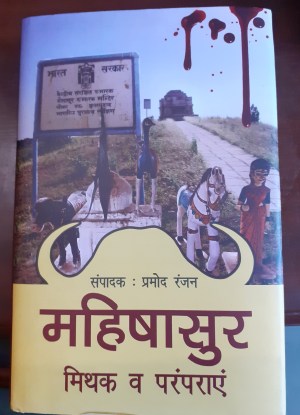
Cover of book Mahishasur – Mithak va Paramaprayen [Myths and Traditions],ed. Pramod RanjanI should begin with a caveat, or more correctly, an amendment to a position I adopted in the earlier post. In that piece, I had used the terms “anti-majoritarian” discourse and “anti-majoritarianism” to refer to the the larger discursive formation against the Hindu Right. I used that expression largely because I went along part of the way with Abhay Dubey who uses it in his book, to which that piece was a response. However, that expression assumes that there is only one “majority” or only one way of imagining majority in this country. More importantly, it concedes a certain “natural pre-givenness” to the project of Hindu unity as though that were a self-evident fact. The only thing that makes the project of Hindu unity appear so “natural”, it needs to be underlined, is that it is backed by “tradition” and “religion” in a way that say a class notion of majority is not. If we assume that the dominant tradition is the sole tradition, then this term could make sense but as the stirrings of a renewed search for a Bahujan counter-tradition, especially in North India, come into view, it gives us a sense of another possible way of imagining “majority”. It should be underlined here that this renewed search today does not emerge out of the blue from nowhere but draws on the work of earlier medieval thinkers and social/ religious reformers not just in the North (for instance Kabir, Ravi Das and Nanak) but also from Phule, Ayyankali, Sri Narayana Guru, Periyar, Iyothee Thass and many others in the South in more recent times. There is one difference however: rather than use the negative descriptor “Non-Brahmin”, the present search is more explicitly about the production of a Bahujan identity. Ambedkar of course, remains a continuous reference point in this discourse.
“Our love is constructed. Our beliefs colored. Our originality valid through artificial art. It has become truly difficult to love without getting hurt”
–Dalit Scholar Rohith Vemula, who was institutionally murdered.
Often academic interests die a quiet death due to crassly political reasons but they die yet again, due to non-recognition and to their relentless reduction to the apolitical. Much as there must be emphasis on seeking solutions to the troubles that humanity is facing, it cannot be ignored that reducing the ‘root’ cause of everything to the realm of ‘apolitical’ can be academically simplistic and politically dangerous. And why must there be an obsession with relegating everything to the ‘apolitical’ domain? Why do journalists who continually work within political systems still consider depression to be something external to the sphere of politics? Why must there be academicians who discount historicity and complexity by equating violence with counter violence? And why, similarly, must there be politicians who condemn violence on ‘both sides’? Because, even a simple reading of the political should reveal its association with power, challenge its centralization, and more importantly the show up the invisibilization that generates hegemony.
Reviewing Anand Teltumbde’s book Khairlanji: A Strange and Bitter Crop, Rajesh Ramachandran concludes:
The book however has a serious ideological flaw. It inadvertently falls into the Brahminical trap of theorising class conflicts in terms of positing Dalits against the new Shudra oppressors. Kilvenmani, Karamchedu, Chunduru and other examples are repeated at least seven times in the text to argue that new oppressors are Shudras. If that be, how does Teltumbde explain desperately poor tribals killing and raping Dalits in Kandhamal? The real oppressor is the caste hegemony perpetuated by the core Sangh Parivar constituency of the Brahmin-Bania-Thakur trinity. Is it any surprise that it was Parivar’s Brahminical commentators who first introduced the Dalit-Shudra contradiction to theorise the “failure” of Kanshi Ram’s Bahujan experiment and the split of the unbeatable BSP-Samajwadi Party alliance in UP. Hope the Dalit ‘holocaste’ series doesn’t serve this Hindutva agenda. [Mail Today, 26 October 2008]


 KAFILA - COLLECTIVE EXPLORATIONS SINCE 2006