Tag Archives: Buddhism

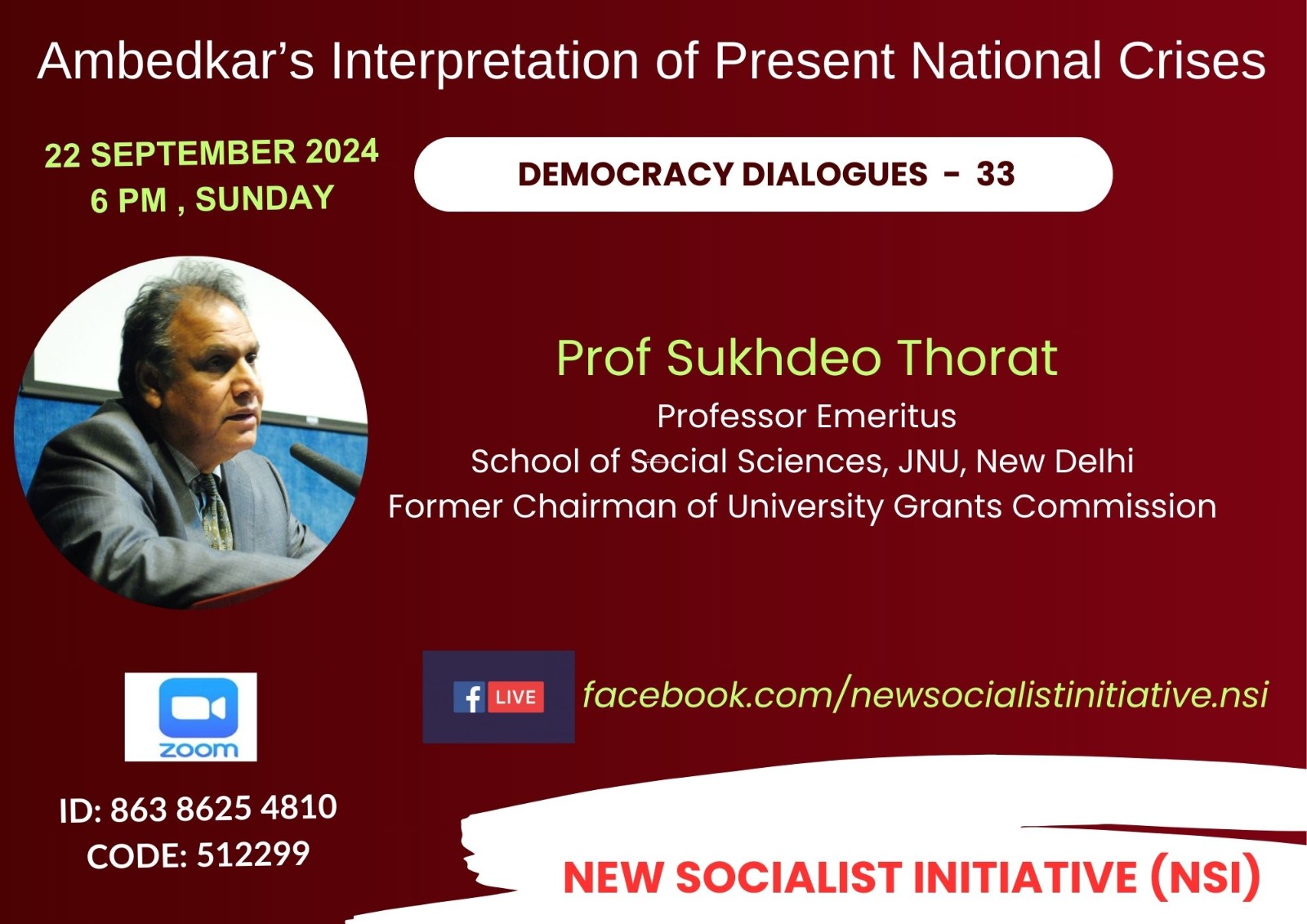
Dr. Ambedkar’s  Interpretation of Present  National Crises

Prof Sukhdeo Thorat

Professor Emeritus, School of Social Sciences, Jawaharlal Nehru University, New Delhi 

Theme :Dr. Ambedkar’s  Interpretation of Present  National Crises

Number of scholars have tried to explain the present crisis by drawing insights from  the experience of Fascism of Hitler in Germany 1930’s and/or  similar viewpoints . Without undermining these attempts, I feel that  Ambedkar’s  theoretical perspective on Indian history presumably helps us more to grapple with the  present crisis .In Ambedkar’s view it is continuation of the non-stop efforts from ancient times to bring back Brahmanism . Ambedkar observes that “that there was in ancient India, a great struggle between Buddhism and Brahmanism. It is not even a struggle but a quarrel over some creed ,The Buddhism  was revolutionary and while Brahminsm  was  counter-revolutionary. It was a revolution and counter revolution in doctrine by a revolution in political and social philosophy”. The present attempt is an on-going legacy of the ancient Indian where it began , and carried through the medieval to British and to the present time with tenacity and stubbornness to maintain the privileges that the Brahmanical ideology bestowed on  those who coined this ideology .The lecture will try to bring insights on Ambedkar’s perspective .

About the Speaker
Prof Sukhdeo Thorat, Professor Emeritus, School of Social Sciences, Jawaharlal Nehru University, New Delhi ; former Chairman of University Grants Commission and former Chairman of ICSSR (Indian Council of Social Science Research) is a leading economist, educationist and writer.
A renowned Ambedkar scholar Prof Thorat graduated with a B.A. from Milind College of Arts, Aurangabad, Maharashtra and has done PhD in Economics from Jawaharlal Nehru University. He was a  Faculty Member at Jawaharlal Nehru University, New Delhi and visiting faculty at Department of Economics, Iowa State University, Ames, USA and has been associated with various national-international institutes and organisations.
Recipient of many awards including Dr Ambedkar National Award (2011) and Padmashree ( 2008), he has authored and edited many books and monographs. Here is a list of his major publications :
– Ambedkar on Social Exclusion and Inclusive Policy
– Dalits in India? Social and Economic Profile (Sage)
– Ambedkar in Retrospect: Essays in Economics, Society, and Politics (edited) with Aryama & Negi. (Rawat Publication)
– Social Science Research in India : Status, Issue and Policies ( co-authored with Samar Varma) – Oxford University Press ( 2016)
– Politics of Representation : Historically Disadvantaged Groups in India’s Democracy ( co edited with Prof Sudha Pai) Palgrave Macmillan ( 2012)
– Untouchability in Rural India Sage, 2006 (with G. Shah, Harsh Mander, Satish Deshpande & Amrita)
– Caste, Race, and Discrimination – Discourse in International Context (edited) (with Umakant), Rawat Publication, Jaipur (2004)
Is the ‘Politics’ of Compassion Transcendental? Sasheej Hegde

Guest post by SASHEEJ HEGDE

Don’t ask for the meaning, ask what’s the point. (Ian Hacking).

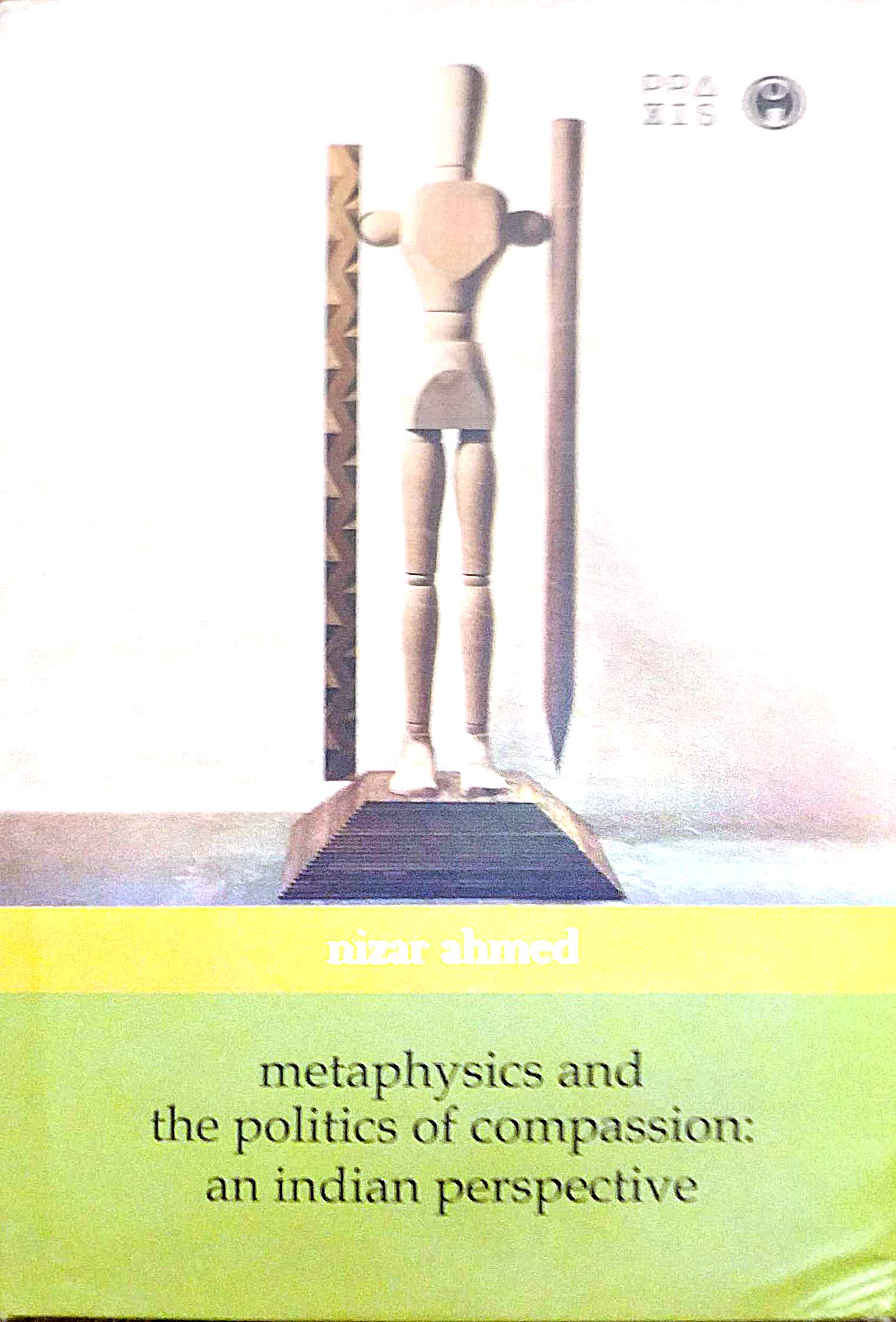
Nizar Ahmed, Metaphysics and the Politics of Compassion: An Indian Perspective (Kozhikode, Kerala: InsightinPublica Printers and Publishers Pvt. Ltd., 2023, pp.93, Rs.300/-).  [ISBN – 978-93-5517-340-9]

1. Introduction

It is no easy task to resist such a forceful and persuasive intervention in a genuinely problematic area of metaphysics and the emotions, as it were, complicated furthermore by the fact that it strives to articulate ‘an Indian perspective’ on the same. The work, emanating from a reclusive philosopher from Kerala and published by a ‘small’ publishing house in the region, requires some attention, yet – and, I attempt to do so without coming across, hopefully, as condescending, or even paternalistic. I must confess, though, that the author Nizar Ahmed (henceforth, NA) is a dear friend for many years now, indeed from the time of his Ph.D. in Philosophy from IIT-Kanpur and taking up a faculty position in the School of Social Sciences at Mahatma Gandhi University, Kottayam (from where he moved to the Sree Shankaracharya University of Sanskrit at Kalady, Kerala, and retiring eventually from that posting).  Dare I say it, NA remains a ‘legend’ in critical circles in Kerala, although he actively resists the attention that his work (both in English, and even more in Malayalam) commands.

Continue reading Is the ‘Politics’ of Compassion Transcendental? Sasheej Hegde

Why Hindutva Loves to hate Ashoka the Great

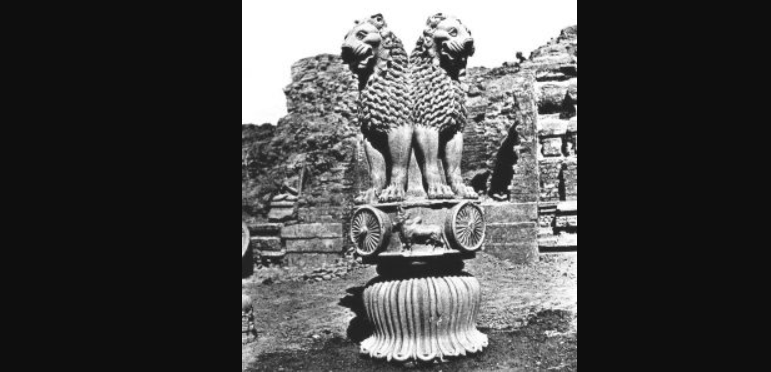
Ashokan lions adorn Indian currency and the Dharmachakra features in the tricolour. Neither symbol has any sanctity for the ideologues of the ruling dispensation.

ashoka

Thousands of kings and emperors shone for a brief moment in history, then quickly disappeared. But in ‘The Outline of History: The Whole Story of Man’, H.G. Wells writes, “Ashoka shines and shines brightly like a bright star, even unto this day.” The famous British historian EH Carr also wrote, “What is history? It is a continuous process of interaction between the historian and his facts, an unending dialogue between the present and the past.”

Yet, history is a continuous ‘us versus them’ for some individuals and outfits in India. Their interaction with the past typically degenerates into a vicious monologue aimed to vitiate the present and control the future. Nowhere is their vandalism of history more visible than what the Hindutva brigade is doing to the last great Mauryan ruler, Ashoka (304-232 BCE). Often compared with a medieval Mughal ruler—whom the Hindutvadis detest and distort in equal measure—they are now transforming the Ashokan period beyond recognition into a symbol of cruelty and bigotry.

Ashoka is widely known to have filled with remorse after the tremendous bloodshed in the battle of Kalinga. After that, he is known to have devoted his life to “conquest by Dhamma or right/moral life”. It is less known that Ashoka was among the earliest rulers to launch public utilities such as hospitals, encouraged tree-plantation, dug public wells and ordered the construction of rest houses along roads. His commitment to public reason is considered phenomenal, as he, two hundred years before Christ, organised the earliest open general meetings in the world.

( Read the full article here)

Nehru, Ambedkar and Challenge of Majoritarianism

Image result for nehru ambedkar

( Photo courtesy : The hoot)

(To be published in the special issue of ‘Janata’)


The spectacle of what is called religion, or at any rate organised religion, in India and elsewhere, has filled me with horror and I have frequently condemned it and wished to make a clean sweep of it. Almost always it seemed to stand for blind belief and reaction, dogma and bigotry, superstition, exploitation and the preservation of vested interests.

– Toward Freedom: The Autobiography of Jawaharlal Nehru (1936), pp. 240–241.

If Hindu Raj does become a fact, it will no doubt, be the greatest calamity for this country. No matter what the Hindus say, Hinduism is a menace to liberty, equality and fraternity. On that account it is incompatible with democracy. Hindu Raj must be prevented at any cost.

– Ambedkar, ‘Pakistan or Partition of India’, p. 358.

Introduction

India’s slow ushering into a majoritarian democracy is a matter of concern for every such individual who still believes in pluralism, democracy, equality and a clear separation of religion and politics. The way people are being hounded for raising dissenting opinions, for eating food of their choice or entering into relationships of their own liking or celebrating festivals according to their own faith is unprecedented. The situation has reached such extremes that one can even be publicly lynched for belonging to one of the minority religions or for engaging in an activity which is considered to be ‘suspicious’ by the majority community.

No doubt there is no direct harm to the basic structure of the Constitution, its formal structure remains intact, de jure India does remain a democracy as well as a republic, but de facto democracy has slowly metamorphosed into majoritarianism and the sine qua non of a republic—that its citizens are supreme—is being watered down fast. It does not need underlining that this process has received tremendous boost with the ascent of Hindutva supremacist forces at the centrestage of Indian politics. Continue reading Nehru, Ambedkar and Challenge of Majoritarianism

“Welcome to the Land of Enlightenment”: Kaveri Gill

Guest post by KAVERI GILL

Bihar Tourism’s Neglected Treasures

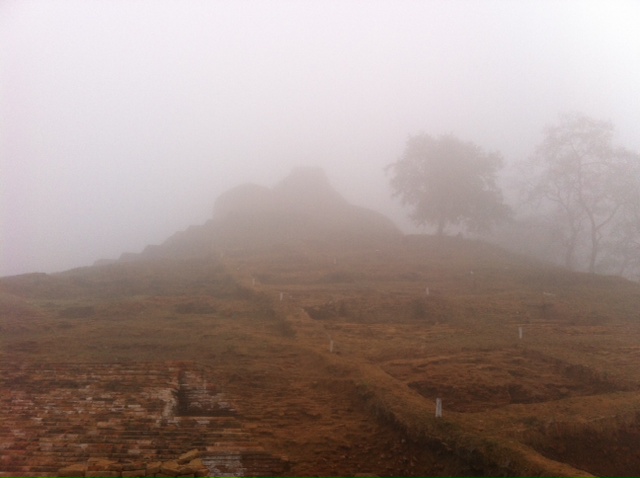
Kesariya Stupa East Champaran

A recent work trip took me to the north-east of Bihar, the poorest region of a state with ‘critical’ poverty incidence by any measure. For instance, within the state, on NSS 2004-05 data, West Champaran is the worst-performing district on headcount ratios (76.9) in rural India (Chaudhuri and Gupta, Economic and Political Weekly, 2009). Such destitution was on ample evidence amongst the segregated group of mahadalit and minority women members of a self-help group we spoke to, in a tola with no electricity and only candles to dispel an eerie fog settled over the village at dusk. Of 13 of them, 11 had repeat experience (up to three times per woman) of losing a child in the last trimester of pregnancy, just after giving birth or of a child under 5 years of age.  It was from Champaran that Gandhi first led landless labour and tenants or ryots, in his first satyagraha against the British, protesting the coerced cultivation of the cash crop, indigo. Almost a century later, not much has changed in tangible terms for the population of this part of the democratic Republic of India. Continue reading “Welcome to the Land of Enlightenment”: Kaveri Gill