
Tag Archives: Mahatma Gandhi

Can a Teacher be Compelled to Offer Prayers in School Premises ?

An atheist school teacher’s case in Nashik before the Bombay HC resonates with the recent case of a Dalit teacher’s suspension in Rajasthan.
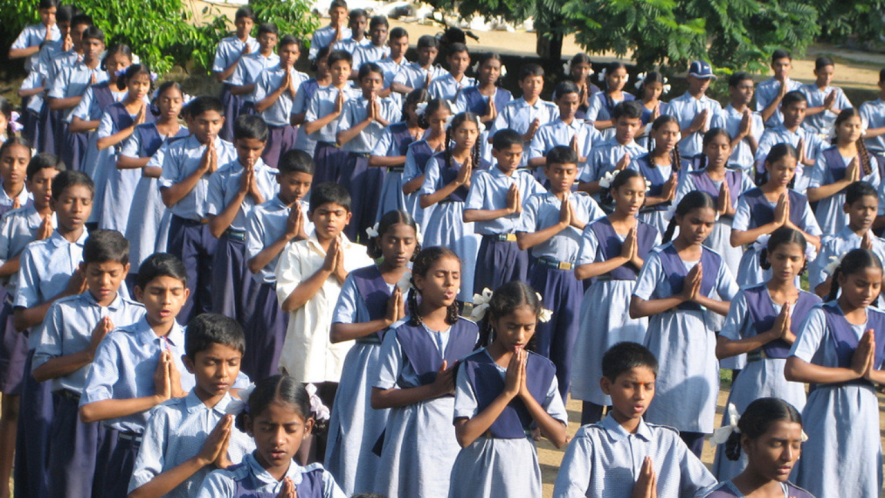
Representational Image. Image Courtesy: Flickr

Can anyone compel a teacher to offer prayers inside a school?

This was a little vexed question before the Bombay High Court when a case came up before a two-judge bench led by Justice Abhay Oka and Justice Revethi Mohiti-Dhere. Sudhir Salve, an atheist teacher from a school in Nashik — who otherwise had an excellent record in his profession — had approached it for relief, because the school management where he worked had denied increment to him for ‘indiscipline’.

The teacher’s refusal to fold hands at the time of school prayer or even at the time of taking oath of the Constitution was construed as such an act. As it happens in most such cases, Salve’s case had lingered on for more than six years in the lower courts.

But it did not take much time for the two-judge bench to decide the case, which declared that any such compulsion to fold hands will be a ‘[v]iolation of the fundamental rights conferred on an individual under the Constitution’.

One was reminded of Salve’s case when the suspension of Hemlata Bairwa, a Dalit lady teacher from an upper primary school in Rajasthan’s Baran district, made headlines recently.

To recapitulate the turn of events, it was Republic Day (January 26, 2024) and Bairwa had garlanded the portraits of B.R. Ambedkar, Savitribai Phule and Mahatma Gandhi before the assembly of students in her school. Two of her fellow teachers interrupted the programme and asked her to put a photograph of Saraswati, goddess of knowledge as per Hindu mythology, which she plainly refused. Despite pressure by them, who even allegedly made casteist slurs against her and were even helped by the local head of the panchayat, Bairwa refused to relent.

When the video of the whole incident went viral, the state education minister Madan Dilawar announced her suspension in a public programme — an act that evoked a strong reaction within the Dalit community. Demonstrations were held in different parts of the state opposing this action by the education minister, demanding revocation of the suspension order and removal of the minister from the post.

The question arises: Will Bairwa similarly have to wait for a long period like Salve for justice? Or whether the Bombay High Court’s intervention would impel the Rajasthan High Court to take up her case suo motu.
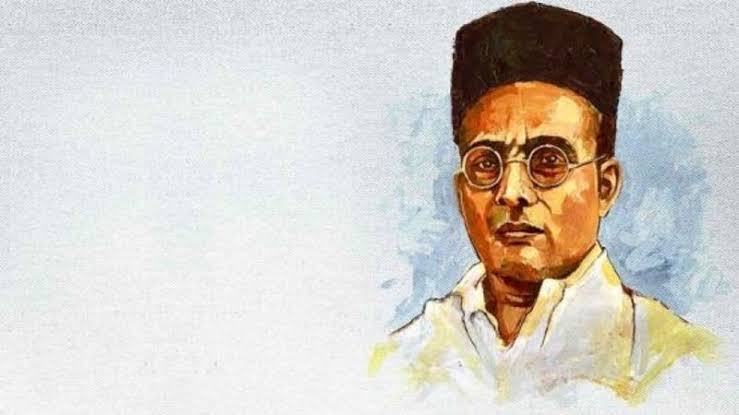
Exit Azad! Enter Savarkar!!

Even at the breakneck pace at which its proponents are rewriting history in the Hindutva mould, its real past will habitually catch up with it.

Savarkar

Last year, a statue of freedom fighter and first education minister of independent India, Maulana Abul Kalam Azad, was destroyed by Hindutva mobs at Kankinara in North 24 Parganas district, West Bengal. At the time, there were communal flare-ups in many districts of the state in the aftermath of aggressive Ram Navami marches, the first of their kind in the country.

The episode was immediately forgotten. Few would have had the premonition that the incident was was merely a precursor to the larger game-plan of the Hindutva right, to erase not just the legendary freedom fighter’s statute, but his name from history.

Now, for some reason, the Indian Council for Historical Research (ICHR) has decided to organise a seminar on ‘Veer Damodar Savarkar: Life and Mission’ on 11 November, the birth anniversary of Maulana Azad, perhaps gives an indication of their intent. This particular date also has no apparent connection with Savarkar, who was born on 28 May 1883 and died on 26 February 1966.

Besides, just over a decade ago, 11 November was declared as National Education Day, to commemorate Azad and recall his contribution to policies and institutions that streamlined the educational needs of newly-independent India. It was a day to reflect on and discuss the country’s education system and its future.

( Read the full article here : https://www.newsclick.in/exit-azad-enter-savarkar)

Caste and other demons

Can Dalits rightfully claim that they have a ‘homeland’?

Dr Babasaheb Ambedkar

( Review of The Doctor and the Saint: The Ambedkar-Gandhi Debate — Caste, Race, and Annihilation of Caste; By Arundhati Roy, Penguin, Rs 299)

“Gandhiji, I have no homeland.” The first meeting between Gandhi and B.R. Ambedkar, who later became chairman of the drafting committee of independent India’s Constitution and its first law minister, is memorialized in this sentence. It expresses the centuries-old plight of those most oppressed in the varna hierarchy under the “institutionalised social injustice at the heart of the country”.

Has there been a qualitative change in the situation of the ‘ex-untouchables’ since this meeting some 90 years back? Can Dalits rightfully claim that they have a ‘homeland’? Figures collated by National Crime Records Bureau show that “a crime is committed against a Dalit by a non-Dalit every sixteen minutes”, including four rapes a day and murders of 13 Dalits every week. And these figures do not include “the stripping and parading naked, the forced shit eating, the seizing of land and the social boycotts…” This is the backdrop of the book, The Doctor and The Saint: The Ambedkar-Gandhi Debate — Caste, Race, and Annihilation of Caste by Arundhati Roy. It earlier formed part of an introduction to an annotated 2014 edition of Annihilation of Caste — the historic pamphlet Ambedkar wrote when invited by the ‘Jat Paat Todak Mandal’ in Lahore. The invitation was withdrawn after the hosts read the lecture draft. Continue reading Caste and other demons

First Terrorist of Independent India

Image


…Government have, however, noticed with regret that in practice members of Rashtriya Swayamsewak Sangh have not adhered to their professed ideals.

“Undesirable and even dangerous activities have been carried on by the members of the Sangh. It has been found that in several parts of the country individual members of the Rashtriya Swayamsewak Sangh have indulged in acts of violence involving arson, robbery, dacoity and murder and have collected illicit arms and ammunitions. They have been found circulating leaflets, exhorting people to resort to terrorist methods, to collect firearms, to create disaffection against the government and suborn the police and military.”

(The government communique of February 4, 1948, announcing the ban on RSS after Gandhi’s assassination)


On Nathuram Godse, (19 th May 1910 – 15 th Nov 1949) Advani asserts that Godse had “severed links with RSS in 1933… had begun to bitterly criticise the RSS”. This was flatly contradicted by none other than Godse’s brother Gopal, who was also an accused at the trial for conspiracy to murder. He published his book Why I Assassinated Mahatma Gandhi in December 1993. Speaking in New Delhi on the occasion of the release of his book, Gopal Godse revealed what many had suspected—they had both been active members of the RSS (The Statesman; December 24, 1993).

(Ref : Whitewashing Godse is part of the Sangh Parivar’s sordid game, From: Frontline, January 26, 2013)


What could be said to be the first act of terrorism in independent India?

Everybody would agree that killing of Mahatma Gandhi by a Hindu fanatic Nathuram Godse constitutes the first terrorist act in independent India. Godse, a Maharashtrian Brahmin, hailing from Pune was associated with Hindu Mahasabha at the time of Mahatma’s assassination and had his initial forays in the world of politics with the RSS. During his tour of the area Hedgewar, the first supremo of RSS, use to be accompanied by Nathuram , the future assassin of Gandhi. Godse had in fact joined the RSS in 1930, winning prominence as a speaker and organiser.

Continue reading First Terrorist of Independent India

An Idiot for PM ? : (Non)Sense of History in NaMo

‘Though this be madness yet there is method in it’ 

– ‘Hamlett’, Shakespeare


The 2014 elections aren’t merely about changing the government. The rhetoric ahead of the polls makes one believe that it’s an attempt at once to change historical narratives handed down to successive generation of Indians. And the man in the forefront of it all is the BJP’s prime ministerial candidate Narendra Modi.

 –  11/11/2013 Blogs-Hindustan Times

I.

Wordsmiths of the world need to put in their heads or pull in their socks (you may say) to coin a new word which can rather resonate with what goes on in this part of South Asia in the name of political speeches. Should one call it ‘polifiction’ or ‘politainment’ or some similar word.

Perhaps a word exists and this poor pen pusher is ignorant about it.

Anyway, the matter has become bit urgent with the feverish preparations which are going on here for the battle royale which would take place in the year 2014 and the not so silent emergence of NaMo on the national scene and the daily dose of half truths, fiction and complete distortion which goes under the name of oratory. Continue reading An Idiot for PM ? : (Non)Sense of History in NaMo