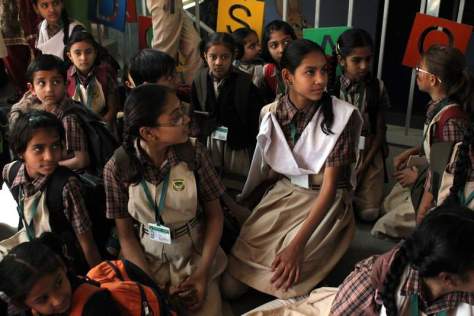
On Tuesday, February 19, the Ahmedabad Municipal Corporation ratified its budget and elected to build the first municipal school in Juhapura, the largest ghetto of Muslims in Ahmedabad. Juhapura was incorporated into the Ahmedabad Municipal Corporation five years ago and many residents wondered why the AMC took so long to build a school to serve Juhapura’s 350,000 residents. At the forefront of this struggle is IIT Delhi physics professor VK Tripathi. It was during a chance meeting with a sandwich shop owner in Washington DC that Professor Tripathi first learned about Juhapura. Continue reading Prof VK Tripathi and the fight for Schools in Juhapura: Zahir Janmohamed→
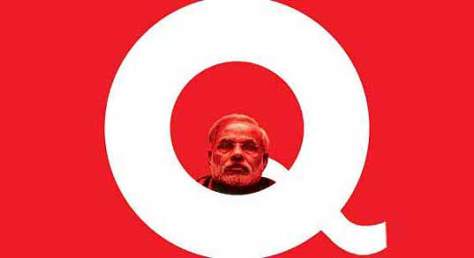
Don’t tell us stories about development, Narendra Modi. Your Vibrant Gujarat and claims of development are shameless hollow lies, and even if they were true, it would still be an unethical and blood-stained development.
But they are lies, Modi, lies.
Here’s a report by Pranjal Sharma in Business World that sees through the working of your aggressive PR machinery:
The Centre for Monitoring Indian Economy (CMIE) recently examined the investment statistics flaunted by the Gujarat. The Vibrant Gujarat investment summit held by the chief minister has been projected to have earned billions of dollars of fresh investment into India. But a closer look at the figures reveals a different story. Only a small percentage of projects announced in Vibrant Gujarat (VG) summits in 2009 and 2011 have actually moved on the ground. The details of many grand projects are missing… Continue reading We remember Gujarat 2002. And we know you’re lying about development.→
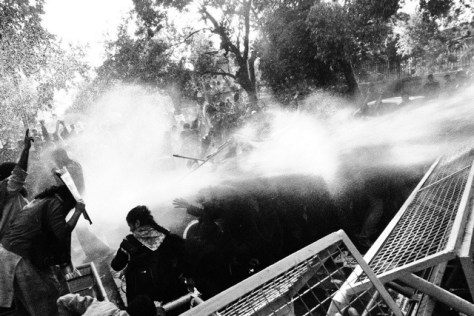
On 6th January, 2013 the usually quaint Delhi University transformed into a battle ground of ideologies. The road leading to Sri Ram College of Commerce (SRCC) where Narendra Modi was invited to speak at the Sri Ram Memorial Oration stands witness to all that went wrong day before yesterday. Continue reading Bhag Modi Bhag: Three eyewitness accounts from a protest in Delhi University→
I was very excited when I learned you were coming to Ahmedabad and I was honoured that you expressed interest in possibly meeting with me.
I was sitting with a journalist friend when I read your Tweet about visiting Ahmedabad and he told me you are a “pioneering feminist who did ground breaking work.” He also told me that in 2005 you signed a very strong petition calling for Gujarat Chief Minister Narendra Modi’s dismissal because of Modi’s role in the 2002 Gujarat riots. He also added that you have been very vocal on behalf of Kashmiri Pandits. After I witnessed the Gujarat riots in 2002, I returned to the United States—where I was born and raised—and I gave lectures for six months about the violence I saw. In each lecture, an audience member would inevitably shout at me that I have ignored the plight of the Kashmiri Pandits. It is true. I know very little about Kashmir, and for that matter Kashmiri Pandits, and I would have enjoyed and benefited from listening to your views on the conflict there.
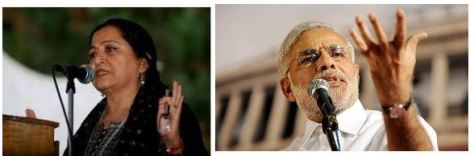
I understand from your Twitter feed that you have left Ahmedabad. I know your days in Ahmedabad were limited and I fully understand that you were not able to meet. Therefore in this letter I will try to convey some of the things I had hoped to tell you in person, in particular about your Tweets. Continue reading An open letter to Madhu Purnima Kishwar: Zahir Janmohamed→
…27 of the 30 complaints that were addressed to the commission spoke of indifference of police officials towards dalits.These issues were raised immediately after NHRC chairman KG Balakrishnan praised status of scheduled castes (SC) in Gujarat. He said the state’s schemes for development of the marginalised are working well and penetration of education among scheduled caste and scheduled tribes has reached 70%.Almost all dalits and their leaders present in the audience were not in agreement with this statement. [DNA]
I
Justice Balakrishnan, retired Chief Justice of the Supreme Court of India, and at present Chairman of the National Human Rights Commission (NHRC), – who has remained in news since his retirement altogether for wrong reasons – provided further ammunition to his critics with his recent visit to Gujarat. The manner in which he lauded the state government for its ‘innovative schemes for the upliftment of dalits’ and claims that ‘..[f]uture of the SC community seems to be fairly good in Gujarat as compared to many other states’ is being seen as an attempt to clean chit and whitewash acts of ommission and commission.of a government which is still mired in the controversies surrounding the carnage in 2002
The said two day visit (14-15 th March) was part of the plan envisaged by the Commission to hold “open hearing” sessions on issues related to dalit atrocities in different parts of the country. According to media inputs, this was one of the important recommendattion by the K.B. Saxena committee which had done a painstaking job and brought out a report on dalit atrocities in the country few years back.for the commission itself. Not some time ago the commission had held its first such hearing in the state of Orissa.
Kashana Flats, Paldi, Ahmedabad, as they stand today. Photo credit: Prateek Gupta
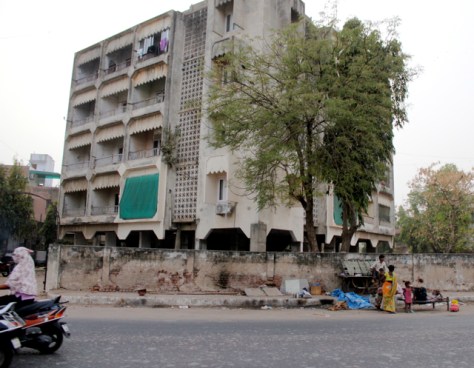
When the riots broke out in 2002 in Ahmedabad, after the burning of the Godhra coach, I was in the tenth standard. I remember listening to the news in the morning, just after which my best friend Ketan had called me and asked “Why did you guys do this?” I didn’t know how to respond to that. I think I just laughed it out and we began discussing what was happening in the city. My father took the phone away from me. I was preparing for my board exams and was just about to leave for one of the last days of school, after which we would go on a study leave. My father, who had experience with riots, told my two elder sisters and me to not go to school and stay at home that day. Continue reading Reflections of a Refugee from Modi’s Gujarat: Reza Noorani→
This guest post by former Gujarat DGP RB SREEKUMAR is a letter to the Union Minister of Home Affairs.
Dear Shri P. Chidambaram,
I belonged to Gujarat cadre of Indian Police service (IPS)-1971 batch-and retired from service on 27.2.2007 in the rank of Director General of Police (DGP), Gujarat state.
2. As a senior citizen (age-65 years) staying in Gujarat since 1970s, I am constrained to write the following for your kind consideration and urgent remedial action.
3. The morale, self esteem and image of the Gujarat Police in general and of IPS officers giving leadership to police force in the state in particular, have been in steady decline since 2002 anti-minority genocide. The media, reputed human rights activists and national bodies like the National Human Rights Commission, the National Commission for Minorities and the National Commission for Women have thrown light on serious intentional acts of commission and omission by Gujarat government functionaries (except in cities like Surat, Bhavnagar and a few districts in South Gujarat and Saurashtra), that facilitated extensive and gruesome mass violence against minorities.
This guest post byURVISH KOTHARIwas originally written in Gujarati and has been translated byVISTASP HODIWALA
Associated Press
Some facts are so simple and self-evident that they elude you completely at the time they happen. Digesting them takes time – 2, 3,7, maybe even 10 years. By that time, the passion and the anger has abated a bit and there is a sense of composure that pervades our beings.
Like the fact about the communal violence that gripped the State of Gujarat in 2002.
Of course, a mere mention of this is enough to get the chief minister’s fanboys roll up their sleeves, even as their opponents ready themselves to launch a counter onslaught. But with the passage of ten long years, the first question should not be about whether the Chief Minister was complicit in the crime or not. No, it cannot be.
Bilkis Bano. Photo via a grab from a recent NDTV report
To mine the detritus of the Gujarat pogrom for positive stories may seem like sacrilege. But when memories are dredged up to mark a decade of the horrors of 2002, a little blasphemy could help balance the account books.
Mostly what we recount of Gujarat 2002 is deaths. Yet, more than the murder and mayhem, the pogrom stood out for an unprecedented scale of sexual violence that Muslim women were subjected to. George Fernandese in his capacity as the Union defence minister had explained to the Parliament after a quick tour of Gujarat that women raped or molested during riots was not surprising or exceptional. I will not go here into the polemics of why violating women’s sexuality is considered a means of dishonouring a community,
There’s an untold story about how the community handled sexual violence. If the dominant community legitimised rape driven by its insecurities and politics that stemmed from history and identity issues, it was perhaps for the first time that the persecuted community reacted to rape in a progressive way.
Rape is double-edged sword, first leading to physical violation and second to social ostracisation in most societies. Which is common to mask the identity of rape victims for fear of social stigma. Strangely, during the 2002 riots, Muslim women, some of them burqa clad and most of them from tightly-knit rural communities never betrayed the kind of shame or guilt that rape victims are expected to show. What was their fault? Why should the victim feel shame and guilt? And so it was that many of them did not cloak their identities, and instead chose to come out publicly to demand justice. Continue reading Three Stories of Resilience from Gujarat: Ayesha Khan→
In Outlook magazine last week, its web editor Sundeep Dougal asked 25 questions of Narendra Modi about the 2002 Gujarat pogrom and the subversion of justice since then. Predictably, the army of Narendra Modi Defenders began to spill outrage at such blatant compilation of true charges against Mr Modi. Doing the rounds of the internet is a point by point rebuttal to Dougal’s questions by a blogger, Shashi Shekhar, who goes by the name Offstumped, and is a known online Modi defender. Offstumped’s answers have been responded to by Dougal, and yet Offstumped’s rejoinder is being circulated all over the internet by Modi defenders in the hope of persuading public opinion that Mr Modi is a spotlessly clean man whose actions and inactions did not result in any loss of life, property or dignity of anyone in 2002 and later. The rather large army of Narendra Modi Fans on the internet hopes that by repeating their standard lies again and again, they will one day become accepted truth. Continue reading Defending Narendra Modi: An Exercise in Obfuscation→
Guest post by R B SREEKUMAR, former Director General of Police, Gujarat, who deposed before the Nanavati Commission.
Gujarat riot victims prevented from protesting against Narendra Modi during his sadbhavna fast in September 2011.
The Gujarat genocide in 2002, resulting in killing of nearly 1,500 innocent citizens, mostly from India’s major minority community and subsequent pervasive subversion of governmental machinery to sabotage justice delivery to riot victims, has to be understood as a man-made disaster. A disaster broughtabout by lack of professionalism and lack of integrity and commitment to the letter, spirit and ethos of the Constitution of India, on the part of all officials of the state, from the Chief Minister Narendra Modi to the police constables.
An analysis of the sequence of events from the time of the gruesome killing of 59 Hindu passengers in the train burning incident on 27 February, 2002 to this day, will bring up many unambiguous facts and data on deliberate acts of omission and commission by political leaders, bureaucrats and policemen, aiming at the actualization of the anti-Muslim carnage in Gujarat in 2002, and since then, the lopsided justice delivery to riot victims.
This release was put out on 24 February 2012 byHUMAN RIGHTS WATCH
(New York) – Authorities in India’s Gujarat state are subverting justice, protecting perpetrators, and intimidating those promoting accountability 10 years after the anti-Muslim riots that killed nearly 2,000 people, Human Rights Watch said today. The state government has resisted Supreme Court orders to prosecute those responsible for the carnage and has failed to provide most survivors with compensation.
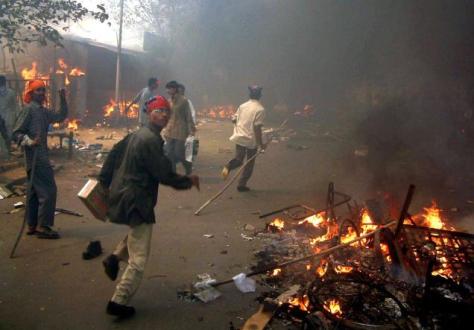
The violence in Gujarat started on February 27, 2002, when a train carrying Hindu pilgrims was attacked by a Muslim mob and caught fire, killing 59 people. In a retaliatory spree by Hindu mobs, hundreds of Muslims were slaughtered, tens of thousands were displaced, and countless Muslim homes were destroyed. Continue reading A decade on, Gujarat justice incomplete: Human Rights Watch→
Of all the things about my last workplace, being summoned by one of our editors to her cabin was one that I did not particularly like. The problem was that, unlike other parts of the office, in her cabin I could not even pretend to seem interested in what she had to say. My eyes would involuntarily travel to the soft-board above her desk and get fixated on a slightly hazy colour photograph of Gujarat Chief Minister Narendra Modi. And if I shifted focus a bit towards the left, then I could also see another familiar figure standing next to Mr. Modi. That of the cabin’s proud occupant.
Now, it is not a hidden secret that the Indian business news community admires Mr. Modi. His biennial Vibrant Gujarat Summits, desi version of international pseudo-events like the Davos World Economic Forum, are a definite hit among business news hacks. How can you not be at a place where deals upwards of $452 billion get signed over just a couple of days?
What a farce! What a farce of a fast! One doesn’t quite know whether to laugh or cry over this state of affairs in the world’s largest democracy. It is a sad day in a nation’s history when someone who presided over a state-sanctioned genocide goes on fast in the name of “peace and harmony” and media vultures and assorted politicians rush to canonize him as the apostle of peace. When it comes to political theatre, few can beat our politicians. They have no qualms in mimicking their more successful fellow travelers if it can get them a few more votes or push them a couple of notches up the popularity ladder.
Till a few days ago, I hadn’t heard of Aqeel Shatir. A friend sent me a link to a report in the Indian Express on December 20 about a poet who had been asked to pay for an anti-Narendra Modi remark in his anthology, Abhi Zindaa Hoon Main (I Am Still Alive). I got in touch with the reporter, in Ahmedabad, who had filed the story and soon after that spoke on the phone with Shatir.
Aqeel Shatir is his takhallus or literary alias. The name his parents gave him was Aqeel Ahmed. His ustad offered him a choice of two pen-names. One was Aazar, which means a sculptor, someone who carves beautiful forms from marble. The other was Shatir, whose literal meaning is chess-player but denotes someone who possesses cunning. Continue reading “I Am Still Alive”: Amitava Kumar→
Can you even imagine Indian politics, or even India, without Murdabad? Who in this country has not seen a protest with people shouting “murdabad” after the name of a politician? Murdabad literally means death be upon you. In Gujarat, though, wishing death upon Narendra Modi can land you in jail. After the chief minister contracted swine flu, one Umesh Anupchandra Jain in Surat sent his friend Nirav Jagdishchandra Rana an SMS that read: “Jay Shree Ram. Narendra Modi ne swine flu positive. Bhagwan ene jaldi uthavi le aevi prarthna. Jaisi karni vaisi bharni.” That translates as: ‘Jai Shri Ram. Narendra Modi is swine flu positive. Let’s pray that god takes him away soon. As you sow, so you reap.’
So what if the recipient, Nirav, further circulated this to another 500 people? And so what if some of those were Modi fans, who were infuriated enough to go to the police station with it? What in those words gives the police the right to arrest Umesh and Nirav under charges of promoting enmity between groups, criminal conspiracy and abetting a crime, besides the IT Act. The irony of the Narendra Modi government accusing somebody of promoting enmity amongst groups. You may say it’s in bad taste, you may invoke Gandhi and say and eye for an eye makes the whole world blind. But jail for an innocuous SMS makes Gujarat a police state. Continue reading Narendra Modi – Murdabad! Murdabad, murdabad!→
The 4th ‘Vibrant Gujarat Global Investors’ Summit, organized by the Gujarat government on 12-13 January 2009 in Ahmedabad, and the statements by some prominent Indian corporate leaders, have spawned protests, analysis, debates and questions about corporate accountability, complicity, responsibility and rights in Indian democracy. At this biennial event, ‘Jai Jai Garvi Gujarat’ has been showcased as an ‘ideal investment destination, both for Indian and foreign investors’, where prospective investors have ‘only Red Carpet and no Red Tape and it is where investors can sow a rupee and reap a dollar as returns’ (see Official portal of Gujarat Government).
Bringing together business leaders, investors, corporations and policy makers by a democratically-elected government, exploring business opportunities and signing memorandum of understandings are legitimate economic activities. However, the projection of the Chief Minister of the State, Narendra Modi, as the next Prime Minister of India by corporate cheerleaders is much more than mere economic activity. It is turning a blind eye to gross abuses of rule of law, and knowingly assisting a political leader and his government to continue committing them. It is becoming party to a specific political vision in a manner that incurs responsibility and blame. Such corporate leaders thus become complicit with a government and its leader in serious human rights abuses. It is negative and unacceptable.
Sheela Bhatt’s assertions that the Gujarati Muslim hasn’t been seeking retribution by a long shot are not surprising at all. What is illuminating is this:
One of the surprises of Saturday’s blasts was that except one blast in Sarkhej, all the blasts were executed in East Ahmedabad, which includes the highly communally sensitive walled city area. The accuracy of the planning suggests that a person with a complete grip on the social-political mindset of the city and its communal geography must be behind the blasts.
No one in this shaken city doubts that these blasts were planned by someone who has a thorough knowledge of the past 25 years history of communally sensitive areas and the Sangh Parivar’s role in it. Continue reading Ahem-dabad again→
[While this post is also posted on my blog, I want to add a small qualification as to why I have put this up on Kafila as well. This post goes out on Kafila in the optimistic spirit of peace and wisdom in our hearts in the midst of the various blasts that have been taking place in different cities across India.]
(I write in the spirit of my words and in submission of myself to my vulnerabilities and to the present …)
One blast here,
One there,
One everywhere.
Today here,
Tomorrow there.
One blast here
And one blast there.
So that is what we, in various parts of the world, have been hearing about in the last two days. And yet, the indifference on my skin remains. It only thickens. But I remain sensitive to more mundane issues that concern me/bother me/sit on my mind/nag me. And what is sitting on my mind as of now, is that beautiful feeling of vulnerability and the thought of what it means to be vulnerable in the city. The feeling of vulnerability is beautiful as of now because I write in the solitude of music, my words and my difficult and vulnerable self, shut off from the noise of the blasts and of the noise of the crowds that existed in my space a while ago.
Prof. Ashish Nandy, India’s leading intellectual acknowledged as one of the the founding fathers of postcolonial studies has recently got a new ‘identity’. According to the Gujarat Police he is now an accused in a criminal case supposedly for ‘promoting enmity between different groups on grounds of religion, race, place of birth and language.’ Definitely neither Prof Nandy nor many of his admirers would have ever imagined in their wildest dreams that a day would arrive when he will face prosecution for his writings. But as they rightly say it, in Gujarat things happen bit differently. Continue reading Why NAMO Loves To Hate Prof Nandy→
radical Islam in India as this generationu003cbr />remembers with gratitude the handsomeu003cbr />contribution of Rajiv Gandhi and his cohorts tou003cbr />Sikh militancy.u003cbr />u003cbr />The secularist dogma of many fighting the sanghu003cbr />parivar has not helped matters. Even those whou003cbr />have benefited from secular lawyers and activistsu003cbr />relate to secular ideologies instrumentally. Theyu003cbr />neither understand them nor respect them. Theu003cbr />victims still derive solace from their religionsu003cbr />and, when under attack, they cling moreu003cbr />passionately to faith. Indeed, shallow ideologiesu003cbr />of secularism have simultaneously broken the backu003cbr />of Gandhism and discouraged the emergence ofu003cbr />figures like Ali Shariatis, Desmond Tutus and theu003cbr />Dalai Lama – persons who can give suffering a newu003cbr />voice audible to the poor and the powerless andu003cbr />make a creative intervention possible from withinu003cbr />worldviews accessible to the people.u003cbr />u003cbr />Finally, Gujarat’s spectacular development hasu003cbr />underwritten the de-civilising process. One ofu003cbr />the worst-kept secrets of our times is thatu003cbr />dramatic development almost always has anu003cbr />authoritarian tail. Post-World War II Asia toou003cbr />has had its love affair with developmentalu003cbr />despotism and the censorship, surveillance andu003cbr />thought control that go with it. The East Asianu003cbr />tigers have all been maneaters most of the time.u003cbr />Gujarat has now chosen to join the pack.u003cbr />Development in the state now justifies amorality,u003cbr />abridgement of freedom, and collapse of socialu003cbr />ethics.u003cbr />u003cbr />Is there life after Modi? Is it possible to looku003cbr />beyond the 35 years of rioting that began in 1969u003cbr />and ended in 2002? Prima facie, the answer isu003cbr />"no". We can only wait for a new generation thatu003cbr />will, out of sheer self-interest and tiredness,u003cbr />learn to live with each other. In the meanwhile,u003cbr />we have to wait patiently but not passively tou003cbr />keep values alive, hoping that at some point willu003cbr />”,1] );
// –>
Future generations will as gratefully acknowledge the sangh parivar’s contribution to the growth of radical Islam in India as this generation remembers with gratitude the handsome contribution of Rajiv Gandhi and his cohorts to Sikh militancy. [The Times of India, 8 January]



 KAFILA - COLLECTIVE EXPLORATIONS SINCE 2006