First of all, JNU has no exclusively M.Phil. intake at all. Continue reading JNU VC misleads media on research vacancies: Ayesha Kidwai

First of all, JNU has no exclusively M.Phil. intake at all. Continue reading JNU VC misleads media on research vacancies: Ayesha Kidwai
Guest Post by JATIN GORAYA and PRADEEP NARWAL
ABVP ARE THE FOOT-SOLDIERS OF THIS FASCIST GOVERNMENT WHO ORCHESTRATED THE ATTACK ON JNU POST 9TH FEB LAST YEAR!
APPEAL TO EVERYONE TO REJECT AND ISOLATE THE KILLERS OF ROHITH AND THOSE WHO ORCHESTRATED THE #SHUTDOWNJNU CAMPAIGN!
As JNU is still recovering from the aftershocks of last year sangh parivar’s attack on our university post 9th of February we are again facing an unprecedented attack on our university – its democratic space, progressive admission policy, its inclusive character. The latter has been the heart and soul of JNU which the student movement has built over the last four decades. Last year’s attack was an attack on our right to dissent, to curb our democratic spaces and to implement the fascist Hindutva agenda on our universities. This year, in the name of “academic quality” and “excellence”, by reducing the seat intake & closing admission they want to ensure that none is able to access higher education in JNU.
We were members of ABVP previous to the events of Feb 9 last year, and we subsequently resigned because of our differences with this fascist, casteist, Brahmanical and patriarchal organisation. These differences, as we have earlier said, had been long standing ones. But after the orchestrated attack on JNU, we felt a limit had been crossed and we could no longer associate with ABVP. Continue reading Ex-ABVP Activists Reflect on How the ABVP Orchestrated 9th of February in JNU Last Year: Jatin Goraya and Pradeep Narwal
This is my Malayalam opinion piece for iemalayalam, on something despite the outcry against the CPM in the mess around Kerala Law Academy. The public discussion has been, not unexpectedly, on the line of Kerala’s well-entrenched scandal journalism, which has a history of a hundred years, at least. This is a form of journalism that highlights the sexual lives – proper or improper – of powerful male politicians which accompanies the attack on their public failings directly or indirectly- a very highly successful tactic, hitherto, to undermine even the seemingly unassailable. When women began to figure in this kind of journalism as something more than just passive sexual objects, as active agents of corruption and manipulation – most markedly, in the controversy over the businesswoman Sarita Nair – scandal journalism worked by highlighting the huge contrast between their ‘feminine-respectable’ names, sartorial styles, behaviour, and so on, and the despicable manipulations they indulged in. This is the case also with much media discussion of the principal of the Kerala Law Academy, Lekshmi Nair.
However, this tactic is not only misogynist, it also lets the elite-femininity that she represents escape critique. This is a very contemporary form of respectable femininity that presents itself as essentially domestic, but wields delegated masculine power to vicious ends, and it is almost all-pervasive in disciplinary institutions in Kerala now. Not surprisingly perhaps, the CPM’s mishandling of the issue has not just shown how poorly committed the party is to women’s rights, but also how soft it is on this elite-feminine power.
The full essay, in Malayalam:
https://www.iemalayalam.com/opinion/cpm-j-devika-law-academy-lekshmi-nair-gender-caste-women/
We, the undersigned, condemn the repeated attacks on Professor Nivedita Menon, the most recent of which being the police complaint lodged against her on the 3rd of February, 2017 (as also against Professor Rajshree Ranawat) for allegedly making ‘anti-national’ remarks during a seminar organised by the Department of English, Jai Narain Vyas University. This incident, we believe, is continuous with the spate of attacks that Professor Menon has had to face for taking an astute stand against the RashtriyaSwayamsevakSangh (RSS), its student-wing the Akhil Bharatiya Vidyarthi Parishad (ABVP), and the nefarious politics of Hindutva in general. We refuse the rationale of dissent against Hindutva as dissent against the nation, because our idea of the nation is not of the Hindu Rashtra but of secularism, democracy, and social justice. Both as a voice of dissent and a formidable scholar of politics, Professor Nivedita Menon is an inspirational figure. She is a consistent articulation of conscience and an abiding commitment to the ideals that our freedom fighters envisioned for our nation. It is our conviction that patriotism is not only love for the abstract entity of the nation but also for its people, regardless of class, caste, religion, gender, sexual orientation, ability, or any other marker that is used to advantage or disadvantage groups. The ‘patriotism’ that the RSS and its henchmen claim to champion is hateful, divisive, and truly anti-national.
It is our concern as students, therefore, that the ABVP claims to speak for the student community. This petition is a rejection of that assertion, and a statement in solidarity with Professor Nivedita Menon. We hope for and demand the cessation of attacks on Professor Nivedita Menon and the protection of her inalienable freedom and right to oppose the politics of division and communalism. Continue reading Students In Solidarity With Professor Nivedita Menon and Rajshree Ranawat – A Statement – UPDATED SIGNATORIES.
PEOPLE’S UNION FOR CIVIL LIBERTIES, RAJASTHAN
PUCL demands an end to the Harassment of Dr. Nivedita Menon(JNU), Dr Rajshree Ranawat and Dr Vinu George (of JNVU, Jodhpur)
and the
Criminalizing and throttling of Academic Freedom in Rajasthan
The PUCL is shocked at the harassment of Dr Rajshree Ranawat and Dr Vinu George of the English Department of Jai Narain Vyas University, Jodhpur, by University authorities, Jodhpur police and the BJP/ABVP outifts along with their fellow vigilante groups. The harassment and relentless persecution is for organizing an academic conference titled “History Reconstrued through Literature: Nation, Identity, Culture”, in which one of the speakers was Prof Nivedita Menon of JNU, whose lecture was mis-reported sensationally in some local Hindi papers on the basis of the claims of one person. Following on this, the university authorities as well as private persons have filed police complaints against all three, and the university authorities have issued show cause notices to Dr Ranawat and Dr George. We condemn this effort of criminalizing and throttling academic freedom. Continue reading Stop criminalizing academic freedom in Rajasthan: People’s Union for Civil Liberties
DARSHANA MITRA in The Wire
While many in India have recoiled at the manner in which the Trump administration has made religious discrimination a key ingredient of its refugee and immigration policy, we should also turn to look at similar legislative provisions being proposed in our own country.
The Citizenship (Amendment) Bill of 2016 is a short, three-page document that seeks to amend Section 2(b) of the Citizenship Act. The Citizenship Act deals with the acquisition and termination of Indian citizenship. Section 2(b) of the Citizenship Act defines the term “illegal immigrant”. The Citizenship (Amendment) Bill proposes to amend the definition of this term by adding this proviso:
“Provided that persons belonging to minority communities, namely, Hindus, Sikhs, Buddhists, Jains, Parsis and Christians from Afghanistan, Bangladesh and Pakistan, who have been exempted by the Central Government by or under clause (c) of sub-section (2) of section 3 of the Passport (Entry into India) Act, 1920 or from the application of the provisions of the Foreigners Act, 1946 or any order made thereunder, shall not be treated as illegal migrants for the purposes of this Act.”.
This effectively means that persons from minority religious communities from our neighbouring Muslim majority countries shall not be considered as illegal migrants and subjected to prosecution. Further, the Bill also proposes an amendment to the Third Schedule of the Act, which would allow minority communities, namely Hindus, Sikhs, Buddhists, Jains, Parsis and Christians from Afghanistan, Bangladesh and Pakistan to qualify for naturalisation as a citizen of India if they are resident in India or in service to the Government of India for an aggregate period of not less than six years, as opposed to eleven years for everyone else.
Sent by Shukla Sawant, Professor, School of Arts and Aesthetics, JNU.
Joaquín Torres-García, Upside-down Map (1943).
Read more about this image and about “the essentially fictional status of maps and the power they possess for construing and constructing worlds.”
If you would like to endorse this statement, as I have, please go to the link given below. As of 4 February 2017, 13.00 GMT the letter has 6000+ signatures.
On 27 January 2017, President Donald Trump signed an Executive Order putting in place a 90-day ban that denies US entry to citizens from seven Muslim majority countries: Iran, Iraq, Syria, Yemen, Sudan, Libya and Somalia. So far, the ban includes dual nationals, current visa, and green card holders, and is affecting those born in these countries while not holding citizenship of them. The Order also suspends the admittance of all refugees to the US for a period of 120 days and terminates indefinitely all refugee admissions from Syria. There are indications that the Order could be extended to include other Muslim majority countries.
The Order has affected people with residence rights in the US, as well as those with rights of entry and stay. Some of those affected are fleeing violence and persecution, and have been waiting for years for resettlement in the US as refugees. Others are effectively trapped in the US, having cancelled planned travel for fear that they will be barred from returning. The order institutionalises racism, and fosters an environment in which people racialised as Muslim are vulnerable to ongoing and intensifying acts of violence and hatred.
Among those affected by the Order are academics and students who are unable to participate in conferences and the free communication of ideas. We the undersigned take action in solidarity with those affected by Trump’s Executive Order by pledging not to attend international conferences in the US while the ban persists. We question the intellectual integrity of these spaces and the dialogues they are designed to encourage while Muslim colleagues are explicitly excluded from them.
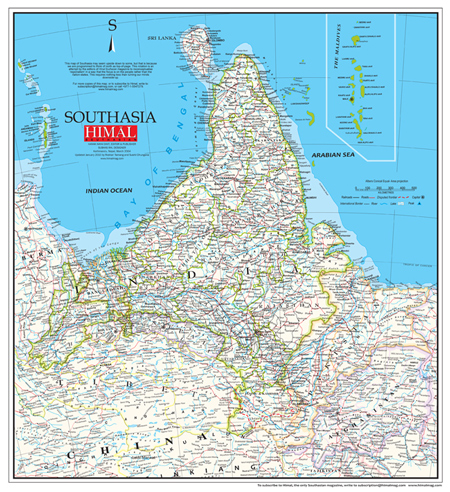
Himal Southasian’s ‘right-side-up’ map. In their words: “This map of Southasia may seem upside down to some, but that is because we are programmed to think of north as top of page. This rotation is an attempt by the editors of Himal to reconceptualise ‘regionalism’ in a way that the focus is on the people rather than the nation-states. This requires nothing less than turning our minds downside-up.”
Turn your eyes away, gentle reader. You have already become anti-national by viewing this image.
More on this in a minute. First some background.
On the 3rd of February, ABVP called a bandh in Jai Narain Vyas University (JNVU), Jodhpur, forcibly stopping classes and demanding suspension of the organizers of a conference and police action against them, as well as against myself. Police complaints have now been lodged, and perhaps FIRs, we hear.
The charge? The conference, and my lecture in particular, was anti-national. Not one of these ABVP students attended the event, nor is there yet a video recording available to my knowledge, largely because the ABVP also gathered in intimidatingly large numbers outside the shop that had conducted the recording, and the owner shut up the shop and fled. The entire drama and some sensationalist and outright false stories in the local Hindi press, is based entirely on the testimony of one person, NK Chaturvedi, retired professor from the History department at JNVU, who attended just one session, mine.
Continue reading On RSS ignorance, the “upside down map” of India, and on being “anti-national”
To be truly radical, said Raymond Williams, is to make hope possible rather than despair convincing. Today, his words are both a diagnosis of all that ails the contemporary Indian city as well as the clearest articulation of what we must strive to be in the years to come. Amidst the smart, the inclusive, the global, the world-class, and the sustainable: how does one find the radical city?
This is no easy task. By their nature, cities concentrate both opportunity and risk, hope and despair. If growth rises, so does inequality. If diversity rises, then so does segregation. If infrastructure and built form expand, so do ecological risks. Historically, if cities have held innovation, mobility, and democracy, they have been equally adept at violence, poverty, and inequality. This is then where we must start: to acknowledge the city as a site of trade-offs, not the convenient listing of aspirations where the smart, inclusive or sustainable city can be created at no cost, no price, or without crowding out other visions and alternative futures. As India urbanizes, the only certainty we have is that these trade-offs will become more stark, with the stakes becoming higher for more and more people.
