All posts by Nivedita Menon

Protest the communally motivated murder of Yakub Shaikh in Mumbai!

A CALL FOR PROTEST on 29th October 2015 outside Toyota Shinrai, Cotton Green, Mumbai.

On 29th September at 2:30 pm,  a day after Dadri lynching in Uttar Pradesh, Yakub Shaikh, a worker at the Toyota Shinrai workshop cum showroom at Cotton Green, Mumbai, was brutally murdered at his workplace. The murder took place as a result of some of his co-workers forcefully inserting an air pipe at 140 PSI pressure into his rectum. His organs burst open leading to what must have been a painful but instant death. The gruesome `lynching’ was sought to be suppressed by the management and co-employees at the showroom.

His family was misinformed throughout, the various versions of the death being told  to them as “heart attack”, food poisoning, medicine overdose and finally “a prank”, by the company and police. The two CCTV cameras covering the spot of murder were reported by the Toyota Shinrai management to police as having been out of service for months, whereas a close inspection shows that they have been tampered with and damaged very recently. Clearly there seems to be an unholy nexus between the police and the Toyota company.

The police have recorded the statement of an 18-year old temporary worker as the complainant and registered an FIR in his name. Why wasn’t the  management made the complainant? In a large workplace where 40-50 people work, why were the statements of co workers not recorded? The single witness / complainant is likely to  turn hostile at any moment. Why have the police refused to accept the version from the victim’s family? Why has the management given different versions of the death to the family? Why the management wanted to give a false story of heart attack, and why the police ACP was trying to do a negotiation for 3 lakhs? Why was there a delay in doing post mortem? The management’ s false heart attack story and the delay in deciding on post mortem itself warranted demand for charging/implicating the management in covering-up/destroying evidence, if not conspiracy with the murderers.  Does not a single arrest to such a gruesome murder point to a conspiracy and a deliberate attempt by the police to shield the Toyota Company and the other accomplices to the murder? Throughout, the police have taken every possible step to silence the victim’s family.

A fact-finding team of lawyers and activists from various organizations have submitted a report after their own investigation that a minimum of 5-6 people were involved in pinning down Yakub Shaikh and inserting the air pipe into his rectum. It is clearly a case of pre-planned murder. The murder also happened a day after the Dadri lynching soon after Eid and Yakub Shaikh had been threatened for having eaten `meat’.

A month after the murder of Yakub Shaikh, the police and management are singing in chorus that Yakub was killed because of a prank that misfired. We concerned citizens strongly condemn the murder and demand that the officials of Toyota Shinrai showroom along with the employees responsible for the murder be booked and justice be given to the family of Yakub Shaikh.

We appeal  to all democratic citizens, trade unionists and secular activists to gather in large numbers at 5 pm on Thursday, 29th October . We will gather at Lal Maidan and from there we will proceed to Toyota Shinrai as a sign of protest against the gruesome murder of Yakub Shaikh to demand justice for the victim and his family.

CPDR, BBA, JKA and concerned citizens.

Remove ban on food items like beef and meat

Sign the petition posted at Change.org by SANKET CHHABRA

I am a Jain vegetarian person, but moreover I am a supporter of free will! It started with the ban of beef in Maharashtra, but now it’s spreading, I know the government means respect for the Jain community, but if they are banning meat during our festival, should’t it also force us to eat meat during the celebration of Id, all I am asking for is for everyone to choose what they want to eat and whenever they want it! I call for support for this petition as I do not want the people of a DEMOCRATIC country to be forced into doing something they don’t believe in! Thank You to all the Governments for the respect you have given this small community of ours, but please don’t force the people with different beliefs to do the same!

SIGN THE PETITION HERE

Statement of outrage against police crackdown on students at #Occupy UGC: Faculty Feminist Collective, JNU

The Faculty Feminist Collective of JNU stands in solidarity with the students protesting the revocation/review of the UGC non-NET fellowship. We are outraged at the brutal police action against students gathered in a protest demonstration since yesterday, without a single convincing response from the UGC or the MHRD that could allay the anxieties of thousands of students across India that the non-NET fellowship will not be discontinued. Prevarication on this basic demand by press releases announcing the setting up of a review committee has only indicated a malafide intent.

We are deeply dismayed to hear of the reports of significant injuries to unarmed protestors and the detention of a number of students by the police until late last night.

The MHRD Minister and the UGC Chairperson should understand that the situation can only be defused by their unequivocal assurance to the academic community that there shall be no rollback or any other amendment of the eligibility of students for the UGC Non-NET Fellowship scheme for the universities that are already in receipt of these fellowships in this or future academic years.

Furthermore, it should take positive and visible steps to meet students’ demands for an enhancement of fellowship remuneration and undertake to extend this fellowship scheme to state universities as well.

Education is a right, not a privilege, and as members of the academic community, we will resist all moves to subvert this basic understanding.

We fully endorse the JNUSU’s call for a strike, and in protest at state action and in solidarity with students, we will not be taking classes today.

The students have returned to UGC. Let us assemble there to show that we stand with them.

When I see them, I see us

Received via LINDA GORDON

Produced by Black Palestinian Solidarity

Statement From Teachers And Researchers In Support Of ‘Occupy UGC’ in Delhi

Statement in support of students protesting against the UGC’s proposal to scrap the Non-NET fellowship for research scholars, and in condemnation of the police crackdown on agitating students in Delhi on October 23, 2015

This is to express our complete solidarity with, and extend our full support to, students from universities across Delhi as well as other locations in the country who are protesting against the UGC’s decision to scrap Non-NET Fellowships for MPhil and PhD research scholars, and demanding an increase in the fellowship amounts. In particular, we condemn strongly the violent police action upon the peacefully protesting students on October 23, 2015, after the students had spent close to 48 hours in a sit-in at the UGC office in New Delhi protesting the failure of  the UGC authorities to extend a hearing to their grievances. We are shocked by the rapid escalation in aggression demonstrated by the UGC authorities against the students. At 6 am on Friday, 23rd October, about a hundred protesting students were forcefully evicted from the UGC premises and taken across the city to be detained for one whole day in the police station at C block, Rajiv Nagar, Bhalaswa Dairy.

As pressure from students and the public mounted, the police were obliged to let the students go at the end of the day. Meanwhile at the UGC a police lathi-charge grievously injured students who had gathered again to protest there, and from reports at least two students needed to be hospitalized. Continue reading Statement From Teachers And Researchers In Support Of ‘Occupy UGC’ in Delhi

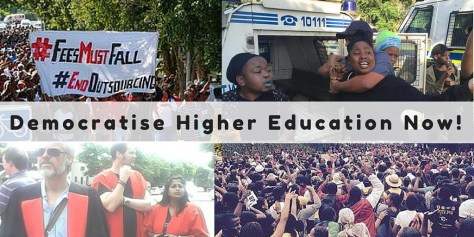
Statement from South African academics supporting Student Struggle in South Africa

Statement posted on Amandla.mobi

Transformation_is_rising_(1)

Statement to Vice-Chancellors, Minister of Higher Education & Training, Blade Nzimande, and the Minister of Finance, Nhlanhla Nene.

We the undersigned, as academics in South African institutions of higher education, and allies in South Africa and overseas, stand with students in their fight for the democratisation of our universities. The current student protests that have erupted across the country are historic. They demonstrate a younger generation willing to take up the struggle against inequality, and to insist on the principle of education for all. Our students are leading the national debate on education, and we insist that they deserve our respect and attention.

We have witnessed students act with extraordinary discipline, tactical skill and moral purpose. This commitment and self-control has gone unseen by many university managers, government leaders and the media who have misrepresented students as uninformed, irresponsible or irrational. Protesting students have faced and overcome potentially divisive tensions within their ranks, and have shown maturity in their intellectual arguments and political interventions. Above all, they have required us to confront a grievous national problem: the persistent exclusion of those who are black and poor from higher education, and from the opportunities that higher education makes possible. Continue reading Statement from South African academics supporting Student Struggle in South Africa

South African student protests and re-emergence of people’s power: Camalita Naicker

Guest Post by CAMALITA NAICKER

Students at University of the Western Cape Photo cred - Musaed Abrahams

Students at University of the Western Cape (Photo cred – Musaed Abrahams)

The #nationalshutdown of all major universities in South Africa continues, even after a historic victory yesterday, when, after several days of mass mobilisation by students and workers President Jacob Zuma was forced to concede a zero-percent fee increase in university tuition fees next year. Yet, it was bittersweet for the more than twelve thousand people who marched to the Union Buildings in Pretoria who were, once again, tear-gassed and shot at with rubber bullets and stun grenades. The police turned violent when students began demanding, after waiting for several hours, that the President address them. Instead, Zuma chose to speak to the media in a press briefing and leave the students to the police. In Cape Town, students marched to the airport to show their solidarity with those in Pretoria; there too police fired rubber bullets, tear gas, and stun-grenades even as students fled into the neighbouring residential areas. For many, the victory it is only a partial one, a short-term solution deferring the problem to another day. It does not resolve the issue of unaffordable education nor does it address other important issues that the national action has been tied to like the outsourcing of labour on university campuses or the general discontents of the lack of transformation at higher education institutions in the country. Continue reading South African student protests and re-emergence of people’s power: Camalita Naicker

Low Intensity, High Impact Communalism Targeting better off Muslims: Janhastakshep Report on Dadri killing

See also another fact-finding report earlier published on Kafila.

National Minorities Commission report on Dadri killing here.

JANHASTAKSHEP REPORT:

On 2nd October 2015 a team of Janhastakshep comprising of academics, journalists and a student went to Basehada village in Dadri tehsil of Gautam Buddh Nagar District to investigate the incidence of communal lynching of a Muslim man Akhlaq and attack on his son Danish (who is battling for life) on the 28th of September for allegedly killing a calf and eating beef. The team comprised of academics Dr Vikas Bajpai from Jawaharlal Nehru University and Prof Ish Mishra from Hindu College, Delhi University; journalists – Anil Dubey, Rajesh Kumar and Parthiv and student activist of Hindu college, Delhi University, Sheetal.

The Context

It is noteworthy that the incident at Bishara village comes in wake of uninterrupted controversies and communal tensions that have been kept alive around the issue of cow slaughter / ban on beef in different parts of the country; as also several incidents of communal violence; intimidation and killing of intellectuals who have opposed the Sangh parivar’s communal designs and its retrogressive sociopolitical agenda. i

It is in this context that the present incident of communal lynching at Bishara village cannot but be seen as another link in the chain of above mentioned developments.

Bishara Village

The village itself has a long existence in time that was claimed to date back to at least four to five centuries. It is a big village with as many as 9,500 votes corresponding to a population of around 15,000 and up to 2,500 families approximately. The village is part of a satta i.e. a grouping of seven villages dominated by Rajputs. Apart from the Rajputs the other Hindu castes are the Brahmins, the Lohars (blacksmiths), the Kumhars (earthen ware artisans), the Jatavs (leather workers), Dhimars (a caste of fishermen and palanquin bearers) and the Balmikis (the sweepers). Along with these there are between 35 to 40 Muslim families in the village. Continue reading Low Intensity, High Impact Communalism Targeting better off Muslims: Janhastakshep Report on Dadri killing

Christians oppose demand for ban on Agnes of God: Press Statement

We, the following signatories,  object to Mr. Joseph Dias, Secretary, Catholic Secular Forum, issuing press statements, representing himself as the spokesperson of the entire community while he seeks bans on films and plays on the ground that they hurt the sentiments of the Catholic religious community in India.  Since such demands tarnish the image of the entire community, we appeal to the press that they should not be projected as the views of the entire Christian community.
 
We wish to state that the views expressed by him are his own, or at best, that of his organization and this by no stretch of the imagination, can be portrayed as the views of the entire Catholic community, as is being done in recent times. His demands are sensational in nature and are self serving to attract media attention unto himself and we are opposed to the same.  

The Patel agitation and the ‘paradox’ of demanding OBC status: Rita Kothari

Guest Post by RITA KOTHARI

Not long ago, a Gujarati film, Kevi Rite Jaish (“How will I go?”  dir. Abhishek Jain, 2012) provided to its viewers a rare fare. It was, unlike Gujarati films of the past, based on the life of urban Ahmedabad  and told the story of a young man whose dilemma was similar to that of scores of aspiring youth in Gujarat. Harish Patel, the protagonist, is obsessed with the idea of migrating to the United States and becoming, like many members of his community of Patels, a ‘motel-king.’ Harish Patel’s room is decorated with Statue of Liberty and Obama – deities that he needs to propitiate. However, his inability to answer satisfactorily the questions  asked by the visa officer at the US embassy leads to his failing to get a visa. The film builds up in comical vein the “trauma” of this event,  which prevented Harish Patel from  fulfilling his dreams in the promised land.  Several abortive attempts, including one involving fake sponsorship papers, bring to the viewer the satirical picture of a community that in the film at least, cannot see beyond motels and United States. The title poses  a real and rhetorical question for Harish Patel, who finally realizes that there are opportunities in his motherland  and this self-realization, certainly not a profound one, is suggested by signifiers of home-made food made by his mother.  A thoroughly ordinary film that this was, its success lay in striking a chord among young viewers who may also have been the chief patrons of such an economic venture.

To my knowledge, there was no counterview to the film contesting the stereotype of the Patel community, for this is indeed the dominant image of an urban Patel in popular imagination—affluent, enterprising and obsessed with the United States. Continue reading The Patel agitation and the ‘paradox’ of demanding OBC status: Rita Kothari

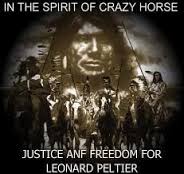
Sovereign Imagination – The Art Of Leonard Peltier: Frances Madeson

September 12 was Native American artist Leonard Peltier’s birthday, his 40th behind the bars of a jail in the USA. FRANCES MADESON pays tribute to him.

images

Leonard Peltier is the longest held Native American political prisoner in the U.S. He was wrongfully convicted in the 1975 killing of two FBI agents on the Pine Ridge Reservation in South Dakota. Leonard was at Pine Ridge at the request of the traditional elders who witnessed the brutal murders of over sixty Native people in what is termed the “reign of terror.” To date, no one has been charged or brought to trial [for those 60 murders] and yet he has served over 40 years for standing between the line of fire and the Keepers of our Sacred Ways on the very soil that was witness to the massacre at Wounded Knee. The trial for Leonard consisted of numerous documented constitutional violations, intimidation and coercion of government witnesses, falsifying of information, and manufactured evidence. Although the prosecutor admits “we don’t know who killed the agents,” and Mr. Peltier was denied the right to present a defense, he remains in a super-max penitentiary.

The Peltier capture and incarceration story is an important through line in the ongoing narrative of colonization of Native peoples. As much as one might desire to assign him dual hats — a jaunty beret for artist, a feathered warbonnet for AIM (American Indian Movement) freedom fighter — the identities are merged, and not readily separable; donning and doffing haberdashery is a privilege a man in Leonard Peltier’s position does not possess. He has but one vulnerable hatless, head, and it’s been on the chopping block for a very long time.

Read this article here.

Global Investors Meet in Chennai – Bargaining over the Bride: T Venkat

Guest Post by T VENKAT

The Government of Tamil Nadu organized a Global Investors Meet (September 9-10), on the lines of the now famous ‘Vibrant Gujarat’ model. GIM, as they call it, was touted as intending to attract thousands of crores of investment to Tamil Nadu. The main routes from the airport to the many different venues in Chennai were prepared to receive the corporate celebrities and the political heavy weights. For the past week, workers worked through the night getting the venue, the routes and the hoardings ready for this big day. As I was passing through the venue the day before the event began, watching all the meticulous planning, the overflow of cops and their blaring vehicles, the flood lights and the workers underneath them, the whole exercise seemed surreal.

The City is decked up for the great event. Continue reading Global Investors Meet in Chennai – Bargaining over the Bride: T Venkat

Lions, Liars and Masters of the Universe: Shrinivas Dharmadhikari

Guest Post by SHRINIVAS DHARMADHIKARI

Last month’s killing of Cecil, the 13-year-old, rare black-maned lion by American dentist Walter Palmer, was met with global outrage and condemnation. However, this foolish bravado cannot just be treated as another sign of American (or white) exceptionalism (read sickness)  because behind this is a much larger and thriving Trophy Industry.

A few facts will make the size and destructive power of this industry clear. Americans traveling to Africa make up more than 60 per cent of the foreign-participated lion trophy hunts carried out each year. This is according to John Jackson, president of the lobbying group Conservation Force. According to another scientist, Eric Jensen, a University of Warwick professor  who studies public engagement in wildlife issues, the Trophy industry caters to the human need for dominance and control of nature and provides in addition a sense of masculinity having hunted a large animal. Continue reading Lions, Liars and Masters of the Universe: Shrinivas Dharmadhikari

Saving ‘Development’ From Dangerous Women Activists: Kamal Nayan Choubey

Guest Post by  KAMAL NAYAN CHOUBEY

The inclination of the Indian State to suppress any movement related to the just demands of marginalized sections has increased immensely in recent times. There is no question of dialogue. Coercive methods are generally employed to contain these movements. This is what has happened with the movement of tribal people are struggling against the Kanhar Dam in the Sonbhadra district of Uttar Pradesh. In this movement, women activists play a crucial role, and in order to contain it, the UP Police arrested two key women activists Roma and Sukalo, and six other women activists from the Robertsganj office of All India Union for Forest Working People (AIUFWP) on 30th June 2015.

DSC00028

Roma is the General Secretary of the AIUFWP.

The UP police has registered cases of inciting rioting against the women activists and it has also reopened old cases against them, particularly against Roma. Apart from them, another tribal woman activist Rajkumari was arrested on 21st April.

DSC00115

Sukalo

Continue reading Saving ‘Development’ From Dangerous Women Activists: Kamal Nayan Choubey

The Anthem of ‘Black Lives Matter’

MEERA NANDA has sent us this moving and militant anthem of the Black Lives Matter campaign.

janelle-getty_wide-40db75d71631e05766c321b52a99a3cee3eb15a5-s800-c85

R&B singer Janelle Monáe released a blistering 6 1/2-minute protest song on Friday called “Hell You Talmbout.” [African-American slang for “what the hell are you talking about.”] The song’s premise is simple, and that simplicity is the source of its power. The lyrics are the chanted names of black Americans killed by police and vigilantes, followed by the phrase “say his name” or “say her name.” The chorus is an anthemic, gospel-leaning repetition of the song’s title. Monáe is joined on the track by a drum line and the members of her Wondaland Arts Society collective: Jidenna, Roman GianArthur, Deep Cotton, St. Beauty and George 2.0. All of the vocals are raw, several to the point of breaking. None of the names are sung.

At the moment, Hell You Talmabout is available as a stream only. Here is the link.

And here are the lyrics. Note that some of the names are hyperlinked to tell you about the person being named.

Continue reading The Anthem of ‘Black Lives Matter’

A Different kind of India-Pakistan Dialogue

As NSA talks between India and Pakistan were suspended, another kind of cross border conversation was taking place.

The vocalist of Indian Ocean band, Rahul Ram along with Varun Grover and stand up comedian Sanjay Rajoura produced a song to the tune of Kishore Kumar’s ‘Mere Samnewali Khidki mein’ (from Padosan). Their song ‘Mere Samnewali Sarhad Pe’ is a delightful and gentle parody of the mirror image pathologies in both our countries.
In response,  Muhammad Hassan Miraj, who identifies himself as a Major in the Pakistan Army, wrote an equally disarming reply,  sung by Mujtaba Ali, with Ali and Kamran on guitar while Gul Durrani directed the video.
Here’s to cross border solidarities!

In Solidarity with the Students of the Film &Television Institute of India (FTII)

We, the undersigned teachers, scholars and researchers within and outside the university system in India, are disturbed by the repeated and systematic attempts to undermine the academic autonomy of universities and other institutions of teaching and learning, such as the FTII (Pune), by the government. There is a concerted effort to monopolise academic spaces by replacing substantive academic autonomy with policies aimed at destroying academic excellence, diversity, creativity and an atmosphere in which students and teachers can think critically and function freely.

Further, we strongly protest the organised attacks against students and other individuals, in universities and elsewhere, for critiquing the state, be it through film screenings, books, talks or exhibitions. The growing number of censorships and bans is encouraging a widespread culture of intolerance and anti-intellectualism that is openly threatening the freedom of academic expression, democractic and participatory governance, and fundamental rights. Continue reading In Solidarity with the Students of the Film &Television Institute of India (FTII)

Two Or Three Things I Know About My Country: Pradeep Jeganathan

As the people of Sri Lanka complete the voting process for the Parliamentary elections of 2015, PRADEEP JEGANATHAN  reflects on his country’s history and politics.

We’ve never really had a father. We like to think we did, of course, be it D.S. Senanayake, S.W.R.D. Bandaranaike or S.J.V. Chelvanayagam. But they never had a vision for Lanka that made sense, in the end. Unlike a Mahathir, Nehru or a Mandela, their vision was partisan, and the results plain to see. Senanayake’s great contribution was to disenfranchise the up country Tamils, and ignore the vernacular language question. Bandaranaike and Chelvanayagam were his children, fighting for the house that he never finished building.

We’ve gone along since, fatherless children that we are. So many have been killed, and so many have killed. Maimed. Seen the essence of inhumanity, lived with it, so it has become ordinary. Many of us like to think Rajapakse is our father, since it is said he rescued us from all this, took us over the mountains to the valley of peace. Certainly, he’s proclaimed himself father and king, and his sons princes. And he’s had his moments.

Read the rest of this piece in Colombo Telegraph.

The penultimate paragraph refers to a song by Nanda Malini:

We’ve always had our mother. She is Lanka. That is the third thing I know about my country, and when I say, our mother is Lanka, or Ilankai or Eelam (for that too is a name for Lanka), I do not mean it in the sense of an inanimate goddess that is to be adored, appropriated and used as a cover for racism, violence and inequality. No, I mean it in the sense of Lanka’s lament, in the great songstress’ lyric, “Deddahas Pansiya Vasarak. (For 2,500 years).” In this beautiful song, Nanda Malini sings Lanka’s lament, her almost helpless sadness and deep grief, at the robbers and killers she has given birth to, who have then become big men and women, clinging to power by selling her name.

Here is the song:

Pradeep Jeganathan is currently Professor, School of Humanities and Social Sciences, Shiv Nadar University.

What did Colonialism do to India? Ram Puniyani

Guest post by RAM PUNIYANI

A video of Shashi Tharoor speaking at Oxford on a debate related to the colonial period has been ‘viral’ on the social circuit for a while. In this video Tharoor makes a passionate plea to the British that they make reparations for the losses to Indian economy during the British rule. He puts the blame of India’s economic decline on the British and also recounts Jalianwala Bag, Bengal famine as the major highlight of British rule which reflected the attitude of British towards this colony of theirs’. Tharoor points out that resources from India were used by British to build there economic prosperity and to fund their Industrial revolution.

However, Dr. Manmohan Singh (2005), the previous prime minister, had made a very different kind of argument. In this Dr. Singh as a guest of British Government extols the virtue of British rule and gives them the credit for rule of law, constitutional government, and free press as the contributions which India benefitted from.

So where does the truth lie? Not only the context and tone of the speeches by these two Congressmen is totally different, the content is also totally on different tracks. Dr. Singh as the guest of the British Government is soft and behaving as an ideal guest and points out the contributions of the British rule and there is some truth in that. Tharoor as an Indian citizen with memory of the past; is narrating the plunder which this country suffered due to the British rule. He is also on the dot. These are two aspects of the same canvass. What Tharoor is saying is the primary goal of British and what Dr. Sigh is stating is an incidental offshoot.

Continue reading What did Colonialism do to India? Ram Puniyani

Sex Workers And Women’s Organisations Condemn DCW Chair Swati Maliwal’s Statement On Sex Work

[While in complete agreement with the statement posted below, I would like to add a personal note. I am a citizen of Delhi who believes that in its short stint in office so far, and despite every attempt by the central government to paralyze its functioning, the Aam Admi Party has taken decisive, creative and positive steps in several fields – education, health, and above all in its strong assertion that water is a natural resource that should not be treated as a commodity.

Nevertheless, it is unfortunately increasingly clear that on gender related issues, AAP’s functionaries exhibit the deepest conservatism – from Kejriwal’s speech on March 8th, which thanked his wife for keeping “his” home running, to Somnath Bharti on making Delhi safe enough for even “beautiful women” to be out at night, as if sexual violence is a tribute and compliment to the beauty of women, to Swati Maliwal’s aligning herself with the deeply conservative abolitionist position on sex work.

This conservatism is at odds not only with “elite activists”, as AAP may think, but with the views of the majority of ordinary people, who poured out into the streets after December 16th 2012, and sent scores of petitions to the Justice Verma Committee, expressing basically the belief in the rights of all women to public spaces at all times, and condemning victim blaming; sex workers are ordinary people too, and so are housewives, who even while they run homes with devotion and efficiency, are not unaware of the unfairness of the shared domestic space being considered to belong to the husband and “his” family. A March 8th message could have recognized women in their different roles, as housewives, domestic servants, CEOs, political activists. As a party that has learnt from other social movements, AAP needs to urgently start a conversation with women’s organizations of different kinds, including sex workers’ organizations.]

The statement follows:

The National Network of Sex Workers and women’s organisations in India strongly condemn the observations and statement of Delhi Commission for Women (DCW), Ms. Swati Maliwal calling sex work and prostitution akin to “rape” and calling for its “eradication”. We call on her to immediately withdraw her statement and tender an unconditional apology to the all women in sex work, whose dignity has been impacted by her observations.

The Honorable Supreme Court has recognized the need to ensure that sex workers are able to live a life of dignity. The Court set up a panel to discuss “Conditions conducive for sex workers to live with dignity in accordance with the provisions of Article 21 of the Constitution.” (Budhadev Karmaskar vs. Government of West Bengal).

 The Chairperson of DCW should do her homework before launching into a campaign that has not engaged with the ongoing debates and dialogues to recognize the rights of adult consenting workers to remain in sex work and ensure that their human rights and dignity are protected, such a short sighted and uninformed perspective demeans the office of a Commission set up to protect the rights and dignity of women. Continue reading Sex Workers And Women’s Organisations Condemn DCW Chair Swati Maliwal’s Statement On Sex Work

Coming up! Must-have new products for women

Thanks to Kalyani Menon-Sen!


Porcupine Jacket – free hugs to molesters


Bagzilla – portable monster assist


Intergalactic Pest Control