Category Archives: Centre watch

Your government is removing your YouTube videos and you don’t even know about it

After reporting Google Transparency Tools’ latest revelations about how much India asks Google to delete content and pass government agencies private user data, Firstpost writes, “To put all this in its proper perspective, Indians still enjoy robust Internet freedom – and occasionally even an excess of freedoms…” And then it goes on to compare internet freedom with China, assuring all is well with the world.
There is no such thing as excess freedom. There is a way to deal with the “scurrilous postings and videos” the article talks about. It’s called the law.

I write an article in a newspaper that is seen as “scurrilous”. The offending party will go to court. The court will decide if it is scurrilous enough to violate the law of the land (be it defamation, libel, or whatever) and summon me. I get a chance to defend myself. Continue reading Your government is removing your YouTube videos and you don’t even know about it

Ten lessons of the fortnight that was: Jay Mazoomdar

Guest post by JAY MAZOOMDAAR

The 13-day blockbuster— peddled as the second freedom struggle, panned as irresponsible blackmailing, and a lot in between — is over. Anna Hazare accepted honeyed coconut water from two little girls, introduced to the crowd as a dalit and a Muslim, and went on to recuperate in one of India’s most expensive hospitals, one branded after Hindu spiritual literature at that.

News TV is still fighting the vacuum by flogging the debate – so much so that seasoned correspondents are chasing a rather dismissive Dr Naresh Trehan to unravel the mystery of Anna’s endurance. Biker gangs have gone into a sulk and roads at India Gate are looking safer for traffic and women (which is not saying much in Delhi). What is more, India has started taking note that too many Indians have meanwhile drowned in floods. Continue reading Ten lessons of the fortnight that was: Jay Mazoomdar

Are We Talking to the People Who Are Out on the Streets? – Kavita Krishnan

Guest post by KAVITA KRISHNAN  (Editor, Liberation)

The people saying ‘I am Anna’ or ‘Vande Mataram’ are not all RSS or pro-corporate elites. They’re open to listening to what we have to say to them about corporate corruption or liberalization policies. The question is – are we too lofty and superior (and prejudiced) to speak to them?

Throughout the summer, student activists of All India Students’ Association (AISA) and Revolutionary Youth Association (RYA) engaged in this painstaking exercise for months. They campaigned all over the country, in mohallas, villages, markets where there is no visible Left presence. No, these were not areas of ‘elite’ concentration – mostly middle, lower middle or working class clusters, or students’ residential areas near campuses. In most places, people would begin by assuming they were campaigners of Anna Hazare. When students introduced their call for the 9 August Barricade at Parliament, they would be asked, ‘What’s the need for a separate campaign when Anna’s already leading one?’ They would then explain that they supported the movement for an effective anti-corruption law to ensure that the corrupt don’t enjoy impunity. But passing such a law could not end corruption, which was being bred by the policies that were encouraging corporate plunder of land, water, forests, minerals, spectrum, seeds… They learnt to communicate without jargon, to use examples from the state where the campaign was taking place. They would tell people about the Radia tapes, and the role of the corporates, the ruling Congress, the opposition BJP, and the media in such corruption.

Continue reading Are We Talking to the People Who Are Out on the Streets? – Kavita Krishnan

Hazare, Khwahishein Aisi: Desiring a new politics, after Anna Hazare and beyond corruption

Hazare, khwahishein aisi, ke har khwahish pe dam nikle
bahut nikle armaan, lekin, phir bhi kam nikle

Hazare, so many desires, that every desire takes our breath away
so many hopes, and yet so few

(with due apologies, for liberties taken, to Mirza Asadullah Khan Ghalib, sometime poet and native of Delhi)

On the ninth of april, this year,  I wrote a posting on Kafila titled – ‘At the Risk of Heresy : Why I am not Celebrating with Anna Hazare Tonight‘. A little more than four months later, I have to say I have not yet found reasons to celebrate. But I am not in mourning either. What follows is my attempt to think this through, in all its contradictory character. For once, I am not even trying to be consistent. If my argument occasionally faces two directions at once, it is probably because I feel the needs to be double faced in order to understand a double-faced moment. When all the talk is only of the need for honesty, one might want to stake a claim to being double-faced, if only for the sake of breaking the moral monotony.

Continue reading Hazare, Khwahishein Aisi: Desiring a new politics, after Anna Hazare and beyond corruption

A Response from the Harud Literature Festival

In response to the open letter expressing a set of concerns about the forthcoming Harud Literature Festival, the festival organisers have responded:

We wish to categorically state that the Harud literature festival is not government sponsored. It has been conceived with the intent of creating a platform for free and open debate, discussion and dialogue through contemporary narratives, literary fiction and poetry.

The festival seeks to showcase writing in urdu, kashmiri, dogri and english from the region and other Indian writers. We seek support for the spirit of the festival which is plural, inclusive and supports freedom of speech and expression. [Link]

Response to Gail Omvedt: Nirmalangshu Mukherjee

Guest post by NIRMALANGSHU MUKHERJEE

First of all I strongly object to the various insinuations posted in several comments. However, with due respect to a veteran activist, I think the older generation of left activists are by and large failing to come to terms with an unfamiliar form of protest in the IT-age. For them perhaps, Tahrir square looks full of promise at a distance from where all the finer dark spots get blurred; not so when it is happening in the neighbourhood.

The janlokpal campaign has three broad components: the core group with Anna in front, the bill itself, and the people. The Maoist campaign also has these components. There are serious problems with the first component in either campaign insofar as the condition of “democratic elections” are concerned. In the Maoist case, it is just an upper caste and largely upper class coterie of people thrust on the adivasis. The programme of proctracted war to establish “new democracy,” i.e., the second component, is also deeply flawed. Yet, the Maoist campaign is routinely advertised as a just campaign because it is supposed to be a people’s campaign driven by a people’s army. The current terminology is “bottom-up.” The reality of this proclamation is not the issue here, the structure of justification is. The Maoist campaign with its flawed first two components is justified because “people” have accepted and wanted them, contrary to fact as indicated. But the same commentators are terrified when the same structure is offered for the janlokpal bill. Or is it because Dandakaranya, likeTahrir Square, is safely remote while these “middle-class people” are dangerously close?

Continue reading Response to Gail Omvedt: Nirmalangshu Mukherjee

An open letter on the ‘Harud’ literary festival

Srinagar-based photojournalist Showkat Shafi is seen in this photograph being assaulted by the Jammu and Kashmir Police on 19 August 2011. He was carrying out his professional duties, as is clear from the camera in his hand that the police is trying to snatch away. He and his Mexican photographer colleague were detained at the police station and beaten up, allowed to go and be hospitalised only five hours later. The police said they mistook them for stone-pelters. Photo credit: Faisal Khan

*
Given below is an open letter signed by fourteen of us. Should you want to add your name to it, please do so in the comments section of this post. I shall update the names of the signatories on the post itself. Please clearly indicate that you want your name added, and write your full name and profession.

Continue reading An open letter on the ‘Harud’ literary festival

New Trade Union Initiative on Anti-Corruption Struggle

We are reproducing below a statement issued by NTUI

NTUI Statement On the Fight Against Corruption

Workers’ life and work experiences are very different from those of the middle class and the ruling elite; so is their experience with corruption. For the middle class, corruption is a mechanism to accelerate government procedures in the public or private sectors. For the working class, corruption deepens their experience of subordination. Instances of corruption that are directly experienced by the working people are the result of the unequal power relations that govern workers’ daily interaction with public institutions and is therefore contributing to a sense of distrust and loss of faith in these institutions. There can be little doubt that corruption affects the working class disproportionately more than it affects economically more privileged sections of society.

Continue reading New Trade Union Initiative on Anti-Corruption Struggle

If only there were no people, democracy would be fine…

This post has been jointly written by Nivedita Menon and Aditya Nigam

At Ramlila Maidan

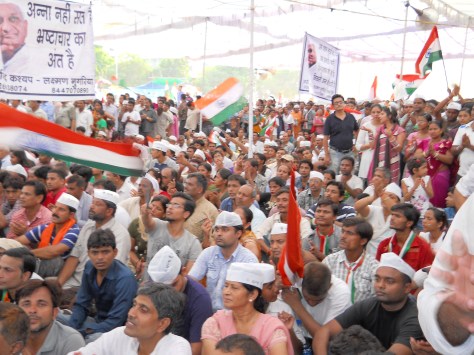
We went to Ramlila Maidan yesterday, the four of “us” considerably swelling the numbers of about a lakh and a half of people there by 6.30 pm, when we left. They were either sitting inside, milling about outside all around its walls, or pouring in having walked from India Gate.  (Is the media exaggerating the numbers? In our opinion it is underestimating them considerably).

Continue reading If only there were no people, democracy would be fine…

We should be there: The Left and the Anna moment

My head has been in a whirl the past few days with a single question – how do we on ‘the Left’ manage so unerringly to be exactly where ‘the people’ are not, time after time?

At this moment I don’t mean the organized Left, for the Left parties  have been cautious about criticizing  the current upsurge; they strongly defended the right to democratic protest when Anna Hazare and his colleagues were arrested, and now have launched a Third Front initiative on the issue of corruption and the Lokpal Bill; the students’ front of CPI (ML), AISA, has been organizing militantly on the issue for a very long time now, and is very much part of the campaign.

I mean the few hundreds who form my own community, the people with whom I have organized protests and run campaigns and sat on dharna and drafted petitions;  struggled against communal violence and sexual harassment,  for queer freedom and workers’ rights, against the nuclear bomb and nuclear energy, in support of reservations and against the moves in our universities to hold up appointments to reserved posts. Many of these people I know personally, some are among my closest friends, and many more I know as part of the broad Left/secular non-party tendency in the country’s politics, where I feel most at home.

Continue reading We should be there: The Left and the Anna moment

NAPM Extends Support to Anti-Corruption Movement and Demand for an Effective Lokpal

[The statement was issued by the National Alliance of People’s Movements on 14 August. Much has happened since then – the arrest of Anna Hazare – accopanied by silence and often ridicule poured by the radical elite, but in the face of what is perhaps one of the most widespread mass movements in India after Independence. Over the past few days, we have been witness to innumerable demnstrations and marches in almost every colony in Delhi – where no TV camera ever reached or was even expected to when the ‘real’ action is going in in central Delhi. Contrary to the general propaganda and even our own earlier impression, this is no more simply a middle class movement. I am reproducing it here, somewhat belatedly, because it still touches on some of the post important points at issue in the ongoing struggle. – AN]

Anna Hazare Ji and manyothers across India will be starting their fast from August 16th in Delhi demanding an effective Lokpal. NAPM supports the people’s movement for a corruption-free India and urges the citizens of the country to plunge into this struggle. NAPM, along with other organisations is holding relay fast, human chains, public meetings and other programmes, in Chennai, Pune, Mumbai, Narmada Valley, Hyderabad, Guwahati, Bhubaneshwar, Bangalore, Mysore, Mou, Balia, Allahabad, Muzzafarnagar and other places. We urge our members and supporters to join this call and challenge the corrupt and defensive governments at the Centre and the states.

We strongly disapprove of the way in which government has been trying to put severe restrictions on holding peaceful protests in the capital, and Delhi Police under the garb of implementing the Supreme Court’s Guidelines is imposing unnecessary conditions on protests, as it did early this month on SANGHARSH anti-land acquisition protest, AISA-DYF anti-corruption protest and others. For an independent democratic country like ours, imposition and insistence on police permission and strict guidelines for holding peaceful protests and Sataygraha seems completely contradictory and only shows shrinking spaces for democratic freedom of expression and curb on fundamental rights of its citizens.

Continue reading NAPM Extends Support to Anti-Corruption Movement and Demand for an Effective Lokpal

The Lokpal- NCPRI approach: the right to differ

In the midst of the overwhelming focus on Anna Hazare and the campaign around a bill that lacks consistency or clarity, both legal or ethical, below is a letter from Aruna Roy drawing our attention to an alternative approach to the Lokpal. It is an existing process for us to partake in, agree, disagree and/or rally behind.

Click here for more information on this alternative.

A letter from Aruna Roy

We write to you on a matter of mutual and common concern, the
Lokpal bill, now in Parliament. The context of this letter is
explained below.When the Joint Drafting Committee of the Lokpal was working on the Jan
Lokpal ,  the NCPRI had written to the Chair, Shri Pranab Mukherjee,
and the co-chair Shri Shanti Bhushan, enquiring about the TORs and the
process of and participation, in public consultation. Both assured us
that there would be formal public consultation. It did not happen.

When the government bill went to cabinet with the intention of placing
it in the monsoon session of parliament, the NCPRI decided to make its
position known. The NCPRI is continuing with its deliberations and
consultations and has  prepared an approach paper and a set of
principles for circulation. This is a work in progress.

The belief in consultations and discussion is the reason why we write to you. Continue reading The Lokpal- NCPRI approach: the right to differ

Indian Academics Urge Divestment from POSCO: Sign petition

Children and women of Gobindpur village in  Jagatsinghpur district form a human chain to stop the forces from destroying their homes

The US-based Mining Zone Peoples Solidarity Group (MZPSG) has been working on an international solidarity campaign as part of the anti POSCO campaign in Orissa. They  launched a divestment campaign some months ago aimed at four retirement funds, all of which have significant investments in POSCO.

One of these is the TIAA CREF, that is, the US-based Teachers Insurance and Annuity Association – College Retirement Equities Fund, a financial services non-profit organization that is the leading retirement provider for people who work in the academic, research, medical and cultural fields.

As part of the campaign 600 US based faculty wrote to TIAA CREF some weeks ago, asking it to divest from POSCO. They are now seeking support from faculty based in India, expressing solidarity with their US -based colleagues and pressing upon TIAA CREF the urgency of the need to divest from POSCO.

Please consider signing the petition using the link provided below.

PLEASE DO NOT SIGN IN AS ANONYMOUS.

Indian Academics Urge Divestment from POSCO

If you do sign, please forward this to at least five to ten colleagues and friends working in your university or any other Indian university/college.

Please note that the signatures page will be updated manually by the admin, so you may not see your signature immediately on signing the petition.

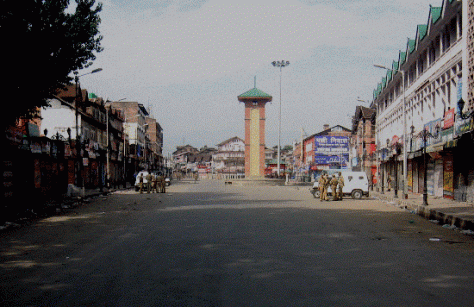
When the State Celebrates the People’s Independence but the People Don’t: Twelve Questions for the Press Trust of India

Srinagar's Lal Chowk on 15 August 2011. Photo credit: Zahoor Zargar / KashmirDispatch.com

To:

The Editor,
The Press Trust of India,
New Delhi.

Dear Editor:

This is regarding your news report, “I-Day Celebrated Peacefully in Kashmir Valley“.

While the news report tells us how the celebrations were held by the chief minister in Srinagar and the deputy chief minister in Jammu, and what arrangements were made for the celebrations to take place, there’s one line in that report that tells us:

Meanwhile, normal life was was affected in Kashmir Valley due to a shutdown called by both factions of Hurriyat Conference and tight security restrictions for the Independence Day.

I have a few questions for you.

Continue reading When the State Celebrates the People’s Independence but the People Don’t: Twelve Questions for the Press Trust of India

Onwards to the Independence of the Corrupt!

Let us pledge this 15th of August, that we will tirelessly work towards the independence – nay dictatorship – of the corrupt. We must tirelessly fight every attempt to raise  corruption as an issue – by gullible people who do not understand that corruption is not a real issue. We will not allow such people to be misled by demagogues and fascists who are  interested only in power – even if they do not show their hunger for power by contesting elections. Indeed, precisely because they do not contest elections.

Is the new mantra of democracy? How else do we understand the deafening silence on the series of dictatorial measures adopted by the government, on the part of all those who have been vocal, indeed strident, in their attack on the Anna Hazare movement? It is one thing to be opposed to the Anna Hazare movement but the silence – from parties as well as intellectuals, democratic rights groups and self-righteous editorial commentators of the Indian Express – on the desperate measures being adopted by one of the most corrupt governments ever, is inexplicable. It is as if the only threat to democracy today comes from a group of people who want to raise their voice in civil disobedience against public money being looted by elected representatives acting at the behest of powerful corporate interests.

First the Delhi Police simply refused permission to Anna Hazare and the India Against Corruption fast. Then they asked them to hold their protest in Burari! That is to say on the border of Haryana. This was but another way of disallowing it. Then they came out with a novel idea – a set of preconditions that include an undertaking that there will not be more than 5000 people and that the fast will be wound up in three days. Clearly, no self-respecting set of protestors will agree to such conditions and so ‘Team Anna’ refused to sign the undertaking.

Continue reading Onwards to the Independence of the Corrupt!

Why Devender Pal Singh Bhullar should not be hanged

This public statement was issued by AMNESTY INTERNATIONAL in June

India: Amnesty International calls for death sentence on Devender Pal Singh not to be carried out

AI Index ASA 20/033/2011

Amnesty International calls on the Government of India not to carry out the death sentence imposed on Devender Pal Singh in 2001 after his conviction in an unfair trial. Under international law, the execution of a person convicted and sentenced to death in an unfair trial is a violation of the right to life. Continue reading Why Devender Pal Singh Bhullar should not be hanged

Parliamentary Sovereignty or an Active Citizenry? V. Krishna Ananth

Guest post by V. KRISHNA ANANTH*

The political class, cutting across the spectrum, is now being haunted by a spectre. Anna Hazare has captured the imagination of a cross section of the people and his campaign is certainly gathering support. It remains to be seen if this support translates into a movement on the streets and more so against the state machinery that is threatening to pull all the stops. The people have shown such courage in the past. That is another matter.

Team Anna’s decision to go ahead with protests against the draft Lok Pal Bill, as approved by the Union cabinet, has spurred a debate. The proponents of the draft bill as well as sections in the political arena who claim to oppose the Government are united against another round of fast by Anna Hazare; they call it blackmail and an attempt to usurp Parliament’s power to legislate. They also claim that the principles of democracy shall not be sacrificed.

A number of them are on record that the draft proposals are subject to amendments and that the power to propose amendments and decide on them shall rest with the elected representatives of the people. It is another matter that the Prime Minister, who heads the cabinet, qualifies as a representative of the people only because membership of the Rajya Sabha is considered as good as being a member of the Lok Sabha to remain a minister under Article 75(5) of the Constitution. In any case, the fact is that Dr. Manmohan Singh has claimed, in an affidavit, that he is ordinarily a resident of Assam! We all know the truth but that too is besides the point.

Continue reading Parliamentary Sovereignty or an Active Citizenry? V. Krishna Ananth

Democracy, Populism and the ‘Middle Class’: The Return of ‘Anna Hazare’

[This is a considerably expanded version of an article that was published in Himal May 2011. It is being re-published, elaborated and updated, in the context of the farcical draft of the Lokpal Bill roduced by parliament and the threatened round 2 of the movement. – AN]

Corruption – a Systemic Affair?

Let me start with an ’emperor’s new clothes’ kind of question: What is a systemic understanding of ‘corruption’? What is a political understanding about corruption as opposed to say, a touchy-feely ‘moral’ problem? Yes, some of these phrases are straight from Arundhati Roy’s ‘When Corruption is Viewed Fuzzily’, published in the Indian Express on 30 April. But my question is not directed only at her. She represents – at least on this issue – a much wider consensus among sections of the radical intelligentsia.

Roy herself has left nothing to the imagination as to what she means:

“Among the millions of understandably furious people who thronged to Jantar Mantar to support Anna Hazare and his team, corruption was presented as a moral issue, not a political one, or a systemic one — not as a symptom of the disease but the disease itself. There were no calls to change or dismantle a system that was causing the corruption. Perhaps this was not surprising because many of those middle-class people who flocked to Jantar Mantar and much of the corporate-sponsored media who broadcast the gathering, calling it a “revolution” — India’s Tahrir Square — had benefited greatly from the economic reforms that have led to corruption on this scale.”

To her, the system that lies at the root of corruption is embodied in the ‘economic reforms’, which have led to corruption on this scale. I have no way of measuring the scale – though I might be inclined to agree with her that in my living memory, I have not seen so much compressed into such little time-space – from CWG to l’affaire Niira Radia to Adarsh Housing scam and the Bellary brothers – not to speak of the daily corruption in land acquisitions that dot the landscape of the country. Nonetheless, I do remember that something like the Bofors scandal or the ‘irresistible rise’ of Dhirubhai Ambani – all predate the ‘economic reforms’. And of course, I will not even try to mention the innumerable cases of corruption from Nagarwala onwards – including political corruption that led to big mass movements in Gujarat and Bihar in the 1970s. Those were the days when Mrs G proclaimed that ‘corruption is a global phenomenon’. To me saying corruption is systemic and must be analyzed ‘politically’ (whatever that means), sounds pretty much the same.  So, if neo-liberalism is responsible for corruption, how do we explain the instances mentioned above? How do we understand the great socialist states which secreted corruption from every pore? What does a ‘systemic analysis’ of corruption really tell us?

However, Arundhati Roy was making this point, it seems to me, not in order to analyze the phenomenon of corruption but to comment on the Anna Hazare movement and its ‘character’:

“When corruption is viewed fuzzily, as just a touchy-feely “moral” problem then everybody can happily rally to the cause — fascists, democrats, anarchists, god-squadders, day-trippers, the right, the left and even the deeply corrupt, who are usually the most enthusiastic demonstrators.”

Continue reading Democracy, Populism and the ‘Middle Class’: The Return of ‘Anna Hazare’

Deconstructing The NAC : Ruchi Gupta

Guest post by RUCHI GUPTA

The past couple of months have seen a renewed attack on the National Advisory Council (NAC). The NAC has been decried as an unconstitutional, undemocratic, “super-cabinet” where unaccountable “jholawalas” hatch harebrained schemes guaranteed to run the government aground. Another line of criticism has focused on the process of the formation of the NAC, its space within the Indian Constitution, and its capacity to influence policy. The two criticisms merge with the demand to disband the NAC on the count that the NAC does not have to face the outcome of its recommendations, and by virtue of it being chaired by the head of the ruling Alliance, can arbitrarily force the implementation of its recommendations.

There is however, a need to examine how the NAC has functioned, what it has done, as well as understand the space it occupies in the policy-making paradigm of the country. While the concerns about the legitimacy of the NAC relate to important issues of Constitutionality, the criticism about the nature of its policy recommendations is motivated by ideology and is of much less relevance to its impact on democratic processes.

It is true that the NAC is an entity created to give the leader of the ruling alliance a role in policy making. Nevertheless, partly through the kind of members chosen, and the norms of functioning it has evolved, it has opened up the otherwise closed and secretive processes of formulation of law and policy, beyond its own membership to citizens groups and people with expertise. It can, in fact with some effort become a platform to further a more just and participative democracy. In this essay, we deconstruct the NAC and situate it in its political context to understand both its pitfalls and potential.

Continue reading Deconstructing The NAC : Ruchi Gupta

Every time there is a bomb blast in India

Jyoti Punwani writes:

Expectedly, the questions were the same. What were you doing on the day of the blasts? Had you gone to Cheetah Camp? Do you know anyone from the Indian Mujahideen? How many times have you been to Pakistan? Why does only your information come to us? Get your house documents.

Amanullah was ready with the answers and documents… [Must Read]

From Kafila archives:
What does it mean to be a Muslim in India today?

Half Widow, Half Wife? Responding to Gendered Violence in Kashmir: APDP

This is a press release from the ASSOCIATION OF PARENTS OF DISAPPEARED PERSONS, The Bund Amira Kadal, Srinagar, 190001. It is about a new report, which you can download in .pdf format at the end of this press release.

Srinagar, July 28, 2011 – The Association of Parents of Disappeared Persons (APDP) today released the report Half Widow, Half Wife? Responding to Gendered Violence in Kashmir. It examines the situation of women in Indian-administered Kashmir whose husbands have ‘disappeared,’ but not yet been declared deceased. Members of APDP who are themselves half widows released this report at SK Municipal Park, Srinagar. Continue reading Half Widow, Half Wife? Responding to Gendered Violence in Kashmir: APDP