Category Archives: Countryside

The Desertification of Punjab and the Liability of Opinion Makers

In August last year, we had drawn attention to a piece by Indian Express editor Shekhar Gupta on the remarkable edit page piece he had penned on what he claimed was the ‘absence of drought’, in the Green Revolution region and provided his ‘explanation’ of why it had been possible. It had been possible, Gupta had opined, because all the great things had been accomplished in decades when the most retrograde environmental and jholawala movements in the history of mankind had not yet arrived on the scene. And with no evidence whatsoever and with nothing but his blind ideological faith, Gupta had even misled his readers that ‘underground aquifers were being constantly recharged’. This when just a few days ago, NASA satellite pictures had shown the extent of groundwater depletion in this region. Continue reading The Desertification of Punjab and the Liability of Opinion Makers

Women become targets; SPOs issue gag orders

Ever since Mukram hit the news, there has been a sure and steady attempt to cut-off access to the areas surrounding the Chintalnar Camp.

In the meantime, sources who helped me and a reporter from Tehelka access the villages are worried about their safety. SPOs in Chintalnar have reportedly threatened to “take action” against villagers who help the press.

The following is a recent article for The Hindu that has provoked some of the backlash against the press.

A series of shots rang out in the night far beyond the barricaded perimeter of the Central Reserve Police Force camp here in Chhattisgarh’s Dantewada district. For a few minutes, the sentries on duty returned fire before their guns, and the ones that sounded in the distance, fell silent.

By morning, the adivasi settlements around the camp had emptied, the villagers wary of being caught and questioned by the CRPF’s morning patrol. “Everyone is hiding in the forests,” said a villager from Markaguda, a village about two km from the camp, “I expect we shall be beaten up this morning.”

Mukram violence worsens; adivasi girls allege rape


Two sisters live in a clearing in the forest about 10 km beyond the abandoned houses and empty yards of Mukram village in Chhattisgarh’s Dantewada district. A third young girl cowers in the courtyard of her aunt’s house in neighbouring Tokanpalli. Between 14 and 18 years of age, Kose, Rame and Hidme (names changed) say they fled their homes in Mukram after they were sexually assaulted by Special Police Officers of the Chhattisgarh Police on May 22 this year.
“We can’t return to Mukram,” said Rame, “If they [the SPOs] find us again, they said they would cut my body into pieces and bury it in cement and no one would ever find it.”

Notes on the Jaffna Economy

One of my friends in a discussion group in Colombo on ‘Democratising State and Society’ put forward the following challenge couple weeks ago.  He said, a year after the end of the war, many of us who had been following the situation of the displaced people in the North, including the lack of freedom of movement and the militarization of the North have done little to engage the oppressive economic conditions of those affected by the war and now being resettled.  That challenge was in the back of my mind as I visited Jaffna for ten days over the last two weeks.  I tried to grasp what one could on a short visit.  The following are very preliminary notes on the Jaffna economy, with a particular emphasis on agriculture and fisheries which ¬- despite technocratic and diasporic dreams of an information economy – continue to determine the economic life of the larger Jaffna population.  These tentative notes I hope will stimulate some interest towards much needed research on the economy of the Jaffna District and the war affected Northern and Eastern Provinces. Continue reading Notes on the Jaffna Economy

Mukram slips into a vortex of violence

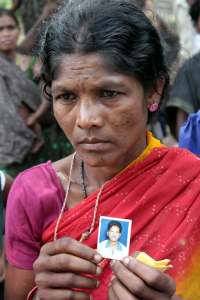
Aimla Rame holds up a picture of her husband Aimla Nanda who disappeared after a police raid in Mukram. Photo: Aman Sethi/ The Hindu

Mukram: Rumours swirling around Mukram suggest that this adivasi village in Chhattisgarh’s Dantewada district may soon be abandoned. “There is talk of going to Orissa or Andhra [Pradesh],” said a prominent adivasi leader with familial ties to Mukram, “It could happen in as little as a week. Villagers say there is too much pressure from both, the Maoists and the Police.”
A mid-sized village of about 100 houses, Mukram shot to prominence as the site where an ill-fated company from the 62nd Battalion of the Central Reserve Police Force (CRPF) rested on the night of April 5 this year.  At dawn on April 6, the company was ambushed by about 300 armed cadres of the Communist Party of India (Maoist), resulting in the death of 76 security force members.
In a statement released after the attacks, the CPI (Maoist) praised the efforts of Comrade Rukhmati, a Maoist commander and Mukram resident, who was killed in the ambush. On May 11, The Hindu reported the death of Kunjam Suklu, a Mukram resident who, his family members allege, was beaten to death by the CRPF in a fit of retaliatory rage.

युद्ध के रूपक का जाल

अपने नए बंद के दौरान सी.पी.आई.( माओवादी) ने छत्तीसगढ़ और बंगाल में अर्ध-सैन्य बल के सदस्यों के साथ बस में सफ़र कर रहे साधारण ग्रामीणों की हत्या करने के बाद जो बयान दिया है उससे यह साफ़ है कि अभी शायद इससे भी क्रूरतापूर्ण कार्रवाइयां देखने को मिल सकती हैं. उनके प्रवक्ता ने कहा कि उन्होंने पहले ही छतीसगढ़ के ग्रामीणों को यह बता दिया था कि उन्हें इस युद्ध की विशेष परिस्थिति में क्या करना है और क्या नहीं करना है. मसलन, पुलिस या सैन्य बल के लोगों के साथ किसी भी तरह का कारोबार या सामजिक व्यवहार प्रतिबंधित है, उनके साथ किसी सवारी गाडी में सफ़र नहीं करना है. इसके आगे उनसे यह भी कहा गया है कि उन्हें पुलिस या सैन्य बल की गतिविधियों पर नज़र रखनी है, उनके पास हथियारों का अंदाज़ करना है और इसकी खबर जनता सरकार को देते रहना है. इस दल के प्रवक्ता ने कहा कि साधारण लोगों का मारा जाना अफसोसनाक है लेकिन एक तरह से वे खुद इसके लिए जिम्मेदार थे क्योंकि उन्होंने चेतावनी का उल्लंघन किया था. Continue reading युद्ध के रूपक का जाल

To P Chidambaram: Response from a member of civil society, by AK Agrawal

By ARUN K AGRAWAL

Dear Shri Chidambaram,

This is in response to your repeated taunts on NDTV that the civil society must respond to the wanton killing by the Naxals. It appears that the interview was tailor made for getting the consent of the Cabinet for more firepower and airpower to combat the Maoist. The diabolic support of Arun Jaitly, be it by describing you an injured martyr, was designed to achieve his ambition through the support of the mining barons of the BJP ruled states.

As a member of society I hope I am being civil in disagreeing with you on your hard line approach against the innocent tribal. I also hope you will not find it too shocking for being accused of being largely responsible for the rise and growth of Naxalism, as the following happened on your watch as Finance minister.

Continue reading To P Chidambaram: Response from a member of civil society, by AK Agrawal

Death of villager mired in controversy

Sukma: Chhattisgarh police confirmed the death of Mediyum Bandhi, a 27
year old adivasi from Aitpal village, in the Sukma police station in
Chhattisgarh’s Dantewada district. Police claim they shot Bandhi
as he tried to escape from the lock-up. Bandhi was shot three times in
the back with a Self Loading Rifle (SLR).

Bandhi’s death comes three days after an explosion, triggered by the
Communist Party of India (Maoist), killed 15 civilians and 16 members
of the security forces.  Many of the policemen killed were Special
Police Officers based out of Sukma.

According to Sukma police, Bandhi, 27, and Podiyam Kosa, 25,
were apprehended on Wednesday morning from Aitpal
village as they were wanted in a number of criminal cases including
murder.  The two villagers were first taken to Gadiras police
station for questioning and then brought to Sukma as Gadiras does not
have a lock-up.

Welcome to a Leninist State

I have been thinking about the recent warning issued by the Home Secretary G.K.Pillai to Indian intellectuals, especially to those who are seen to be sympathetic to the Maoists. He says that they could be booked for their intellectual support to the dreaded enemy of the nation called Maoists.  I felt like thanking him. For once the government, rather the state seems to have taken notice of the importance of the breed called ‘intellectual’. They do matter! Their opinion is valued! The masses are influenced by them!!! They are heard!!! Continue reading Welcome to a Leninist State

Ethical violations of HPV vaccination trials in India: SAMA

This guest post has been sent by the SAMA team

On July 9, 2009, the Andhra Pradesh Minister for Health and Family Welfare in association with the Indian Council of Medical Research (ICMR) and PATH (Programme for Appropriate Technology in Health) International a non-profit organization based in USA launched what it described as a ‘demonstration project’ for vaccination against cervical cancer. The vaccine, against the Human Papillomavirus (HPV), which is one of the most common families of viruses and the source of a common sexually transmitted infection, was administered to 14,000 girls between the ages of 10 and 14 in three mandals – Bhadrachalam, Kothagudem and Thirumalayapalem – of Khammam district in Andhra Pradesh. In Andhra Pradesh, the vaccine used was Gardasil, manufactured by Merck Sharpe and Dohme, the Indian subsidiary of Merck and Co. Inc., a US-based pharmaceutical company.

In a similar project, on August 13, 2009, the Gujarat government launched a two-year ‘Demonstration Project for Cancer of the Cervix Vaccine’ in three blocks of Vadodara District – Dabhoi, Kawant and Shinor – to administer three doses of the HPV vaccine to 16,000 girls between 10 and 14 years. There were reports of deaths of four girls from Andhra Pradesh and two girls from Gujarat following the administration of the vaccine.
Continue reading Ethical violations of HPV vaccination trials in India: SAMA

Arms and the Maoists

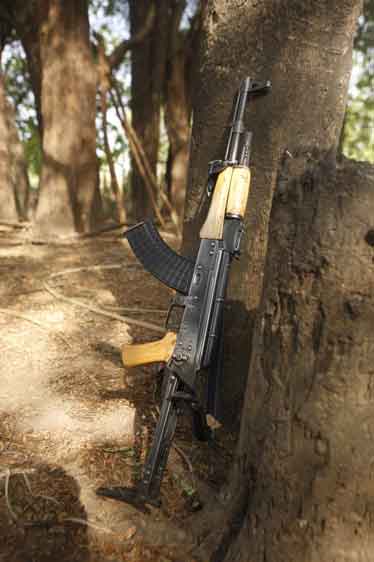
Ramana's AKS series Kalashnikov Rifle. A variant of the AK-47, the 'S' references the 'Skladnoy' or 'folding' metallic shoulder stock. Photo: Ishan Tankha/Open Magazine
In 1988, Ravula Srinivas paid Rs 100,000 for a black-market AKS series Kalashnikov rifle with a light-wood finish and a folding metal shoulder stock.  On April 6 this year, the same rifle was pressed into service in an ambush that killed 75 members of the Central Reserve Paramilitary Force and one Head Constable of the Chhattisgarh police in Chhattisgarh’s Dantewada district.
In the intervening years, Ravula has grown from a young student from Warangal into Ramana, Secretary of the South Bastar Regional Committee of the CPI (Maoist) and chief architect of the April 6 attack; unchanged by the years, the rifle has never left his side.
On April 14, The Hindu was offered access to Maoist leaders Ramana and Ganesh Ueike. in the Jagargunda forests in Dantewada.  The visit offered a rare, though by no means comprehensive, insight into how the CPI (Maoist) sources, maintains and distributes weapons among its cadres.

Nandini Sundar – Will counting caste reduce inequality?

Nandini Sundar’s recent Op-Ed for The Hindu on caste-enumeration in the latest round of the census. Read the entire article here.

But come back with your comments – what do you think about caste–enumeration?

Yesterday when the census enumerator visited, I asked him how he felt about the current debate on counting caste in the census: “Not comfortable at all”, he said, “I don’t even like asking whether someone is SC/ST or Other, leave alone what their caste is.” But, he added, “caste is an inescapable reality of Indian society.”

The debate on counting caste in the census has not moved on from 2001, when opinion was equally divided. Supporters of caste enumeration argue that census categories merely reflect existing classifications, and that only the census can provide the figures necessary to map inequality by caste. Opponents argue that the census does not mirror but actively produces social classifications and ways of thinking. They point to the history of mobilisation around caste in the census and the consequent dangers of both distorted data and increased social tensions. In neither case has much thought been given to how the data might be used, the different kinds of figures needed for different purposes, or alternative ways of collecting the required data. Read the rest of the article here

In Search of Brahmeshwar Singh, ‘the Absconder’

The Myth of the ‘Misuse’ of Laws Meant for the Protection of Dalits and Tribals

Are the laws meant for the protection of Dalits and tribals are put to misuse?

It is a theme which recurs regularly in the discussions engaged in by the chattering classes of the country. While nobody can deny that frivolous cases are not filed under this act the manner in which the issue gets raised creates an impression that the only ‘use’ of this law is its ‘misuse.’ Neither the polity nor the articulate sections of our society seem ready to go for a reality check. In fact, as a marker of these classes’ ‘sensitivities’ towards this delicate issue, even Ms Mayawati in her earlier incarnations as Chief Minister of UP had cautioned the police about its ‘misuse’. She is also reported to have issued G.Os (government orders) to use this law only in cases of rapes and murders of the Dalits.
Continue reading In Search of Brahmeshwar Singh, ‘the Absconder’

Tata sponsored ‘Green Hunt’ in Kalinga Nagar to destroy democratic tribal movement

[We publish below a press statement released by Prafulla Samantra and others, received via Biswajit Mohanty, which highlights just how the struggle of the tribal people in Kalinganagar is being met with the most ferocious repression by the local administration acting at the behest of the Tatas. Kalinganagar is emblematic of the many democratic mass movements and struggles that are being crushed by a predatory state in cahoots with corporate capital. – AN]

Yesterday the Collector of Jajpur district assured Dabar Kalundia, a tribal leader of Bisthapan Birodhi Jan Manch (BBJM) that he would come to Baligotha village on 28 March for a meeting with the dissenting villagers and find a solution to the prevailing conflict. But within a day the Collector has broken his word as today about 24 platoons of armed policemen have been deployed in Kalinga Nagar to suppress the democratic and non-violent movement of the BBJM. It is feared that there will be bloodshed at a larger scale than 2 Jan 06 when 14 tribal men, women & children were killed in a police shootout. The villagers fear the police will attack tomorrow morning.
Continue reading Tata sponsored ‘Green Hunt’ in Kalinga Nagar to destroy democratic tribal movement

School’s Out in Chhattisgarh, (But the Force is in!)

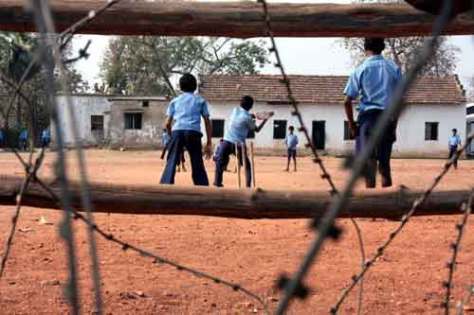
School’s out! In Kerlapal, Dantewada, battle-weary soldiers of the B Company of the 2nd Battalion of the Central Reserve Police Force peer over barbed-wire fences as skinny schoolboys in sky-blue shirts play cricket. The force has occupied the senior school and with it the basketball court and part of the playing field; but the game must go on.
As paramilitary troops pour into Chhattisgarh to fight the Maoists, the absence of military barracks has forced soldiers and children to share the only concrete structures in the countryside — the village school.

The Day of Long Knives

Gachanpalli: Stories of the “Operation” reverberate along the path from the Andhra Pradesh border to Gachanpalli, a village deep in forests of Chhattisgarh’s Dantewada district. Villagers along the 35 kilometre stretch of broken track, bombed-out schools, and graves, still speak of the day when security forces swept through their fields and killed 12 men.

Testimonies collected from the villages of Gachanpalli, Gattapad and Palachalam in the Konta block in Dantewada claim that at least 12 of the 30 people killed during a security operation in September 2009 were innocent villagers with no links to the Maoists.  If true, the allegations point to a concerted attempt at dissimulation on the part of Chhattisgarh’s security forces.

The Plot thickens: more petitioners show up

The Gompad case gets murkier. Gachanpalli is another village mentioned in the same case I have been writing about for some time now. I visited the village this week to find a similar pattern where villagers vanish without really telling anyone where they are going and suddenly show up in the Supreme Court in New Delhi.
Given the matter is sub judice, I’ll refrain from any theorizing at this point.
a.
Gachanpalli: A frayed umbrella, a half filled bottle of cooking oil and two shopping bags stuffed with clothes constitute the unlikely tombstone that marks Kowasi Ganga’s grave.  “It’s the sum total of his worldly possessions,” says his grandson Kowasi Muye, “It’s a Muria tradition.”
Kowasi Ganga, 75, died on September 17 2009. Muye’s last memory of his grandfather is of Ganga dying dead outside their home.  He had been stabbed multiple times.

Appeal for talks with broader section of people’s struggles in the forest and mineral belt

Aditya Nigam, Dilip Simeon, Jairus Banaji, Nivedita Menon, Rohini Hensman, Satya Sivaraman, Sumit Sarkar, Tanika Sarkar

In the light of the recent demands raised by sections of the intelligentsia urging the government to heed the CPI (Maoist) “offer of talks”, we insist that “civil society” should rather, put pressure on the government to initiate talks with representatives of all struggling popular and adivasi organizations. The CPI (Maoist) cannot be treated as the sole spokesperson of all the people in the forest and mineral belt, convenient though this may be for the state and for that party. Does the government believe that violent insurgents are the only deserving interlocutors? Continue reading Appeal for talks with broader section of people’s struggles in the forest and mineral belt

“Police killed them” say the villagers

I have been following the Gompad case for the past month and a half, and have been surprised at every turn.  The issue is centred on the deaths of 12 villagers on October 1 2009 in Chhattisgarh.  The matter is currently sub judice – so I would prefer not to comment on what I think happened, but this is my most comprehensive piece on the issue till date.

a.

GOMPAD: A charred wooden stake and three graves are all that remain of the Madavi family in this remote village in Chhattisgarh’s Dantewada district.

“Madavi Kanni was lying face down in front of the burnt house,” said an eyewitness. “She had been slashed with a sword and shot in the chest.” The bodies of her father, Madavi Bajar, her mother Madavi Subbhi and her 12-year-old sister Madavi Mutti, were found under a tree, 50 metres away.

Testimonies collected by The Hindu from Gompad allege that a composite force of Adivasi special police officers and security force regulars appeared on the outskirts of the village in the early hours of October 1, 2009. “We ran away when we saw the force,” said the witness, speaking on condition of anonymity. “We found the bodies when we returned.”
Continue reading “Police killed them” say the villagers

Vote! Or else…

In Lingagiri, it didn’t take long to tally the results of the recently concluded panchayat elections. On January 31 this year, a sum total of four people voted in this remote village in Chhattisgarh’s Bijapur district. The polling booth opened on time, the polling officers were present, and then the force arrived.
Pujari Rajamma, 35, was combing her hair in her courtyard. “I was getting ready to walk down to the polling office, when the uniformed men stormed in,” she said. “They checked my fingers for the voting mark.” When they didn’t find it, they beat her with sticks. The bruises are still visible on Rajamma’s back; she can barely move her swollen left arm.

Green Hunt: The Anatomy of An Operation

An operation is underway in Central India, but no one really knows what it is. Variously described as a media myth, a comprehensive hearts and minds strategy, and an all-out offensive by paramilitary forces and the state forces along the borders of Chhattisgarh, Jharkhand, Andhra Pradesh and Maharashtra, Operation Green Hunt has become a shoebox of news clippings, police reports, public demonstrations and armed encounters.

Depending on the definition, Green Hunt either began in July 2009, September 2009 or November 2009. Speaking off record, senior policemen confirmed that the intensification of “search and comb” operations in Chhattisgarh began as early as July last year. In September 2009 the press reported on the progress of “Operation Green Hunt”: a massive 3 day joint operation in which the central CoBRA force and state police battled Naxal forces in Dantewada. Continue reading Green Hunt: The Anatomy of An Operation