Category Archives: Genders

Yo, Yo Honey Singh and Other Implied Learnings: Aprajita Sarcar

Guest post by APRAJITA SARCAR

Kudiye ni tere brown rang ne, munde patt te ni saare mere town de…..Hun bach bach ke, tenu rab ne husn ditta rajj rajj ke/Main keha kaali teri Gucci, te Prada tera laal/ Kithe challo oh sohneyo, sajh dajh ke ke/ Tere wargi naar ni honi, mainu munde kehnde si /Hoge ni tere charche Star News to BBC /Ho brown brown skin wali, let me tell you one thing /Rab di saunh you so sexy! Continue reading Yo, Yo Honey Singh and Other Implied Learnings: Aprajita Sarcar

Gird Your Loins

A new product ’18 Again’ has hit the Indian market. A vaginal tightening gel, the advertisement left us mildly bemused.

With her newly tautened privates, the saree-clad lady seems in remarkably good cheer, given she apparently ‘feels like a virgin’ and ‘it’ (it presumably being sex), ‘feels like the very first time’. Namely awkward, painful, inexperienced fumbling? Ah well! There’s no accounting for tastes, not least the fantasies of the Indian man.

Regardless, we think this is a step in the right direction. Virgins being a scarce commodity these days, a handy at-home converter for any sacrifices you may have planned is a thoughtfully designed product indeed. (The makers of ’18 Again’ are unclear on what to do with those of us who escaped the wastelands of virginity before 18, but there you have it. You can’t please everyone, certainly not those sluts who didn’t even wait till they were legal). The makers of 18 Again are hoping for strong revenues on the back of exponential domestic demand.

As this article details, the Indian vagina now caters to a broad spectrum of consumer taste and preference. Backed by a strong commitment to product diversification, the Indian vagina is set to enter the 21st century  with applications and appliances, room fresheners and Christmas trees. Needless to say, we are delighted; our only grouse being that the products are somewhat limited in scope and vision. And so with an eye to the future we present a small list of potential uses and a plea that we all broaden, rather than tighten, our imagination. Continue reading Gird Your Loins
“Sexism is as common as sweat at the London Olympics”

Annie-Rose Strasser draws our attention to some delicious instances of sexism at the Olympics, from  from female boxers being asked to wear skirts to differentiate them from the men, to women’s teams taking coach while men’s fly first class.

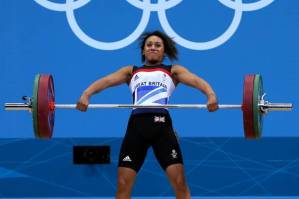
Meanwhile 18 year-old British Olympic weightlifter Zoe Smith responded sharply on her blog to Twitter-brains tweeting or chirping that she is too manly:

[We] don’t lift weights in order to look hot, especially for the likes of men like that. What makes them think that we even WANT them to find us attractive? If you do, thanks very much, we’re flattered. But if you don’t, why do you really need to voice this opinion in the first place, and what makes you think we actually give a toss that you, personally, do not find us attractive? What do you want us to do? Shall we stop weightlifting, amend our diet in order to completely get rid of our ‘manly’ muscles, and become housewives in the sheer hope that one day you will look more favourably upon us and we might actually have a shot with you?! Cause you are clearly the kindest, most attractive type of man to grace the earth with your presence.

Oh but wait, you aren’t. This may be shocking to you, but we actually would rather be attractive to people who aren’t closed-minded and ignorant. Crazy, eh?! We, as any women with an ounce of self-confidence would, prefer our men to be confident enough in themselves to not feel emasculated by the fact that we aren’t weak and feeble.

Having fun yet?

Why the Maldivian ski team is good in short bursts (and other reflections on the Olympics): Sajan Venniyoor

Guest post by SAJAN VENNIYOOR

Now that the 2012 London Olympics has established its progressive republican credentials by recruiting former cold-war assassin, James Bond, to hurl Britain’s 86 year old Queen from a helicopter, following it up with tributes to labour unions, suffragettes, people of colour and the National Health Service (or as the Tories say, ‘leftie multicultural crap’), could we ask some fundamental questions like, what the hell is an ‘Olympic sport’ and how does a 71 year old man in a top-hat sitting on a very expensive horse exemplify the virtues of going faster, jumping higher and being stronger, unless the medal goes to the horse?
Continue reading Why the Maldivian ski team is good in short bursts (and other reflections on the Olympics): Sajan Venniyoor

A blow to reproductive rights in Pakistan: Ayesha Asghar

Guest post by AYESHA ASGHAR

Early in July, Kashmala Tariq, Member of the National Assembly (MNA) of Pakistan, whom Wikipedia describes as “actively involved in women’s rights”, opposed the tabling of the Reproductive Health Bill 2012, saying that it was not in conformity with Islamic laws. The Bill was introduced by another MNA, Atiya Inayatullah, with the purpose of providing reproductive health services, including legal access to abortion,  to women in Pakistan.

Tariq accused the Bill of following the agenda of foreign NGO’s and stated that such proposals that might be in contravention of Islamic injunctions should be sent to the Council of Islamic Ideology and every party’s opinion should be sought. The Bill has been sent to the Cabinet Division for further deliberations.

Does this mean that our women representatives don’t know what reproductive rights include? The responsibility of women parliamentary representatives in Pakistan is more challenging than that of men, as women are more often made victims of oppression either in the name of culture or religion.

Continue reading A blow to reproductive rights in Pakistan: Ayesha Asghar

The Right to Our Bodies

In a case where the “facts” are both complex and yet also the question at hand, let us start with one that should be undisputed: Pinki Pramanik says she is a woman. She has lived as one, competed as one, and identifies as one. She and no other person or institution – particularly the law or medical science – has the right to decide what her gender identity is regardless of her anatomy, her chromosomes or her hormones. As the investigations against her began, her claim to be a woman should have been accepted at face value regardless of whether narrow judgments of her appearance, manner, physicality or dress led some to believe otherwise.

To add to Nivedita’s post below and track what the Pinki Pramanik case continues to tell us, here is a link to the rest of the Times of India piece cited above that appeared on Monday. The argument I make in that piece has taken a new turn. The gender test results, as reported by the media currently, now say that Pinki is “male” because she has XY chromosome. Yet the report says at the same time that she has “female genital ducts and female external genitalia.” What indeed, then, are we to make of a “conclusive” report that finds Pink to be “male”? The terms and words of the test undo themselves and the underlying assumptions and pathways to the conclusion are far from apparent. If Pink is indeed intersex, then all of these results can stand without the conclusion the report draws of her being “male.” Worth reading are a Journal of American Medical Association article here on Gender Testing and the Olympics, Alice Dreger on sex and gender testing in sports here.

In a national daily this morning, there is a photograph of Pinki. She is taking cooking lessons with her mother in her village. The performance of her gender has begun as her sex is questioned. The only strategy open to her is to now constantly claim all that is uncontestably “woman”: a saree, a pallu over the head, in the kitchen, learning from her mother. Yet again the binaries and essentialisms of our gender identities are reproduced as Pinki tries to erase signs of the apparent “masculinity” of her appearance and behaviour that has driven much of the outrage against her thus far.

On bodies and gender, and what Pinki Pramanik teaches us

The story of Pinki Pramanik and her partner can be pieced together like any other story of intimacy gone bad. After all, human beings invariably encounter pain and betrayal in intimate relationships, just as they encounter joy and desire. No relationship is free of power, whether produced by individual personalities or by social structures — patriarchy, the assumption of heterosexuality as natural, caste, class, race. Why then has Pinki’s story become about something else altogether? Because we assume that our bodies are “naturally” male or female.

But would anyone pass a gender test?

(Here’s the rest of this short piece published in Indian Express yesterday).

Last year I had posted The disappearing body and feminist thought on kafila, raising very much the same issues.

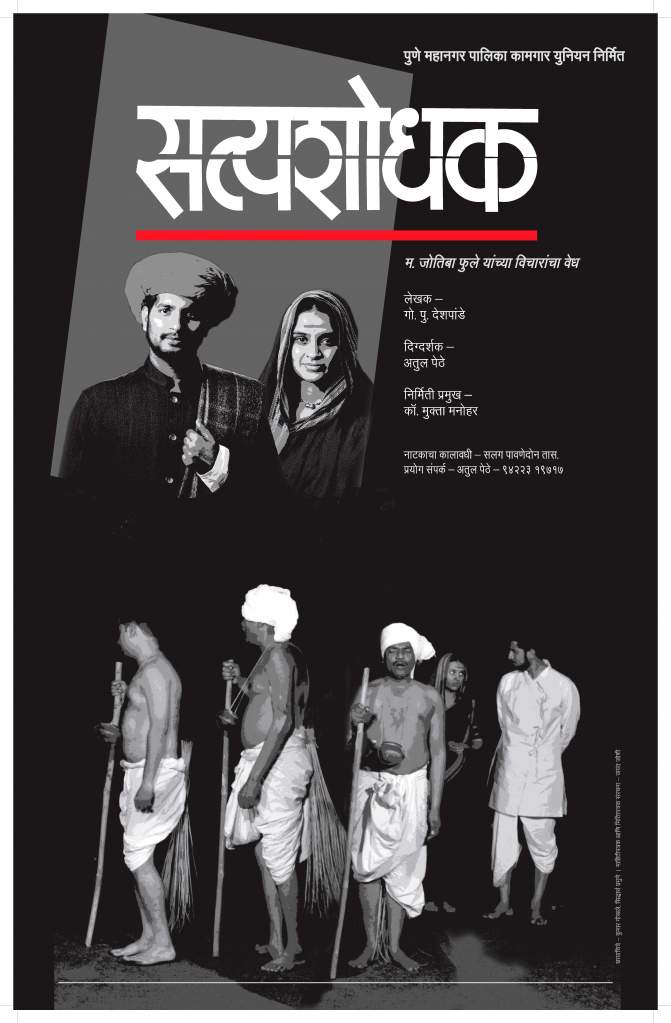
Satyashodhak – A Performance

(A shorter version of this review appeared in Tehelka)

Writer: G P Deshpande

Director: Atul Pethe

Performed by Pune Safai Karmacharis Union

Image

It was apt that a landmark production of G P Deshpande’s 1992 play Satyashodhak on the life of the 19th century anti-caste crusader Jyotiba Phule was performed in a week that witnessed the killing of the head of the Ranbir Sena – a week in which we were reminded that the bitter legacy of caste haunts us as strongly as ever. It was unusual however, that the performance should be held at the recently-opened May Day café and bookstore in Delhi – a space dedicated to the different and more hopeful legacy of the international working class movement, and located close to the heart of a former industrial district in a city that practices careful amnesia about its working classes. It is entirely unusual further that the performers were both Dalit and members of the Pune Municipal Safai Karmacharis Union. While the ancient, poisoned streams of caste and class have often overlapped on the subcontinent, they have not, as we are aware, produced unified or even similar political responses.

Continue reading Satyashodhak – A Performance

Consent, Age and Agency: reflections on the recent Delhi High Court judgement on minors and marriage: Flavia Agnes

This is a guest post by FLAVIA AGNES

I am responding to the sense of despair expressed by some women’s groups and more specifically to the press conference called by Bharatiya Muslim Mahila Andolan (BMMA)  to condemn the judgment of the Delhi High Court which permitted a minor (almost 16-year old) girl to marry the man of her choice rather than restore her back to her parental authority.  In their campaign for codification of Muslim law, BMMA has asked for laying down 18 as the minimum age of  marriage for girls (and 21 for boys), the underlying presumption being that all underage marriages must be declared as void.

Before we come up with a knee jerk response to the hype created by the media and bite the bait,  we need to have greater clarity on whose side we (feminists) are batting in this confrontation between  parental authority and the active  agency expressed by a teenaged girl. Also I wish to raise a connecting question — if the Muslim law was codified and minimum age for marriage was stipulated, as has been done under the Hindu Marriage Act, would the High Court have responded differently?  Would the judges have sent the girl back to her parental custody?  And the last question – could that have been construed as a ‘progressive ruling’ by us, those claiming to be “feminists”? Continue reading Consent, Age and Agency: reflections on the recent Delhi High Court judgement on minors and marriage: Flavia Agnes

Abortion as a feminist issue – who decides, and what?

The recent post by Shohini Ghosh on the first episode of Satyameva Jayate has raised key questions around the complicated relationship between abortion as such and the selective abortion of female foetuses. This dilemma is one with which the women’s movement in India has been grappling since the late 1980’s. In this post, I would like to move away completely from the television programme, especially because there the focus was on women who were forced to have abortions after sex determination, on which there is little to debate. I am concerned here with the more troubling question that Shohini also raises, of how to understand a situation in which women themselves decide to have sex selective abortions. I outline here the main contours of feminist debate and activism over close to three decades, that have circled around complex understandings of ethics and agency in the context of women’s control over their bodies. I conclude by stating my own position on the issue, which is not necessarily the position taken by the movement as such.

Continue reading Abortion as a feminist issue – who decides, and what?

What I learned from “The Patriarchy”: Nilanjana S. Roy

Guest post by NILANJANA S. ROY

Reading Saba Dewan’s post, on patriarchy and St Stephen’s, was a release. For years, I had struggled to make sense of two contradictory things—my years at college were some of the happiest of my life, but the institution that was held up to us as one of the best in India was also built on a flawed and deeply discriminatory set of beliefs.

(It’s hard to write about this in part because it always felt like complaining about what was, in essence, a very privileged life–those of us who went to St Stephen’s were by definition lucky, in our acquisition of English, in our officially liberal families, in our assumption of a secure place in the hierarchies of power in India.) Continue reading What I learned from “The Patriarchy”: Nilanjana S. Roy

Dil Se Nahin Dimaag Se Dekho – Thoughts on Satyamev Jayate Episode 1: Shohini Ghosh

Guest post by SHOHINI GHOSH

The first episode of Aamir Khan’s much publicized TV show Satyamev Jayate telecast on May 6, 2012 dealt with “Female Foeticide”. The following is a reflection of the show’s line of reasoning. Since only one out of 13 episodes has been telecast, what follows should not be taken as a judgement on the series but a response to the first episode. For reasons that I will explain later, I will use the term Sex-Selective Abortions (hereafter SSA) instead of `Female Foeticide’.

Continue reading Dil Se Nahin Dimaag Se Dekho – Thoughts on Satyamev Jayate Episode 1: Shohini Ghosh

Of chick charts, hen charts and other such women’s stories: Saba Dewan

Image credit: Tribhuvan Tiwari / outlookindia.com

Guest post by SABA DEWAN

(For Vrinda, Uma, Sukhpreet, Dipta and all of us who found strength in each other to raise our voices in protest…) 

A few months back I visited St. Stephen’s College in Delhi University for a screening organized by the students there of my film, ‘The Other Song.’ It was my first visit after 26 years when I had been an undergraduate student here from 1982 – ‘85. I confess I have never felt any urge to go back nor have I suffered nostalgia about the three years I spent in St. Stephen’s College although I have carried vivid memories of that time. Sharp, brittle memories that defined many of the choices I have made in life over the years; the most important being of believing in and hopefully practicing a feminist politics based on equality and respect for all. Feminism truly has been a legacy that St. Stephen’s College inadvertently bequeathed to many of its women students of my generation. Continue reading Of chick charts, hen charts and other such women’s stories: Saba Dewan

NWMI Condemns The Violent Abuse Of Meena Kandasamy

[We at Kafila are absolutely horrified at the abuse directed at poet and activist Meena Kandasamy for expressing her views on twitter regarding the beef-eating festival at Osmania University. That supposedly ‘neutral’ educational institutions replicate upper-caste Hindu dietary taboos, is no surprise, nor that the ABVP reacted with its customary violence to that questions upper caste privilege. What is shocking is the attitude of the Vice Chancellor and the sexist, misogynist, violent speech directed at her on the web. It is telling that those who take such umbrage at the eating of cows, think nothing of advocating the public rape of women. Below is a statement issued by the The Network of Women in Media condemning the hate speech directed at her. We stand in solidarity with Meena Kandasamy.]

The Network of Women in Media, India (NWMI), strongly condemns the violent and sexist abuse unleashed on poet, writer, activist and translator Meena Kandasamy, presumably in response to her posts on Twitter about the beef-eating festival at Osmania University, Hyderabad, on 15 April 2012 and the ensuing clashes between groups of students. Continue reading NWMI Condemns The Violent Abuse Of Meena Kandasamy

Nigah statement condemning the shutting down of Sunil Gupta’s exhibition ‘Sun City & Other Stories’

This statement has been put out by NIGAH
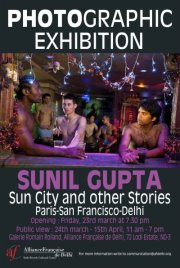
On Friday, March 23 2012, Sunil Gupta’s photographic exhibition ‘Sun City & Other Stories’ opened at the Alliance Francaise in Delhi. That evening itself, plainclothes men of the Delhi Police from the Tughlaq Road Police Station arrived at the show and ordered the removal of numerous photographs. In the chaos that followed, the photographs were removed by the Alliance Francaise under the ‘supervision’ of the Delhi Police and the exhibition was closed for the evening. The next day, the Alliance Francaise informed Sunil -via a third party – that the entire show would be shut down.

Why did this happen? On that day itself the Delhi Police said that someone had called the emergency police hotline, and complained to the Delhi Police about this exhibition which, according to the complainant, was ‘against Hindu culture’. Another version of events, also produced by the Delhi Police, claims that they received a complaint at the Tughlaq Road Police Station from someone who had made a video of the exhibition, complaining about the nudity in the photographs. Continue reading Nigah statement condemning the shutting down of Sunil Gupta’s exhibition ‘Sun City & Other Stories’

Does democracy stop at the doorstep of the women’s hostel?

This appeal comes to us via MAYA JOHN

Friends,

Since January of 2012, residents of Delhi University’s largest postgraduate women’s hostel, University Hostel for Women (UHW) have been waging a battle against outright suppression of their democratic rights by, both, their hostel authorities and the University’s Proctorial Committee. Since the hostel’s Chairperson is also the Proctor of the University, the Proctorial Committee has been intervening in the matter, not as a neutral party, but in complete connivance with the hostel authorities. There are two issues which are central to the ongoing struggle of the women students, namely, the imposition of a union constitution by the authorities, and the existence of archaic and conservative rules in the hostel.

Continue reading Does democracy stop at the doorstep of the women’s hostel?

I Singe The Body Electric

Meena Kandasamy is the author of two compilations of poetry: Touch and Ms. Militancy. The following is an incredibly brave and extremely disturbing piece she published in Outlook last week. Her writing, and the violence this account describes, makes commentary shallow and inadequate. I was particularly shaken by the thought of a woman waking up, sipping coffee, watching television, participating the quotidian banalities of companionship with a man who could at any instant, for any reason, turn into a violent monster. This is the world we’ve built: rapists prowl the cities, abusive teachers stalk schools and universities; at home, violence breaks in waves.

As a bored housewife, I colour-code the domestic violence: fresh red welts on my skin, the black hue of blood clots, the fading violet of healed bruises. It appears that there is no escape from this unending cycle of abuse, remorse-filled apology and more abuse. One day, when I am whipped with a belt and cannot take it anymore, I threaten him with police action. He retorts that no man in uniform will respect me after reading a line of my verse. He challenges me to go to anyone anywhere. I have no friends in that small world—only his colleagues who think the world of him and his students who worship the earth on which he walks. I do not know whom to trust, even our neighbours could hand me back to him. In the middle of the night, I want to rush to a nearby convent, seek shelter. Would I be understood? Would it work out? How far can I run away in a city that does not speak my tongue, a city where young women in bars are beaten up?

Read the rest of Meena’s piece here,

Modesty of Dress and Indian Culture: Suchi Govindarajan

Widely circulating just about everywhere, but for the unfortunate few who may have missed it…

I for one want to kiss the hem of her salwar/sari/jeans/other modest outfit.

Sir/Madam,
I write to complain about the abysmal standards of modesty I am noticing in Indian society. All bad things – sensationalist TV, obscene movies, diabetes among elders, pickpocketing, dilution of coconut chutney in Saravana Bhavan – are a result of Evil Western Influences. However, to my surprise, in this issue of modesty, even the Great Indian Culture (we had invented Maths and pineapple rasam when westerners were still cavemen) seems to encourage this.

The problem, sir/madam, is that revealing attire is being worn. Deep-neck and sleeveless tops, exposed legs–and these are just the middle-aged priests! Some priests are even (Shiva Shiva!) doing away with the upper garment. And I am told some temple managements even encourage this.

Read the rest of this brilliant and biting piece here.

Feminism and the Family – Thoughts on International Women’s Day

Excerpts from my forthcoming book Seeing Like a Feminist (Penguin India/Zubaan Books).

Have you heard of ‘nude make-up’?

This is what it is:

‘Nude makeup looks are all about your skin looking fresh and dewy, without looking like you’re even wearing any makeup. All you need is eyeliner, mascara, nude lipstick, and a highlighting blush that will give your skin a natural-looking glow.’[1]

The whole point of nude makeup clearly, is to spend hours painting your face in order to make it look like you never touched it at all.

The maintaining of social order is rather like that. It requires the faithful performance of prescribed rituals over and over again throughout one’s lifetime. Complex networks of cultural reproduction are dedicated to this sole purpose. But the ultimate goal of all this unceasing activity is to produce the effect of untouched naturalness.

When one ‘sees’ the world like a feminist though, with the gaze of a feminist, it’s rather like activating the ‘Reveal Formating’ function in Microsoft Word (what an earlier generation of WordPerfect users knew as ‘Reveal Codes’). The feminist gaze reveals the strenuous, complex formatting that goes on below the surface of what looked smooth and complete. Continue reading Feminism and the Family – Thoughts on International Women’s Day

Three Stories of Resilience from Gujarat: Ayesha Khan

Guest post by AYESHA KHAN, Baroda-based journalist

Bilkis Bano. Photo via a grab from a recent NDTV report

To mine the detritus of the Gujarat pogrom for positive stories may seem like sacrilege. But when memories are dredged up to mark a decade of the horrors of 2002, a little blasphemy could help balance the account books.

Mostly what we recount of Gujarat 2002 is deaths. Yet, more than the murder and mayhem, the pogrom stood out for an unprecedented scale of sexual violence that Muslim women were subjected to. George Fernandese in his capacity as the Union defence minister had explained to the Parliament after a quick tour of Gujarat that women raped or molested during riots was not surprising or exceptional. I will not go here into the polemics of why violating women’s sexuality is considered a means of dishonouring a community,

There’s an untold story about how the community handled sexual violence. If the dominant community legitimised rape driven by its insecurities and politics that stemmed from history and identity issues, it was perhaps for the first time that the persecuted community reacted to rape in a progressive way.

Rape is double-edged sword, first leading to physical violation and second to social ostracisation in most societies. Which is common to mask the identity of rape victims for fear of social stigma. Strangely, during the 2002 riots, Muslim women, some of them burqa clad and most of them from tightly-knit rural communities never betrayed the kind of shame or guilt that rape victims are expected to show. What was their fault? Why should the victim feel shame and guilt? And so it was that many of them did not cloak their identities, and instead chose to come out publicly to demand justice. Continue reading Three Stories of Resilience from Gujarat: Ayesha Khan