Category Archives: Sex

The Right to Our Bodies

In a case where the “facts” are both complex and yet also the question at hand, let us start with one that should be undisputed: Pinki Pramanik says she is a woman. She has lived as one, competed as one, and identifies as one. She and no other person or institution – particularly the law or medical science – has the right to decide what her gender identity is regardless of her anatomy, her chromosomes or her hormones. As the investigations against her began, her claim to be a woman should have been accepted at face value regardless of whether narrow judgments of her appearance, manner, physicality or dress led some to believe otherwise.

To add to Nivedita’s post below and track what the Pinki Pramanik case continues to tell us, here is a link to the rest of the Times of India piece cited above that appeared on Monday. The argument I make in that piece has taken a new turn. The gender test results, as reported by the media currently, now say that Pinki is “male” because she has XY chromosome. Yet the report says at the same time that she has “female genital ducts and female external genitalia.” What indeed, then, are we to make of a “conclusive” report that finds Pink to be “male”? The terms and words of the test undo themselves and the underlying assumptions and pathways to the conclusion are far from apparent. If Pink is indeed intersex, then all of these results can stand without the conclusion the report draws of her being “male.” Worth reading are a Journal of American Medical Association article here on Gender Testing and the Olympics, Alice Dreger on sex and gender testing in sports here.

In a national daily this morning, there is a photograph of Pinki. She is taking cooking lessons with her mother in her village. The performance of her gender has begun as her sex is questioned. The only strategy open to her is to now constantly claim all that is uncontestably “woman”: a saree, a pallu over the head, in the kitchen, learning from her mother. Yet again the binaries and essentialisms of our gender identities are reproduced as Pinki tries to erase signs of the apparent “masculinity” of her appearance and behaviour that has driven much of the outrage against her thus far.
On bodies and gender, and what Pinki Pramanik teaches us

The story of Pinki Pramanik and her partner can be pieced together like any other story of intimacy gone bad. After all, human beings invariably encounter pain and betrayal in intimate relationships, just as they encounter joy and desire. No relationship is free of power, whether produced by individual personalities or by social structures — patriarchy, the assumption of heterosexuality as natural, caste, class, race. Why then has Pinki’s story become about something else altogether? Because we assume that our bodies are “naturally” male or female.

But would anyone pass a gender test?

(Here’s the rest of this short piece published in Indian Express yesterday).

Last year I had posted The disappearing body and feminist thought on kafila, raising very much the same issues.

Consent, Age and Agency: reflections on the recent Delhi High Court judgement on minors and marriage: Flavia Agnes

This is a guest post by FLAVIA AGNES

I am responding to the sense of despair expressed by some women’s groups and more specifically to the press conference called by Bharatiya Muslim Mahila Andolan (BMMA)  to condemn the judgment of the Delhi High Court which permitted a minor (almost 16-year old) girl to marry the man of her choice rather than restore her back to her parental authority.  In their campaign for codification of Muslim law, BMMA has asked for laying down 18 as the minimum age of  marriage for girls (and 21 for boys), the underlying presumption being that all underage marriages must be declared as void.

Before we come up with a knee jerk response to the hype created by the media and bite the bait,  we need to have greater clarity on whose side we (feminists) are batting in this confrontation between  parental authority and the active  agency expressed by a teenaged girl. Also I wish to raise a connecting question — if the Muslim law was codified and minimum age for marriage was stipulated, as has been done under the Hindu Marriage Act, would the High Court have responded differently?  Would the judges have sent the girl back to her parental custody?  And the last question – could that have been construed as a ‘progressive ruling’ by us, those claiming to be “feminists”? Continue reading Consent, Age and Agency: reflections on the recent Delhi High Court judgement on minors and marriage: Flavia Agnes

Good woman=Mother/Bad woman=Sex worker/Sex worker mother =? Amrita Nandy

Guest post by AMRITA NANDY

The math of this morality can be puzzling. Why should “sex worker mother” sound like an oxymoron to so many?

It was Mother’s Day recently –  judgment time on who can be a mother, what makes a good mother. Time magazine’s provocative current cover shows a young Los Angeles mother breastfeeding her three year old son (standing on a stool to reach mommy’s breast) as the headline asks “Are you mom enough?” The accompanying article on “attachment parenting”, as put forward by “parenting expert” Bill Sears in his The Baby’s Book, encourages parents to keep their infants in constant bodily contact with the parent by wearing a baby sling, let their children wean themselves from the breast when they are ready and allow “co-sleeping” which aids a child to grow up to be well-adjusted adults.

Attachment parenting has been widely criticized for setting the bar for good parenting impossibly high, especially for parents who have to work full-time, but it is a bar quite easily reached by Radha – she is very “mom enough”.  Amidst the din of the Delhi brothel where she works, she continues to suckle her four year old daughter. But if the judges of “good mothering” were policemen in Satara, Radha would not qualify. For them, a sex worker mother is a “shame”. This is why they dared to kick Anu Mokal, a four-months pregnant sex worker, leading to bleeding and an eventual miscarriage.

Continue reading Good woman=Mother/Bad woman=Sex worker/Sex worker mother =? Amrita Nandy

Solidarity March: Justice for sex worker mothers

Press statement issued by Mitra Sanghatana (Collective of children of sex workers )and Veshya Anyay Mukti Parishad (VAMP), a collective of sex workers, Maharashtra.

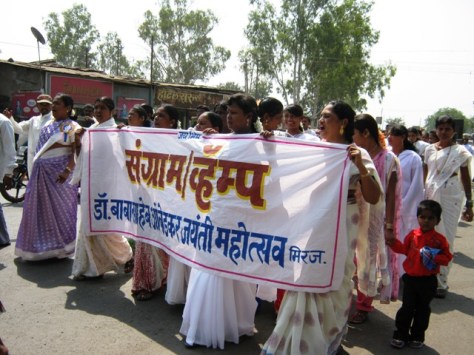
File photograph of members of SANGRAM and VAMP, collective of sex-workers, celebrating Dr Ambedkar Jayanti

Women’s groups and progressive organisations in India are shocked that Ms. Anu Mokal, a pregnant sex worker in Satara, was beaten up by police inspector Dayanand Dhome on April 2, along with her friend Ms. Anjana Ghadge. Three days later, on 5th April, she suffered a miscarriage. The incident occurred on 2nd April 2012, around 7.30 pm, when Anu Mokal, who was four months pregnant, and Anjana Ghadge were bringing dinner for their friend who was admitted in the civil hospital. Near the Satara bus stand area, senior Police Inspector Dayanand Dhome accused them of soliciting and when they refuted it abused them and called them liars. Dhome and his subordinates started beating Anu and her friend Anjana. Dhome repeatedly kicked them and said that women like Anu are a ‘shame’. Her pleas that she was four months pregnant fell on deaf ears. Anu and Anjana were detained and put in a lockup. They were eventually released on April 3.

Continue reading Solidarity March: Justice for sex worker mothers

A Statement Supporting the Delhi HC Judgment on Section 377: Ruth Vanita

Guest post by RUTH VANITA, Professor at the University of Montana. This statement was written in the context of the teachers’ intervention in the Supreme Court in the appeal by religious groups against the Delhi High Court judgement on Section 377 . This statement does not form part of court documents. You can read Shivaji Panikkar’s statement here

I belong to a middle-class family of educationists, various members of which migrated to Delhi from Rangoon and Lahore at Partition. I was educated entirely in Delhi, first at Springdales School, and then at Miranda House. I got my Ph.D.  from Delhi University. I started teaching at the age of 20 at Miranda House; I taught there for 18 years and then for two years as a Reader in the English Department, Delhi University, before taking early voluntary retirement in 1997.

Continue reading A Statement Supporting the Delhi HC Judgment on Section 377: Ruth Vanita

A Statement Supporting the Delhi HC Judgment on Section 377: Shivaji Panikkar

Guest post by SHIVAJI K PANIKKAR,  art historian and Dean, School of Culture & Creative Expressions, Ambedkar University, Delhi. This statement was written in the context of the teachers’ intervention in the Supreme Court in the appeal by religious groups against the Delhi High Court judgement on Section 377 . This statement does not form part of court documents.

You can read Ruth Vanita’s statement here.

I was born in a traditional, upper caste Hindu family and lived in Kerala till I was 22 years old, and since then shifted to study, work and live inBaroda,Gujarat. In 1975c I completed a B.A in Kerala with Economics and History as my subjects. InBarodathrough 1980s, at MS University I did another B.A. in Dance (Bharatanatyam), an M.A. and Ph. D in Art History as specialization. I was appointed as Professor in 1998. Till recently I was Head of Department of Art History & Aesthetics, Faculty of Fine Arts, M.S. University of Baroda. I have an experience of teaching at the University of about 25 years.

Since childhood    I knew I had homosexual inclinations, and lived it secretively till the age of about 43/45 years. Since then I lived an openly gay life; a fact that I couldn’t any more hide in my personal life as well as in my professional life. It was a matter of emotional and intellectual honesty and integrity that I accepted in public my sexual orientation, and no more live a life of fear and oppression.

Continue reading A Statement Supporting the Delhi HC Judgment on Section 377: Shivaji Panikkar

Teachers’ Intervention in the Supreme Court on Section 377

The Delhi High Court judgement reading down Section 377 to decriminalize consensual sex between adults was appealed against in the Supreme Court by several religious groups. However during the appeal, the Government of India withdrew its objections to the High Court judgement. In addition, there were some parties that intervened to support the judgement – parents, medical practitioners and teachers, among others. The Supreme Court judgement is awaited, but meanwhile, I am posting below the  position of the 16 teachers who intervened in this matter. This statement does not form part of court documents.

As teachers we essentially wanted to make the argument that Section 377 vitiates for everybody (and not just for gay people) the general atmosphere of free expression, learning, enquiry, and dignity that an academic environment should ensure.  That we oppose Sec 377 because its existence on the statute books legitimizes an atmosphere that runs counter to the spirit of openness and acceptance of difference that should mark modern academic spaces.  Its existence is not only an affront to those who are non-heterosexual, but it is an affront to each and every person in the academy who believes that every teacher and student has dignity that should be respected, and that learning is a continuous and life-long process, in which fixed ways of thinking are continuously challenged and reshaped by winds of change.

  Continue reading Teachers’ Intervention in the Supreme Court on Section 377

Between Aid Conditionality and Identity Politics – The MSM-Transgender Divide and Normative Cartographies of Gender vs. Sexuality: Aniruddha Dutta

This guest post by ANIRUDDHA DUTTA continues a theme raised on Kafila by Rahul Rao

Late last year, the UK and US governments made announcements supporting the global propagation of LGBT (lesbian-gay-bisexual-transgender) rights as human rights, suggesting that the future disbursal of aid might be made conditional on how LGBT-friendly recipient countries are perceived to be. The potential imposition of ‘gay conditionality’ on aid has been rightly critiqued for imposing a US/European model of sexual progress on ‘developing’ countries, which may justify covert geopolitical agendas and fail to actually benefit marginalized groups. But whatever form such conditionalities may take in the future, a more implicit and routine form of aid conditionality has been already at work, relatively unnoticed, for several years now – the presumption of distinct and enumerable minorities corresponding to categories like homosexual or transgender as target groups for aid in socio-cultural contexts where gender/sexual variance may not be reducible to such clear-cut categories or identities. Increasingly, community-based organizations (CBOs) working to gain gender/sexual rights or freedoms need to define themselves in accordance with dominant frameworks of gender-sexual identity to get funding both from foreign donors and the Indian state, creating identity-based divisions among CBOs and presenting existential challenges to communities that do not exactly fit these categories.

Continue reading Between Aid Conditionality and Identity Politics – The MSM-Transgender Divide and Normative Cartographies of Gender vs. Sexuality: Aniruddha Dutta

Nigah statement condemning the shutting down of Sunil Gupta’s exhibition ‘Sun City & Other Stories’

This statement has been put out by NIGAH
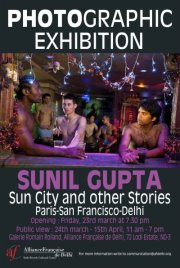
On Friday, March 23 2012, Sunil Gupta’s photographic exhibition ‘Sun City & Other Stories’ opened at the Alliance Francaise in Delhi. That evening itself, plainclothes men of the Delhi Police from the Tughlaq Road Police Station arrived at the show and ordered the removal of numerous photographs. In the chaos that followed, the photographs were removed by the Alliance Francaise under the ‘supervision’ of the Delhi Police and the exhibition was closed for the evening. The next day, the Alliance Francaise informed Sunil -via a third party – that the entire show would be shut down.

Why did this happen? On that day itself the Delhi Police said that someone had called the emergency police hotline, and complained to the Delhi Police about this exhibition which, according to the complainant, was ‘against Hindu culture’. Another version of events, also produced by the Delhi Police, claims that they received a complaint at the Tughlaq Road Police Station from someone who had made a video of the exhibition, complaining about the nudity in the photographs. Continue reading Nigah statement condemning the shutting down of Sunil Gupta’s exhibition ‘Sun City & Other Stories’

A Modest Proposal for the Castration of Male Police Officers

Dear Kafila Readers,
Here is a modest proposal to castrate police men and male police officers and security forces personnel in India who come into contact with women in the line of duty. I thought it would be an appropriately thoughtful, and at the same time useful and practical way to end a turbulent year. The context from which this modest proposal emerges is elaborated upon below. In a remarkably forthright statement, the chief of police in the state of Andhra Pradesh, Shri Dinesh Reddy in southern India has recently said that ‘fashionably dressed women’, including ‘women who wear salwar kameez in villages’ provoke and invite rape, as men are not able to control their ‘sexual jealousy’ and the ‘police are not able to control men’. The Indian Express and Asian News International (see below) have carried reports of this statement.

Incidentally, the last few years have shown a high incidence of custodial rape all over India, where police men and security forces personnel have raped women detained by them. According to some reports, these incidents are on the rise.  In other words, police men are increasingly unable to control the men that they themselves are. Continue reading A Modest Proposal for the Castration of Male Police Officers

Who’s afraid of Veena Malik?

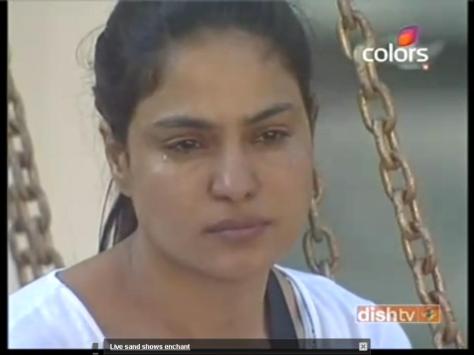
News broke of Veena Malik’s “nude” – more accurately, implied nude – photographs in FHM India magazine when the image of the magazine’s cover went viral on Twitter, even before the magazine was on newsstands. The media in India and all over the world reported “outrage” in Pakistan, in keeping with the international image of Pakistan as a country taken over by Islamists who would wreak havoc over a Pakistani woman posing without clothes for an Indian magazine with ISI tattooed on her arm.

FHM India itself magazine emphasised Malik’s nationality, calling her a “Pakistani WMD” and discussing burqas with her, even mentionining the word burqa on the cover, to reinforce the stereotype of a hot Pakistani model defying a country riven with Islamic extremism.

But in reality, there hasn’t been as much backlash in Pakistan as the world outside would expect or believe. Says Islamabad-based journalist Shiraz Hassan, “I am surprised that except a few news channels and papers nobody has been bothering about Veena Malik, as though they don’t care what she did. Haven’t seen anything from hardliners also.” Continue reading Who’s afraid of Veena Malik?

Invitation to a Debate: Queer Politics and Aid Conditionalities

Breaking from usual practice, I am cross-posting a piece from Akshay Khanna writing as part of the Participation, Power and Social Change blog over at the Institute of Development Studies at the University of Sussex. Akshay is writing in response to this statement by UK Prime Minister David Cameron where, in a nutshell, he threatens cutting off aid to countries that still ban or make homosexuality illegal. Continue reading Invitation to a Debate: Queer Politics and Aid Conditionalities

Mental Health Professionals Criticise Union Health Minister’s Statement on Homosexuality

PRESS STATEMENT: MENTAL HEALTH PROFESSIONALS CRITICISE UNION HEALTH MINISTER’S STATEMENT ON HOMOSEXUALITY

6 July 2011: We are a group of highly qualified mental health professionals who are practicing as psychiatrists, clinical psychologists and behavioural psychologists from across the country. We regret the statement made by Union Health Minister Ghulam Nabi Azad on Monday where he called homosexuality a “disease”, as being “unnatural”, and a having “come from western shores”. Scientific evidence shows that homosexuality is a natural variant of human sexuality and is not a mental disorder or disease. Homosexuality as a specific diagnostic category was removed from the World Health Organisation’s ICD-10 Classification of Mental and Behavioural Disorders published in 1992, and from the American Psychiatric Association’s DSM-IV Guidelines in 1973. Continue reading Mental Health Professionals Criticise Union Health Minister’s Statement on Homosexuality

These rapes aren’t rapes? Amrita Nandy

Guest post by AMRITA NANDY

Like the French, Mona, a 30-year old sex worker in Delhi, is intrigued and amazed over the hullabaloo around the DSK sexual assault case.  From her one-room shed, she has been keenly following television channels for the latest on the scandal. She asked me if I had any updates, adding: “That man may be in jail for 25 years! Really? Unbelievable. For us, being assaulted at work is a regular part of it. I tolerate some of it and ignore the rest. But you see… I cannot complain if I am harassed. A sex worker is a doll in the hands of her customer. No one will play with the doll if she complains!”

While Mona’s fatalism may have helped her cope, the risks at work are especially dire for non-brothel sex workers.  Some have nearly been killed.

Continue reading These rapes aren’t rapes? Amrita Nandy

‘मेरे लिए लेस्बियन होने का सबसे बढ़िया पहलू है मज़ेदार सेक्स’

Published originally in English  here

Translated by AKHIL KATYAL

मैंने हाल ही में एक डोक्युमेंटरी फिल्म देखी, प्रतिभा परमार की १९९१ में बनायीं हुई खुश, जो कि दक्षिण ऐशिआयि एल.जी.बी.टी (लेस्बियन, गे, बिसेक्सुअल, ट्रांसजेंडर)  लोगों कि अलग-अलग ज़िन्दगी के बारे में थी। एक लेस्बियन महिला से जब फिल्म में पुछा गया कि ‘लेस्बियन होने का सबसे बढ़िया पहलु क्या है?’ तो उसका जवाब था ‘मेरे लिए लेस्बियन होने का सबसे बढ़िया पहलु है पूरी तरह से ख़ुशगवार, मज़ेदार सेक्स!’ फिर वो महिला, पूरे नब्बे दशक के फैशन में सजी हुई, ऐसे मुस्कुराई,
कि लगा  कि वहीं उसी वक्त, उसी जगह, उसे अपने मज़ेदार सेक्स के सारे पल याद आ गयें हों।
मुझे, एक क्युइर एक्टिविस्ट के नाते, जो कि इस फिल्म के बनने के समय कुछ आठ साल कि थी और जो कि सार्वजनिक ढंग से एल.जी.बी.टी लोगों के बारे में न्यायालयों में और पत्रकारों से बोलती आई है, एक भी ऐसा पलयाद  नहीं आ रहा है, जब मैंने सेक्स के बारे में कुछ लिखा या बोला हो। Continue reading ‘मेरे लिए लेस्बियन होने का सबसे बढ़िया पहलू है मज़ेदार सेक्स’

Modest? Sexy? Or just an athlete?

By goddess, it’s that spot again – at once familiar and deeply uncomfortable. Us feminists in the same rage as the patriarchs and religious right, over the same damn thing. For very different reasons, we bellow (cutely), but is anybody listening?

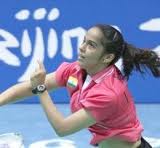
The  Badminton World Federation has announced its new dress code that requires women players to wear skirts  “to ensure attractive presentation of badminton.” Almost every Indian woman player has objected, saying that dress should be one’s personal preference.

Of course most workplaces have dress codes.  So this is about more than simply an infringement of individual tastes. This is about the utter blatant sexism of this particular requirement. Basically, what’s the BWF saying quite shamelessly? That they expect more people to come to the sport if they can see suggestively flying skirts (on women). Even if there are shorts beneath, which they have grudgingly permitted. It’s not enough to show legs, skirts have to fly. Continue reading Modest? Sexy? Or just an athlete?

How is Savita Bhabhi a Threat to India’s National Security?

“Ask the Home Ministry, because this is a security issue.”

That is what India’s Minister for Communications and Information Technology said recently when asked about the lack of transparency in the blocking of websites in India.

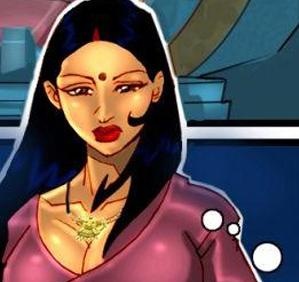
Now, one of the websites blocked in India is Savita Bhabhi, as also several mirror websites of the same. Savita Bhabhi, as you doubtless know, was a soft-porn web comic. All I want to ask Kapil Sibal is: How is Savita Bhabhi a threat to India’s national security? Wait, I have another question: Continue reading How is Savita Bhabhi a Threat to India’s National Security?

The disappearing body and feminist thought

Presented at conference organized by  Department of English (Delhi University)  February 14, 2011. The title of the  conference was “Postfeminist Postmortems?  Gender, Sexualities and Multiple  Modernities”.

Cross-posted on Critical Encounters

To paraphrase Anthony Appiah’s famous and oft-quoted question – Is the post of postfeminist the post of postmortem? That is, as in postmortem, does “post” mean definitively over, after, having transcended, gone beyond? To those who would answer “yes”, those privileged young women who float through their empowered lives in the wake of over a century of feminist struggles but disown their own heritage, to them I can only say – I’ll be a post-feminist in post-patriarchy. Or – not for a long time yet, baby.

But my answer to that question is “no”. I understand the post of postfeminism in the sense that Laclau and Mouffe understand their postmarxism. That is, post-feminist as indicating “having passed through” that body of thought; having lived through, experienced, feminist theory and politics in such a way that the terrain one now inhabits has been decisively transformed; but also post-feminist in the sense that in the course of this passage new objects have been configured that the old feminism could not have seen, or recognized.

It is in this kind of postfeminist moment that I locate my presentation today.

Continue reading The disappearing body and feminist thought

JNU and the ‘sex scandal’: Aprajita Sarcar

This is a guest post by APRAJITA SARCAR

As a former JNU student, it is a pity that I have to write this post in order to draw attention to a crisis that needs urgent attention: the inability to talk about intimacy.  I say intimacy, as against sex, as against scandal, as against molestation, as against the “professionally shot” footage that made it to the front pages of newspapers.

Jawaharlal Nehru University (JNU) has a crisis to face that has been imminent for a while, and it comes from the inability to talk intimately, about intimacies. Because intimacies are distinct from rhetoric. Continue reading JNU and the ‘sex scandal’: Aprajita Sarcar

Sound Enough: How to Enjoy the Jaipur Literature Festival: Revati Laul

Guest post by REVATI LAUL

“Excuse me, Mr. Farooqui, I just need a sound byte from you,” said a young reporter from the fairly young news channel News X. He was talking to my friend Mahmood Farooqui, author of Besieged: Voices From Delhi 1857, co-director of the Oscar nominated film Peepli Live and founder-revivalist of Dastangoi – the rich, medieval art of storytelling. Seeing that the setting was the beautiful and quaint Diggi Palace in Jaipur with a substantial gathering of the world’s literati for the Jaipur Literary Festival, Mahmood was preparing to hold forth on storytelling, culture, 1857…when this completely unexpected gem poured forth from the fearless reporter’s lips.

“Can you sum up what you think of literature in one word?” Continue reading Sound Enough: How to Enjoy the Jaipur Literature Festival: Revati Laul