
I have been thinking about the recent warning issued by the Home Secretary G.K.Pillai to Indian intellectuals, especially to those who are seen to be sympathetic to the Maoists. He says that they could be booked for their intellectual support to the dreaded enemy of the nation called Maoists. I felt like thanking him. For once the government, rather the state seems to have taken notice of the importance of the breed called ‘intellectual’. They do matter! Their opinion is valued! The masses are influenced by them!!! They are heard!!! Continue reading Welcome to a Leninist State
Category Archives: Violence/Conflict
The Maoist Killings Once Again
The news of killing of more than 40 people travelling in a bus blown by a blast in Dantewada is only a new chapter in the book of brutalities that is being scripted in Chhatisgarh and other parts of India in the name of ‘the People’. Six people were found slain in Rajnandgaon just a day before this blast. A day before that four villagers were killed in Bengal because they were thought be close to the CPM and were labeled as informers. Two days before these killings in Bengal, two villagers who were Gram Rakhis were killed in Orissa. This list does not include the death of 6 Para Military persons in Chhatisgarh who were killed a land mine detonated by the Maoists in Chhatisgarh.
Are these operations a response to the Operation Green hunt launched by the government? Or are they part of the Protracted People’s War that is being carried out by the purest revolutionaries of our earth who do not waver and shiver at the sight of blood? Or, as some friends caution us from rushing to any conclusion, as Shuddhabrata Sengupta has done, are they “ ‘ false flag operations’ conducted by some rogue elements of the state machinery” or directly endorsed by the state ? How are we to know who is the perpetrator of these crimes? Do we wait for a statement from the Maoists and if they deny their involvement, launch an investigation to find out the real culprit? It took nearly a month for the Maoists to officially own the attack which extinguished the lives of 76 CRPF men. The Maoist leadership congratulated the bravery of its combatants who had achieved the feat of eliminating a whole company of Indian para military force.
Continue reading The Maoist Killings Once Again
Adivasis allege torture in anti-Naxal operations
Seventeen Adivasi villagers of Samna in Orissa’s Narayanpatna block
claim that they were brutally assaulted in custody last week, an
allegation the police have denied.
According to the villagers, they were picked up on May 9, as part of a
joint operation conducted by the Orissa and Andhra Pradesh police
along the inter-State border, airlifted to a police station in Andhra
Pradesh and held in custody for three days before being released on
May 14.
“Uniformed policemen surrounded our village on Sunday morning [May 9],
when we were leaving for the market,” said Nachika Jaddo, one of those
who were picked up. “Seventeen men, including two dokras [old men]
were rounded up, beaten up and then dragged to a spot 2 km away.”
Continue reading Adivasis allege torture in anti-Naxal operations
On Alleged Maoist Atrocities
While I have on several occasions expressed my disgust at the way in which the Government of India is conducting it’s ‘Operation Green Hunt’, I have to say that the news of the attacks by alleged Maoists in Chattisgarh, in which 6 villagers have been killed, and more recently a bus, with several civilians (and some special police officers) has been bombed, is deeply disturbing.
It is a totally different matter from attacking men in uniform, (such as the CRPF jawans who were attacked not so long ago, resulting in 76 casualties). Though I do not support any war, including the Maoist initiated ‘Peoples War’ or for that matter, the Government of India’s ‘Operation Green Hunt’, in any war, armed men in uniform in a combat zone are fair targets. The death of the 76 CRPF jawans, though regrettable, is not in any way different from the death of any guerrila soldiers in the PLGA in any combat operation. I refuse to be blackmailed into thinking of such an event as an evidence of Maoist ‘atrocities’.
‘An acceptance of Israel’s legitimacy does not imply an acceptance of all that it does’: Amitav Ghosh
Given the long discussion on an earlier post on this subject, I think it is important to post here Amitav Ghosh’s long, persuasive response to the campaign that requested him not to accept the Dan David Prize. I’m taking the liberty of copying this response from here.
May 14, 2010
Dear Signatories to the letter of May 7:
I am sorry I have been slow to respond to your letter expressing disappointment in my decision to to accept the Dan David prize. I will attempt to do so now. Continue reading ‘An acceptance of Israel’s legitimacy does not imply an acceptance of all that it does’: Amitav Ghosh
From Murder Mystery to Spy Thriller: Raveena Hansa
THE CONTINUING SAGA OF THE MUMBAI TERRORIST ATTACKS
This is a guest post by RAVEENA HANSA.
A great deal of new evidence concerning the 26 November 2008 terrorist attacks in Bombay has emerged over the past year. This includes the book Who Killed Karkare: The Real Face of Terrorism in India by S.M.Mushrif, a former police officer with a distinguished record, who uses news reports during and just after the attacks to question the official story; the book To the Last Bullet by Vinita Kamte (the widow of Ashok Kamte) and Vinita Deshmukh; revelations concerning Hemant Karkare’s bullet-proof jacket and post-mortem report; the David Coleman Headley trial; and the trial of Ajmal Kasab, Fahim Ansari and Sabauddin Shaikh. I do not include the Ram Pradhan Commission report on police responses to the attack, for reasons I will explain.
The Headley Affair
The Headley affair has, predictably, grabbed a great deal of publicity. The fact that the FBI had been investigating the involvement of this American in conducting reconnaisance for the 26/11 attacks seems to have come as a revelation to the Indian investigators, who had a chance to apprehend him but instead chose to detain two Indian Muslims, Fahim Ansari and Sabauddin Shaikh, for preparing maps of 26/11 targets.
It has been established that Headley was an agent of the US Drug Enforcement Administration, and his plea bargain leads us to conclude he was also a US intelligence agent: in other words, a spy. It is also known he was involved with the Lashkar-e-Taiba (LeT), and supplied information to them about targets attacked on 26/11. There are three possible explanations that would fit these facts:
1) He started off as a US intelligence agent, but was won over by the LeT, and was acting on their behalf.
2) The US intelligence agency employing him was complicit in the 26/11 attacks. Since the most likely fallout of such attacks would be increased tension and even armed clashes on the Pakistan-India border, and since it appears to be a priority of US foreign policy to reduce such tension, this would suggest that Headley was being handled by a rogue element in US intelligence.
Arms and the Maoists
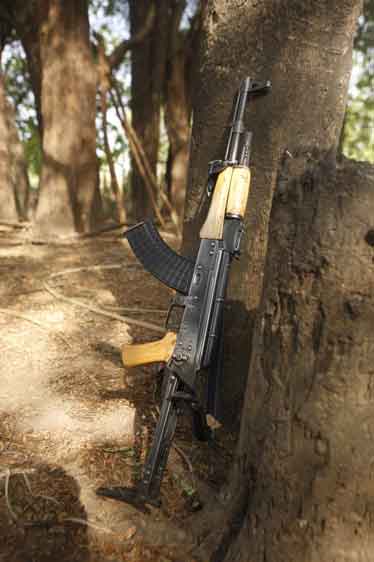
In 1988, Ravula Srinivas paid Rs 100,000 for a black-market AKS series Kalashnikov rifle with a light-wood finish and a folding metal shoulder stock. On April 6 this year, the same rifle was pressed into service in an ambush that killed 75 members of the Central Reserve Paramilitary Force and one Head Constable of the Chhattisgarh police in Chhattisgarh’s Dantewada district.
In the intervening years, Ravula has grown from a young student from Warangal into Ramana, Secretary of the South Bastar Regional Committee of the CPI (Maoist) and chief architect of the April 6 attack; unchanged by the years, the rifle has never left his side.
On April 14, The Hindu was offered access to Maoist leaders Ramana and Ganesh Ueike. in the Jagargunda forests in Dantewada. The visit offered a rare, though by no means comprehensive, insight into how the CPI (Maoist) sources, maintains and distributes weapons among its cadres.
Tactical Retreat?
The Maoist ‘postponement’ of the general strike has drawn diverse reactions. Ruling parties have projected it as a victory of democracy, constitutionalism, and law and a massive defeat for the Maoist ‘politics of blackmail’. Sections of the media and civil society that had urged the Maoists to pull back feel it is a result of popular pressure exerted by the peace rally on Friday morning. And while some Moist leaders and cadre are reported to be confused, demoralized, and angry at the leadership for letting go, others are hopeful that this will pave the way for an agreement on peace and constitution.
The responses are naturally shaped by one’s own location on the political spectrum. But what it ignores is that there is a complex set of factors that led to the Maoist decision. The non-Maoist euphoria also glosses over the fact that the strike was not the problem; it was only a symptom of the problem. And while the strike is off for now, those underlying issues remain unresolved.
The Maoists made four miscalculations. Continue reading Tactical Retreat?
In Search of Brahmeshwar Singh, ‘the Absconder’
The Myth of the ‘Misuse’ of Laws Meant for the Protection of Dalits and Tribals
Are the laws meant for the protection of Dalits and tribals are put to misuse?
It is a theme which recurs regularly in the discussions engaged in by the chattering classes of the country. While nobody can deny that frivolous cases are not filed under this act the manner in which the issue gets raised creates an impression that the only ‘use’ of this law is its ‘misuse.’ Neither the polity nor the articulate sections of our society seem ready to go for a reality check. In fact, as a marker of these classes’ ‘sensitivities’ towards this delicate issue, even Ms Mayawati in her earlier incarnations as Chief Minister of UP had cautioned the police about its ‘misuse’. She is also reported to have issued G.Os (government orders) to use this law only in cases of rapes and murders of the Dalits.
Continue reading In Search of Brahmeshwar Singh, ‘the Absconder’
The City Turns Red – Kathmandu on May Day
When Maoist Newa state in charge Hitman Sakya asked the assembled crowd at Khula Manch to silently honor martyrs, the moment turned somber. The leaders stood with their heads down on the stage, and on the ground, all one could see were thousands and thousands of fists raised up. There was pin-drop silence.
A bit later, members of the Maoist cultural wing sang and danced. The lyrics were deeply political, hitting out at the NC, UML and India, projecting the Maoists as the only people’s party, and wooing the security forces by showing uniformed personnel shaking hands with Maoists ‘to build a new Nepal’. The crowd was enthralled. Continue reading The City Turns Red – Kathmandu on May Day
Heading for a Bloodbath: Rohini Hensman
This post by ROHINI HENSMAN is an article published on the Outlookindia.com website on April 22, 2010.
To people desperately trying to avert a bloodbath in the forest belt, the recent PUDR statement on the massacre of 76 CRPF jawans in Dantewada caused considerable consternation, and Sumanta Banerjee’s response to it even more so. According to the PUDR statement,
‘As a civil rights organization we neither condemn the killing of security force combatants nor that of the Maoists combatants, or for that matter any other combatants, when it occurs’.
Sumanta Banerjee objected to the equating of Maoist violence and state violence, saying that
‘these soldiers, by being cannon-fodders of the Indian state, however tragic it might be, suffered the fate that – I’m sorry to say – they deserved…To come back to the latest incident of the Maoist attack on the CRPF camp in Chhattisgarh…. if we accept it as a part of a civil war, such killings are inevitable (just as the CRPF killings of Maoists) in a violent system that has been institutionalized by the Indian state. The difference between the CRPF violence (involving ‘false encounters’, raping of tribal women, burning their homes, etc.) on the one hand, and the Maoist violence on the other (which means attacks on oppressive landlords and the police and para-military forces like the CRPF which come to the aid of the landlords) – has to be distinguished by civil society groups’
Both the statement and the response assume that a civil war is already in progress, and therefore the killing of combatants is not illegal.
‘Boycott of Israel would not serve any useful tactical purpose’: Amitav Ghosh

The British Committee for the Universities of Palestine (BRICUP) and Pakistanis for Palestine amongst others have appealed to the novelist Amitav Ghosh to decline the Israeli Dan David Prize he is being given jointly with Margaret Atwood.
The BRICUP open letter to Ghosh reads:
It’s surprising to have to raise Israeli colonialism with a writer whose entire oeuvre seems to us an attempt to imagine how human beings survived the depredations of colonialism. Gosh, even the Dan David judges like the way you evoke ‘the violent dislocations of people and regimes during the nineteenth and twentieth centuries’.
Those making him this appeal have reminded him of his rejection of the Commonwealth Writers’ Prize in 2001.
Give below is Ghosh’s response to the appeal: Continue reading ‘Boycott of Israel would not serve any useful tactical purpose’: Amitav Ghosh
Maoists issue a statement, the media plays it down
The CPI (Maoist) has issued a statement after the killing of the CRPF men in Dantewada. You would imagine that the statement should be all over the media. If you Google you will find it here and there, and if you’ve been reading the papers I won’t blame you for missing it. It’s buried in the inside pages today, and only the Hindustan Times yesterday had put it on its front page. This is not surprising considering that after the CRPF killings the media has gone into war mode. It’s war out there, they’re saying again and again. Anchors are shouting, news-magazines are declaring war and calling the Indian state impotent and the top editors are saying it’s a turning point, ab bas bahut ho gaya, now let’s just shoot ’em dead. What, no air strikes? get real guys.
Continue reading Maoists issue a statement, the media plays it down
A search that depressed me
[Thinking about recent political developments in Lanka, here is a recent poem by Mahendran Thiruvarangan, who lectures at the University of Jaffna — AK]
A search that depressed me
Searching
in those semi-arid paddy fields,
the cleavages of the silent hills, no longer luscious,
the dried up river,
the never-ending rows on the ballot sheet.
No sickles, no hammers, the sky blackened without stars,
green, blue, yellow, white, brown — all could paint our walls
with faces of new-born patriots and traitors,
the missing red,
gone with the wasted blood,
the Left,
left forever?
Bridges bombed and broken,
the tree long lost its roots,
the violent tsunamis,
patriotisms and nationalisms,
homelands and motherlands,
the ship is out of sight,
the crew all dead and missing,
sleeping in new camps,
with strange bedfellows who praise gods and demons.
The unhappy farmer of Tissamaharama,
the manacled Tamil prisoner from the thickets of the Wanni,
the withered tea-plucking woman in Talawakkele,
the homeless fisherman on the Eastern coast,
the evicted Jaffna Muslim,
the unspoken Malays, Burghers and Telugus,
disconnected,
throttling each other in battles misfought.
Cracks everywhere,
the wall crumbles.
Getting Indian Democracy Right: Rohini Hensman
Guest post by ROHINI HENSMAN
‘Far away, in that other fake democracy called India’: so said Arundhati Roy in a passing reference to India when she began her talk at the finale of the Left Forum 2010 in New York in the middle of March. Fake democracy? Yet in the same month her long essay ‘Walking With the Comrades,’ supporting the struggle of the CPI (Maoist) in the tribal areas, was published by a mainstream, corporate-controlled Indian magazine, Outlook. How would that be possible if India were just a ‘fake’ democracy? By way of a comparison, across the border in Sri Lanka, the March issue of Himal Southasian was seized by customs on account of an article of mine, despite the fact that I have always been sharply critical of the insurgencies of the LTTE and JVP, and cannot by any stretch of the imagination be described as sympathetic to terrorism or violence. Earlier editions of Himal with articles by writers critical of both the government and the LTTE have suffered the same fate. My articles have been turned down by one newspaper after another in Sri Lanka, and I do not blame their editors and owners: so many journalists, editors and owners who have been critical of the regime in power have been jailed, killed or disappeared, even if they, too, had been critical of the LTTE. Continue reading Getting Indian Democracy Right: Rohini Hensman
‘Nice. Nice. Good shot. Thank you.’
Violence and revolution
THIS note attempts to understand the nature of the politics behind the violent actions of the Maoists. There seems to be an agreement among human rights activists that Maoist violence is a ‘forced’ response to the extreme repression of the Indian state. The argument is that since the Indian state has been consistently ignoring or violently repressing various people’s movements, the people are left with no choice but to take recourse to the gun.
There is a fallacy in this argument. We know about people’s movements on issues of land rights or displacement which have not turned into armed insurrections, even though they have suffered major losses and have been treated in a very callous manner by the state. Apart from the Narmada Bachao Andolan there are hundreds of big and small peoples’ resistance movements in Jharkhand, Chhattisgarh, Orissa, Bengal, Tamil Nadu and other states which have not given up on the ‘parliamentary’ path of struggle.
Interestingly, we find that Maoist groups are also active in these areas and they constantly try to infiltrate and take control of such movements. We do not know of any movements organized by the Maoists which were initially ‘peaceful’ but compelled to turn to arms after all attempts at working with the state failed. I would suggest that the theory of ‘peaceful’ movements mutating into ‘violent’ insurrections appears flawed. Also that instead of using ‘Maoist’ as an adjective in a careless manner we should treat them as a political formation organized on the lines articulated in its political programme and constitution which is based on its own Marxian theory of revolution which is impossible without violence. Continue reading Violence and revolution
Tata sponsored ‘Green Hunt’ in Kalinga Nagar to destroy democratic tribal movement
[We publish below a press statement released by Prafulla Samantra and others, received via Biswajit Mohanty, which highlights just how the struggle of the tribal people in Kalinganagar is being met with the most ferocious repression by the local administration acting at the behest of the Tatas. Kalinganagar is emblematic of the many democratic mass movements and struggles that are being crushed by a predatory state in cahoots with corporate capital. – AN]
Yesterday the Collector of Jajpur district assured Dabar Kalundia, a tribal leader of Bisthapan Birodhi Jan Manch (BBJM) that he would come to Baligotha village on 28 March for a meeting with the dissenting villagers and find a solution to the prevailing conflict. But within a day the Collector has broken his word as today about 24 platoons of armed policemen have been deployed in Kalinga Nagar to suppress the democratic and non-violent movement of the BBJM. It is feared that there will be bloodshed at a larger scale than 2 Jan 06 when 14 tribal men, women & children were killed in a police shootout. The villagers fear the police will attack tomorrow morning.
Continue reading Tata sponsored ‘Green Hunt’ in Kalinga Nagar to destroy democratic tribal movement
The Rumour of Maoism
This essay has been published in the current issue of Seminar (No. 607, March 2010).
In his classic Elementary Aspects of Peasant Insurgency in Colonial India, Ranajit Guha outlines a certain methodological imperative for the historian who wanted to ‘get in touch with the consciousness of [peasant] insurgency’ when access to it is barred by the discourse of counter-insurgency that structures official records. How does one look beyond this discourse of the state that frames the archives in order to gain access to the voice of the rebels? Guha’s solution was relatively simple: Counter-insurgency, he argued, derives directly from insurgency and is so determined by the latter that ‘it can hardly afford a discourse that is not fully and compulsively involved with the rebel and his activities.’1
Unlike British Marxist historian E.J. Hobsbawm who had tried to track the story of ‘social bandits’ through a somewhat problematic reading of folklore,2 Guha warned that ‘folklore relating to peasant militancy can be elitist too’, for many singers and balladeers belonged to upper-caste families who had fallen on hard times and were, therefore, often suspicious of the revolt of the lower castes or tribals. Guha underlined that though the records of the colonial state and its police officials registered the voice of those hostile to the insurgents – including landlords and usurers – they could not avoid being shaped by the will of the insurgents. His conclusion therefore was that the presence of rebel consciousness could be read in the body of evidence produced by the discourse of counter-insurgency itself.
The burden of Guha’s argument was that in order to decode the language of counter-insurgency, it was often enough to simply reverse the values in the terms used by the official discourse: thus ‘badmashes’ simply meant peasant militants and not ‘bad characters’; ‘dacoit village’ would indicate an entire village involved in the resistance and ‘contagion’ would most likely refer to the solidarity generated by the uprising.
Those were happier days from the historian’s point of view. For the peasant and tribal insurgencies that Guha was discussing were organic struggles which drew their leadership from amidst the peasants or tribal communities themselves. Whether it was Sidhu Kanoo, Birsa Munda or Titu Mir – the leadership of the movements and their ‘ideologies’ derived directly from the world of the tribals. The context of colonial India was also, in a significant sense, quite clearly polarized and the possibility of written records being produced from a multiplicity of sources was simply out of the question. It may, therefore, be possible to follow Guha’s suggestion and merely reverse the values in order to get a sense of that other discourse. Continue reading The Rumour of Maoism
School’s Out in Chhattisgarh, (But the Force is in!)
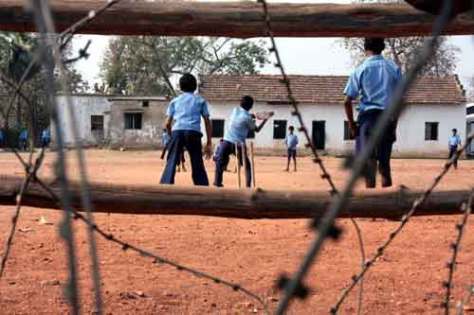
School’s out! In Kerlapal, Dantewada, battle-weary soldiers of the B Company of the 2nd Battalion of the Central Reserve Police Force peer over barbed-wire fences as skinny schoolboys in sky-blue shirts play cricket. The force has occupied the senior school and with it the basketball court and part of the playing field; but the game must go on.
As paramilitary troops pour into Chhattisgarh to fight the Maoists, the absence of military barracks has forced soldiers and children to share the only concrete structures in the countryside — the village school.
A Believer’s Obeisance: Soumitra Ghosh
SOUMITRA GHOSH is with the National Forum of Forest Peoples and Forest Workers (NFFPFW). A guest post received via Dilip Simeon
Does the Outlook article [by Arundhati Roy] tell us anything new? The Maoists have built a dream world in Dandakaranya, and the gun has heralded that dream. The Green Hunt is meant to shatter this dream, period…Apart from good anecdotes, there’s no political analysis of the movement, and the problematique of the Maoist movement was cursorily mentioned.
It seems rationality is banished. You oppose Green Hunt means that you see in the Maoists an unending series of dreamers and visionaries, and the making of a new world order. She doesn’t even bother to be historical, the history is what her contacts tell her.
What is utterly unacceptable is this woolly-headed,mushy and journalistic portrayal of a political movement. The Maoist movement was never,and won’t be a ‘adivasi’ movement,in the sense we use the term to describe a range of social movements.
 KAFILA - COLLECTIVE EXPLORATIONS SINCE 2006