Category Archives: Violence/Conflict

‘constitutional’ Realities: Priya Thangarajah

Guest post by PRIYA THANGARAJAH

The piece is unfinished, consciously so. The thought is unfinished and needs to be fleshed out and thus posting this, so that this important idea can be evolved collectively. It raises a range of questions and contributes to existing debates on constitutional law from a social change/human rights perspective. (consciously the words ‘constitution’ and ‘india’ are not capitalised. ) It contributes significantly to an understanding, not just of north east india but the realities of chattisgarh, jharkhand, bihar, kashmir to name a few. It helps us understand all the wars fought within the country – ‘constitutionally’ about which much is being said in the media and elsewhere by state and non-state actors.

The constitution, some argue, is an aspirational document. Baxi states that it is created to protect the rights of the impoverished. Created to protect the weaker sections of society and that’s how the Dworkinian trumping of rights works. Rights of the weaker parties always trumps that of the stronger. But whatever the aim of the constitution maybe, its sacrosanct. Sacred. Amendments can be made with great difficulty but the constitution per se cannot be done away with for a new one. Continue reading ‘constitutional’ Realities: Priya Thangarajah

The Day of Long Knives

Gachanpalli: Stories of the “Operation” reverberate along the path from the Andhra Pradesh border to Gachanpalli, a village deep in forests of Chhattisgarh’s Dantewada district. Villagers along the 35 kilometre stretch of broken track, bombed-out schools, and graves, still speak of the day when security forces swept through their fields and killed 12 men.

Testimonies collected from the villages of Gachanpalli, Gattapad and Palachalam in the Konta block in Dantewada claim that at least 12 of the 30 people killed during a security operation in September 2009 were innocent villagers with no links to the Maoists.  If true, the allegations point to a concerted attempt at dissimulation on the part of Chhattisgarh’s security forces.

The Plot thickens: more petitioners show up

The Gompad case gets murkier. Gachanpalli is another village mentioned in the same case I have been writing about for some time now. I visited the village this week to find a similar pattern where villagers vanish without really telling anyone where they are going and suddenly show up in the Supreme Court in New Delhi.
Given the matter is sub judice, I’ll refrain from any theorizing at this point.
a.
Gachanpalli: A frayed umbrella, a half filled bottle of cooking oil and two shopping bags stuffed with clothes constitute the unlikely tombstone that marks Kowasi Ganga’s grave.  “It’s the sum total of his worldly possessions,” says his grandson Kowasi Muye, “It’s a Muria tradition.”
Kowasi Ganga, 75, died on September 17 2009. Muye’s last memory of his grandfather is of Ganga dying dead outside their home.  He had been stabbed multiple times.

Point Forty Five

Dear Mr P. Chidambaram,

On 8 March last year, Aman Kachroo was lynched to death in a college hostel in Himachal Pradesh. It was just another case of ragging. It happened nearly eight years after the Supreme Court of India banned ragging in May 2001. In fact, since May 2001, there has been at least one ragging death every other month, as reported by the English language media. You can imagine how many cases are hushed up, blamed on academic pressure and ‘depression’, and never investigated. We are also not going into the much larger number of cases of attempted suicides, drop-outs, and not even measuring the psychological impact on freshers.

In 2001, the Supreme Court’s orders said that an educational institution that is unable to control ragging would face grant cuts or even disaffiliation by affiliating bodies such as the UGC, AICTE, Medical Council of India and a host of others. Not one of them ever found any college unable to control ragging. Their bureaucrats issued circulars and thought their signatures on the circulars were good enough. Years later, some of them told the Supreme Court that they did not have the powers to act against institutions – even though a Supreme Court order had empowered them to do so!

Such matters clearly concern your colleague Kapil Sibal, so why am I writing to you? We shall come to that, just let me tell you what happened thereafter. Continue reading Point Forty Five

Three Years of Nandigram Firing: An Appeal

Sumit Sarkar, Tanika Sarkar, Dilip Simeon, Aseem Srivastava, Amita Baviskar, Amit Sengupta, Nandini Sundar, Satya Sivaraman and others

Nandigram: Punish the guilty, Pay compensation to victims now!

On the third anniversary of the horrific police firing in Nandigram, which occurred on 14 March 2007, we strongly condemn the failure of various state institutions to do justice to the victims and survivors of this violent attack on a peaceful mass movement.

Till date not a single police official, government bureaucrat or CPI (M) politician involved in the wanton massacre of peasants resisting forcible takeover of their land has been prosecuted. At least 14 people were killed in the incident and hundreds injured. Several independent inquiries and tribunals found that more than a dozen women had been sexually assaulted or raped. It is a matter of deep shame for Indian democracy that the men who were responsible for the barbaric violence – including persons in uniform and out of it – continue to roam with impunity.

The Calcutta High Court’s direction to the CBI to inquire into the violence in Nandigram on 14 March and to prosecute those responsible has not been carried out under various pretexts. These include litigation in the Supreme Court against this order, launched by the West Bengal government. That no clear judgment has been pronounced on this important issue till now only serves to lower the credibility of our judicial institutions. In light of the aftermath of the anti-Sikh carnage of 1984, we fear that as time goes on, evidence will be lost and witnesses intimidated. After some years, lip service will be paid to judicial procedure and the criminals will go scot-free. Such a sabotage of justice has happened before in West Bengal.
Continue reading Three Years of Nandigram Firing: An Appeal

Appeal for talks with broader section of people’s struggles in the forest and mineral belt

Aditya Nigam, Dilip Simeon, Jairus Banaji, Nivedita Menon, Rohini Hensman, Satya Sivaraman, Sumit Sarkar, Tanika Sarkar

In the light of the recent demands raised by sections of the intelligentsia urging the government to heed the CPI (Maoist) “offer of talks”, we insist that “civil society” should rather, put pressure on the government to initiate talks with representatives of all struggling popular and adivasi organizations. The CPI (Maoist) cannot be treated as the sole spokesperson of all the people in the forest and mineral belt, convenient though this may be for the state and for that party. Does the government believe that violent insurgents are the only deserving interlocutors? Continue reading Appeal for talks with broader section of people’s struggles in the forest and mineral belt

The Headley Trail

I

Have you had a chance to browse through the latest media interaction of the US ambassador to India, a gentleman called Mr Timothy Roemer? (US wants Headley to be brought to justice: Roemer, February 18, 2010 17:53 IST, rediff.com ) And could anyone decipher that it was a response to the growing clamour in a section of the media about seeking access to American terror suspect Headley whose name has surfaced in the light of his links with the 26/11 plot and who is at present lodged in the US jail. There were also reports about Headley’s visit to India in March 2009 and his survey of the Osho Ashram, Chabad House as well as the German Bakery in Pune, which became a site of the bomb explosion in second week of February 2010. Continue reading The Headley Trail

“Police killed them” say the villagers

I have been following the Gompad case for the past month and a half, and have been surprised at every turn.  The issue is centred on the deaths of 12 villagers on October 1 2009 in Chhattisgarh.  The matter is currently sub judice – so I would prefer not to comment on what I think happened, but this is my most comprehensive piece on the issue till date.

a.

GOMPAD: A charred wooden stake and three graves are all that remain of the Madavi family in this remote village in Chhattisgarh’s Dantewada district.

“Madavi Kanni was lying face down in front of the burnt house,” said an eyewitness. “She had been slashed with a sword and shot in the chest.” The bodies of her father, Madavi Bajar, her mother Madavi Subbhi and her 12-year-old sister Madavi Mutti, were found under a tree, 50 metres away.

Testimonies collected by The Hindu from Gompad allege that a composite force of Adivasi special police officers and security force regulars appeared on the outskirts of the village in the early hours of October 1, 2009. “We ran away when we saw the force,” said the witness, speaking on condition of anonymity. “We found the bodies when we returned.”
Continue reading “Police killed them” say the villagers

‘Non-violent terrorism’ and India’s dirty war in Kashmir

Guest post by MOHAMAD JUNAID

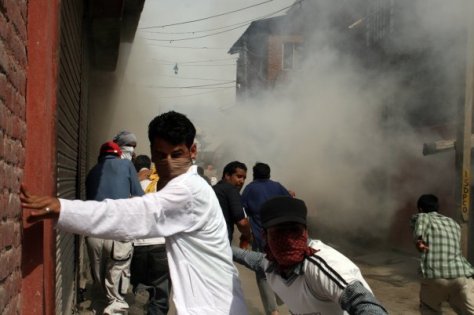
Dozens of young boys have been arrested across Kashmir under draconian laws over the last few weeks. The charges that have been filed against them range from “waging war against the state” to defiling “state honor”. In recent months Indian military and police commanders have described protests in Kashmir as “agitational terrorism” and “non-violent terrorism” in order to justify violent clampdown on protests by Kashmiris.

As the headlines go, Stone-pelting an act of war: J-K gov.

In the same period around 8 people, mostly teenagers, have been either shot to death or fatally injured by indiscriminate use of tear-gas shells. Over the last two years the number of dead in shootings is more than a hundred. Meanwhile thousands of people have been injured. Many of them will be left with permanent physical disabilities. The police authorities have banned any peaceful assembly of people. Many places in downtown Srinagar and other towns have reported police brutalities. Even the villages are not being spared. Only yesterday, mourning villagers were attacked by CRPF troopers in Redwani in South Kashmir. Dozens of them were injured by CRPF’s indiscriminate firing. Most of the injuries were inflicted above the waist showing an intention to kill Continue reading ‘Non-violent terrorism’ and India’s dirty war in Kashmir

“Twenty million out of twenty-seven million Nepalis are with the Maoists”: Interview with Prachanda

(This interview of Pushpa Kamal Dahal by me appeared in the Nepali Times a few days ago, along with another report.)

A conversation with Maoist supremo Prachanda this week not only brought out the party’s new line, but also offered a glimpse into his analysis of current politics and future strategy.

The root of the problem, according to Prachanda, is that the 12-point understanding was ‘tactical’ for everyone who signed the agreement. “The other side felt they could get us into the mainstream and weaken us. We thought we could use the process to create a new mainstream, which would include political competition.” Neither side got what they wanted, entirely. This paradox has forced the parties to make a more fundamental strategic choice. “This was inevitable and we are now heading for a crisis climax.”

The army issue is key. Neither side feels it lost the war. Prachanda concedes that no one won the war in material terms, but believes the Maoists won the war politically. “It was the then Royal Nepalese Army’s mandate and goal to protect the monarchy and block a republic,” he says. “They failed, and the PLA played a big part in bringing about this change.” The way forward for these “recognised and legitimate” outfits, he says, is “sticking to the peace accord, democratising the army and professionalising the PLA.” Continue reading “Twenty million out of twenty-seven million Nepalis are with the Maoists”: Interview with Prachanda

Undermining Political Reconciliation with Post-Election Repression

The following are my prepared remarks at the Global South Asia conference at New York University on 13 February 2010.  My prepared remarks on the Sri Lanka panel in titled, ‘Return of the Displaced and Political Reconciliation’ are below.  The remarks in the Sri Lanka panel which I chaired were to complement the presentations by Sharika Thiranagama, New School for Social Research titled, ‘Houses of the Future: Return and Reconciliation amongst Northern Muslims and Tamils’ and V. V. (Sugi) Ganeshananthan, University of Michigan, Lanka Solidarity, journalist and author of Love Marriage titled, ‘Dialogue in the Diaspora’.  The February 2010 issue of Himal Southasian magazine is a special issue on Jaffna, Sri Lanka and has a number of articles that address the post-war moment. The Sri Lanka Democracy Forum (SLDF) statement on 18 January 2010 titled, ‘SLDF Calls for National Attention on Demilitarization and a Political Solution’ details many of these issues in depth.

I want to begin with the end of the war, which inevitably leads to a shift in politics.  Post-war politics can not be same as war politics.

During the last couple years of the war, President Rajapaksa put together a war coalition comprised of a broad spectrum, from Sinhala nationalists to sections of the Old Left.  Despite the end of the war, the President and his government attempted to keep the war mentality alive, as we have seen through the continued suffering of the displaced as they were herded into internment camps with no freedom of movement.  It was indeed a lost opportunity for political reconciliation. Continue reading Undermining Political Reconciliation with Post-Election Repression

Vote! Or else…

In Lingagiri, it didn’t take long to tally the results of the recently concluded panchayat elections. On January 31 this year, a sum total of four people voted in this remote village in Chhattisgarh’s Bijapur district. The polling booth opened on time, the polling officers were present, and then the force arrived.
Pujari Rajamma, 35, was combing her hair in her courtyard. “I was getting ready to walk down to the polling office, when the uniformed men stormed in,” she said. “They checked my fingers for the voting mark.” When they didn’t find it, they beat her with sticks. The bruises are still visible on Rajamma’s back; she can barely move her swollen left arm.

Green Hunt: The Anatomy of An Operation

An operation is underway in Central India, but no one really knows what it is. Variously described as a media myth, a comprehensive hearts and minds strategy, and an all-out offensive by paramilitary forces and the state forces along the borders of Chhattisgarh, Jharkhand, Andhra Pradesh and Maharashtra, Operation Green Hunt has become a shoebox of news clippings, police reports, public demonstrations and armed encounters.

Depending on the definition, Green Hunt either began in July 2009, September 2009 or November 2009. Speaking off record, senior policemen confirmed that the intensification of “search and comb” operations in Chhattisgarh began as early as July last year. In September 2009 the press reported on the progress of “Operation Green Hunt”: a massive 3 day joint operation in which the central CoBRA force and state police battled Naxal forces in Dantewada. Continue reading Green Hunt: The Anatomy of An Operation

Uncanny parallels between Beg’s and Shah’s deaths

This is a guest post by Akhilesh Upadhyay

The gruesome murder on Sunday of media entrepreneur Jamim Shah, 47, has brought back chilling memories of June 29, 1998. On that day, Mirza Dilshad Beg, a sitting lawmaker, was gunned down outside his home in Siphal, Kathmandu. It was a dark night and the hillside neighbourhood looked darker still due to load-shedding, when we (reporters and photographers from Kantipur and The Kathmandu Post) arrived at the scene, soon after the 9.30 hit-and-run incident.

The newsroom had received a tip-off from a local who had heard what he suspected were gun-shots. It was an innocent world in many ways. Nepalis were still unfamiliar with sounds of bombs and gun-shots, the Maoist-waged “people’s war” was still in its infancy, violent deaths still shook everybody, and political assassination was unheard of. But what shocked the Nepalis most was how ugly games from powerful external forces could play out in Nepal, as it watched haplessly. The incident also gave many of us in the newsroom a first-hand lesson on forces which operate from behind the scene. Two of the theories that made the rounds then clearly pointed at the cross-border nature of the operation; the third one was that Beg’s death had to do with “family problems,” which turned out to be false. Continue reading Uncanny parallels between Beg’s and Shah’s deaths

Drop A Beat, Turn Up My Symphony

This is a guest post by John Bevan

Nearly half the 8 million population of Haiti, (the size of Wales, Belize and El Salvador— seems that was one of the standard sizes for countries at the time) lived in the Capital Port-au-Prince.  So the elimination of the Capital approximates to the loss of half the country’s entire infrastructure, limited as it was.  The loss of many of its intellectuals and elected politicians, few enough in the first place, given the brain-drain northwards, with some third of Haitians living in the US, adds to the knock the country has taken.

In 2006, the main Port-au-Prince daily proudly lead with the story- “Haiti there at World Cup Final”- referring not to their football team but Wyclef  Jean who sang a duet with Shakira before the France-Italy final in Berlin.  Wyclef boosted the image and self-image of Haitians a few years earlier when he won a Grammy for the 1996 Fugees album, The Score, and accepted it while wearing a Haitian flag, Haitians still being at the bottom of the pile of all US immigrant groups.  He rarely appears on videos without the flag somewhere about his body. Continue reading Drop A Beat, Turn Up My Symphony

The Many ‘Vices’ of Chitralekha

Chitralekha, a dalit woman from Payyanur, Kannur, has been in the news since 2005, for her open challenge to the CITU in that left bastion. An autorickshaw driver, she had protested at the CITU’s constant interference at work and the intensely male hostility against her presence in an almost exclusively male line of work. Braving ‘character-assault’ from the CITU which called her a ‘loose woman’, a ‘regular drunk’ and so on, she continued working until,in December 2005, her autorickshaw was burned down. She fought, however, and was supported by various Dalit, Feminists and Citizen’s initiatives. In June 2008, she procured a new autorickshaw with their support. This did not mean that she was now acceptable to the CITU . Now recently, she complained that the CITU had seized a chance encounter to beat her and her husband, and the police, who arrived on the scene, took them to the police station and unleashed even worse violence. Her complaints have been ignored or treated with hostility by the mainstream media in Kerala. Activists and concerned persons in and outside Kerala, however, have rallied to her support. Continue reading The Many ‘Vices’ of Chitralekha

The absurd theatre of Sri Lanka, applauded by India

Every time I go to Sri Lanka, my historical sensibility gets heightened. I still remember this huge hoarding of Mahinda Rajapaksa ‘lovingly’ holding an old woman, obviously Tamil as she was wearing a pottu. That woman could be one of the 2.5 lakh people who have lost their homes, belonging and land in the war. She could be part of the other lakhs who have lost all of this in the more than twenty-five years of war.

The day before yesterday, 26th January, was the first ‘free’ election ‘after the war’. During the months before the election, 700 incidents of violence were reported, leading to the death and injury of many. Yesterday, as the results rolled out, chaos hit the streets of Colombo. We don’t even have enough information about what happened in the rest of the country yesterday. Rumours were floating about. I shall not dwell on the rumours and provide them legitimacy, although I am tempted to, as some of them are shocking and could be true. Ethics come in the way. Continue reading The absurd theatre of Sri Lanka, applauded by India

The Suicide of Sense

Mumbai has been in the grip of a wave of student suicides this past month. According to the Mumbai Mirror, as many as 25 suicides have taken place in the city in the new year, most of which have been by students. As expected, the media has tripped over itself reporting every sordid and tragic detail of the students’ personal lives, and public anxiety in Mumbai is climbing to the level of all-round hysteria. The general consensus is that there is too much pressure on young minds from schools and parents; the Maharashtra State government has reacted by issuing directives to all eight regional education boards in the state asking principals to arrange workshops to identify depressed students and urge them to seek psychiatric help. State education minister Balasaheb Thorat has promised a stress-free curriculum in school boards, and followed this up by a new rule that allows failure in one subject for an overall pass result in the SSC. A south Mumbai hospital has recruited a former depressive who has a history of three suicide attempts to counsel others against suicide. The Thane Mental Hospital has in the meanwhile gone one step ahead and created what they call a ‘20-minute anti-suicide psycho drama skit’ to be performed on the streets and in educational institutions. According to hospital superintendent Dr. Sanjay Kumavat, the skit will focus on the trauma that family members go through when a child commits suicide, and the ‘problems created by such a situation’ (Mumbai Mirror Jan 18th 2010) – this will hopefully prevent them from taking the proverbial ‘drastic step’.

Continue reading The Suicide of Sense

Enemy Property

There have been several news reports recently about attempts by the builder Mafia to capture properties near the Jama Masjid in Shahjehanabad (popularly, known as old Delhi) to build a 100 room hotel. Reports have also suggested the involvement of a local politician, though the politician has refuted the allegations very firmly.

This piece is not about the builder mafia or the local politician, but about another issue that has cropped up during the investigation of the attempted land grab. It has been found that the ownership of one of the properties is under dispute and a case has been going on for close to two decades.

The reports say that the disputed property belongs to the “custodian of enemy properties”. Even a cursory reading of the reports would reveal the identity of the original owners of these properties. The original owners of these properties were Muslims of Delhi.

Muslims, who had lived in Shahjehanabad for generations, some for centuries like the families of my ancestors. Continue reading Enemy Property

The police detain 3 more in Gompad case

Konta: The mystery surrounding the killing of nine Adivasis in Gompad village in Dantewada district in October last year is deepening, with the Chhattisgarh police detaining three more witnesses to the incident and restricting all access to the area on the pretext of Operation Green Hunt.

Operation Green Hunt is a catch-all phrase, used by the police and media alike, for all major anti-naxal offensives since July 2009.

As previously reported by The Hindu, the Chhattisgarh police have assumed total control over the movements of Sodi Sambho – one of several witnesses in a Supreme Court petition that alleges that the 9 civilians were killed by the security forces.

On Friday, armed policemen and Special Police Officers (SPO) lined the length of the highway from Dantewada town to Konta, the block headquarters closest to Gompad, stopping vehicles and questioning commuters. Travelling with local journalists Anil Mishra of Nayi Duniya and Yashwant Yadav of Navbharat, this correspondent was repeatedly detained along the route and told that Gompad village was out of bounds as a major anti-naxal operation was underway. Non-journalists were, however, let through.

Continue reading The police detain 3 more in Gompad case

Inaugurated: The Malabar Moral Police!

The dastardly attack on the eminent writer Paul Zachariah by the DYFI in the CPM fortress of Payyanur in north Kerala on 10 January has been roundly condemned across the political spectrum in Kerala. Zacharia was heckled and abused at a literary seminar organized by a publisher for  criticizing the moral policing  practiced by the official left in Kerala. He condemned the recent DYFI-PDP joint ‘moral action’ against the Congress leader Rajmohan Unnithan and a Sewa Dal leader which, according to the the DYFI leadership, were ‘provocative’. Zacharia was accosted by a gang of men when he was about to leave Payyanur and openly threatened. He was told that such talk was not permitted in the left bastion of Payyanur; when the threat did not produce the desired reaction, they resorted to physical intimidation, and relented only after the intervention of the organizers who are CPM sympathizers, and other writers present there. The day after, prominent leaders in the CPM, including the Chief Minister and the Minister for Education, condemned the action. Continue reading Inaugurated: The Malabar Moral Police!