Reading the Violence in Assam: Here and There: Musab Iqbal

Guest post by MUSAB IQBAL
… the fact that violence was not merely transitional, a birthmark or a departure, but a much more general and continuous aspect of modern life – Gyanendra Pandey

1.

The misreading or out of place reading of any local and contextual issue and putting it in a wrong frame can be very catastrophic. The recent episode of violence in Assam and the fury it triggered across the country is a classic example of such misreading. But apart from the misreading this complete episode is certainly indicator of certain other phenomenon underlying our fragile society.

Moreover it looks that this is not only adding to verbal construction of abuse but also a very controlled confusion working at someone’s behest. The rally and violence in Mumbai, Ranchi, and Jamshedpur whose motivating factor was this violence happening in northeast and cross border against “Muslims”. The other episode, which adds to cynicism, is through popular newspapers in South India and in Assam publishing that Assamese will be subject to target and then under the cloud of rumor and suspicion these residents of the state is forced to run.

Continue reading Reading the Violence in Assam: Here and There: Musab Iqbal

Another Onam – MB Manoj on Dalits, Onam and Malayali identity

Today is the first day of Onam – and MB Manoj reminds us about other histories of Kerala and other Malayali voices than those of the dominant Nair community.

The interview is entirely in Malayalam. But here’s a short account of what Manoj says in both videos below:

Reading Onam through the eyes of Dalits, the festival loses its “natural” association with the Malayali identity. In fact, in the words of Manoj – “Onam is a black day for Dalits, a day of murder, even as it is a day of happiness for the upper castes”. The coming of Onam also marks the coming of the caste system and slavery in Kerala. Manoj talks about Dalit cultural life in Kerala and its relation to Onam. There are folk songs which criticise the upper-caste nature of Onam and its vegetarianism. Similarly, there are songs which criticise the temple entry proclamation of Kerala. There is a realisation among Dalits that Onam is a celebration of the murder of their king by the upper castes. As part of this realisation, Dalit movements, and especially the Indian Dalit Federation, have observed hunger strikes during Onam days. Manoj reminisces participating in one of these hunger strikes in Idukki town in Kerala during his college days. Manoj stresses that most Dalits, tribals and backward castes eat meat during Onam and their culture fall outside the cultural milieu of Onam. Therefore, for the lower-castes, Onam is neither a cultural nor a national festival, but a festival of the upper-castes.


Memories of Drought: Bharat Patankar

Guest post by BHARAT PATANKAR

English translation of Marathi article published in Sakal

Some years had passed since the completion of the Koyna dam which was the basis for the all-round development of Maharashtra.   Electricity had begun to be produced from the water stored in the dam.   The campaign to bring electricity to the villages had begun.  An increase in industrial development also began to be felt; however the situation of agriculture was as shown in the film, “Mother Krishna is flowing calmly”.   The situation is described in the song, “Mother Krishna is flowing calmly, unaware of happiness or sorrow on her banks/ Limitless water flows without a break; nobody diverts it for irrigating the land/ how can this Ganges become fruitful to the lazy people?”   Such was the situation.  It was not only true for the Krishna.  It was also the case for the Godavari and Tapi.  Agriculture was still dependent on wells and rainfall for irrigation.  Aside from Mulshi, Rajewadi, Bhatghar and other dams of the British period and a few dams after independence, all of Maharashtra was like this.

The 1972-3 drought was general.  Continue reading Memories of Drought: Bharat Patankar

Fair Use and Course Packs: A Comparative Perspective : Danish Sheikh

Guest post by Danish Sheikh

The first day of law school, we were handed 5 sets of non-aesthetically pleasing  spiral bound sheets of paper.  They contained a jumble of articles from eclectic sources; varied in size from a 150 pages to this-is-going-to-sprain-my-arm; and when relied on by the instructor, were absolutely indispensable.  The course packs were provided by the university at a reasonable fee, and soon became an integral part of our legal education.  True, there were occasional classes where a textbook was imposed on you by the professor, but again, it was often possible to track down a helpful senior’s tattered copy. Only if you got truly unlucky did you have to deplete your dwindling student resources to fork out money for a 500 page hardbound tome.

Continue reading Fair Use and Course Packs: A Comparative Perspective : Danish Sheikh

Oxford and Cambridge University Publishers v. Students of India

This is an op ed which was written for the Indian Express  and addresses some of the key issues in the ongoing copyright case filed against Rameshwari Photocopy services and the Delhi university. I am reposting  it here for now. It is a little truncated because of the word limit for newspapers but will post a longer version with comparisons from other countries.

Oxford and Cambridge University Publishers v. Students of India

 Accompanying a team conducting a raid against a photocopying shop outside AIIMS a few years ago a copyright lawyer had a moment of revelation akin to the apocryphal story of St Paul’s conversion  on the road to Damascus when Paul was asked by God “Why do you persecute me?”. In this case even as the photocopier was being arrested he defiantly turned to the lawyer and said “If I don’t sell these photocopies where do you think your doctors are going to come from? The lawyer in question is now a leading expert on copyright and public interest and one wonders whether a similar question posed to the lawyers representing Oxford and Cambridge University Press would evoke a similar change of heart especially if they considered their own route to becoming lawyers. The fact of the matter is that in most academic disciplines textbooks are extremely expensive and unaffordable for the average student and if one attempted to buy all the books which are prescribed for a course it would mean that only very few privileged students would afford an education in India. Continue reading Oxford and Cambridge University Publishers v. Students of India

The Hidden Injuries of Race: A Response to Lawrence Liang: Rijul Kochhar

Guest post by RIJUL KOCHHAR

Turn on the television any given day now, and you will be greeted by the news-media in unison informing you about the psychosis of fear—“north east fear/scare” is a useful shorthand—that seems to have gripped some of our fellow citizens. The numerous characterizations, all of which are variations on a theme, are not only ill-informed, they are also wholly inadequate and directionless. What does it mean to say that north-easterners are in the grip of fear, running away herd-like to their corners of the home-world? The bovine image, though useful in the sense of visualizing the sheer numbers involved, doesn’t allow us to think beyond.

This piece is an attempt in that direction. The fear is real, it is palpable on the railway platforms and at airports of major cities, and it surely has had the potency to disrupt a large number of people in the steps and motions of their daily lives. Others, including on Kafila, have written about the contentious issue of borders and migrants, of numbers and mutable identities; The Hindu has featured a series of interesting articles under the Sunday Story section, delineating the central role of information-technology and communication—technology whose role itself has radically transmuted amidst the last few months of the troubles, where we have seen the emergence of the cellphone screen as the new, unchartered frontier of radical, affective simulacra. Fingers have been raised, especially by our ever-articulate military-intelligence-scholarly community, against the customary foreign hand, and many of their accusations, might, in the days ahead, speak their own truth.

Continue reading The Hidden Injuries of Race: A Response to Lawrence Liang: Rijul Kochhar

Full text: The Indian government’s recent orders to Internet Service Providers to block websites, webpages and Twitter accounts

Joji Thomas Philip has put out these documents in The Economic Times.

18 August:

19 August: Continue reading Full text: The Indian government’s recent orders to Internet Service Providers to block websites, webpages and Twitter accounts

An Analysis of the Latest Round of Internet Censorship in India (Communalism and Rioting Edition): Pranesh Prakash

Guest post by PRANESH PRAKASH

How many items have been blocked?

There are a total of 309 specific items (those being URLs, Twitter accounts, img tags, blog posts, blogs, and a handful of websites) that have been blocked. This number is meaningless at one level, given that it doesn’t differentiate between the blocking of an entire website (with dozens or hundreds of web pages) from the blocking of a single webpage. However, given that very few websites have been blocked at the domain-level, that number is still reasonably useful. Continue reading An Analysis of the Latest Round of Internet Censorship in India (Communalism and Rioting Edition): Pranesh Prakash

How Delhi paper ‘Sahafat’ fell for fake images of violence in Burma

Yousuf Saeed wrote in Kafila on 13 August how fake images of violence against Muslim Rohingyas in Burma – images that were in fact, of, say, earthquake victims. In his post he mentioned how even some Urdu papers in India were fooled by the images,which provoked violent protests in Mumbai,and recently, Lucknow.

Now, CM Naim describes in detail how Sahafat, an Urdu newspaper published from Delhi, fell for these fake images. Naim translates large parts of two charged-up articles in Sahafat, one of which calls for the boycott of Buddhists in Delhi. One article was published on 10 August and one on 16 August. As Naim says, it’s time for the Press Council of India to take note. One excerpt: Continue reading How Delhi paper ‘Sahafat’ fell for fake images of violence in Burma

Drugs in 3(d) and What Matters in the Novartis Case at Supreme Court: Dwijen Rangnekar

Guest post by DWIJEN RANGNEKAR

Background

Glivec (called Gliveec in the US) is a drug for chronic myelogenous leukaemia (CML) – a rare and debilitating form of cancer. A Novartis drug, it has been heralded as a sign of pioneering pharmaceutical research. And, no doubt, it is a ‘life-saving’ drug; though, it also has to be taken life-long. Most narratives of the research pathways of Glivec gloss over the 40+ years of publicly funded and conducted research that isolated the cause, a BCR-ABL oncogene, and performed the initial clinical research that identified a promising candidate (STI 571 – imatinib mesylate). Novartis, the Swiss-headquartered pharma transnational, proceeded to synthesise and test STI 571, which in 1993 was patented. Further research found that a beta crystalline form of imatinib mesylate was more stable – and this was also patented (in 1997) and approved in the US in 2001. In 1998, a patent application for this beta crystalline form was filed in India – and this is in dispute here.

Section 3(d) is a provision in India’s patent law – and is unique to India; though, as explained in the article, it reflects a wider authorship of global public concern. The section was introduced in the third amendment to Patent Act, 1970 (i.e. The Patents (Amendment) Act, 2005) when India was fulfilling its final commitments to patent-related obligations at TRIPS. Written in technologically neutral language, 3(d) seeks to deny the availability of patents where a ‘new form of a known substance … does not result in the enhancement of the known efficacy of that substance’. This, along with other provisions, would hopefully make it more difficult to patent trivial and incremental modifications to a drug; thus, extending patent terms and delaying entry of generic alternatives. Continue reading Drugs in 3(d) and What Matters in the Novartis Case at Supreme Court: Dwijen Rangnekar

Notes from the warfront: Maruti workers ‘on trial’: Rakhi Sehgal

Guest post by RAKHI SEHGAL

Friday, 17 August 2012  – Gurgaon Civil court

There is a ‘list of 162’ workers that has not been disclosed but which forms the basis for the police to either arrest or let go of Maruti workers once they are picked up. The family members of these 162 are being harassed and intimidated and being visited thrice a day by local police, sometimes accompanied by Gurgaon police – at times 12-15 police show up.

After they pick up one of the workers (who is on this list of 162) he is processed as an accused under the same FIR 184 under which the union leaders and the earlier batch of 91 workers were arrested.  The FIR names 55 workers and then says ‘500/600 others’, so anyone being picked up is being processed as part of this unnamed 500/600 others.

Under intense questioning by Advocate Rajender Pathak, the SHO Manesar PS, Om Prakash Bishnoi, admitted that the ‘list of 162’ is based on a list given by management. Although Adv. Pathak requested that the judge note this point, the judge did not do so. Instead the judge merely directed that the statements of the SHO are unsatisfactory and has asked him to come back on 22 August with more satisfactory explanations. Continue reading Notes from the warfront: Maruti workers ‘on trial’: Rakhi Sehgal

India Gate vs. India

August 15 marked the 65 anniversary of India’s Independence from foreign rule and colonialism. September 21 will mark the 155 anniversary of the recapture of Delhi by the British and the end of the first valiant rebellion against foreign rule.

Between May 11, 1857 and May 21, 1857, Delhi was free of the British. The rebel soldiers had chosen Bahadur Shah Zafar as their leader and since the Red Fort was where he lived, the Lal Qila came to be seen as the centre of the First War of Independence. Delhi was seen as the heart of India and Lal Qila was the heart of Delhi and that is why once the British recaptured Delhi they wasted no time in arresting Bahadur Shah Zafar and quickly moving into the fort. Continue reading India Gate vs. India

Kashmir civil society express concern over Amarnath construction plans

The press release below has been jointly issued by a number of eminent citizens and civil society members in Kashmir. Full list of signatories at the end.

Srinagar, 18 August 2012: Civil society groups of Kashmir express their serious concern over the recent Supreme Court directions to the J&K government for undertaking civil engineering works leading to construction of roads and other infrastructure in the environmentally fragile Himalayan habitat around the Amarnath cave shrine in the valley of Kashmir. This move comes even as the committee formed by the Hon’ble court for recommending ways and means to promote safe journey of pilgrims to the cave shrine is yet to submit its report.

At a joint meeting of various civil society groups held on 16 August at Srinagar, the following resolution was adopted: Continue reading Kashmir civil society express concern over Amarnath construction plans

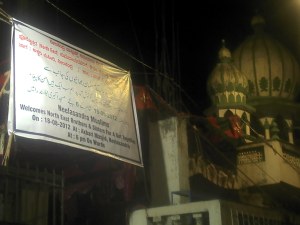
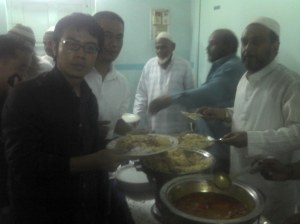
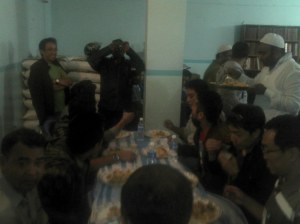
Iftar Party for Members of the North East Community hosted at Nilasandra: A Report

In the last few days the Nilasandra area in Bangalore has gained infamy across India as  it came up as the name touted over and over again as the most sensitive area in Bangalore and the one which featured in most  rumours about potential attacks against members of the north east community.

In a remarkable show of camaraderie and generosity the Muslim community called for an iftar party in the Akbari Masjid in Nilasandra and dozens of members of the north east community were invited along with members of the state administration. Over a thousand Muslims from Nilasandra, Anepalaya and Austin Town collectively vowed to safeguard the north east community living in Nilasandra.

In a touching speech one of the officials of the Akbari masjid Sadr Saab said that it was unfortunate that Nilasandra had shot to fame in this manner, and that residents of Nilasandra wanted to prove the world wrong by ensuring that there would be no violence of any kind in the days to come. A seventy year old man belonging to the Gurkha community similarly stated that he had lived for a long part of his life in Nilasandra and had never encountered anything unpleasant so far and did not expect to  in the future either.

There have also been similar exercises in trust building that have taken place in other parts of the city and lets hope that these gestures of friendship will contribute towards lessening the atmosphere of distrust and fear that currently exists.

Strangers in a Place They Call Home: Lawrence Liang

Publishing a post for Lawrence Liang who is unable to do so himself at the moment. This piece also appeared in the Hindu this morning. I flew in myself from Bangalore last night and scenes of departure, though not nearly similar to those at the train stations, were palpable at the airport as well. Let me add to Lawrence’s words below three more thoughts that are still forming in my head. The first is the weakness of the word of public institutions and officers in our cities and how little solace they seem to offer or reliability they seem to have, particularly for “minority” residents — (how that word seems to have lost all other meaning other than identifying targets). Panic is also evidence of the fragility of structures that are meant to protect difference rather than just tolerate it. As Lawrence says below, the empirics do not negate how real the fear itself is.

The second is the limits to ideas of “tolerance” in response to diversity versus a more affirmative and protective inclusion — what would it take for the space between rumour and panic to be wider, deeper and further so it is not so easy to bridge?  Here a range of global experiences on cities and their attempts to hold difference are well worth looking at — we are not the first and nor will we be the last to fight this battle which is, in a sense, as old as cities themselves. But, to take one example, would we tell a different story today if public services in Bangalore were framed in response to the diversity of the residents — where they were offered, in all the languages really spoken by residents including the hundreds and thousands of residents from the states of the Northeast? Would the word of the Law minister have more power then? Would panic hesitate? 

The third is a reminder of how Indian cities still belong to states. The supposed linguistic and ethnic organisation of our federal structure has scripted a different urban future for many of our cities — how can Lawrence’s desired anonymity and cosmopolitanism take root if Bangalore still belongs not to its residents but to the idea of Karnataka?  Onto Lawrence’s much more articulate thoughts.

Strangers in a Place They Call Home

Lawrence Liang

One of the underrated pleasures of living in a city is anonymity —guaranteed not by the fact that you look the same as everyone else but that no one really cares that you look different. And a truly cosmopolitan city is one in which everyone looks different. I have been fortunate that for the 30 or so years that I have lived in Bangalore I have not had to deal with the fact that I look different. Save for occasional reminders of my Chineseness, the city has given me enough space to be who I am — cinephile, bibliophile, foodie — without having to bother too much about questions of identity. It is therefore disconcerting to suddenly step out into public spaces self-conscious of my Mongoloid features. Paranoia is not a grand sensation and it manifests itself in the myriad minute gestures and encounters. It seems unbelievable that the experience of a city can change so rapidly because it is clear to me that the last few days in Bangalore have been precisely about that. A miasma of fear, doubt and anxiety has descended on the city. It is possible that much of this has been fuelled by rumours and hearsay; and while the rumours may be false the fear sadly isn’t.

Continue reading Strangers in a Place They Call Home: Lawrence Liang

The Myth of the Bangladeshi and Violence in Assam: Nilim Dutta

Guest post by NILIM DUTTA

Map credit: idsa.in

The recent spate of violence that began in the Kokrajhar district of Assam in the month of July 2012 and then spread to the adjoining districts of the Bodoland Territorial Council, primarily between the Bodos and the Muslim community of immigrant origin settled in these districts, has once again unleashed a vicious debate on the perils posed by alleged unrestricted illegal immigration from Bangladesh, this time even on the floor of the Lok Sabha.

The situation has been further complicated by a ‘protest’ in Mumbai against ‘violence on Muslims in Assam’ turning into a riot or by sundry attacks as ‘retaliation’ against people from North East elsewhere in India. Thanks to either shockingly uninformed or brazenly motivated opinions being aired around incessantly, much of it in the national electronic and print media, the dominant discourse that has evolved around the issue has created three distinct perceptions:

First, that illegal immigration of Bengali Muslim peasants from neighbouring Bangladesh into Assam has been continuing unabated, leading to skewed demographic profiles of Assam’s districts bordering Bangladesh and thereafter, turning several adjoining districts of Assam to Muslim majority. Continue reading The Myth of the Bangladeshi and Violence in Assam: Nilim Dutta

Celebrating Tyranny and Victimisation in Kashmir: JKCCS

This press statement comes from the JAMMU AND KASHMIR COALITION OF CIVIL SOCIETY

Srinagar, 15 August 2012: It is despicable that the police officers responsible for serious human rights violations are receiving awards despite the crimes they have perpetrated. Today’s awards to some of the Jammu and Kashmir Police officers are an act of celebrating tyranny and victimization.

Superintendent of Police, Altaf Ahmad Khan is one of the officers who has been awarded with the President’s Police Medal for Gallantry. Altaf Ahmad Khan is notoriously known for perpetrating human rights violations in the areas where he has served. Continue reading Celebrating Tyranny and Victimisation in Kashmir: JKCCS

We have lost to the judicial machine, but still we have won: Pussy Riot

On February 21 this year, Maria Alyokhina (24) Nadezhda Tolokonnikova (22) and Yekaterina Samutsevich (30) of the punk band Pussy Riot, stormed into Moscow’s Christ the Saviour Cathedral and belted out a ‘punk prayer’, asking the Virgin Mary to “Throw Putin out!” They were charged with hooliganism motivated by religious hatred.
The three have been held more than five months at Pre-Trial Detention Facility No. 6, near Pechatniki metro station in Moscow.

In her defiant and thoughtful closing statement at the trial a couple of days ago, Yekaterina Samutsevich  said:

In the closing statement, the defendant is expected to repent, express regret for their deeds or enumerate attenuating circumstances. In my case, as in the case of my colleagues in the group, this is completely unnecessary. Instead, I want to voice my thoughts about the reasons behind what has happened to us. Continue reading We have lost to the judicial machine, but still we have won: Pussy Riot

Of Nationalism and Love in South Asia

The predominant emotion with which jingoistic Indians and Pakistanis view each others’ misfortunes is schadenfreude. They count each other’s conflicts and rebellions to keep score. The Indian will talk about sectarian violence in Pakistan, and the Pakistani will ask about the treatment of Dalits in India. The Pakistani will complain against Indian atrocities in Kashmir  and the Indian will point fingers at Balochistan.

When I see such Indo-Pakistani interactions online, I am reminded of these words: Continue reading Of Nationalism and Love in South Asia

Yo, Yo Honey Singh and Other Implied Learnings: Aprajita Sarcar

Guest post by APRAJITA SARCAR

Kudiye ni tere brown rang ne, munde patt te ni saare mere town de…..Hun bach bach ke, tenu rab ne husn ditta rajj rajj ke/Main keha kaali teri Gucci, te Prada tera laal/ Kithe challo oh sohneyo, sajh dajh ke ke/ Tere wargi naar ni honi, mainu munde kehnde si /Hoge ni tere charche Star News to BBC /Ho brown brown skin wali, let me tell you one thing /Rab di saunh you so sexy! Continue reading Yo, Yo Honey Singh and Other Implied Learnings: Aprajita Sarcar

Can we save the last natural forest in the vicinity of Delhi?

The road that leads to Faridabad from Gurgaon used to be a sleepy little one before it was expanded into a four lane expressway. The local villagers for some reason call it the ‘Relaynce’ (Reliance) Road, I am not writing this piece to speculate on their reasons, but because I want to take you off this road.

Get to Andheria Mod and ask for directions to the Gurgaon-Faridabad Road. Once on this road be on the lookout for the Gwal Pahari Campus of TERI (Tata Energy Research Institute). It would appear to your left, keep driving. A little while later if another structure looms into view, this time to your right and if simultaneously your senses are assailed by the stench of garbage you should feel assured that you have successfully stuck to the right path. Whoever said that the search for the divine is fraught with great challenges was not joking.

Why the search for the divine, because that is where I am leading you. Continue reading Can we save the last natural forest in the vicinity of Delhi?

DISSENT, DEBATE, CREATE