Swami Aseemanand’s Confessions: It’s time for an apology?: JTSA

This note comes from the JAMIA TEACHERS’ SOLIDARITY ASSOCIATION

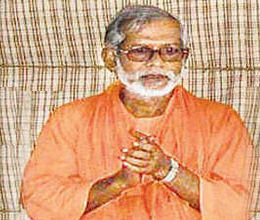
Swami Aseemanand

Swami Aseemanand’s confession before the metropolitan magistrate of Tees Hazari Court has finally put the seal of legal validity over what had been circulating for months now, since the surfacing of the audio tapes seized from Dayanand Pande’s laptop. That Hindutva groups had been plotting and executing a series of bomb blasts across the country—including Malegaon (2006 and 08), Samjhauta Express (2007), Ajmer Sharif (2007) and Mecca Masjid (2007).

For the past several years however, dozens of Muslim youth have been picked up, detained, tortured, chargesheeted for these blasts—with clearly no evidence, except for custodial confessions (which unlike Swami’s confessions have no legal value). Report after report has proved that the Maharashtra and Andhra police willfully refused to pursue the Hindutva angle preferring to engage in communal witch-hunt—or as in the case of Nanded blast—where the evidence was so glaring as to be unimpeachable—weakening the prosecution of these elements.

Continue reading Swami Aseemanand’s Confessions: It’s time for an apology?: JTSA

My Name is Pandey

Swami Aseemanand

With so much talk of Hindutva terrorism (see Kafila archive), I as a Hindu want to clarify that:

  • Not all Hindus are terrorists.
  • Not all terrorists are Hindus.
  • Not all Hindus are Hindutvawaadis.
  • All Hindutvawaadis are Hindus.
  • Not all Hindutvawaadis are terrorists
  • All Hindus who are terrorists are Hindutvawaadis. Continue reading My Name is Pandey

New Delhi – A Heritage Zone at 80!

[This article by Sohail Hashmi was earlier inadvertently posted under the name of Shivam Vij. The error is regretted.]

Connaught Place renovation for the Commonwealth Games, September 2010. Photo credit: AP

In 1988 Lutyen’s Delhi, was declared a heritage zone by prohibiting building activity within the 26 square kilometre area out of the 43 Sq. Km. area that falls within the civic control of New Delhi Municipal Committee (NDMC). A move has now been initiated to get the entire area declared a UNESCO World Heritage site.

The very logic of an area being declared a Heritage Zone should preclude any interference with the layout and design of the entire zone. Non-interference also means that, future building and development activity, if at all permitted, has to conform to the original parameters of design, materials, fittings and fixtures used, building techniques, landscaping and the kinds of trees planted in the heritage zone.

Even before the 1988 freeze on construction, there was a master plan for Delhi and it clearly identified the Lutyen’s Bungalow Zone as an area where high rises were not to be permitted. Continue reading New Delhi – A Heritage Zone at 80!

Periyar on the Constitution

As a follow up to the earlier piece, here is a translation of excerpts from Periyar’s speech on the constitution soon after it was framed.

Here there is a need for a note on how we can read these historic documents. This is not a call to burn the constitution (Figuratively maybe a little bit but not literally. That would be a waste of paper. We’d rather recycle it en masse as a symbolic gesture! ). The purpose is to break down into details, this ‘nation’ that we often use as a default construct. We know it has a history and a not so long one. We also know that it has been contested by many from its very inception. Independence day should also be observed as ‘partition into india and pakistan day’ for starters. There have always been challenges ranging from debates over secession of regional kings when independence was declared, to demands for a separate nation that always existed and continue to do so. Continue reading Periyar on the Constitution

Ayodhya for Buddhists: All India Confederation of SC/ST Organisations

Press release from the ALL INDIA CONFEDERATION OF SC/ST ORGANISATIONS

Neither Hindus nor Muslims are entitled to the disputed land at Ayodhya. SLP filed in Supreme Court claming the title for the Buddhists.

New Delhi, 7th January, 2011

Dr. Udit Raj, Chairman of Buddha Education Foundation and the All India Confederation of SC/ST Organisations, told the press that Special Leave Petition (SLP) no. DC 466/2011 has been filed in the Supreme Court against the judgment of Allahabad High Court, Lucknow Bench in the much disputed matter of Ayodhya.

Continue reading Ayodhya for Buddhists: All India Confederation of SC/ST Organisations

Who is a Dilliwala?

Chhat Puja at India Gate, Delhi. Photo credit: S. Subramanium / The Hindu

For most residents of New Delhi, the region known as Old Delhi falls within the realm of the unknown. Aside from business people and those who earn a living inside the walled city only a few from outside the walled city used to venture into, what is derisively called Dilli 6. At least this was the picture till very recently.

With the introduction of the Metro entry into and exit from the heart of the city, it has become less daunting. More and more people from outside the “walled city area” have begun to tentatively explore the narrow winding lanes of Shahjahanabad. Except for those who come to explore ‘history and heritage’ and their numbers are small, consisting mostly of fair skinned tourists, most others arrive to explore the fabled flavours of the street food of Old Delhi or Shahjahanabad to give the place its correct name.

Continue reading Who is a Dilliwala?

Anees Ahmed Ganai, 17

And that’s only one of 115, only from one year of many years.

Periyar on ‘independence’

It is hard to introduce E.V.R.Periyar. A good sign of the fact that his thoughts are broad based and radical is the way in which they can be used in different contexts. With each context, the description of the person also changes. For the purposes of this piece one may say, ‘he was a radical thinker who sought to question many aspects of the ‘nation’ that are taken for granted such as democracy, freedom, unity, integrity and so on’. This critique took many shapes and forms throughout his career based on his position in tamilnadu and the particularities of that history. In 1972, he reflects on the nation as it is today. And disheartening for us and even to him as he wrote these words, he stands by what he said the moment india got ‘independence’ in 1947. Continue reading Periyar on ‘independence’

Irom Sharmila is in love

…which in these dark times is so life-affirming:
I can spot a Khushwant Singh, a Khalil Gibran and a Chetan Bhagat in the pile of books. “Most of these books have been gifted to me by my lover,” she says. This is the first I’ve heard of a man in her life. I hesitate, but Sharmila is clearly keen to talk about him. A Britisher based in Kerala, he got to know about Sharmila after he read Burning Bright, a 2009 book on the Manipuri struggle written by Deepti Priya Mehrotra and published by Penguin. “He wrote me a letter after he read the book. We have been exchanging letters since then,” she says shyly. Continue reading Irom Sharmila is in love

Suddenly Sanyal: The Many Arrests of Narayan Sanyal

First published in The Hindu

Narayan Sanyal is a 74-year-old man with white hair parted to one side and fibromatosis in both hands. His arrest memo notes that he wears dentures, has spots on his body and smokes cigarettes. “My health is not going well, arthritis is a new thing catching up, age is telling,” he writes in a letter addressed to a ‘Dear friend V’. This letter and two others became crucial evidence in the conviction last week of Mr. Sanyal, Kolkata businessman Pijush Guha and eminent doctor and human rights activist Binayak Sen.
Behind their conviction lies a curious paradox to which the Chhattisgarh police has never given a satisfactory answer: Why was Mr. Sanyal — whose Maoist connections led to charges against the co-accused in the first place — himself never charged with sedition or conspiracy to wage war or even with belonging to or supporting an unlawful organisation until well after Dr. Sen’s arrest under those serious offences?

Continue reading Suddenly Sanyal: The Many Arrests of Narayan Sanyal

“I Am Still Alive”: Amitava Kumar

Guest post by AMITAVA KUMAR

Till a few days ago, I hadn’t heard of Aqeel Shatir. A friend sent me a link to a report in the Indian Express on December 20 about a poet who had been asked to pay for an anti-Narendra Modi remark in his anthology, Abhi Zindaa Hoon Main (I Am Still Alive). I got in touch with the reporter, in Ahmedabad, who had filed the story and soon after that spoke on the phone with Shatir.

Aqeel Shatir is his takhallus or literary alias. The name his parents gave him was Aqeel Ahmed. His ustad offered him a choice of two pen-names. One was Aazar, which means a sculptor, someone who carves beautiful forms from marble. The other was Shatir, whose literal meaning is chess-player but denotes someone who possesses cunning. Continue reading “I Am Still Alive”: Amitava Kumar

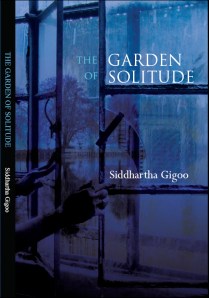
‘Snakebite or sunstroke?’: An extract from Siddhartha Gigoo’s novel, ‘The Garden of Solitude’

SIDDHARTHA GIGOO‘s The Garden of Solitude [Flipkart / Amazon] is the first novel in English by a Kashmiri, on Kashmir. As it starts arriving in bookstores, I am grateful to him for sharing an extract.

‘Life teaches us that there is beauty in ugliness,’ Sridar said.

Then Pamposh said something that Sridar was not prepared for.

‘Every day I lead the life of a centipede. I crawl. I lick. I hide. I sting. I wake up to the fumes of kerosene in the morning and the sting of speeding ants, feeding ravenously on the sugar spilled on the floor of the tent. It feels as if I have never had a morsel of rice for ages. I wake up hungry and go to bed hungry. I lead the life of a centipede, I crawl. All around the camp, there is stench of human excrement and waste. People wake up in the morning, hungry and muddled.

Continue reading ‘Snakebite or sunstroke?’: An extract from Siddhartha Gigoo’s novel, ‘The Garden of Solitude’

The Dead Need No Reification: Vasanth Kannabiran

Guest post by VASANTH KANNABIRAN

Kannabiran died on 30 December 2010. As per his wishes and ours, and based on previous discussions we declared that the last rites would be simple, speedy and secular. The secular part we ensured. There were no flowers, no lamps, no mantras, no ceremonies. But the clamour for progressive “traditions” was what I found troubling in the extreme. In doing away with religious orthodoxy, all we have done is replaced it with other orthodoxies. Continue reading The Dead Need No Reification: Vasanth Kannabiran

Trysts at Midnight: Calcutta, Now: Prasanta Chakravarty

This is a guest post by PRASANTA CHAKRAVARTY

[The Bangla film Sthaniya Sambaad (Spring in the Colony, 2009) was recently released. The film, by way of mapping the diurnal workings of a refugee colony in contemporary Calcutta, asks important questions about the changing cityscape, of the new, emerging world of land grabbers and fly-by-night investors and of the bemused young and old who are outside of this world and yet are sucked within its machinations. This is a conversation about education, humanities and the nature of artistry in the age of modularization—between MOINAK BISWAS, one of the directors of the film (with Arjun Gourisaria) & Reader, Film Studies, Jadavpur University, Calcutta and PRASANTA CHAKRAVARTY, Associate Professor of English, University of Delhi.]

Prasanta: Your film got a commercial release finally, which is wonderful. Among the initial reactions, in reviews, internet discussions and so forth, one notices a lot of interest in the polyvalent nature of your craft. I would like to take one particular strand of the film and probe a little: that is, its quite sharp critique of the phenomenon of vocationalization of education. This is a constant and niggling thread, right? Now, one fundamental argument for modular training, especially in humanities and social sciences, at this point, is a democratic one: that it will provide competence to a large number of the unemployed, ensure jobs and help in national growth. Continue reading Trysts at Midnight: Calcutta, Now: Prasanta Chakravarty

A curtain call for the world’s largest democracy: Neerja Dasani

Guest post by NEERJA DASANI

Please ladies and gentlemen…

A round of applause for this worthy verdict!

Please understand now:

Silence is molten. Continue reading A curtain call for the world’s largest democracy: Neerja Dasani

Full text: The Binayak Sen Judgement (English Translation)

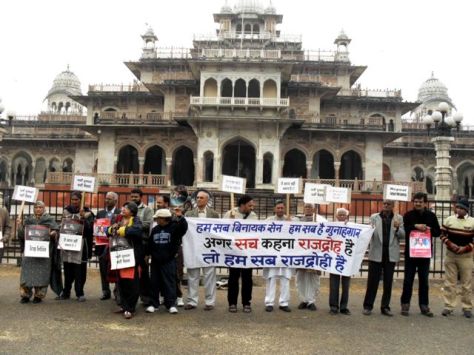
Protest in Jaipur

(Given below is the full text of the judgement sentencing Dr Binayak Sen for life. It is a translation from the Hindi. The translation has been done by the Free Binayak Sen Now campaign. You can download here (.pdf) the Hindi original. For updates on the Free Binayak Sen Now campaign, see BinayakSen.net. If you are on Facebook, you can join the Binayak Sen Solidarity Forum.)

Continue reading Full text: The Binayak Sen Judgement (English Translation)

KG Kannabiran (1929-2010)

Guest post by ANANT MARINGANTI

I was on my way to the Basheerbagh Press Club at 5.45 pm Thursday, December 30 when my mobile rang.

“Have you heard the news ?” I knew what that ominous question meant. But who was it?

The friend who called was one of the listed speakers at the Free Binayak Sen meeting at the Press Club where I was going. It had to be someone both of us knew intimately. “Kannabiran. I am on my way. I can pick you up,” he said quickly. Continue reading KG Kannabiran (1929-2010)

The Logical Urges of Sedition

[An edited version of this article by me has appeared in the November-December 2010 issue of Conveyor, a magazine published from Srinagar.]

On 22 October 2010, there was a public seminar in Delhi, titled “Azadi: The Only Way”. I did not plan to attend it as I had important work that day. However, a day before the event, it was announced that the keynote speaker would be none other than Syed Ali Shah Geelani. How could one not go to hear what the man of the moment had to say?

I reached late, when two speakers had already spoken, Kashmiri Pandits had already created a scene, even getting into a physical fight with some Kashmiri Muslims. As I entered the precincts of the Little Theatre Group auditorium, I met Delhi University student Suvaid Yaseen who showed me a small cut in his hand, caused by the fisticuffs with the Pandits. Some of the Pandits had been taken away by the Delhi Police and detained for a few hours, many others still inside the auditorium. The auditorium was full of cries of “Hum kya chahtay? Azadi!” To hear that in central Delhi rather than Srinagar’s Lal Chowk is a little incredible. But it had happened before, on 7 August, at Jantar Mantar, the only place in the capital of the world’s largest democracy where protest is allowed. At Jantar Mantar too, Pandits were being restrained by the Delhi Police. Continue reading The Logical Urges of Sedition

History in Stone and Metal

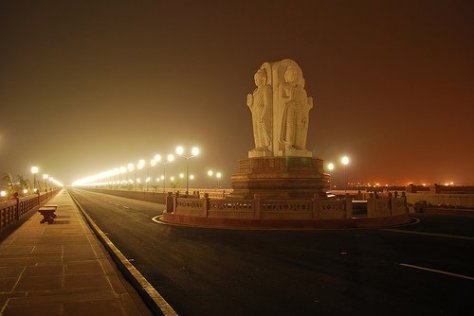
Photo by Bhanu Pratap Singh / Round Table India

A prominent Dalit academic once told me that when a Dalit entered the seminar room, the rest of them should feel uncomfortable. Given the monumental oppression Dalits face, this should be the least consequence of Dalits getting a voice.

I am reminded of this when I think of Mayawati’s gigantic Dalit memorials that have changed Lucknow’s landscape.

Continue reading History in Stone and Metal

The Merchant of Murshidabad

At 10.45 a.m. on May 1, 2007 Pijush Guha checked into the Mahindra Hotel here and vanished. The hotel register indicates that he checked out at 8.45 p.m. the same day but no one knows where he went, who he met or what he did till 4.10 p.m. on May 6, 2007, when Anil Kumar Singh claimed he saw town inspector B.S. Jagrit detain Mr. Guha near the Raipur railway station.

According to Mr. Singh’s court testimony, the police searched Mr. Guha’s black and blue shoulder bag and found pamphlets supporting the banned Communist Party of India (Maoist), a mobile phone, a rail ticket dated May 6, 2007, Rs. 49,0000 in cash and three letters which, Mr. Guha said, were written by the jailed Narayan Sanyal, an alleged Maoist, and handed over to him by physician and human rights activist, Binayak Sen. Mr. Jagrit claimed he made the arrest on the basis of information received on his wireless set but did not know where Mr. Guha had been during the five days prior to his arrest. Continue reading The Merchant of Murshidabad

Hallowed precincts: The Viceregal Lodge of Shimla

This slideshow requires JavaScript.

Text and photographs by Sohail Hashmi
First published in
Terrascape

Those driving to Shimla through National Highway 22, reach a bypass known as Tuti Kandi, it is here that one has to decide if one wants to continue uphill to the former summer capital of colonial India or to avoid the busy, traffic jammed Shimla and carry on ahead to Kufri and beyond.

Continue reading Hallowed precincts: The Viceregal Lodge of Shimla

DISSENT, DEBATE, CREATE