As we celebrate 61 years of India becoming a Socialist Democratic Republic we are shocked to witness that the spirit of our Constitution stands violated every so often today, sacrificing people’s democratic rights and throttling the socialist dream of our Constitution makers.
Writing on the history of insanity in the age of reason in seventeenth century Europe, French philosopher Michel Foucault notes: “People know what they do; frequently they know why they do what they do; but what they don’t know is what what they do does.” Foucault’s insight into the workings of power is an incitement for us to think boldly in public, sadly an endangered species in today’s India.
The recent judgment on the Guha-Sen-Sanyal case prompts one to wonder: Could state functionaries know what what they do does? Could ruling elites who watch silently or goad and guide the guardians of law and order to perform at their bidding know what what they do does? Could the state’s branding of Binayak and thousands of others as Naxalites, Maoists, terrorists or seditionists (terms that it conflates but without scholarly or legal basis) allow civil-liberties activists to create a brand Binayak? Continue reading Branding Binayak: Balmurli Natrajan→
On this Republic Day, while armoured tanks muscle across Rajpath in New Delhi, little ossified museums of culture called tableaux charm the assembled pass-holding citizenry and the Prime Minister sits like a barely-sentient caricature of himself behind a bullet-proof screen, it may do well to think about the other republic that remains hidden within the bosom of Superpower India – the republic of unfree labour.
This is a world where the laws of the upside world are inverted – where the more you work, the less you are paid, the more your company profits, the poorer you end up and if you find yourself the victim of an injustice and god forbid complain about it, the police put your family in jail. It’s a great irony of our times that we believe the choice before us is between loving the Nation and loving the Corporation, not realising that most of the time its the same person wearing two grotesque masks. All those who believe that the world begins with their newspapers and television sets and ends at their white picket fences (and all those who don’t), please take a minute to go through the excellent documentation of the war that is raging for workers in this country, put together by the Gurgaon Workers’ Solidarity Group, the Faridabad Mazdoor Sangathan and several other exemplary organisations.
FINAL UPDATE:Over a hundred names (113) that were received by 9 am on 27th morning have now been added. Apart from the press, the statement will be sent also to the Union Home Minister, Chief Minister of Maharashtra and Chairpersons NHRC and NCW. Final list of names now posted here.
UPDATE: Close to a hundred endorsements from all over the country have been received from academics, social activists, lawyers, film-makers, theatre persons, students, journalists and office bearers of PUCL and IAWS . This will now be sent to the press, and may be circulated widely. All names received by 3 pm are now listed at the end of the statement.
Below is a statement being circulated by some of us for endorsement. Please endorse by 3 pm tomorrow (26th January)
History repeats itself, and we learn so little from it. Or rather, we learn too much from it. I am excerpting below about half the text of a report dated 27 January 1992, written byEDWARD A. GARGANin The New York Times, describing in detail Murli Manohar Joshi’s hoisting of the Indian flag in Srinagar’s Lal Chowk. Wish I had a picture!
He [Murli Manohar Joshi] had begun his trek, which he named Pilgrimage for Unity, 44 days before at India’s southernmost point. But the inability of the security forces to protect even their highest officials made it clear that there was no way, despite the presence of several hundred thousand troops in the Vale of Kashmir, to protect a convoy of cars and buses filled with zealous Hindus. So Mr. Joshi and a small contingent of his closest supporters were flown here on Saturday night. Continue reading ‘As followers pushed to get close, the pole broke in several places and the flag tumbled down onto Mr. Joshi’→
“Excuse me, Mr. Farooqui, I just need a sound byte from you,” said a young reporter from the fairly young news channel News X. He was talking to my friend Mahmood Farooqui, author of Besieged: Voices From Delhi 1857, co-director of the Oscar nominated film Peepli Live and founder-revivalist of Dastangoi – the rich, medieval art of storytelling. Seeing that the setting was the beautiful and quaint Diggi Palace in Jaipur with a substantial gathering of the world’s literati for the Jaipur Literary Festival, Mahmood was preparing to hold forth on storytelling, culture, 1857…when this completely unexpected gem poured forth from the fearless reporter’s lips.
Guest post by MADHUMITA DUTTA and VENKATACHANDRIKA RADHAKRISHNAN The writers are activists based in Chennai working on issues of land, labour, industry and SEZs.
Sriperumbudur grabbed media attention in 1991 when former Prime Minister Mr Rajiv Gandhi was assassinated during an election rally. Since then, this nondescript little village-town in west Chennai, dotted with paddy fields and large expanses of natural water-bodies, has transformed itself into a little ‘Shenzen’- world’s largest special economic zone in Southern China, which churns out one out of every eight mobile handsets sold anywhere in the world. Slated to attract investments worth $4 billion in electronics and automobile manufacturing, Sriperumbudur is now home to the largest mobile handset making factory of Nokia, a Finnish company that can churn out 7.5 lakhs handsets a day. This town and its neighbouring region is also known as the Detroit of India, churning around 12,80,000 cars every year. With a booming manufacturing industry and a promise of 2 lakhs jobs, Sriperumbudur is touted as the jewel in the industrial crown of Tamil Nadu. But of recent this seemingly success story has turned a little sour. Continue reading The New Cellu-lar Jail: Madhumita Dutta & Venkatachandrika Radhakrishnan→
Guest post by MADHUMITADUTTAand VENKATACHANDRIKA RADHAKRISHNAN The writers are activists based in Chennai working on issues of land, labour, industry and SEZs.
A view of Nokia's Sriperumbudur plant. Photo credit: Economic Times
S Ambika, a 22 year old woman factory-worker, died in the middle of the night in a posh hospital in Chennai on 31st Oct. She was a permanent employee of Nokia Telecom Special Economic Zone (SEZ) in Sriperumbadur in Kancheepuram district of Tamil Nadu. Her agonising death was due to a fatal accident at a panel loading machine in the factory.
Like the unseasonal and tenebrous rain clouds that are hovering over Thiruvananthapuram in what should be a sunny, light-mist-adorned January, a pall of gloom, of impending danger, hangs around my everyday life in Kerala. This is not a general feeling. It is however shared by many of us who write and speak critically about the powers that be. The space to speak and write thus has been shrinking for a while now, but now there is a sense of dangerously teetering on the edge: the Indian state seems to be upon us, and with a vengeance. Continue reading Un-Indianizing Kerala: How to defend K K Shahina→
“There are no less than 24 groups as of now supporting Qadri on FB and 1 against what he did, that says it all.”
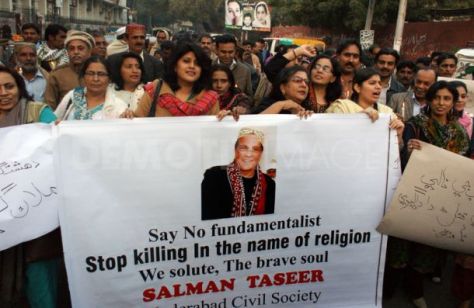
So went a tweet from a fellow Pakistani early morning on Jan 5, the day after the assassination of Salmaan Taseer, the governor of Punjab who took a courageous stand against religious extremists in Pakistan.
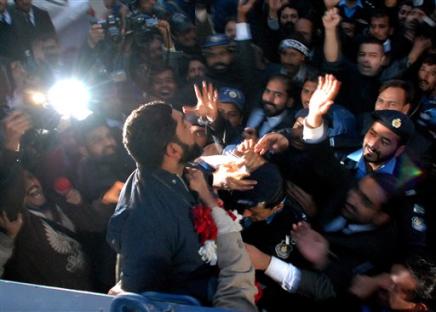
Images aired earlier this month where lawyers and other citizens in Pakistan were seen garlanding and felicitating the murderer of Punjab Governor Salmaan Taseer might have made those involved look tasteless and crude, but their acts were far from shocking. All his faults aside, Taseer had stood up for a Christian woman who had been accused of blasphemy and sentenced to death by a district and sessions (lower) court. He was killed because he had referred to the blasphemy statutes as ‘black laws’ which are abused at will, and had called for reform. As such, Taseer was killed because he had stood up, albeit in a roundabout way, for secularism and basic humanity. Continue reading The dirty ‘S’ word in Pakistan: Urooj Zia→
Given below is a note written by a Kashmiri student from downtown Srinagar who calls himself ‘Kale Kharab’, meaning ‘hot headed’. Taken from his blog, the note reads like a personal manifesto, a statement of purpose, a testimony more telling than what the most patient interviewer can elicit. This note gives you more insight into what is happening in Kashmir than a lot of what you may have read or seen on TV news about the killing of 115 protestors across Kashmir in 2010 by Indian forces. This testimony, written early on during the uprising, on 30 August 2010, shows how irredeemably India has lost the plot in Kashmir all over again, with a new generation of Kashmiris.
How and why I became a stonepelter
byKALE KHARAB
I am from downtown srinagar born in 1991. I was admitted to one of the best school of valley. As a child I had dream to became engineer. Whenever somebody used to ask me about my aim I would proudly say engineer. As I started to grow up I started to became familar with many words which everyone used to talk about that among them few were “azadi” (freedom), “hartal” (shutdown) but I was unable to understand the meaning of these words. I loved the word hartal as it was holiday, so I always wished for hartal. As I grew up I came to know about mujahids. I used to listen stories of mujahids. I would oftenly ask my elders to tell me about mujahids. They told me stories of many mujahids like Issac, Ishfaq, Jan Malik which I liked to share with my friends. Continue reading “These are not stones these are my feelings”→
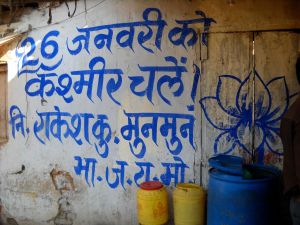
The graffiti reads: '26 Janwari ko Kashmir chalein. Nivedak: Rakesh Kumar Munmun, BJYM'. Trans: 'Let's go to Kashmir on 26 January. Appeal by Raksh Kumar Munmun, BJYM.''
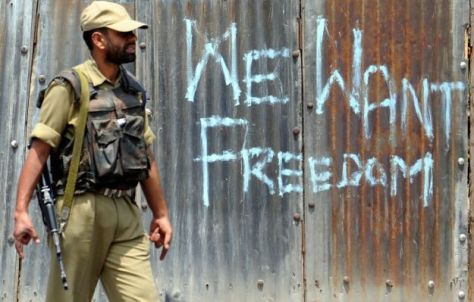
A policeman walks by a street in Kashmir, summer of 2010. Graffiti demanding azadi was all over the Valley this summer.
In Hazaribagh, one of the oldest cities of the newly formed state of Jharkhand, one is more likely to come across the word Kashmir than the name of the city itself these days. Kashmir, a place that most of the residents of Hazaribagh would have only heard of. At almost every nook and corner, teashop, wall of the city one would find an invitation to the ‘raashtriya ekta yatra’ from Kolkata to Kashmir to hoist the revered Indian flag at Lal Chowk. And this public invitation comes from none other than the youth wing of BJP, namely the Bhartiya Janata Yuva Morcha. Continue reading ‘Kashmir ho ya Guwahati, Apna desh, apni maati’: Mahtab Alam→
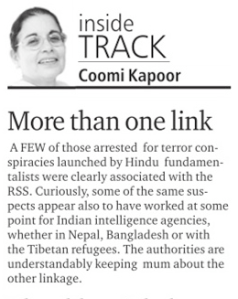
Veteran journalist Coomi Kapoor wrote this small snippet in the Indian Express yesterday. Hope it is only the beginning of more information on what this country’s intelligence agencies have been up to in the name of its citizens.
Why does No One Killed Jessica open with the execution of Jessica Lal but rush so quickly to the windswept altitudes of Kargil? And why, when she first blasts on to the screen as embedded journalist Meera reporting on the war, does Rani Mukerji look more like she’s embedded inside an SNL skit on Barkha Dutt? I let out a little laugh then, but the laughs only got bigger from there. Here is a film that knows nothing about how the media works; worse, it fails to pass off its version of the media as believable. Here are a few lessons I learned watching the film:
1. Aspiring reporters will be glad to note that though journalists generally fight tooth-and-nail at press conferences to get their questions heard, a helpful “Yaar, please, mujhe poochne do!” will elicit total co-operation and rapt attention.
'Bengal's mothers and daughters are all freedom fighters'
Guest post byJYOTI RAHMAN
Bangladesh will mark its 40th year of independence in 2011. The celebrations have already begun, and will continue until next December. The TV channels are already playing patriotic tunes. One such tune is Shona shona shona. The song says the land, mati, of Bangladesh is better than gold, and under this land sleeps many heroes: Rafiq, Shafiq, Barkat, Titu Mir and Isa Khan.
Who are these heroes? Rafiq, Shafiq and Barkat were killed by the Pakistani authorities during the language uprising of 1952 — a milestone moment in Bangladesh’s nationalism. Titu Mir defied the East India Company and organised a peasant revolt in the 19th century. Isa Khan was a Bengali chieftain who resisted the Mughals in the 16th century.
Notice how all of these heroes are Bengali Muslim men?
2011 marks the birth anniversary of one of Southasia’s greatest poets, Faiz Ahmed Faiz. Centenary celebrations are planned in Pakistan, India and Bangladesh throughout this year. The Southasian magazine Himal has brought out in its January 2011 issue a set of six articles on Faiz. A note accompanying the issue reads:
Over the course of human history, intellectuals and artists have helped broaden the scope of citizenship and the nebulous contours of citizen rights. Southasia is no exception. Despite its colonial past and internal fault-lines, it can boast of extraordinary individuals who have stood up against tyranny and reaffirmed the innate strength of the human spirit. Continue reading Celebrating Faiz→
Ilina Sen, wife of the human rights’ activist and people’s doctor, Binayak Sen, reacting over the judgment, which gave life imprisonment to Dr. Sen said, “My faith in the judiciary has been shattered”. “I am in a state of complete shock…in our stupidity we believed the judicial process would be fair,” she told media persons at a press conference in Delhi. Continue reading Look who has faith in the judiciary!: Mahtab Alam→




 2011 marks the birth anniversary of one of Southasia’s greatest poets, Faiz Ahmed Faiz. Centenary celebrations are planned in Pakistan, India and Bangladesh throughout this year. The Southasian magazine Himal has brought out in its January 2011 issue a set of
