
Internet is a young albeit furiously expanding medium and given the notoriously qualmish and unenterprising relationship Hindi as a language has had with technology in general and mass media in particular, it is not surprising that it is mainly the youth in their twenties and thirties who have taken to the still younger practice of blogging in a big way. Although the Hindi blogsphere running into something like 500 today is reminiscent of the early formative years of the language itself – chronologically coinciding with the differential construction of public power of languages, which in turn was in part determined by how forthcoming they were in executing the switchover from the oral or written mode to the print – the similarity between the two eras and two technologies ends pretty much here. Continue reading The ‘virtual’ confronts the ‘real’
Welcome to Ore-issa

As the shadows lengthen along Keonjhar’s main street, the tube-lit sign above Hotel Arjun flickers to life, illuminating both – the front entrance of the hotel and the cigarette seller adjacent to it. A solitary traffic policeman walks up to the junction right outside the hotel, and assumes his position on at the most significant crossing in town.
Fifteen kilometers down the road the ground shivers as a queue, over a kilometer long, shudders to life. Engine after engine revs up as a convoy, several hundred trucks strong, begins the next stage of the 325 kilometer journey from the iron rich district of Keonjhar in North Orissa to the port of Paradip on the coast. Continue reading Welcome to Ore-issa
J’accuse : A Children’s Doctor and A Mighty State
It has been more than ten days that Dr Binayak Sen, a paediatrician by training and profession and a human rights activist by choice has received a new identity. – A menace to public safety – The Chattisgarh police whose own record of human rights violations would shame even the KPS Gills, has used the provisions of the draconian Public Safety Act and Unlawful Activities Prevention Act ( a substitute for POTA ) to detain Dr Binayak Sen in the wee hours of 14 th May.
Question naturally arises how does a graduate from the prestigious Christian Medical College, Vellore who has been associated with several community health programmes for the last three decades, who even contributed to the state government’s conceptualisation of community health programme ‘Mitanin’ and who played a significant role in the evolution of ‘Shaheed Hospital’ – a hospital started by workers for the workers under the leadership of legendary Shankar Guha Niyogi, has suddenly metamorphosed into a menace to public safety ?
Continue reading J’accuse : A Children’s Doctor and A Mighty State
Queer Images
Sunil Gupta is a renowned photographer whose work over the last three decades has spanned images of the body, migration, exile, HIV and sexuality. He also has a lot to say about the need for an art history centred on sexuality. See his work on www.sunilgupta.net. Also, see his jointly curated exhibit, autoportraits, as part of The Nigah QueerFest ’07. Details at www.thequeerfest.com.
Sunil’s work will come out in a book by Yoda Press in 2008. I had a chance to speak to Sunil recently for an interview that was published in Time Out Delhi. Excerpts:
G: Today, Sunil, you are known as a photographer who has a significant body of work on sexuality, and especially on gay and lesbian lives. How did sexuality first enter your work?
S: I moved to Canada from Delhi when I was 15. I arrived in September, 1969, literally a month after the Stonewall uprising in New York, so you could feel the effects of gay liberation everywhere. I went to a very liberal junior college. Everyone came out then. So being gay was very cool, unlike being Indian which was not cool at all. There were no Indians around me at the time. I started shooting gay news items for a fledgling campus newsletter. Those were my first photographs on sexuality. We were trying to find positive images in those early days. It was about taking happy picture of people happily being gay to counter all the negative imagery around us. Continue reading Queer Images
Why Hindol Sengupta needn’t fear Mayawati
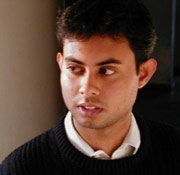
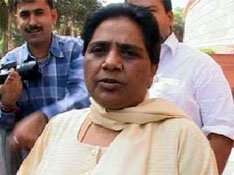
Baba Hindol and Behen Maya
Please read this very important post on the CNN IBN website’s otherwise dull blog section. It has been written by Hindol Sengupta who covers fashion and suchlike for them. His point is that he can’t relate to Mayawati, and finds it ironic that the “backbone of the knowledge, entreneurial [sic] economy” should be a “non-vote bank”. He says that his class of people, his ‘type’ – People Like Us, to use a cliche – “rejoice every time Manmohan Singh takes stage” but alas, even he couldn’t win a Lok Sabha election from South Delhi.
The reason why I think it is an important post is that unlike most other PLUs, Sengupta makes no claim to ‘objectivity’. When Youth for Equality / United Students / other ‘anti-reservationists’ oppose reservations, and speak about Dalits/OBCs, they claim to be doing so with a claim to ‘objectivity’, that is, they do not admit that the viewpoint(s) they are putting forward are of a certain section of society that is influential in shaping public opinion despite being in a minority.
Sengupta admits not only his discomfiture with a democratically elected Mayawati but also that his discomfiture stems from his background, from who he is. He describes himself and his ilk as “middle-class, educated, metro-bred, Christian-education raised, young.” That would abbreviate into MEMCRY, but let’s just use the word ‘yuppie’.
It is quite extraordinary and laudatory for a yuppie to admit his distance from the political rise of the ‘low-class, neo-literate, village-bred, government school-raised, middle aged’. Such an admission is a rarity, and it is exactly what the ‘anti-anti-reservationists’ want the ‘anti-reservationists’ to admit. Continue reading Why Hindol Sengupta needn’t fear Mayawati
Art, Creativity and the Flow of Life – Radha R
[Radha R is an alumnus 1990 B.(Fine) Painting, Faculty of Fine Arts , MSU, Baroda. In the piece below, she reflects on important issues of art and life in the wake of the recent happenings in Baroda. AN]
When I last left the Faculty of Fine Arts in Baroda where I was a painting student between 1985 and 1990 my heart was already heavy with the image of the saffron neo -Hindutva flag fluttering over what was to be my last Navrathri Garbha in a long time to come…
Post Godhra , I once stayed awake in a train that passed by Baroda station at 2a.m just to see how it felt to see once more the platforms upon which I had spent many a day sketching …There was a gloom to the light, an eeriness in the pools of shadows that were insomniac people squatting there perhaps holding in zones of impenetrably dark memories …Beneath the clock, those huddled up and sleeping resembled the dead…
In the same trip just a couple of months since the killings I walked restlessly through the crowds in the Old City around the Ahmedabad railway station … The roads were crowded …the markets were crowded…people of communities that were the murdering and the murdered thronged the centres where goods were exchanged with a briskness that bewildered the imagination …
In the midst of all this, where was history?
…Tucked out of sight under which fold of skin?
Where were the wounds that hemorrhaged their ways into our hearts?
Who was the expert plastic surgeon? Who wielded the Airbrush of erasure to such frightening perfection?
The skin before the TV was after all always correctly fair, almost, blemishless and perfect …save for a small blue vein that dammed up and spilt over the edges within which it was sought to be held and that stubbornly showed itself up from within the layers of the skin… History now calls it the Narmada Bachao Andolan…
… I have never ever felt like going back to a landscape where the scars of personal trauma now mingled inextricably with the suppurating welts of collective suffering…
FOR THE STUDENTS OF FACULTY OF FINE ARTS AND THEIR ACTING DEAN-
Continue reading Art, Creativity and the Flow of Life – Radha R
A Modest Proposal to End All Controversies on Freedom of Expression in India
(apologies for cross posting on Commons Law and Reader List)
As we know well by now from the freedom loving sentiments (that are expressed loudly and frequently) by all sections of the guardians of social order in India, (that is Bharat, that is Hindustan), the real reason why certain insignificant documentary independent and student films, contemporary art exhibitions in university campuses and performances are banned, and their heinous perpetrators arrested has to do with the general populations right to sleep undisturbed each night and not to see anything other than cricket matches, news about cricket matches, election analyses, kaun banega crorepati, Abhishek Bacchan’s wedding, and yoga on TV.
Why should anyone in their right mind want to see, read, listen to or even think about anything else?
Consider the folly that some students in Kottayam have recently contemplated, making a film on of all things ‘Homosexuality’ .
Both of these moves have been met with swift and timely responses. The offending students in Kerala have been expelled by the Christian educational institutition where they were enrolled, and the offending art student in Vadodara, one Chandramohanm has been arrested by the local police at the urging of Hindutva minded citizens.
There are only two things we need to learn from incidents of this nature. The first is as follows –
Actually, all that people need to do is to insist that only the self appointed guardians of public morality (of all stripes and shades) have the right to appear in any broadcast, exhibition, film or other forms of mediated communication. We need every channel to broadcast morally cleansed reality TV all the time. How else will this nation boldly venture where none other has gone before – into that heaven of bliss and freedom known as ennui for the billions.
Continue reading A Modest Proposal to End All Controversies on Freedom of Expression in India
Vanzara’s Parable
Economy of language, as we know, is vital in an era marked by the proliferation of too many words. So my plea is that we stop using the phrase ‘fake encounter’ because encounter will suffice. Fake encounters somehow seems to posit a difference between a real encounter (that’s the one in which the police go on an investigation and the assailants open fire and the police gun them down in self defense) and a fake one (that’s the one in which the police go on an investigation and the assailants open fire and the police gun them down in self defense). A difference, which has clearly escaped my comprehension. In India we have got used to accommodating words that don’t really serve a purpose, or where their meaning has been displaced, and they serve almost as empty pronouns. The names of shops like Zevar Jewelry, Chitra Pictures serve as good examples. Fake encounter is a good addition to the list. Continue reading Vanzara’s Parable
In support of MF Husain
MF Husian’s troubles seem to be increasing by the day. The latest one is over Bharat Mata. In protest against those protesting and acting against MF Husian, I have decided to put up an image of the ‘offending’ Bharat Mata painting. I urge all bloggers to do the same if you want freedom of speech preserved in India. (From here.)

Also see this statement.
The Impossibility of Satire
The first impulse that one has after coming out of a court hearing is to create a satire that accurately captures the slightly bizarre and terrifying vision of judges that one has had a chance to experience. But can caricature really live up to its responsibility of laughing truth to power? John Beger has said that “Graphic caricature is dead because life has outstripped it. Or more accurately, because satire is only possible when a moral reserve still exists, and those reserves have been used up. We are too used to being appalled by ourselves to be able to react to the idea of caricature”. So instead of imposing an impossible goal for satire, let us allow the court speak for themselves. Continue reading The Impossibility of Satire
Gujarat Fake Encounters: The Spin Doctoring has Begun
The Gujarat Fake Encounter Story is rapidly being scripted along the familiar lines of the ‘Corrupt Policeman-Corrupt Politician-Underworld Links’ nexus. While this may be true, (and I do not doubt that Narendra Modi, who holds the ‘Home’ portfolio in Gujarat, must not be entirely un-involved in this matter) it would be unfortunate if the Gujarat ‘fake encounter killings’ , like ‘fake encounter’ stories in Kashmir, Delhi or elsewhere are now spun into ‘systemic aberrations’. Rather, they should be seen as evidence of how the system actually works, and how efficient it is.
Continue reading Gujarat Fake Encounters: The Spin Doctoring has Begun
Devastating Looks: Smirks, Quirks and Judicial Authority
Devastating Looks: Smirks, Quirks and Judicial Authority
Raoul Vaneigem, the Belgian philosopher writes that “The economy of everyday life is based on a continuous exchange of humiliations and aggressive attitudes. It conceals a technique of wear and tear which is itself prey to the gift of destruction which it invites contradictorily”. In an incredible story in his chapter on humiliation, Vaneigem says that one day, when Rousseau was traveling through a crowded village, he was insulted by a lowly peasant whose insults delighted the crowd. The great philosopher Rousseau was completely taken aback and flushed with anger, but could not think of a single thing to say in reply and was forced to take to his heels amidst the jeers of the crowd. By the time he had finally regained his composure and thought of a thousand possible retorts, any one of which would have silenced the joker once and for all, he was at two hours distance from the village.
Vaneigem then says “Aren’t most of the trivial incidents of everyday life like this ridiculous adventure? but in an attenuated and diluted form, reduced to the duration of a step, a glance, a thought, experienced as a muffled impact, a fleeting discomfort barely registered by consciousness and leaving in the mind only the dull irritation at a loss to discover its own origin?”
Continue reading Devastating Looks: Smirks, Quirks and Judicial Authority
In the wake of Nandigram via Dhruva Narayan
A call by concerned citizens
The valiant struggle of the peasantry in Nandigram against the acquisition of their land and homesteads for the proposed chemical hub SEZ has drawn nationwide attention. Despite the massacre of March 14 and the continuing reign of terror unleashed by the police and hired killers of the ruling party in the state, Nandigram has refused to surrender. On the contrary, it has sparked unprecedented mass protests across West Bengal and elsewhere. People’s movements in various parts of the country against the forcible acquisition of farmlands, forests and other natural resource base of the poor in the name of SEZ and for the so-called industrial projects have also drawn inspiration and sustenance from Nandigram. No wonder, Nandigram has become a major focus of people’s resistance against the neo-liberal agenda that seeks to establish the hegemony of global corporate capitalism.
Time is now ripe to bring all the people’s resistance movements across the country together under one coordinating network. Towards this end, we are proposing a People’s Convention, followed by a huge rally, in Kolkata on 2-3 June 2007 (before the onset of monsoon). We call upon all our friends in the people’s movements and people’s organisations, irrespective of political or ideological moorings, to come forward and actively participate in this programme. May the convention/rally become the launching pad for a united nationwide struggle against the government’s land acquisition policy for SEZ and industrial projects.
Continue reading In the wake of Nandigram via Dhruva Narayan
Fake Killing(s) : People As Trophies
Truth is finally out.
People who had a faint glimmer of hope about Kausar Bi’s whereabouts finally know that she is no more. As the counsel for the Gujarat government himself admitted before the Supreme Court, she was killed, burnt and her ashes were thrown in some field. But it does not throw light on the fact that who killed her ?
It appears that Gujarat government wants to buy time to divulge the information. But the CID report filed by Ms Geeta Johri is very clear on this aspect.The interim report of the IG (CID) Geeta Johri – who investigated the case as per instruction from the Supreme Courst – know that Kausarbi was personally strangulated to death by D.H.Vanjara in the very presence of his wife and son (Bhaskar, 28 th April 2007).
Imagine the head of the Anti Terrorism Squad, who till the other day functioned as DIG killing an innocent woman and using his position to cover up the crime.
As things stand today the story of the encounter killing of Soharabuddin Sheikh in cold blood, followed by similar killing of his friend Tulsiram Prajapati and later his own wife Kausar Bi is getting murkier everyday. Continue reading Fake Killing(s) : People As Trophies
‘Liberation of a Monster’
WHY INTERNATIONAL TERRORIST POSADA CARRILES WALKS FREE IN US. Does blowing of civilian airliners, bombing of hotels or other civilian facilities constitute an act of terrorism? Anyone with a feeble sense of justice would definitely answer in the affirmative. But for the US such a categorization is dependent upon the way state department looks at such acts. If it is meant to damage the US then definitely ‘yes’ but if it is meant to damage its adversaries then such actions can not only be condoned but duly supported as well. The much debated case of the Cuban-American terrorist Possada Carilles who was instrumental in blowing up a civilian airliner killing 73 people is a case in point.
It was only last week that Louis Posada Carriles walked out of a New Mexico jail, free on bail. Posada was being held and tried for immigration charges in US but not in connection with the 1976 bombing of a Cuban airliner that killed 73 people. The Bush administration has consistently refused to extradite Posada to Venezuela or Cuba to stand trial for the airline bombing. In a statement, Castro said the Bush administration is allowing: “the liberation of [a] monster.” On Sunday, the Venezuelan President Hugo Chavez accused the US of protecting international terrorism and said that Posada Carriles, that his case should be taken to the United Nations. Cuba has also renewed calls for Posada’s extradition.
Learning from China
Here is an article by Aseem Shrivastava, who suggests that there is a grimmer lesson to be learnt from China than the corporate flunkies would have us believe. Turning Mumbai into Shanghai? More like turning Nandigram into Shenzen…
The Indian Predicament
SEZS: Behind the Curtain
By ASEEM SHRIVASTAVA
SEZS: Behind the Curtain
By ASEEM SHRIVASTAVA
“Few cities anywhere have created wealth faster than Shenzhen, but the costs of its phenomenal success stare out from every corner: environmental destruction, soaring crime rates and the disillusionment and degradation of its vast force of migrant workers”
–“Chinese Success Story Chokes on Its Own Growth”
The New York Times, December 19, 2006.
Within the short span of a few decades China has become the envy of the world. Corporate managers across the globe lose sleep worrying about “the China price”. Real wages and working conditions rivaling those of industrializing, pauperizing Britain two centuries ago have enabled the country to leave far behind any global competitor who has to worry about such inconvenient matters as labor laws and environmental regulations. Thus has accelerated the inter-national race to the bottom that has generated fear since the early days of this phase of corporate globalization. The labor force in the global economy doubled overnight in the early 1990s (from 1400 to 2900 million) when China, India and the Eastern Bloc nations joined it after the fall of the Berlin Wall, under Bush I’s “New World Order.” If real wages and the share of wages in national income have fallen sharply in recent times, and if inequalities have risen dramatically at the same time, the answer to the riddle lies in this quiet accretion, cashed in on by China-based corporations who have set the pace. The logic of capital has inveigled the entire world into a race of totalitarianisms–which inevitably enrich the few and pauperize the many in
Women, Muslims & Other Backward Castes
The staple that one grew up on, was the idea, that WE, the people of India, had through a consensus, decided to constitute ourselves into a nation – a secular, democratic, Socialist (as an after thought perhaps, once Gharibi had been hataoed) republic. One was told that the Executive, the legislature and the Judiciary were the pillars that kept a check on each other, thus ensuring that every one was kept in their place, and the pulls and pressures exerted by each on the other two were built into the state structure in order that every one stayed on the straight and narrow.
All this was however soon forgotten to be replaced by the lived experience of the machinations of an uncaring and callous executive and a by and large insensitive legislature. The only hope now was the Judiciary, the third pillar of parliamentary democracy, and one waited with baited breath for the honourable courts to deliver this nation of a billion and more from the collective mess in which the other two had placed the people of the largest democracy in the world.
Judicial activism became the proverbial straw that one clutched at and hoped for more such straws to keep a destitute nation afloat.
From Informal to Illegal
The fight for city space, today, has gone far beyond the Master Plan. On the traffic signals of South Delhi, the Master Plan 2021 now rivals Paulo Coehlo in sales. Planning and the fight for urban space has, it seems, becomes everyone’s debate. On the surface, this is a fight about planning and order, about drawing the lines between formal/informal, legal/illegal, and public/private to prevent the “anarchy” that may result without planning.
Yet how do we understand “informality” and “illegality” in a city like Delhi? According to the Tejender Khanna Committee, appointed by the government and led by Delhi’s ex- Lt Governor, nearly 70% of the city lives in a state of semi-legality, mostly due to the DDA’s consistent failure to meet its own land acquisition and housing development targets over the last twenty years. Sainik Farms and the slums of Yamuna Pushta are, therefore, just as “informal” as each other, albeit in different ways. Yet the consequences of their informality are vastly different. Within the courts, the Master Plans and in public opinion, it is only the slum dwellers and the urban poor that have become “encroachers,” and the homes that they have lived in for decades “temporary” and “illegal.” In the context of poverty, it seems, informality very easily slides into illegality. Continue reading From Informal to Illegal
Celebrating difference in Southasia
Choles Ritchil, an activist and a leader of the Garo people living in the Modhupur Upozila under Tangail District in Bangladesh was found dead last month. Over the last three years, he had been leading a protest against the establishment of an Eco park in the forests around his village by the department of Forest. He was allegedly tortured brutally by the officers of the local army camp before dying.
Garos are a part of a large tribal minority, along with other hill people, known as pahadis, who are part of present-day Bangladesh, along side the large minority of Hindus. Bangladesh, as we know, was formerly East Pakistan and seceded from it after India fought a war against Pakistan in 1971. Its founder leader Sheikh Mujibur Rahman had said in his founding speech, “From today, you are all Bengalis.” Not all Bengalis are equal. Continue reading Celebrating difference in Southasia
Narendra Modi and Mallika Sarabhai
The Modi administration in Gujarat wants some more censorship, this time the programme is not even about the Gujarat riots:
Modi spent some precious time explaining to Ahluwalia that the TV project on development issues — including women’s empowerment, health, youth and human rights — was done without consulting the state even though these are state subjects.
And, so deep-rooted is Modi’s dislike for Sarabhai — because she has been at odds on various issues including the communal riots — that he is not leaving matters at that.
The BJP on Tuesday announced that it will stage a protest at the Doordarshan office here over Mallika’s project which gets two hours of airtime every day. Local producers are already up in arms against the project. [Times of India]
Here is a previous example of the price that Sarabhai has to pay fro speaking up against Modi.
Amnesty report on the fifth anniversary of the Gujarat carnage
Here. (.pdf)
1. The direct victims of that violence and their relatives continue to face serious challenges and obstacles in securing justice;
2. An overwhelming number of the criminal cases relating to the Gujarat violence remain un-investigated and unresolved, or closed with the result that the majority of he perpetrators of the violence have gone unpunished and remain at large in the state – this is despite the reopening of 1,594 cases for reinvestigation after the Supreme Court of India (Supreme Court) order in August 2004;
3. The plight of those internally displaced from their homes as a result of the violence is continuing one. As many as 5,000 families are living in “relief colonies” without basic amenities or official recognition from the Government of Gujarat. The Government of Gujarat however continues to assert that all those displaced as a result of the violence have been rehabilitated;
4. Human rights defenders, tenaciously engaged in pursuing justice for the victims of the violence, face frequent harassment;
5. There is an ongoing practice of social and economic boycotting of Muslim communities in the state.
 KAFILA - COLLECTIVE EXPLORATIONS SINCE 2006