
Dear Comrades
I feel honoured to be here to be part of the sixth conference of Human Rights Forum*. Many thanks are due to the organisers to invite a left activist like me to this deliberations and giving me an opportunity to share my ideas.
For me it was a belated realisation that the conference is taking place around sixth death anniversary of the legendary activist for human rights and for justice late K Balgopal, who played a key role in the formation of the Forum. It does not need underlining that late K Balagopal was a rare combination of a scholar – mathematician by passion and lawyer by commitment – and activist who not only broke new grounds in the discourse around civil liberties and human rights but did not hesitate to raise uncomfortable questions when the time came. One can still imagine the loss you all must have felt when he suddenly left six years ago. As rightly mentioned by the late K G Kannabiran in his obituary then, how he was ‘one in a century rights activist’ who brought on agenda ‘jurisprudence of insurgence’. Continue reading Neoliberalism, Hindutva Supremacism and Challenges before Revolutionary Movement
 The “
The “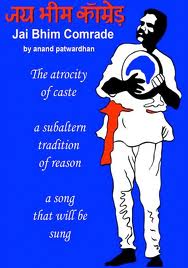 How many murdered Dalits does it take to wake up a nation? Ten? A thousand? A hundred thousand? We’re still counting, as Anand Patwardhan shows in his path-breaking film Jai Bhim Comrade (2011). Not only are we counting, but we’re counting cynically, calculating, dissembling, worried that we may accidentally dole out more than ‘they’ deserve. So we calibrate our sympathy, our policies and our justice mechanisms just so. So that the upper caste killers of Bhaiyyalal Bhotmange’s family get life imprisonment for parading Priyanka Bhotmange naked before killing her, her brother and other members of the family in Khairlanji village in Maharashtra, but the court finds no evidence that this may be a crime of hatred – a ‘caste atrocity’ as it is termed in India. Patwardhan’s film documents the twisted tale of Khairlanji briefly before moving to a Maratha rally in Mumbai, where pumped-up youths, high on testosterone and the bloody miracle of their upper caste birth are dancing on the streets, brandishing cardboard swords and demanding job reservations (the film effectively demolishes the myth that caste consciousness and caste mobilisation are only practised by the so-called ‘lower castes’). Asked on camera about the Khairlanji murders, one Maratha manoos suspends his cheering to offer an explanation. That girl’s character was so loose, he says, that the entire village decided to teach her a lesson.
 KAFILA - COLLECTIVE EXPLORATIONS SINCE 2006