Tag Archives: ASHA workers’ strike Kerala

Countering Propaganda against the ASHA Workers’ Struggle in Kerala: A Response by Anamika A. and others

Rejoinder written collectively by Anamika A, Archana Ravi, Ayana Krishna D, J Devika, Divya G S, Gayatri Devi, Shraddha Jain, Shradha S and Srimanjori Guha

[This piece was written in response to a flagrant misrepresentation of the ASHA workers’ ongoing struggle in Kerala, by Binitha Thampi and Varsha Prasad, which appeared in the Economic and Political Weekly early this month, titled “Labouring on the Margins: ASHA Workers’ Protests in Kerala and Working-class Solidarities” (Oct.4, 2025, LX, 40, 13-17). A group of us — scholars, activists, artists and others who have been closely following the struggle since its beginning — wrote a rejoinder to it. The EPW editor verbally agreed to consider it, but the edit desk insisted that it be subjected to the same peer-review process (as their special articles, it seemed). Commentary pieces, as those who have published in the EPW earlier know, were dealt with at the editorial desk, and the editor was back then obviously competent to judge whether a rejoinder to a commentary piece was a fair one or not. Now that seemingly requires a review process! That does not suit us simply because this atrocious piece of slander is aimed at an ongoing struggle, at the lives of struggling women workers, by other women steeped in academic, social, and political privilege. There is, then, the need to respond quickly, to defend the struggle from the verbal equivalent of a shower of stones thrown at it. At the same time, the very fact that B Thampi’s and V Prasad’s piece, which parrots the CPM troll position in each line and trips over themselves several times empirically and theoretically, has clearly not been subjected to peer-review by the same EPW editorial, for it would definitely would not have got published like it is now — biased in the extreme.

Continue reading Countering Propaganda against the ASHA Workers’ Struggle in Kerala: A Response by Anamika A. and others

An Open Letter to Sarada Muraleedharan about colourism in Kerala

Dear Sarada

I read your post. It is hard to describe the rage that I felt at the colourist dismissal of your work that you called out. As someone who has closely observed your admirable work of saving Kerala ‘s Kudumbashree network meant for the support of the underprivileged from deteriorating into a bunch of crumb-seeking women, I can only say that the comment was also probably driven by sheer envy, and not just shallow thinking. It may be true that your efforts did not fructify everywhere. It is also true that much has regressed, but some aspects continue to endure despite determined push from the political class. No one can deny your exemplary achievements,  rare among civil servants.

Continue reading An Open Letter to Sarada Muraleedharan about colourism in Kerala

A Proposal for a Brahmanical Governance Index (in the background, the chorus: ‘Kerala Number One!’)

Today morning, the newspapers reported that the Kerala government has increased the dearness allowance of state government employees from twelve per cent to fifteen per cent. This group includes government employees, teachers, staff of aided schools, private colleges, polytechnic training colleges, full-time contingent employees and employees of local self-government. Dearness allowance increase is also applicable to service pensioners, family pensioners, ex gratia pensioners and ex gratia family pensioners…

I am told that people are jumping for joy in whatsapp groups of retired teachers etc.

Land purchase facilitation committees are going to be set up at the local-body level to identify land to build houses for families identified as ‘extremely poor’ (64,006 houses).

Yet another report in The Hindu, Thiruvananthapuram edition, claims that inflation rates are highest in Kerala and TN, and one of the chief reasons is the influx of migrant labour (who are clearly purchasing food and other essentials).

The ASHA workers on strike have been demanding their elected government’s attention to two things: their inability to survive on a daily wage of Rs 232 at a time of soaring inflation, and the disgusting feudal-colonial culture of the Kerala Health Department which treats them like female servants under the brahmanical order, the bhrtyas.

The government can quickly turn budget promises into government orders, it seems. It will feed the well-off and make alluring promises of welfare to the (reliably-docile) poorest. But it will not respond to workers demanding fair pay — only they must slave under feudal conditions.

———————

Yes, our government scores high on two indicators of brahmanical governance: ashritha vatsalyam and daanadharmam. Benevolence to the King’s dependents, and giving unto the indigent.

Maybe we should create an index of brahmanical governance too, and start our measuring exercises soon. Our government scored high, in 2017 (during the Hadiya case) and in 2021 (the Anupama Chandran case) on a third indicator of brahmanical governance, pratiloma naashaka, or the annihilating of hypogamy. The only indicator we fall behind is the mleccha naashaka, or the destruction of muslims/ historically underprivileged groups of christians. But given that our handling of ongoing ASHA workers’ struggle has increased our bhrtyaa-mardana rates, and as we have done middling-to-well in our twisting and mishandling of the WCC’s pleas, and so our kulina-damana rates are not so bad, we could be in the race for at least one of the top five slots in Indian brahmanical governance, unless some envious RSS fellows assign an impossible high weight to the mleccha-naashaka indicator!!

Nevertheless, it is tough. Other Indian states are ahead of us in most of these, what we can do is hang tight to aashritha vatsalya and daanadharma, and protect our progresss on bhrthyaa-mardana and kulina-damana. If we can convince the UN that the first two must be assigned a total of ninety per cent weight in the BGI, then it is YAY! Kerala Model Version 2!


In the protest-site, three women are on indefinite hunger strike.

One of the workers gathered there tell me: When I came here first, I was weeping all the time… afraid but not knowing what to do if the government refused us … now that it’s been over a month, my fear has vanished. We have nothing to lose. I prefer to die than live like this. Once you have nothing to lose, you too, won’t be afraid.

Another worker told me about her superior: I am an educated person. I have a college degree and I am trained in accounting software. Now, once when we had to do a survey in the local school with the JPHN, I remember, I suggested that we divide up the work, and that I will write down in the notebook all the data that we need… to which she said, no, you shouldn’t , as we have to give it to the superiors… hinting that I can’t write well…! It stung me, but I didn’t respond, but no more… I am not that meek person anymore.

A third worker recalled : It was a polio day, and I had gone to the booth straight from church that morning, and was wearing a plain white salwar suit. The JPHN looked at me and got all riled up. Why was I wearing a white suit, she wanted to know. That was the nurse’s uniform, she insisted — and that we shouldn’t wear it! There’s no such rule, for sure — it is this feeling in her that we are just ‘workers’, unworthy creatures! I swear, from now, I will not be silent …

From ASHA to Aparajitha, I thought. Just what we need to smash brahmanical patriarchal governance.

[Tearful apologies to Dr K N Raj and all the others who taught us to hold knowledge and empathy together in social research and Srinarayana Guru who showed us that arivu and anukamba can only go together and that in the absence of the other, the one gets irretrievably corrupted.]

Breakthrough in the Technology of Lie-Recycling: News from the ASHA workers’ strike in Kerala

I am not particularly fond of reviewing the writing of party-hacks or hired guns or mediocrities trying to fill their bellies. But citizens watching the struggle of the striking ASHA workers in Kerala’s capital city might be interested in how the ruling government’s toadies engage in logic- and plain fact-denying gymnastics to serve their masters. That is the only reason why I am taking apart this Facebook post by the (future) Secretary of the (yet to be formed) CITU-affiliated Kerala Fallacy-Peddlers and Outright and Recycled Lie Vendors Union (a post that surely must be reward for the production of such egregiousness-guaranteed discourse in ample quantities).

Continue reading Breakthrough in the Technology of Lie-Recycling: News from the ASHA workers’ strike in Kerala

Neither Angels not Devis: Pongala at the ASHA Workers’ Strike in Kerala

The scorching sun in Thiruvananthapuram has been unrelenting. Usually, the festival day of Attukal Pongala, on which thousands of women set up temporary hearths outside their homes and on the roads of the city to cook sweet payasam for the goddess of the Attukal temple, ends with cooling showers. This time the skies were cloudless.

Continue reading Neither Angels not Devis: Pongala at the ASHA Workers’ Strike in Kerala

A Fairy Tale with No Magic: the ASHA workers’ strike in Kerala

Veena George, the Kerala Health  Minister, and her supporters keep demanding incontrovertible proof for the claim that the Sikkim government is paying the ASHAs higher sums. In the spirit of extraordinary cruelty towards the poor and the powerless that has been characteristic of the present government in Kerala, the CPM minions online demand that the striking workers find the proof.

Continue reading A Fairy Tale with No Magic: the ASHA workers’ strike in Kerala

Women’s Day Celebration at the ASHA workers’ Strike in Thiruvananthapuram and B Team Scheming

Yesterday was a day of great strength, solidarity, and remembrance of women workers’ historic struggles for rights and against tyrants. Support for the striking ASHA workers poured in from civil society — cine artists Kani Kusruti, Divya Prabha, Rima Kallingal, and Jolly Chirayath, writers Arundhati Roy, Sara Joseph, and Rosemary, feminist academic researchers Nivedita Menon and Janaki Nair, filmmakers Leena Manimekalai and Paromita Vohra expressed solidarity with the workers. Paromita Vohra inaugurated the morning’s meeting. A cross-section of Kerala ‘s civil and political society, spoke in solidarity. Representatives of feminist groups spoke. The Dalit Human Rights Movement conducted a solidarity march led by their leader Reshma K. Gomathi, of Pomblai Otrumai, spoke about what lay ahead for the striking workers, based on her experience of confronting the CITU during the Munnar tea garden workers’ strike. Representatives of the United Nurses Association took out a solidarity march and their leader spoke in the meeting. Hundreds of ASHA workers and representatives of ASHA worker unions from Tamil Nadu and Karnataka were present.

The workers welcomed all , but also spoke their mind. When the Siva Sena — a group of men — arrived, they were politely asked to vacate centre stage and make space for a woman from their ranks. The representative of the national federation that the KAHWA is affiliated to declared in completely non-ambiguous words that the fight was against the Union government; she welcomed support from members of the NDA but told them that their support was crucial not in Kerala but in Delhi. We expect you to offer the same support when we approach the union government, she said. And also noted: no political party, including the Congress, will take up the issues of the ASHAs wherever they are in power .

Meanwhile, the voice of the national CITU, A R Sindhu, continued to repeat the Kerala CITU male leadership’s ‘silly little sheep’ hypothesis about the striking women workers, and the much-flogged conspiracy theory against the SUCI, using the same bunch of fallacies deployed by the CPM’s fallacy-peddlers’ union workers ( a union that is still a future possibility, but a real one) led by the likes of K K Shahina. Sindhu speaks like the Kerala CITU’s B Team, even though she calls for talks to end the strike. B team because outright strike denigration seems to be the privilege of the Alpha males in the CITU.

What is truly appalling about her long essay in the Malayalam online magazine Truecopy is its chilling lack of empathy.  V T Bhattatirippad , the social reformer, once remarked about the CPM leader EMS Namboothirippad that he was the kind of person who, when faced an urgent call for help with a woman in labour desperately thrashing about in pain, will respond with long analyses about the terrible lack of health care facilities, the bad roads in the country, the need for more doctors etc. He was right about these of course, but that cannot replace an empathetic response.

A R Sindhu and Veena George respond in this way — without empathy. The ASHA workers are striking because the CPM’s election manifesto promise of Rs 700 a day for scheme workers is expiring soon. They are desperate with delays and the sheer impossibility of surviving in Kerala where the cost of living is relatively high. The workers’ strike is actually out of desperation, but the CPM last leaders meet it with a bunch of cold bureaucratic reasons that are all already well known:  central funds are insufficient, they are delayed, you are merely scheme workers, we pay you more than x,y, z… And when they persist and continue to talk about their crisis-ridden lives, Veena George loses her cool, and dons a true kochamma tone — what a load of bother, she stomps her little foot in impatience. Go away, go ask the Union government! Her Royal Highness’  guard rush to her aid at once, trying to shoo the beggars away, while the CITU male leadership aim poison tipped arrows of misogynist insults at them.

However, whatever the monarchical imagination of our rulers, we still think ourselves as the citizens of a democratic country. Sindhu is miffed that certain academics and intellectuals are on the side of the striking workers. C’mon, Sindhu! Your government in Kerala has a whole menagerie which has an entire collection of cosseted intellectuals.

I ask you, send them out against these’ untamed’ intellectuals! We untamed creatures deserve some fun too, I tell you.

Photos: Santhi Rajasekhar

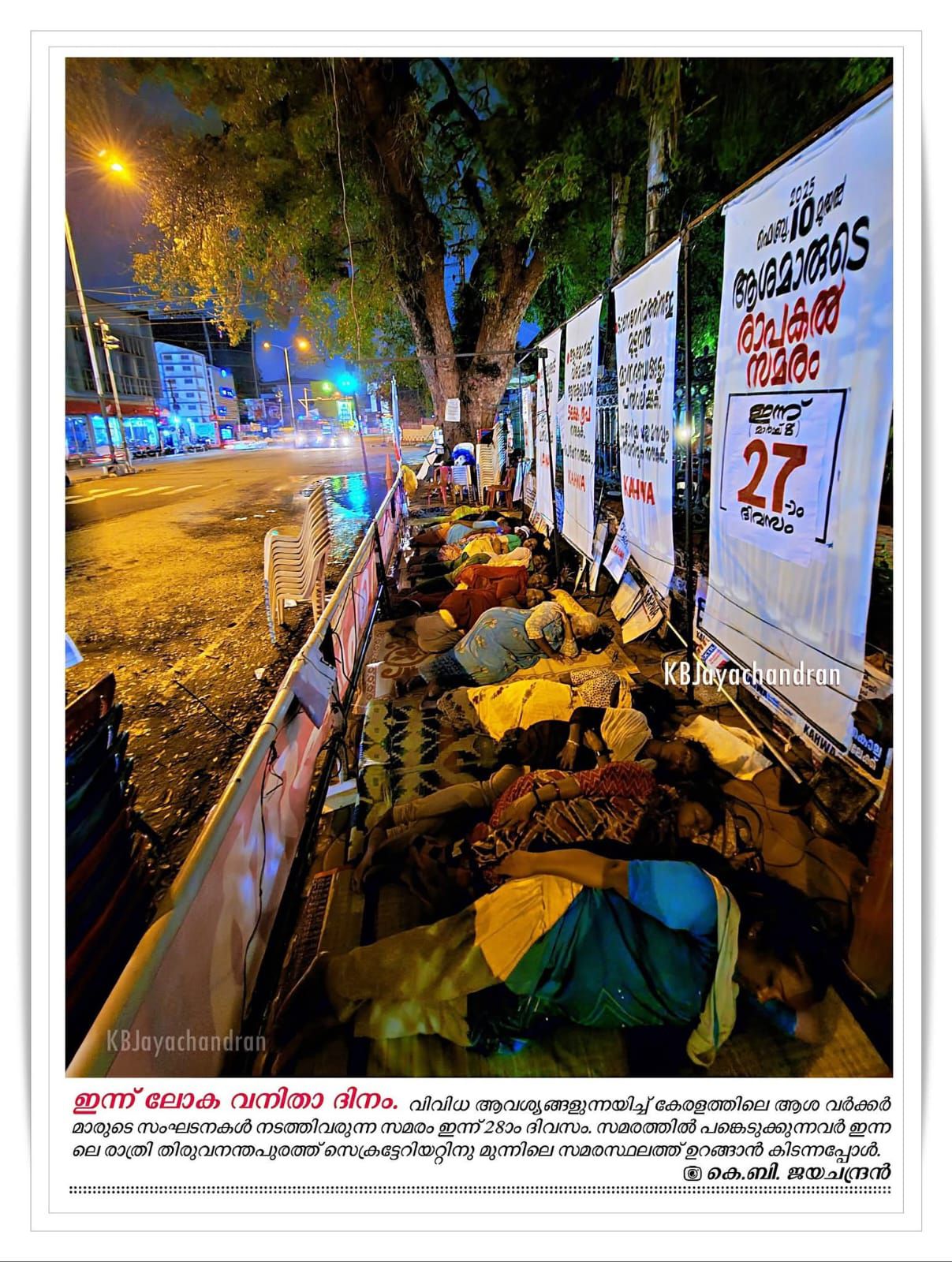
Early morning on Women’s Day in Thiruvananthapuram, 2025

Photo: K B Jayachandran

Today is International Women’s Day.

ASHA workers on strike for the twenty eighth day, sleeping in front of the State Secretariat in Thiruvananthapuram.

Happy Women’s Day from Kerala, the Land of Women’s Empowerment!!

On this day, true to the fighting spirit of the women workers who fought valiantly for their rights and who faced the tyrant’s bullets fearlessly, Kerala’s COVID-warriors, our ASHA workers, sleep on the rain-soaked pavement in front of the State Secretariat in the capital city of Kerala.

Happy Women’s Day, Pinarayi Vijayan and Veena George. You must getting ready for the day refreshed by sleep in your soft beds, in the mansions that we the citizens of Kerala have funded for the comfort of our rulers.

Happy Women’s Day, Com. Thomas Isaac. Yes, you wouldn’t have been so famous the world over, if not for ‘women’s empowerment’ and the whole local-level development jingbang! See how empowered they are now. I am sure you must be happy now.

Happy Women’s Day, all of you in the CPM who have fattened on the achievements of women development workers — T N Seema and others — and the CPM hanger-ons who have managed a ‘feminist look’. Those women have learned to resist power, what a shame! I can imagine you rolling your kohl-lined eyes, frown-lines creasing those big red bindis on your foreheads . Those who set out to empower Kerala’s poorest women are now truly EM-powered. What an interesting and convenient twist!

Happy Women’s Day to Kerala’s ‘development movement’, the Kerala Sastra Sahitya Parishat! But I did not know that a people’s science movement went into mauna vratas, en masse. There can be no other explanations for their stunning silence, for all their concern about Kerala’s local-level development and public health.

Happy Women’s Day, feminist development experts who have all got nice shares of glory, along with other resources, from the Kerala government’s propaganda upholding its commitment to women’s empowerment … you who have not bothered to utter a single word despite seeing this rank injustice unfold … Private expressions of shock are useless, you know?

Any Chance for Aasha? Poem by Desamangalam Ramakrishnan

The Kerala government’s mulish refusal to negotiate with the striking ASHA workers is  baffling no matter what angle you may think of it. The promise of raising the ASHA workers’ daily pay to Rs 700 was an LDF election promise, part of the election manifesto — how can they call it unreasonable now? Raising the pay of ASHA workers would bring back to the well-feeling of twenty six thousand grassroots workers who are well-respected in their communities, but the CPM leadership does not bother, and the CITU studs seem determined to piss them off. In the legislative assembly, Veena George reels off breathtakingly false information, when anyone with access to the official website of the Sikkim government can read government orders that expose her.

But civil society now sees the hubris and expressions of support and anguish at the government’s apparent lack of grace and respect for life -saving labour are pouring in. I am posting here a particularly striking one, a poem by the well-known poet in Malayalam, Desamangalam Ramakrishnan. Aasha in Malayalam means a fervent wish; it also means hope. In this short poem, the poet uses the word to evoke a feeling for the crisis we Malayalis face — of hope in a system, that once swore by the values of care and social justice, intertwining it with the government’s deliberate cruelty to the striking workers. The poem is titled Aashaikku vakayundo?

Any chance of aasha?

Desamangalam Ramakrishnan

Any aasha?
– is there any hope left,
ask the mothers who wait with handfuls
to line the pockets
outside the hospital’s operation theatre.

Harassed travellers, waiting endlessly
till the middle of the night ask:
Any aasha left? Any hope
that a bus, any bus, might come?

Any aasha, hope?

Caring-women,
bringers of food,
water, comfort, tell
those who wait in terror,
locked down at home:
do not abandon hope, do not give up your aasha
even if an elephant pins you on its tusk…

Any hope?
Through steep and narrow paths
the caring-women run,
to knock on the door of a piteous scream
and drive away the sickness with love.
They say: abandon not your aasha; be not bereft of aasha,
let the humble shoots of hope sprout.

Is there hope, is there aasha?
Though it’s just a few
paltry coins,
when will it fill the waist-folds
of one’s dignity and pride?

When it writhes its last writhing
on the door step of the king of the land
who tied its tongue and left it to beg,
our pottan theyyams,
oracles, leveller-spirits,
will break their chains,
swarm out of cellars,
surely.

Or, has Power
turned the one who once
sprinted through these paths
holding aloft the flag woven from
the threads of our blood,
into a mad brute?

Women’s Work is the Central Issue in Kerala today, from Cine-workers to ASHA workers

The nauseatingly patriarchal attack by the CITU State Secretary K N Gopinath on the striking ASHA workers sets a new low, but it is not unexpected. K N Gopinath’s ugly, sexually-coloured remark was about the BJP MP Suresh Gopi’s visit to the protest site. After the police pulled down the did not allow the tarpaulin shelters, the striking workers continued the strike in the pouring rain. The MP distributed umbrellas to the workers. Gopinath said that he knew that the MP distributed umbrellas, but he did not know if “he distributed kisses” there. When questioned, he admitted that the reference was to a sexual harassment complaint against the MP. The man kept defending his offensive remark, in his own admittance a sexually-coloured one, even when questioned strongly by journalists.

Continue reading Women’s Work is the Central Issue in Kerala today, from Cine-workers to ASHA workers

Fast and Fallacious: The CPM Acolyte’s Guide to Confusing People

As the ASHA workers’ strike continues today despite pouring rain today, they have been subjected to a new line of attack. The BJP MP, Suresh Gopi, visited the protest site the other day. Nothing earth-shaking happened. No grand announcements of benefits were made; the striking workers did not hesitate to signal to him that he was speaking from a position of power, and hence the words offered were not enough.

Continue reading Fast and Fallacious: The CPM Acolyte’s Guide to Confusing People

Open Letter to the Kerala Chief Minister about the Ongoing ASHA workers’ strike: Cynthia Stephen

Respected sir,

As a long-time advocate for the rights of women and their empowerment, we are used to comparing the situation of women in Kerala as a good model for women’s empowerment in all fields of life. The history of workers’ struggles and the fact that even women in the informal sector receive government benefits after retirement is a shining example to the rest of the world. 

Continue reading Open Letter to the Kerala Chief Minister about the Ongoing ASHA workers’ strike: Cynthia Stephen

‘Anarchists’? ‘Tin-pan fund collectors’ Movement’? What is the Kerala Asha Health Workers’ Association?

In the past few weeks, the CPM ministers, CITU leaders like Ilamaram Kareem and CPM cyber propagandists have been relentless in their attack against the SUCI, heaping on them insult after insult. The preferred insults have been ‘anarchists’ and ‘tin-pan fund collectors’. The SUCI is a small group of committed people who have however produced significant political impact. They have indeed been a thorn in the flesh of the local CPM for quite some time — from at least the anti-waste dumping struggle at the panchayat of Vilappilsala in 2012 to the K-Rail protests, the SUCI’s intrepid persistence was important in forcing the government to back off. These insults are not new either; we have been hearing them since back in 2012 or earlier. But the Kerala Asha Health Workers’ Association has been especially targeted for slander, as though they were just a tool of the SUCI.

Continue reading ‘Anarchists’? ‘Tin-pan fund collectors’ Movement’? What is the Kerala Asha Health Workers’ Association?

Find a solution to the strike by ASHA workers in Kerala: Statement by Writers and Socio-Cultural Activists


We request the Kerala Government to take necessary actions to end the day/night strike of the Accredited Social Health Activist (ASHA) workers in front of the Kerala secretariat for the last 17 days by meeting their just demands. ASHA workers were the backbone of our valiant fight against the COVID-19 pandemic. However, their work is not acknowledged by our society or our government. The honorarium they receive is paltry compared to the important work they are
doing.

Continue reading Find a solution to the strike by ASHA workers in Kerala: Statement by Writers and Socio-Cultural Activists

This is NOT a law and order problem: The ASHA Workers’ Strike in Kerala– Althea

Now that the ASHA workers’ strike in Thiruvananthapuram has entered its third week and public support for the workers is growing, the Kerala government, instead of trying to solve the issue, is resorting to an age-old tactic: of turning this into a law-and-order issue. Provoked by the sizeable support the workers have garnered from civil society, the police have issued notices to fourteen public intellectuals and activists who participated in the mahasangamam meeting two days back, which was a massive success despite all the threats. They have been ordered to appear at the police station within 48 hours, and accused of disturbing order and obstructing traffic.

Continue reading This is NOT a law and order problem: The ASHA Workers’ Strike in Kerala– Althea

Strikedenigrating, Ilamaram Kareem Style: The ASHA Workers’ Strike in Kerala

After branding the ongoing ASHA workers’ strike in Kerala, now in its third week, as ‘unnecessary’, the CPM, the leading constituent of the ruling LDF, is now proceeding to stage 2 of strike-denigrating, deploying its master-strike-denigrator — the ex-Minister and CITU leader Elamaram Kareem. This man is notorious for his anti-people stance in many earlier workers’ struggles, notably the epic struggle to end the terrible pollution of the Chaliyar river by Birla’s factory there. The full misogyny that defines the present-day CPM leadership in Kerala, as well as its reeking elitism, may be found in the ugly article that he wrote in the CPM’s organ, Deshabhimani a couple of days back. Despite the CPM’s claims about ‘women’s empowerment’, if one takes Kareem seriously, it now firmly believes that the public care work that the ASHAs do are only ‘service’ and that they are ‘not workers’.

Continue reading Strikedenigrating, Ilamaram Kareem Style: The ASHA Workers’ Strike in Kerala