
Tag Archives: China

South Asian Futures in a Tri-Polar World : Professor Pervez Hoodbhoy

Democracy Dialogues Series – Lecture 40
Organised by New Socialist Initiative

Theme :
South Asian Futures in a Tri-Polar World

Speaker :
Professor Pervez Hoodbhoy
Eminent Physicist, author, public intellectual

Time and Date :
6 PM (IST)
Sunday , 27 th July 2025

The lecture is also live streamed at facebook.com/newsocialistinitiative.nsi

Abstract:

The Cold War and the collapse of the Soviet Union are long behind us, and we’re now hurtling toward a tri-polar world dominated by America, Russia, and China. These three powers vy to shape global influence, often competing but sometimes colluding. As the saying goes, “When elephants fight, the grass gets trampled.” So, the central question for this lecture is: What path are the nations of South Asia—including Afghanistan and Iran—likely to take? What alternatives and tools do they possess to navigate this landscape? Most importantly, what vision of society and power should guide them toward a viable future?

Speaker :

Professor Pervez Hoodbhoy is a nuclear physicist, author, and a prominent activist who is particularly concerned with promotion of freedom of speech, secularism, scientific temper and education. He is the founder-director of The Black Hole in Islamabad and as the head of Mashal Books in Lahore, he leads a major translation effort to produce books in Urdu that promote modern thought, human rights, and emancipation of women.

Prof Hoodbhoy received his undergraduate and doctoral degrees from MIT and has taught  physics and mathematics at Forman Christian College-University in Lahore, at the Quaid-e-Azam University (QAU) in Islamabad and later at Lahore University of Management Sciences (LUMS).

He is a recipient of the Baker Award for Electronics and the Abdus Salam Prize for Mathematics. He was visiting professor at MIT, Carnegie Mellon University, and the University of Maryland. In 2003 he was awarded UNESCO’s Kalinga Prize for the popularization of science.

Here is a list of a few of his publications :

– Pakistan: Origins, Identity and Future, published by Routledge (London, New York), 2023.
– Confronting the Bomb – Pakistani and Indian Scientists Speak Out, (edited) Oxford University Press, 2013.
– Education and the State – Fifty Years of Pakistan, (edited) Oxford University Press, 1998.
– Islam & Science: Religious Orthodoxy and the Battle for Rationality, published by ZED Books, London, in 1991 with translations in Turkish, Malaysian, Indonesian, Arabic, Spanish, Sindhi, and Urdu.
– Proceedings of School on Fundamental Physics and Cosmology, co-edited with A. Ali, World Scientific, Singapore, 1991.

Class, Inequality, and the Current Political Moment in China and India : Prof Vamsi Vakulabharanam

Democracy Dialogues Series 39

Organised by New Socialist Initiative

Theme : Class, Inequality, and the Current Political Moment in China and India

Speaker : Prof Vamsi Vakulabharanam

Co-Director of the Asian Political Economy Program and Associate Professor of Economics at the University of Massachusetts, Amherst

Live streamed at Facebook ( facebook.com/newsocialistinitiative.nsi).
———————————-

Theme: Class, Inequality, and the Current Political Moment in China and India

This talk is based on a recently published book by the Oxford University Press – Class and Inequality in China and India, 1950-2010. China and India have seen a significant revival over the last three decades in terms of their place in the world economy. Two and a half centuries ago, they contributed 50 percent of the world output; after suffering a decline thereafter, their share fell to a paltry 9 percent in 1950 but has since resurged to over 25 percent today. Their growth and inequality experiences diverged for three decades following India’s independence (1947) and the Chinese revolution (1949). Thereafter, there are remarkable underlying similarities in the experiences of both countries, especially in terms of their rising inequality patterns analyzed through a class lens. Vamsi demonstrates that the mutual interconnectedness between Chinese and Indian growth and inequality dynamics and the transformation and evolution of global capitalism is key to understanding the within-country inequality dynamics in both countries over the 1950-2010 period. Based on this analysis of class-based inequalities, Vamsi reflects on the current political moment in both countries, from a political economy perspective.

Speaker : Prof Vamsi Vakulabharanam
Vamsi Vakulabharanam is Co-Director of the Asian Political Economy Program and Associate Professor of Economics at the University of Massachusetts, Amherst. He has previously taught at the University of Hyderabad (2008-14) and the City University of New York (2004-07). His recent research focuses on inequality in India and China and the political economy of Indian cities through the axes of gender, caste, class, and religion. In the past, he has also worked on agrarian change in developing economies, agrarian cooperatives, and the relationship between economic development and inequality. Vakulabharanam was awarded the Amartya Sen award in 2013 by the Indian Council of Social Science Research.

Mainstream Myths Versus Scientific Collaboration

The rediscovery of scientific collaboration across borders is a welcome development.

Fake News on COVID

Nothing in life is to be feared, it is only to be understood. Now is the time to understand more, so that we may fear less.

– Marie Curie.

Does the 5G network have any link to the novel corona-virus outbreak?”

Well, any sane person on this part of Earth would readily laugh at this outrageous claim. But this claim has “gone mainstream” leading even to bomb attacks on phone masts. So one has to sit up and analyse.

No doubt, when “psychological states peak and people’s anxiety levels are high,” as one expert puts it, one can easily become prey to such conspiracy theories. And as right-wing or conservative ideas have growing legitimacy in society, things can get even worse. Remember how for a long time Iran’s theocracy was in denial about the Corona-virus threat?

India is no exception to such false claims. All sorts of home remedies are being offered as a definite cure to the disease. We saw Gomutra parties where cow urine was drunk, supposedly as protection from this highly-contagious disease which has taken more than 100,000 lives and infected more than 1.7 million. No doubt it is an arduous task for progressives to counter all the rubbish being peddled around the pandemic and prepare people to take proper care while pressurising the powers-that-be to make public health a priority.

Such struggles can be better fought if individual scientists or groups of scientists join hands to sensitise and educate people.

The recent launch of a pan-institutional CovidGyan website (https://covid-gyan.in/) which is a brainchild of the Tata Institute of Fundamental Research (TIFR), the Indian Institute of Science (IISc), and the Tata Memorial Centre (TMC) is a welcome step in this direction. Other key members of this initiative include Vigyan Prasar, IndiaBioscience, and the Bangalore Life Science Cluster (BLiSC, which comprises InStem and C-CAMP, in addition to NCBS-TIFR).

( Read the full article here : https://www.newsclick.in/Mainstream-Myths-Versus-Scientific-Collaboration)

After Covid-19, We Should All Be Cuba

The pandemic has exposed wealthy states’ neglect of healthcare. A new medical internationalism is needed.

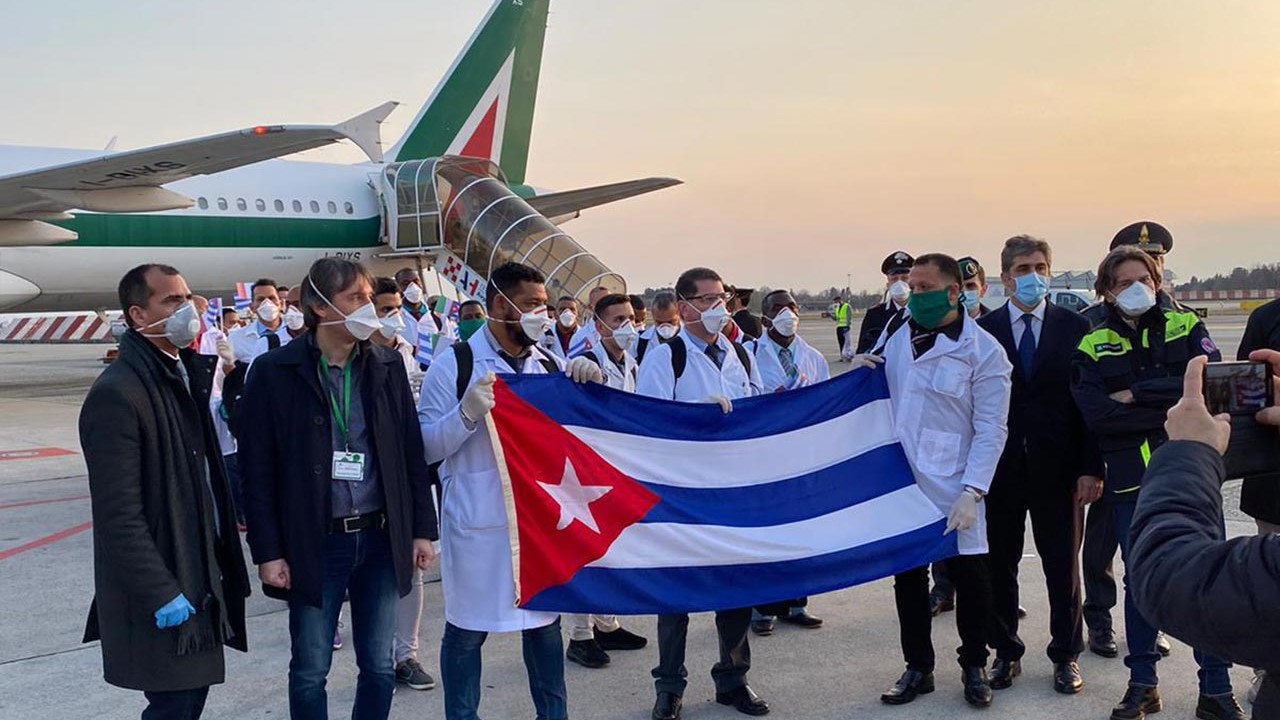
Cuban doctors prepare to leave for Italy to provide medical aid.

Image Courtesy: Malpensa airport website

Rare are those photographs which can be declared iconic right after they are taken, without awaiting the approval of the connoisseurs, critics or people. It is an ordinary-looking photo, of a large team of people, dressed in white robes, disembarking from a plane and being welcomed by someone wearing a white coat too. Take a closer look at the frame and you will note a mood of jubilation among the people who are watching them from the airport’s lounge.

The photo is of Malpensa airport at Milan, an alpha-global city recognised so far as one of the world’s four fashion capitals and the capital of North Italy’s Lombardy region. Today, it has also come to be known as a hotspot of Covid-19 infections, a site where thousands have died of the infection. The picture we are talking about is of 52 doctors and nurses from Cuba who arrived in Italy on invitation from the regional Italian minister of health and welfare, Giulio Gallera.

Italy, ironically, has been party for a long time to the economic sanctions imposed by the United States on this tiny Caribbean nation with a population of around 1 crore (10 million). The sanctions have been declared “illegal” by the United Nations time and again. But the anti-humanitarian attitude of the Italian ruling classes could not stop Cuba from sending its medical team there to combat Covid-19. Media reports tell us that Italy happens to be the sixth country—after Venezuela, Nicaragua, Jamaica, Suriname and Grenada—on the current itinerary of Cuban medical teams flying around to fight the pandemic.

( Read the full article here : https://www.newsclick.in/After-Covid-19-We-Should-All-Be-Cuba)

Remembering Tiananmen Square on the 4th of June

Twenty years ago, the dictatorship that rules China crushed a peaceful gathering of students and young people in Tiananmen Square, leading to large numbers of deaths. That day, I think I came of age, politically. It taught me, that the realities I held in the highest esteem could suddenly, over night reveal themselves to be monsters. There was no quicker way to grow up, suddenly.

I was an undergraduate student in Delhi University at that time, and a member (not overly active) of the Students Federation of India, a front organization of the Communist Party of India (Marxist). I had been following, with close interest, the events unfolding in Beijing, where what seemed to be an entire generation of students and young people had been assembling, peacefully, for more than two months, in support of political reform, openness and democracy. For me, as for many others who identified with the left in India, and elsewhere, the students movement was of enormous significance, as it pointed towards the possibility of a dynamic socialist democracy. We were buoyed by the cheerfulness of our Chinese student comrades, followed every communique, every slogan with care and affection, and said to ourselves, “see, they sing the Internationale”.

Continue reading Remembering Tiananmen Square on the 4th of June

Chinese memories

Suddenly the other day, on the 3 of June 2009, in a bizarre flash of memory I went back two decades ago, June 3 1989. As is well known, hundreds of students in Beijing had begun a protest a few months ago with wide-ranging critiques of the regime – more democracy, end to corruption and workers rights. They were joined by workers, office goers, Beijing residents, local party officials, just about everyone else. Soon the protests had spread all over China, there were demonstrations everywhere. A Chinese friend of mine was in Tiananmen Square, the main centre of the protests. He later told me – “we were all giddy, everyone traveled free in trains to Beijing, people helped us with food and water on the streets, we sang the Internationale and all the old revolutionary songs, suddenly they felt real not false…” All went to Beijing.

For many on the left in India, China occupies a peculiar, proximate place. The events of 1956 in Hungary and 1968 in Czechoslovakia, when Soviet tanks crushed uprisings, did not cause the storms they did in the European left. But China was different – it was in Asia, a large peasant society with an old civilization, and the site of one of the great revolutionary transformations that had begun in the nineteenth century. China had to be different. When the Naxalite militants scribbled ‘China’s path is our path’ or ‘Listen to Radio Beijing’ on the walls of Calcutta in 1969, they were probably out of their mind, but only just.
Continue reading Chinese memories