Tag Archives: Kashmir

Report #1: Attack and killing on Pattan hospital premises

This is the first of a series of fact-finding reports on the recent violence in Kashmir. The fact-finding has been conducted independently by a team of BELA BHATIA, VRINDA GROVER, SUKUMAR MURALIDHARAN and RAVI HEMADRI. For a introduction to this series, see here.

View of the hospital ward ‐ staff think that Adil may have been on the bed with the red mattress when the CRPF incursion took place.

Continue reading Report #1: Attack and killing on Pattan hospital premises

Introduction: Fact Finding Team to Kashmir

This post introduces a fact finding team’s work on the recent violence in Kashmir. The contents of the report are being posted as separate posts and will be linked below as and when they’re posted.

Since June this year, the Kashmir valley has been torn by mass protests which have been met with overwhelming force by Indian security forces. Curfews and closures have been frequent, often shading into each other. No less than 111 deaths have been registered, of which a large number have been of students and youth in the age group of 8 to 25 years. There have besides, been hundreds of cases of injuries, of both protesters and those who just happened to be at the wrong place at the wrong time. An independent fact-finding team went to the Kashmir valley at the end of October to go into the totality of the situation, principally to inquire into the causes for the unconscionably large number of deaths that have occurred in the current phase of mass agitation. The team comprised of academic BELA BHATIA, advocate VRINDA GROVER, journalist SUKUMAR MURALIDHARAN and activist RAVI HEMADRI of The Other Media, a Delhi based campaign and advocacy organisation, at whose initiative the effort was organised. Each member of the team spent varying lengths of time in the valley, but in total, roughly about twenty-five person days were put in the fact-finding exercise. In groups or individually, the team met the families of almost 40 persons who had been killed since the beginning of the civil unrest. Several individuals who had suffered serious injuries were also met. The team worked out of the state capital of Srinagar, and visited villages and towns in five of the Kashmir valley’s ten districts: Baramulla in the north (Sopore and Baramulla tehsils); Anantnag (Bijbehara and Anantnag tehsils) and Pulwama (Pulwama tehsil) in the south; Badgam in the west (Chadura and Badgam tehsils) and Srinagar itself. Separate sessions were held with journalists and media practitioners, university teachers and students, doctors, lawyers and activists besides officials in the police headquarters and the civil administration. The findings of the team are being released in a series of short reports beginning with following two sections. Forthcoming reports will deal with various facets of the situation that civilians in the Kashmir valley face in a season of unabated turmoil.


Next in this series
Report #1: Attack and Killing on Pattan Hospital Premises
Report #2: Palhallan Under Siege
Report #3: Shooting the Messenger in Kashmir

Dilemmas of ‘Right of Nations to Self Determination’: Rohini Hensman

Guest post by ROHINI HENSMAN

The hectic discussion over the Kashmir meeting in Delhi in October entitled ‘Azadi – The Only Way’ has made it urgent to revisit the debate between Lenin and Luxemburg on the right of nations to self-determination. Lenin, starting from his experience in imperialist Russia, insisted on the right of nations like the Ukraine to self-determination (in the sense of their right to form separate states), contending that denial of this right would merely strengthen Great Russian nationalism. In a colonial situation, Lenin was surely right. When a country is under foreign occupation, all sections other than a very small number of collaborators want to be free of the occupiers, even if there are sharp differences between these sections. A striking example is RAWA (the Revolutionary Association of the Women of Afghanistan) which, despite speaking for a section of the population which is sorely oppressed by the Taliban, and continuing to fight against it, nonetheless shares with the latter the goal of ending the occupation by US and NATO forces. In such situations, the right of an occupied nation to self-determination makes sense.

Continue reading Dilemmas of ‘Right of Nations to Self Determination’: Rohini Hensman

Whose Dishonesty? Arundhati’s or Media’s?: Mahtab Alam

Guest post by MAHTAB ALAM

‘Vicharon ki Be-imani (Dis-honesty of thought) cries the heading of the lead article of Dainik Bhaskar’s editorial page on 1st November 2010. The article is written by Venkateshan Vembu, foreign correspondent of DNA English daily, a newspaper published by the same group of publications. It was originally published on 27th October with the headline reading ‘Arundhati Roy is dangerously wrong on Kashmir’. The writer of the article claims that whatever Arundhati has said is not only dangerously wrong and beyond the tolerance level of any law-abiding citizen but, it also has the potential to arouse feelings of anger and violence among the masses. “Yeh kuch is tarah ki beimani hai, jo janmanas me krodh aur aakrosh ki bhawna upjati hai (This is a kind of dishonesty which generates feelings of anger and violence among the people”). Ironically, this turned out to be a ‘prophetic’ disclosure, as right after four days of publication of the original version in DNA, Arundhati’s house in Delhi was attacked by the writer’s ‘Janmanas’, the BJP’s women wing ‘Mahila Morcha’.

Continue reading Whose Dishonesty? Arundhati’s or Media’s?: Mahtab Alam

From New York, a letter to fellow Kashmiris

Guest post by MOHAMAD JUNAID

Dear fellow Kashmiris,

I’m writing this letter from New York, a place far away, yet so close to everything. This city can make you forget, by filching reality away from you. But it also reminds you perpetually, by bringing you close to a different reality, through the pain and suffering of others. There are exiled specimens from all over the world here (yes, mostly those permitted to come to the US). There are Irish and Greeks, escapees from famines and wars. There are Jews from Germany and Germans from Russia, ones who survived persecution. There are Latinos from El Salvador, Peru, Guatemala, and Bolivia, who fled Western-backed dictatorial regimes in their countries in the 1970s and 80s. There are Africans who narrowly missed genocide in Southern Sudan. There are Kurds from Turkey, and Berber from North Africa, driven out of their lands by years of conflict. And, then there are African Americans, who were forcibly brought hundreds of years before to slave for their White masters, and who, despite recent claims of dawning of an age of “post-racial America,” are still groveling at the bottom of the socio-economic heap. Their stories tell a similar conclusion: The world is shrinking for small nationalities and powerless minorities. Continue reading From New York, a letter to fellow Kashmiris

Reflections on the Bigots of Embedded Media: Biswajit Roy

Guest post by BISWAJIT ROY

Now that the xenophobic and paranoid big media clamour for slapping sedition charges against Arundhati Roy and others for speaking up their mind on Kashmir, has temporarily subsided, it is time for some reflection.  This clamour has only underlined the increasingly shrill bigotry of a section of Indian journalists who are deeply embedded in the right-wing statist mission, a la Arnab Goswami. Their stakes in the race for Padma awards or Rajya Sabha nominations may be one of their personal motives for behaving the way they do – baying for the blood of the dissenters and whistle-blowers while ignoring the ground reality in Kashmir valley today. But there may also be corporate institutional compulsions. However, they are espousing bigotry at the expense of the media’s role as the protector and disseminator of dissent in public life as well as watchdog against excesses and abuses of power by the government and other wings of the State in the name of national security and national interests. As a media professional, I would like to share some of my encounters with these self-proclaimed guardians of Indian nationalism in media and frontiers of mainstream journalism.

The Kargil War: the self-proclaimed guardians of national interests Continue reading Reflections on the Bigots of Embedded Media: Biswajit Roy

India Bans US Professor from Kashmir, threatens Indian writer with sedition charges: JKCCS

A note from JAMMU KASHMIR COALITION OF CIVIL SOCIETY

November 2, 2010

On November 1, 2010, shortly after 5.10 am, Professor Richard Shapiro was denied entry by the Immigration Authorities in New Delhi. Richard Shapiro is the Chair and Associate Professor of the Department of Anthropology at the California Institute of Integral Studies (CIIS) in San Francisco. He is also the life partner/husband of Angana Chatterji, who is the Co-convener of the International People’s Tribunal on Human Rights and Justice in Indian-administered Kashmir (IPTK) and also Professor of Anthropology at CIIS. Continue reading India Bans US Professor from Kashmir, threatens Indian writer with sedition charges: JKCCS

Minutes of the seminar on ‘Azadi: The Only Way’

(Shuddhabrata Sengupta has written eloquently his account of the day-long seminar, ‘Azadi: The Only Way’. The seminar was organised by the Committee for the Release of Political Prisoners. Given below are CRPP’s minutes of the seminar. You can also see, on YouTube, two short videos showing the ruckus that some Kashmiri Pandits created before Syed Ali Shah Geelani was to speak (1, 2). Also on YouTube, in two parts (1, 2), is Arundhati Roy’s speech, for which some want her booked for sedition. Those on Facebook can also see most of SAS Geelani’s speech (1, 2, 3). A small part of Geelani’s speech is on Youtube, here. Those hurling abuses at Roy and Geelani would do well to read this text, see these videos, and engage with these ideas intellectually, instead of asking for individuals to be jailed and persecuted.)

Continue reading Minutes of the seminar on ‘Azadi: The Only Way’

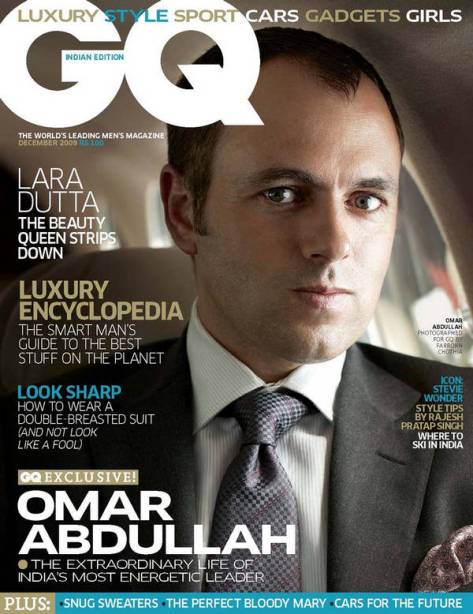
GQ Boy’s platinum pain

Guest post by HILAL MIR


There are various divisions of pain the different classes of people feel in Jammu and Kashmir. Like those bank credit cards which classify customers according to precious metals—Platinum, Gold, Silver—pain is a class thing. For example, when PDP veteran Muzaffar Hussain Baig, after making a long convoluted speech in the Jammu and Kashmir Assembly, said Omar Abdullah’s name figured in the list of the people who used their authority to sexually exploit girls, the junior Abdullah was transformed into a character from a Greek tragedy.

Continue reading GQ Boy’s platinum pain

Kashmir: A “No-Peace” Political Initiative

Guest post by ANGANA CHATTERJI

The 8-point Plan, New Delhi’s political initiative to address the crises in Kashmir, attests to the parallel and incommensurate realities of the sovereign and the subjugated, the Indian state and the Kashmiris.

The 8-point Plan renders obvious New Delhi’s limited comfort zone. The Plan is not an overture to healing the reality of suffering and outrage inside Kashmir. Rethinking militarization and military governance is not the priority. The ambition is to manage Kashmiris and to keep the disarray concealed from the international gaze.

New Delhi announced its 8-point Plan on September 25, 2010, following the visit to India-ruled Kashmir of a 39-member All Party Delegation from New Delhi led by Union Home Minister Palaniappan Chidambaram, and parallel to the 65th Session of the United Nations General Assembly meetings in New York City. That Defence Minister Arackaparambil Kurian Antony did not accompany the All Party Delegation was indicative of New Delhi’s mood.

Continue reading Kashmir: A “No-Peace” Political Initiative

Let Delhi have its thali

Guest post by HILAL MIR

During the convention, Azadi the only Way, at LTG auditorium on Thursday, a potbellied man was standing on the aisle, listening intently to the speech of professor of history at Jadavpur University Sugata Bhadra. The man, I reckon, might be easily burdening earth with nearly 130 kilograms of his fair, north Indian bulk.  The professor was stripping the Indian state to its bare minimum and the audiences clapped. The man could stand it no more. I soon found out his voice was equally weighty, and gravelly—a cross between Shatrugan Sinha and Kulbushan Kharbanda. Quite audibly he said jis thali ma khatey hai usi main chaid kartey hain. In Bollywood films this saying condemning treachery is reserved for domestic helps who fall in love with the pretty daughters of their employers. Here, the context was different. A Maoist sympathizer was sharing the dais with a Kashmiri pro-freedom leader who was sharing the dais with a Sikh secessionist who was sharing the dais with a Naga human rights defender…A veritable thali of secessionism and dissent indeed. No wonder Arnab Goswami was hysterical. Continue reading Let Delhi have its thali

Azadi: The Only Way – Report from a Turbulent Few Hours in Delhi

Dear Friends,

I was present and speaking a few hours ago at a meeting titled ‘Azadi: The Only Way’ on the situation in Jammu and Kashmir, organized by the Committee for the Release of Political Prisoners at the Little Theatre Group in Delhi yesterday (21st October). I was not present from the beginning of the meeting as I was traveling from another city, but can vouch for what occurred from around 4:30 pm till the time that the meeting wound up, well after 8:00 pm in the evening.

The meeting took place in the packed to capacity auditorium of the Little Theatre Group on Copernicus Marg at the heart of New Delhi. Several speakers, including the poet Varavara Rao, Prof. Mihir Bhattacharya, Sujato Bhadra, Gursharan Singh, Mr. Shivnandan (?) an activist from Jammu, Professor G.N.Saibaba, Professor Sheikh Showkat Hussain – Professor of Law, Srinagar University, the journalist Najeeb Mubaraki, Dr. N. Venuh of the Naga Peoples Movement for Human Rights, the writer Arundhati Roy and myself spoke at the meeting. (I may be missing out some names, for which I apologize, but I was not present for a part of the meeting, at the very beginning) The climax of the meeting was a very substantive and significant speech by Syed Ali Shah Geelani of the Hurriyat Conference (G), which spelt out the vision of liberation (Azaadi) and Justice that Syed Ali Shah Geelani held out before the assembled public, of which I will write in detail later in this text.

Continue reading Azadi: The Only Way – Report from a Turbulent Few Hours in Delhi

Bovine Intervention

This article on Kashmir by HILAL MIR was written in 2008, when a land transfer dispute became a catalyst for azadi protests of a scale not seen since 1991. Two years later, it remains relevant.

Moo! Moo! Oh ye white men in blue camouflage uniforms and caps, hearken to my bootless cries. Continue reading Bovine Intervention

Kashmir: A Time for Freedom

Guest post by ANGANA CHATTERJI
First published on 25 September 2010 in Greater Kashmir

“Freedom” represents many things across rural and urban spaces in India-ruled Kashmir. These divergent meanings are steadfastly united in that freedom always signifies an end to India’s authoritarian governance.

In the administration of brutality, India, the postcolony, has proven itself coequal to its former colonial masters. Kashmir is not about “Kashmir.” Governing Kashmir is about India’s coming of age as a power, its ability to disburse violence, to manipulate and dominate. Kashmir is about nostalgia, about resources, and buffer zones. The possession of Kashmir by India renders an imaginary past real, emblematic of India’s triumphant unification as a nation-state. Controlling Kashmir requires that Kashmiri demands for justice be depicted as threatening to India’s integrity. India’s contrived enemy in Kashmir is a plausible one – the Muslim “Other,” India’s historically manufactured nemesis. Continue reading Kashmir: A Time for Freedom

We are all Kashmiris! Or at least should be!: Dibyesh Anand

Guest post by DIBYESH ANAND

Dibyesh Anand is Associate Professor at Westminster University and writes on majority-minority relations in China and India

Democracy is as much an idea, as it is a political system. An idea for which millions have given life and even more have been killed. When non-democratic or quasi-democratic states suppress people, it is a shame, but when established democracies kill their own citizens for exercising their legitimate right to protest, it is a bigger tragedy. Bigger because it is not only men and women who die, but also the hope that democracy offers a humane and representative form of government at least for its own people.

This is the hope that is dying in the world’s largest democracy as the security forces continue to kill unarmed protestors every day for the last two months in Indian controlled Kashmi. Till date, more than a hundred, mostly young men and children, have been killed by those who are supposed to be the protectors. Evidence of torture, gratuitous killings, and sheer brutal dehumanisation of ordinary people are in abundance and yet the Indian state responds by threatening action against those who reveal the evidence and against forums (such as facebook, youtube) that allow these to be made public. There is no sense of humility, regret or introspection. No promise of impartial inquiry and strict punishment for the law-enforcers who kill and maim with impunity. Not even A of an apology.

Continue reading We are all Kashmiris! Or at least should be!: Dibyesh Anand

Kashmir, September 2010. The Reichstag Fire (dispersed) Redux ?

(Apologies for cross posting on the Reader List)

As if by magic, those who had hidden themselves for the past few months in Kashmir are leading mobs and setting schools and public buildings on fire. And many more people have died tragic and unnecessary deaths. This time, unlike in the past, the blame must be squarely shared between those who fired the bullets, and some of those who led the incendiary crowds. Perhaps Kashmir has just entered a new and darker phase, brandishing a burning torch. This situation, in order not to be irreversible, needs the urgent and sane attention of Kashmiris themselves, and of all those who wish Kashmir and its people well.

We could do well by way of beginning by turning our attention to a surprising detail hidden within the reports of the recent events of arson. National Conference apparatchiks, who did not even dare appear in public till recently for fear of being attacked for their role in sustaining the occupation of Kashmir by India’s armed might, are now allegedly seen openly goading mobs of zealots to burn down a school in the name of the defence of religion. If this is true, the what we are witnessing is the realization by them of a wonderful opportunity to wear new costumes and speak new lines in the unfolding theatre of the moment.

Continue reading Kashmir, September 2010. The Reichstag Fire (dispersed) Redux ?

On Torture and Testimonies

I was going to write out a reply to the comments on Shuddha’s post, Kashmir’s Abu Gharaiab, but thought I would expand it into a larger post.

I’d like to make clear that I have been to Kashmir only once – and that too for a few hours in the aftermath of the earthquake, so if anyone writes back saying, “I should see the ground reality in Kashmir”; I concede that point straight off the bat.  I should see the ground reality in Kashmir; we all should.

However, over the last eight months, I have had the opportunity to interact very closely with central paramilitary forces like the BSF and CRPF in the course  of their deployment in Chhattisgarh, where I work. Many of the men conducting anti-Maoist operations in Chhattisgarh have served in Kashmir and the North-East theatres.

Over the last three days, I and a reporter from the Times of India have been working on a story in which a group of adivasis from two villages in Chhattisgarh’s Kanker district have accused the BSF of torturing a number of young men and women from their respective villages by beating them and also administering electric shocks.

Continue reading On Torture and Testimonies

Kashmir’s Abu Gharaib?

Two days ago, I noticed a video posted by somebody on my facebook page. It was yet another video from Kashmir. It was tagged ‘brothers please watch, sisters please do not watch’. In later incarnations of the video, posted repeatedly on Facebook sites, Youtube channels and on blogs. it was tagged ‘Indian Security Forces Kashmiri Youth to Walk Naked on Road’ or ‘Kashmir – India’s Abu Gharib (sic)’.

The video was available on Youtube on the night of 8th/9th September, 2010, before being taken down.

Notwithstanding the misspelling of Abu Gharaib in these tags, there was something compellingly accurate in the designation. What I saw, and what i have seen unfold subsequently as a response by the Indian state to the circulation of this video, makes Abu Gharaib look like child’s play. Welcome to the virtual, viral, televisual reality of the nightmare of Kashmir.

For the past several weeks, I have been watching, and forwarding, several videos uploaded on to Youtube and facebook from Kashmir. Every video that I have seen contains evidence of the brutality of the Indian state’s footprint on the Kashmir valley, and of the steadfast yet resilient courage of its people, and of the innovative use they have been making of the internet to bear witness to their oppression.

See for instance – Innocent Man being Beaten in Kashmir.

I have seen paramilitary and police personnel open fire on unarmed or stone pelting crowds, mercilessly beat up young people and children, attack doctors, patients and nurses in hospitals, smash windows of homes, steal chickens and livestock and hurl the most vulgar invectives at ordinary people. I have watched the armed might of the Indian state retreat in the face of the moral courage of the opposition it encounters on the streets of Kashmir. It doesn’t take much to find these videos. Run a search with ‘Kashmir, Stone Pelting. indian Occupation’ on Youtube. Of follow the links and uploads on the growing cluster of Facebook pages from and about Kashmir. Continue reading Kashmir’s Abu Gharaib?

Governing Kashmir: Critical Reflections on the Historical Present

Guest post by RICHARD SHAPIRO

The Indian state’s refrain to the people of Kashmir is as follows: Indian rule of Kashmir is legitimate because India is a secular democratic republic, organized by rule of law and constitutionally guaranteed human rights. As a democratic state, rule of law may be suspended for national security reasons to protect the state, and such action has been necessary in Kashmir because of cross-border terrorism and ‘separatist’ elements in Kashmir that includes armed militants. The suspension of democratic rights in Kashmir, India states, is necessary to protect India as a secular democratic republic. Elections are periodically held and touted as proof of democracy in India, but without a vibrant civil society ensuring social freedoms, electoral processes obfuscate the subjection of Srinagar to New Delhi and give Indian governance greater legitimacy than if the center took official control over the state of Jammu & Kashmir.

What is the logic of the Indian state to which Kashmiris are subjected? The people of Kashmir must be denied the rights guaranteed to citizens of India because every Kashmiri is considered a real or potential threat to India. Kashmiris are citizens of India who are denied the rights of citizens to protect the state as the guarantor of rights. Law and order demands the denial of democratic rights to the people of Kashmir. Freedom of assembly and movement, freedom of speech and expression, freedom of press, freedom of religion are the basic rights that make India a legitimate state, and it is precisely these rights that must be denied all Kashmiris because when Kashmiris exercise these rights it is considered evidence of the anti-national sentiment of Kashmiris. Continue reading Governing Kashmir: Critical Reflections on the Historical Present

Why Kashmiris should speak to Indians, not India

On 28 May this year, the Economic Times, India’s leading business daily, carried a story titled, ‘Kashmir survey finds no majority for independence’. That is a curious headline. What is ‘no majority’? Either there is majority or there is not. Robert Bradnock conducted this survey for Chatham House, a leading British think-tank, Kashmir on both sides of the Line of Control. The survey was conducted in the autumn of 2009, and the copy mentioned that 44 percent in Azad Kashmir and 43 percent in Jammu & Kashmir favoured an independent Kashmiri nation state.

Similar was the reporting of the survey in other Indian papers. They omitted some details, though. They did not mention that the survey was conducted not just in Kashmir but also the Jammu and Ladakh regions. They did not mention that even after factoring in Jammu and Ladakh, the total support for India was 21 percent and for Pakistan 15 percent. So if there was a three-way poll, the whole region’s average figure of those supporting independence (43 percent) would win hands down. Most of the rest (14 percent) favoured making the LoC a permanent border, which means sealing the status quo, something India and Pakistan came very close to doing in 2007. This 14 percent comes only from Poonch (94 percent), Rajouri (100 percent) and Jammu (39 percent).

Further, they did not mention that in the district-wise results the greatest support for independence was in the Indian side of the Valley – an astounding 95 percent in Baramulla, 75 percent in Srinagar, 82 percent in Badgam, and 74 percent in Anantnag. Pulwama and Kupwara were not surveyed. The highest support for India was 80 percent in Kargil and 67 percent in Leh, 73 percent in Udhampur and 63 percent in Kathua. In Jammu district, it was 47 percent – ‘no majority’. In Azad Kashmir, 50 percent wanted to be with Pakistan.

Now read the ET headline again. ‘Kashmir survey finds no majority for independence’. The story does not tell us what they found a majority supporting. If we have to be polite, we can say that such manipulative reporting of a detailed survey amounts to the Indian media being in denial of the fact that Kashmiris don’t want to be with India. If we have to call a spade a spade, we can say that this amounts to telling us a lie. Read More

Kashmir Comes to Jantar Mantar

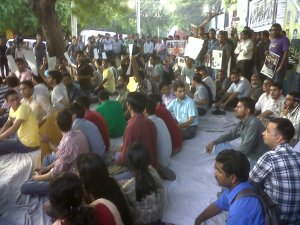
A view of the crowd at Jantar Mantar - image taken on a cell phone camera

Last evening I went to Jantar Mantar after many years. It is a road I pass often, looking at the sad and melancholic little protests that line the kerb, whispering to an indifferent Capital the million mutinies of our banana plantation republic.

Last evening was different. There were perhaps four to five hundred people, many, but not all Kashmiri, men and women, who had gathered to protest against the wanton destruction of life in the Kashmir valley by the security apparatus of the Indian state in the last few weeks and months. 45 civilian deaths in 8 weeks signals a state losing its head. Especially when the deaths occur when the police and paramilitaries fire live bullets on unarmed or stone pelting mobs. When stones, or unarmed bodies are met with ammunition, you know that the state has no respect whatsoever for bare life. That this should happen in a state that calls itself a democracy should make all of us who are its citizens reflect on how hollow ‘democracy’ feels to the mother or friend of a young boy or girl who is felled by a ‘democratic’ bullet.

Continue reading Kashmir Comes to Jantar Mantar