Tag Archives: Kashmir

Screening Jashn-e-Azadi at Presidency University, Kolkata: Waled Aadnan

Guest post by Waled Aadnan
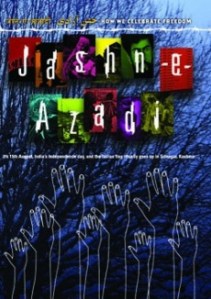
It can be said that 86/1 College Street, Calcutta, has seen a microcosm of the history of modern India unfold within its walls. Since 1874 when the already fifty-nine year old Presidency College shifted to its current address, future Presidents and Prime Ministers of  India, Pakistan and Bangladesh; Nobel Laureates, freedom fighters, an Academy Award winner, Bharat Ratnas; the leadership of the Naxalite movement of the 60s and 70s; and eminent judges, writers, journalists, scientists and actors, have spent their student days at 86/1.

Two years ago, soon after I joined the institution, the Left Front government upgraded Presidency College to the status of a state University in a last-gasp bid to hold on to the votes of the bhadralok intellectuals. 2012 dawned with no Student Union elections having been held the previous year, and it is in this backdrop that the following events unfold.

Salman Rushdie’s well-publicised ostracism from the Jaipur Literature Festival was met not with outrage in Presi’s canteen addas, but with the absence of even a poster put up in protest. News filtered in of a seminar in Symbiosis University being “threatened.” But little awareness existed among students who were more inclined to read tabloid-like, unputdownable newspapers than their relatively austere counterparts, including The Hindu which broke the story.

Continue reading Screening Jashn-e-Azadi at Presidency University, Kolkata: Waled Aadnan
The Place of Dissent in the Campus: Akshath Jitendranath

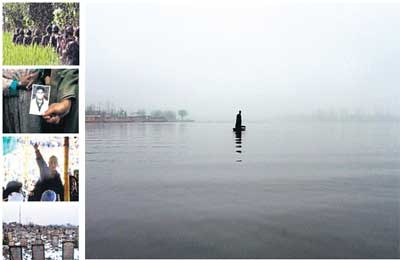
This is a guest post by AKSHATH JITENDRANATH, student at Symbiosis International University, Pune, where a screening of ‘Jahsn-e-Azadi’ by Sanjay Kak was cancelled under pressure from right-wing groups and the Pune Police.

The university campus is where nascent opinion moulds itself into ideological shape. Care must be taken to surround the student with ideologies of different shades. This is a prerequisite for any educational ideology that aspires to be holistic. Pursuant to this end the Symbiosis International University is guided by an ideology that reads, Vasudhaiva Kutumbakam, meaning the whole world is one family. This is a high ideal to be guided by.

However, the events that transpired over the last few days have left this vision a little blinded. Following threats received from the Akhila Bharati Vidyarthi Parishad  (ABVP henceforth), the Symbiosis College of Arts and Commerce have postponed indefinitely, ‘Voices of Kashmir’, a national symposium on Kashmir which was to be held with the support of the University Grants Commission. The ABVP’s major bone of contention was the screening of well known film maker Sanjay Kak’s film, Jashn-e-Azadi (This Is How We Celebrate Freedom). The ABVP claim that the film and the film maker represent an ideology that is anti-India. Further, they threatened violence if the film were to be screened. The administration of the Symbiosis International University, instead of being guided by their ideological vision, gave in to the ABVP threats. Continue reading The Place of Dissent in the Campus: Akshath Jitendranath

To the Students and Faculty of Symbiosis University on the Censors in their Midst

Dear Students, Dear Teachers, Dear Friends at Symbiosis University, Pune

You are faced with an extraordinary situation. A symposium on Kashmir that was to be held in your institution with the support of the University Grants Commission, has been cancelled, postponed (see update at the end of the post) following complaints by activists of the Akhil Bharatiya Vidyarthi Parishad (the student wing of the extreme right-wing militia that goes by the name of the RSS) against the proposed screening of a documentary film ‘Jashn-e-Azadi‘ (‘This is How We Celebrate Freedom’) by the well known filmmaker Sanjay Kak. These complaints, which could more accurately be called threats, have unfortunately received the tacit endorsement of senior police figures in Pune and seem to have met with the approval of your principal. (Thanks to The Hindu – see links above –  for the two balanced reports on this issue.) While the seminar may or may not be held (it stands ‘postponed’ as of now) the administration of Symbiosis have succumbed to the insistence of the right wing groups that Jashn-e-Azadi’s screening remain cancelled. Continue reading To the Students and Faculty of Symbiosis University on the Censors in their Midst

How We Celebrate Freedom

The Hindu reports that a university in Pune has cancelled a planned screening of Sanjay Kak’s 2007 documentary film, Jashn-e-Azadi: How We Celebrate Freedom.

Speaking to The Hindu over telephone, Symbiosis College of Arts and Commerce principal Hrishikesh Soman stated that the ABVP had approached him on Friday, and that the college agreed to cancel the film screening “considering their [ABVP’s] emotions and feelings.” “I told them that the seminar is entirely academic, apolitical and non-religious. But the film has met with criticism from all corners. So we have decided to avoid unnecessary controversies and cancel the screening,” Mr. Soman said. “If people have a very strong reason to protest the film, then we should be tolerant enough,” he stated. [Link]

Shameful as this censorship is, it is a compliment to Sanjay Kak’s fabulous documentary film that the goons of the Akhil Bhartiya Vidyarthi Parishad don’t want people in Pune to see it. The truth about Kashmir must not be told. This is also an example of why the BJP props up its ‘minority morcha’ to oppose Salman Rushdie visiting Jaipur: they want the Congress and the ‘secularists’ and the Muslims to be seen as censor-happy so that they can get away with their own censorship.

Freedom of speech and expression in India, RIP.

Or, not.

Just as Satanic Verses freely circulates on the internet, you can also watch Jashn-e-Azadi online, for free.

Film synopsis:

Continue reading How We Celebrate Freedom

Why Kashmiri Pandits May Never Return to Kashmir: Raju Moza

Guest post by RAJU MOZA

It was in the month of January in 1990 that the onset of militancy in Kashmir resulted in the exodus of Kashmiri Pandits to Jammu, Delhi and elsewhere. Every year since then, January brings back the question of their return to their homes, in the press and increasingly on the internet.

There was something different about it this year. Several recent incidents have given the question of return a new impetus. Continue reading Why Kashmiri Pandits May Never Return to Kashmir: Raju Moza

In the name of sovereignty: APDP

This release comes from the ASSOCIATION OF PARENTS OF DISAPPEARED PERSONS, the Bund, Amira Kadal, Srinagar – 190001, Jammu and Kashmir

Press Statement, 25th January 2012: On 17th October 2011, Association of Parents of Disappeared Persons (APDP) submitted an application for information under Right to Information Act 2009 to the office of the Public Information Officer of State Department of Home. The application was regarding unmarked graves and mass graves in all the districts of Jammu and Kashmir. The State Home Department vide its letter no: Home/RTI/2011/1659 dated: 24th October 2011, transferred the application to the office of Director General of Police, Jammu & Kashmir. Later Director General of Police, Mr. Kuldeep Khoda sent communiqué vide no. legal/RTI/III/98/2011-5590-91 dated 10th December 2011 to the SSP CID Headquarters, asking him to furnish a detailed report on this issue.

Today, on 25th January 2012, we have received a response from the SSP CID Headquarters vide letter no: CID/GB/RTI/2011/8756-58, in which the CID Department has informed us that the information regarding the unmarked graves and mass graves in all the districts of Jammu and Kashmir cannot be shared as the disclosure of the information, according to Jammu and Kashmir Police would be “prejudicial to the maintenance of public peace and tranquility, as the anti-national elements may use the same for incitement of commission of offence in the state”. The SSP CID Headquarters further states, “In the present security scenario it is quite imminent that consequences of such a situation would be highly prejudicial to the sovereignty, integrity and security of the state”. Continue reading In the name of sovereignty: APDP

On the Srinagar Sharia court’s statement against Christian pastors: AICC

This release comes from ALL INDIA CHRISTIAN COUNCIL comes to us via John Dayal

All India Christian Council concern at Srinagar Sharia court statement against Christian pastors

New Delhi, 13 January 2012

The All India Christian Council is deeply disturbed at the Srinagar based Sharia Court issuing a statement against Christian pastors Jim Borst and C M Khanna Srinagar, Jan 11: Supreme Court of Islamic Sharia Wednesday indicted Christian Pastor C M Khanna and Dutch national, Jim Borst for their involvement in luring people to convert their religion. The Sharia court has threatened it will issue a sentence shortly. Such statements can encourage extremist elements to indulge in violence, the Council fears. Continue reading On the Srinagar Sharia court’s statement against Christian pastors: AICC

Human Rights Review – Jammu and Kashmir in 2011: JKCCS

This release comes from the JAMMU AND KASHMIR COALITION OF CIVIL SOCIETY, the Bund, Amira Kadal, Srinagar 190001, (www.jkccs.net)

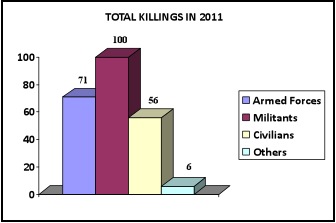
TOTAL KILLINGS

Year 2011 has just passed, and many have declared this year, a peaceful year in Jammu and Kashmir. Of course assertions of peace by various quarters are relative. Enforced silence cannot be construed as peace. Despite the hype of peace, people of Jammu and Kashmir have witnessed unabated violence, human rights abuses, denial of civil and political rights, absence of mechanisms of justice, heightened militarization and surveillance. The figures of violent incidents suggest that 2011 as usual has been the year of loss, victimization, mourning and pain for the people. Continue reading Human Rights Review – Jammu and Kashmir in 2011: JKCCS

J&K government has buried the SHRC report on unmarked graves in Kashmir: APDP

This release comes from the ASSOCIATION OF PARENTS OF DISAPPEARED PERSONS,  the Bund Amira Kadal, Srinagar, Jammu and Kashmir

28 December 2011: Callousness of the government continues vis-à-vis victims of human rights abuses and in particular against the family members of those who have disappeared in the last two decades in Jammu and Kashmir. The relatives of more than 8000 persons continue to wait for the government to probe all the cases of disappearances, deliver justice to the families of the disappeared and punish the perpetrators. Continue reading J&K government has buried the SHRC report on unmarked graves in Kashmir: APDP

Z for Zalim: Semiotics and the Occupation of Kashmir

Ours was the marsh country, down by the river, within, as the river wound, twenty miles of the sea. My first most vivid and broad impression of the identity of things, seems to me to have been gained on a memorable raw afternoon towards evening. At such a time I found out for certain, that this bleak place overgrown with nettles was the churchyard; and that Philip Pirrip, late of this parish, and also Georgiana wife of the above, were dead and buried; and that Alexander, Bartholomew, Abraham, Tobias, and Roger, infant children of the aforesaid, were also dead and buried; and that the dark flat wilderness beyond the churchyard, intersected with dykes and mounds and gates, with scattered cattle feeding on it, was the marshes; and that the low leaden line beyond, was the river; and that the distant savage lair from which the wind was rushing, was the sea; and that the small bundle of shivers growing afraid of it all and beginning to cry, was Pip. – Charles Dickens, Great Expectations

A for Apple and Z for Zebra. Children are taught the alphabet with the help of images. And the association of images with sound. It helps them associate the sound of A with the sound of Apple, and associate that in turn with the image of an apple. The alphabet book depends on images that may be familiar to children. The word Apple is a signifier, and the apple itself is the signified. This is, most simply, what semiotics or the study of signs and sign processes.

In a future world, if there are no zebras, alphabet books may have to replace the last entry with something else. What could it be? Zebra crossing? Zimbabwe?

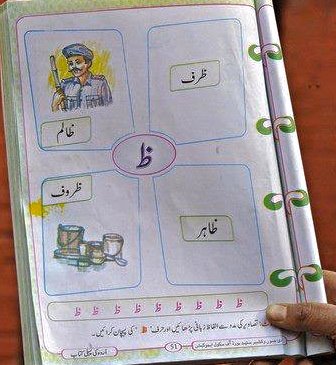
Last week, the Jammu and Kashmir Police registered a case of sedition, defamation and criminal conspiracy against six officials of BoSE, the government’s very own Board of School Education, for this:

This is a page from a book called Baharistaan-e-Urdu. This attempt to teach Kashmiri children the Urdu alphabet (note to self: this is what I need to learn Nastaliq!) makes them say, “Zoi se Zalim,” Z for Zalim, meaning cruel. That is only one of four examples. The other two are: zaroof (utensils), zahir (visible) and zarf (ornamental cup holder).

Continue reading Z for Zalim: Semiotics and the Occupation of Kashmir

Merry Christmas, Rev. Khanna: Thinking about Freedom and Intolerance in Kashmir

I want to begin writing this by wishing a very happy Christmas to Reverend C.M. Khanna, a Protestant presbyter in the All Saint’s Church, Srinagar, Indian held Jammu & Kashmir, who has been facing a situation that no free man should ever have to countenance. He has had to face an arrest (though, thankfully now he is out on bail) and social ostracism for doing nothing that can be construed as criminal or harmful to any individual or society at large. I write this in solidarity with him and his family, and with all those who have been harassed for their faith, or for their lack of faith, anywhere.

(Please follow this link for a comprehensive report on Rev. Khanna’s situation, in the form of a press note submitted by John Dayal)

I know that many people in Kashmir continue to be in prison for reasons of conscience, because they want to be free of the occupation. And this Christmas, my greetings are to them and to their families too. I know that Reverend Khanna is out on bail now, and that many others are not. And I hope that they too will see freedom soon. I am writing about Reverend Khanna not because I value his freedom more than that of others incarcerated in Kashmir, but because if we value freedom, we should not have to measure its value, or calculate its worth depending on who happens to get bail, and who happens to rot in jail. Continue reading Merry Christmas, Rev. Khanna: Thinking about Freedom and Intolerance in Kashmir

Shahid in Srinagar: Arif Ayaz Parrey

Guest post by ARIF AYAZ PARREY

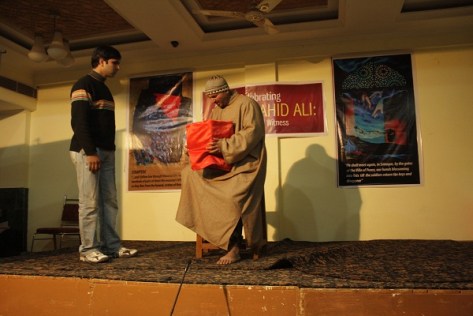
Photo by Muhabit-ul-Haq / TheKashmirWalla.com

I must go back briefly to a place I have loved
to tell you those you will efface I have loved [i]

Exactly ten years after he left us, Aga Shahid Ali returned to his Kashmir. A couple of days earlier, many parts of the valley were blessed with the season’s first snowfall, signalling an end to Harud, the autumn season in Kashmir, and ushering in Wande, the winter. The sky over Srinagar was overcast too, as it has been for the past few days, maybe because this year Moharram has been particularly demanding, with mourners not being allowed to mourn because “the processions might be used by separatists to whip up anti-India sentiments”. The reason for the ban is announced from the same bureaucratic offices which, during the summer, employ the entire state machinery to ensure that people from the plains can climb up the mountains into a cave where Amarnath wants to spend some private time with Parvati so that he can explain to her the mysteries of immortality (Which must include, one would like to presume, the secrets of the longevity of a fragile mountain ecology.) Some like to define this variance in state policy and practice as “secularism”. The connection between the tyranny of Karbala and the present-day Kashmir is firmly established, once again. Continue reading Shahid in Srinagar: Arif Ayaz Parrey

Parveena Ahangar rejects CNN-IBN’s nomination for ‘Indian of the Year 2011’

This press release has been issued by the PARVEENA AHANGAR-led ASSOCIATION OF PARENTS FOR DISAPPEARED PERSONS

Srinagar, December 10, 2011:  On this ‘International Human Rights Day’, December 10, 2011, the APDP (Association of Parents of Disappeared Persons), Srinagar, wishes to state that there is something obscene and perverse in the manner the CNN-IBN has nominated our organization for the ‘Indian of the Year 2011’ award. Sometimes, human rights can be violated by merely mocking those who struggle for human rights. Continue reading Parveena Ahangar rejects CNN-IBN’s nomination for ‘Indian of the Year 2011’

Pundit Manto’s First Letter to Pundit Nehru

This is M. ASADUDDIN‘s translation of a letter written by SA’ADAT HASAN MANTO to Jawaharlal Nehru in 1954. This translation first appeared in The Annual of Urdu Studies (volume 11, 1996).

Pundit-ji, assalamu alaikum!

This is the first letter I’m sending you. By the grace of God you’re considered very handsome by the Americans. Well, my features are not exactly bad either. If I go to America, perhaps I’ll be accorded the same status. But you’re the Prime Minister of India, and I’m the famed story writer of Pakistan. Quite a deep gulf separating us! However, what is common between us is that we are both Kashmiris. You’re a Nehru, I’m a Manto. To be a Kashmiri is to be handsome, and to be handsome … I don’t know. Continue reading Pundit Manto’s First Letter to Pundit Nehru

An open letter from a photojournalist assaulted by Indian security forces in Kashmir: Yawar Kabli

Guest post by YAWAR KABLI

AP photo by Yasin Dar: Local Kashmiri photographers Yawar Nazir, left, and Showket Shafi wait for treatment after they said they were assaulted by police and paramilitary forces during a protest in Srinagar, India, on Nov. 25. At least four journalists said they were assaulted by police and paramilitary forces Friday as they covered a protest in Indian-controlled Kashmir.

All freedoms enshrined in the Constitution of India are being violated or altogether thrown away by the Jammu and Kashmir Police. One could substantiate that with any number of examples. We were not the first pressmen to be thrashed by the police while covering the stone-hurling protests in the Kashmir. On Friday, 25 November 2011, without any rhyme or reason policemen along with the Central Reserve Police Force (CRPF) thrashed four of us, including me, and snatched away our expensive cameras. They did not even hesitate to bundle us into police vehicles while taking us to the Khanyar police station.

Continue reading An open letter from a photojournalist assaulted by Indian security forces in Kashmir: Yawar Kabli

Uthao, uthao video ab, won’t you make the video now?

This photograph shows photojournalist Shahid Tantray being assaulted by the Central Reserve Police Force in Srinagar on 25 November 2011

No tears will be shed for press freedom for attacks on journalists in Srinagar by the Central Reserve Police Force and the Jammu and Kashmir Police. Fahad Shah reports what happened in Srinagar yesterday:

Journalists were beaten up and one of them detained, today, when they were covering the post-Friday prayers protests in the Old City, here at Srinagar. Umar Mehraj, who works as video journalist for Associated Press says he, along with other journalists, was covering protests when Central Reserve Police Force (CRPF) and local policemen start beating. He said while beating, the forces were shouting, “Uthao, uthao video ab (Shoot, shoot the video now.).” Umar says his camera was broken and they were abused too.

Continue reading Uthao, uthao video ab, won’t you make the video now?

Rain, Eid and Geelani: Sameer Bhat

Guest post by SAMEER BHAT

A fine rain was falling as I disembarked the aircraft. Srinagar was shivering at 7 degrees centigrade. Rams and ewes, all set for slaughter on Eid, looked forlorn. Meat-market persons in untidy pherans haggled with locals for rates. Half the male population, I noticed, had not seen a shaving blade for weeks, a very Kashmiri trait most noticeable in winters. While it continued to drizzle, queues outside ATM machines got fretful. At least three people entered the cashpoint at one time to witness your transaction. The invasion of financial privacy has a very harmless ring to it, which is very indigenous. Continue reading Rain, Eid and Geelani: Sameer Bhat

Mistaken Identity: Arif Ayaz Parrey

Guest post by ARIF AYAZ PARREY

The Indian army in Kashmir must be reading a lot of Manto these days. Or Borges. Or Kundera. Or –and this is most likely, given the approaching winter season and their ‘hearts and minds’ programme– Kashmiri folklore.

Not three months have passed since they made a highly publicized acknowledgement of “mistaken identity” after they had killed a mentally “challenged” “Hindu” youth in Poonch and declared that he was a “fierce” “Pakistani terrorist Abu-Usman killed after a 12-hour long gunbattle” (such valour exhibited by the Indian security forces is the stuff of legends in Kashmir) that they have followed it with another announcement of a (dis)similar “mistaken indentity”.

This time, like always, the culprits are the Kashmiri people (whose synonym in the Indian army’s dictionary is “miscreants”) Apparently, people beat to pulp a “member of a covert team of the army and J&K police” who were “sent to Sopore Town on getting info of presence of terrorists in the public rally addressed  by SA Geelani”. The person was carrying a camcorder and his service pistol. The people thought he was the terrorist.

Democracy? History? Or “mishtake”? Choose your option.

Kundera writes, “When the institutions of a state no longer feel the need to make sense or to give plausible explanations, the state can only survive as long as people allow it to lie shamelessly.”

See also:

Previously in Kafila by Arif Ayaz Parrey:

Hooligans of Bhagat Singh Kranti Sena strike again

Maraa, a media and arts collective in Bangalore, has been organizing a monthly event called Pause: Creative Practice in Conflict.  This is a public event, inviting one speaker to present examples of creative practice in a conflict afflicted area. Previous events have showcased examples from Palestine and Afghanistan. In November, Maraa had planned a similar event on Kashmir, scheduled to be held on November 5th 2011.  

Bhagat Singh Kranti Sena (the same people who physically assaulted Prashant Bhushan recently for his statement on Kashmir), and its president, Mr. Tejinder Pal Singh Bagga, wrote a letter to the police alleging that the event which was to be held in the premises of a theatre organization, rafiki, was being organized by the Hurriyat Conference, at which Syed Shah Geelani or Mirwaiz Umar Farukh from the Hurriyat Conferece would speak. They warned the police that if they would not come to stop the event, their organization would make it a situation with unpleasant consequences.

Further, the Bhagat Singh Kranti Sena and Mr. Tejinder Pal Singh Bagga, posted online invitations on social networking site, Facebook, inviting people to come with stones, paint, eggs and tomatoes, to merge in with the audience, and then create chaos. There have been various comments responding to it, by promising violence to those who attend and organize such events.

The following statement has been issued by Maraa in this context:

Continue reading Hooligans of Bhagat Singh Kranti Sena strike again

Kashmir’s Horcrux: Sameer Bhat

Guest post by SAMEER BHAT

Hectic parleys are on at the moment to jettison the dreaded AFSPA in the valley. By conservative estimates the army must have beaten about one in every five Kashmiris at one point or the other since this piece of horrible legislation was slapped on us. An unjust law, is no law at all, Martin Luther, the symbol of protestant reformation, verbalized the sentiment of St Augustine in the 15th century. Rings true to this day.

For more than twenty years people have been punched, thrown in the back of military trucks, knocked down by gun-butts, given kicks, pushed around as they got off a bus or simply slapped around for no apparent reason. Just for being themselves, perhaps. No you could not question the moral turpitude of a military-walla from Madras if he clubbed your aging father.  Continue reading Kashmir’s Horcrux: Sameer Bhat

A prologue to memory: Arif Ayaz Parrey

Guest post by ARIF AYAZ PARREY

Over the corner shop at the busy crossing near home hangs a white board on which the words ‘Muzaffar Pan-House’ are painted in bright red. On the right side of the words, an artistic rendition of the side-view of Muzaffar’s face can be seen. His left hand is also painted in, holding a cigarette. The grey smoke emanating from the cigarette does not vanish before it touches the top of the board.
Continue reading A prologue to memory: Arif Ayaz Parrey