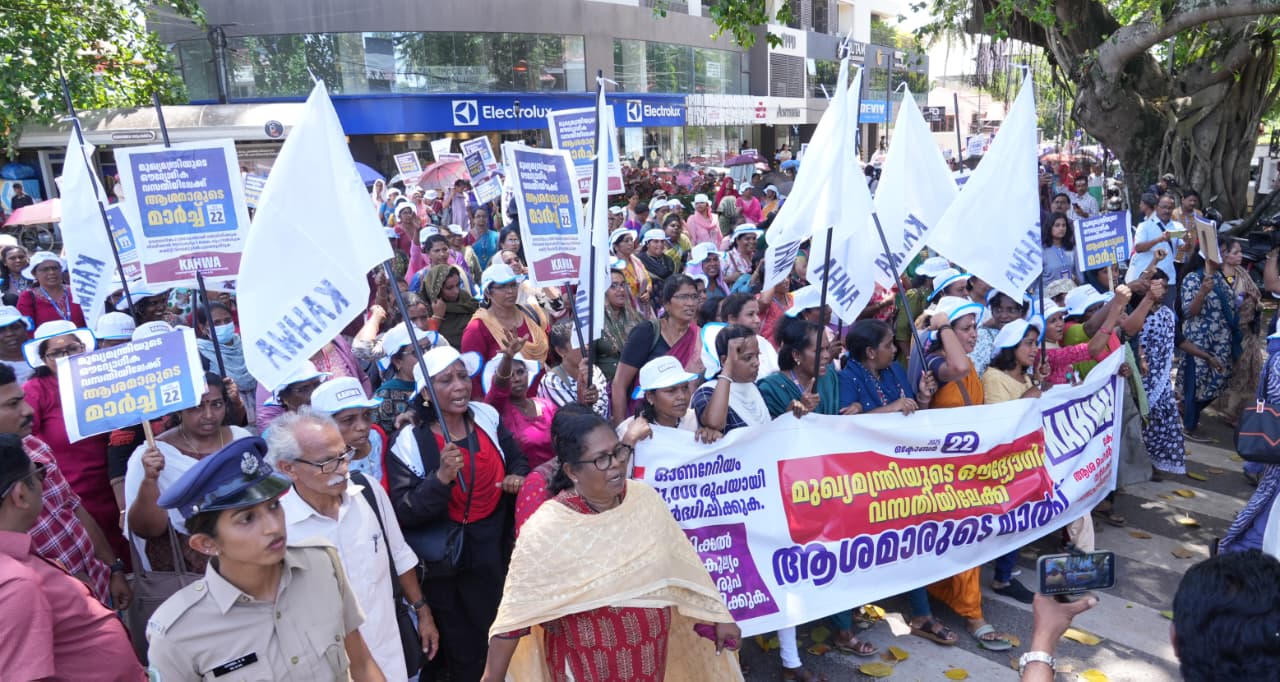
Yesterday, the protesting ASHA workers marched to your residence in the pouring rain, seeking to rouse you from your utterly inexcusable stupor. Yes, over the past eight months, you tried to first crush the strike, and then to kill it by ignoring it. Who does not know that the worst form of violence is indifference?
I am writing to you about the dire situation in Kerala with reference to the strike of the Kerala ASHA Health Workers’ Association for minimum wages and a five-lakh one-time retirement benefits, which has been continuing since the past two months.
There is a huge difference between democratic struggles outside Kerala, and those which unfold inside the state at the moment. While elsewhere they strive to make democracy integral to the system, in Kerala we are struggling desperately to keep alive, at least, the traces of something that we had, a fairly democratised society and a tolerably responsive state.
We write to you out of serious concern about the precarity of the lives of the Kerala ASHA workers on strike and the hostility shown to them by the elected government of Kerala. The ASHA workers’ strike has entered its 50th day and the twelfth day of their indefinite hunger strike. Hundreds of workers are outside the Secretariat building striking for the demands to be heard by the left-led State government, braving the heat stress, sporadic thundershowers, and the humiliation from the government and mainstream party workers.
They have been ridiculed and accused of being puppets of the “fascist, fundamentalist” right-wing trying to jeopardize the elections in 2026. Their backing from SUCI and AIDSO has provoked mainstream left politicians and intellectuals even further, accusing them of being too radical to understand the need to be united at this time. Yet the CPM and its allied organizations, unions have declared unconditional support to ASHA and Anganwadi workers in other states, declaring a nation-wide strike on 20 May.
We reject this apathy and accusations against the workers on strike. We also request that you sign-on to this petition to be submitted to the Chief Minister’s Office as a testament to the broader support that the workers have from the public and civil society in Kerala and across the country.
Please sign the petition for the workers demands to be accepted by the Kerala State Government and circulate this in your networks.
[This is my translation of the statement issued by Kerala’s People’s science /development movement, the Kerala Sastra Sahitya Parishat, about the ASHA workers’ strike, which is now in its forty-fourth day.]
The ASHA workers of Kerala have been on strike since forty-two day now, engaged in seeking an increase in honoraria and other benefits. The issue continues to remain unresolved. The ASHA workers comprise a sector in which 26,000 workers currently work. They are all women, attached to a Central scheme, and receive merely Rs 7000 per month as honorarium. For this reason, it is the duty of both Central and State governments to consider their demands in a democratic fashion and respond with sympathy. The very many struggles unfolding among Accredited Social Health Activists now must be developed into a people’s struggle against globalized economic policies, and the issue of their wage must be settled with Central and State governments working together. What we see in the ASHA workers’ struggle in Kerala is the crisis and tension emerging from the one-sided and top-down imposition of globalizing tendencies upon a society that had grown and developed within the framework of a welfarist state.
Kerala’s public health sector was well-coordinated and accessible to all since a very long time. It is marked by a pro-poor orientation. A large network of health experts and professionals, from doctors to public health nurses, work in it. They are all appointed officially and formally, and are regarded as workers and employees. Therefore, their remuneration and conditions of work are well-defined according to existing rules and laws.
The scorching sun in Thiruvananthapuram has been unrelenting. Usually, the festival day of Attukal Pongala, on which thousands of women set up temporary hearths outside their homes and on the roads of the city to cook sweet payasam for the goddess of the Attukal temple, ends with cooling showers. This time the skies were cloudless.
Yesterday was a day of great strength, solidarity, and remembrance of women workers’ historic struggles for rights and against tyrants. Support for the striking ASHA workers poured in from civil society — cine artists Kani Kusruti, Divya Prabha, Rima Kallingal, and Jolly Chirayath, writers Arundhati Roy, Sara Joseph, and Rosemary, feminist academic researchers Nivedita Menon and Janaki Nair, filmmakers Leena Manimekalai and Paromita Vohra expressed solidarity with the workers. Paromita Vohra inaugurated the morning’s meeting. A cross-section of Kerala ‘s civil and political society, spoke in solidarity. Representatives of feminist groups spoke. The Dalit Human Rights Movement conducted a solidarity march led by their leader Reshma K. Gomathi, of Pomblai Otrumai, spoke about what lay ahead for the striking workers, based on her experience of confronting the CITU during the Munnar tea garden workers’ strike. Representatives of the United Nurses Association took out a solidarity march and their leader spoke in the meeting. Hundreds of ASHA workers and representatives of ASHA worker unions from Tamil Nadu and Karnataka were present.
The workers welcomed all , but also spoke their mind. When the Siva Sena — a group of men — arrived, they were politely asked to vacate centre stage and make space for a woman from their ranks. The representative of the national federation that the KAHWA is affiliated to declared in completely non-ambiguous words that the fight was against the Union government; she welcomed support from members of the NDA but told them that their support was crucial not in Kerala but in Delhi. We expect you to offer the same support when we approach the union government, she said. And also noted: no political party, including the Congress, will take up the issues of the ASHAs wherever they are in power .
Meanwhile, the voice of the national CITU, A R Sindhu, continued to repeat the Kerala CITU male leadership’s ‘silly little sheep’ hypothesis about the striking women workers, and the much-flogged conspiracy theory against the SUCI, using the same bunch of fallacies deployed by the CPM’s fallacy-peddlers’ union workers ( a union that is still a future possibility, but a real one) led by the likes of K K Shahina. Sindhu speaks like the Kerala CITU’s B Team, even though she calls for talks to end the strike. B team because outright strike denigration seems to be the privilege of the Alpha males in the CITU.
What is truly appalling about her long essay in the Malayalam online magazine Truecopy is its chilling lack of empathy. V T Bhattatirippad , the social reformer, once remarked about the CPM leader EMS Namboothirippad that he was the kind of person who, when faced an urgent call for help with a woman in labour desperately thrashing about in pain, will respond with long analyses about the terrible lack of health care facilities, the bad roads in the country, the need for more doctors etc. He was right about these of course, but that cannot replace an empathetic response.
A R Sindhu and Veena George respond in this way — without empathy. The ASHA workers are striking because the CPM’s election manifesto promise of Rs 700 a day for scheme workers is expiring soon. They are desperate with delays and the sheer impossibility of surviving in Kerala where the cost of living is relatively high. The workers’ strike is actually out of desperation, but the CPM last leaders meet it with a bunch of cold bureaucratic reasons that are all already well known: central funds are insufficient, they are delayed, you are merely scheme workers, we pay you more than x,y, z… And when they persist and continue to talk about their crisis-ridden lives, Veena George loses her cool, and dons a true kochamma tone — what a load of bother, she stomps her little foot in impatience. Go away, go ask the Union government! Her Royal Highness’ guard rush to her aid at once, trying to shoo the beggars away, while the CITU male leadership aim poison tipped arrows of misogynist insults at them.
However, whatever the monarchical imagination of our rulers, we still think ourselves as the citizens of a democratic country. Sindhu is miffed that certain academics and intellectuals are on the side of the striking workers. C’mon, Sindhu! Your government in Kerala has a whole menagerie which has an entire collection of cosseted intellectuals.
I ask you, send them out against these’ untamed’ intellectuals! We untamed creatures deserve some fun too, I tell you.
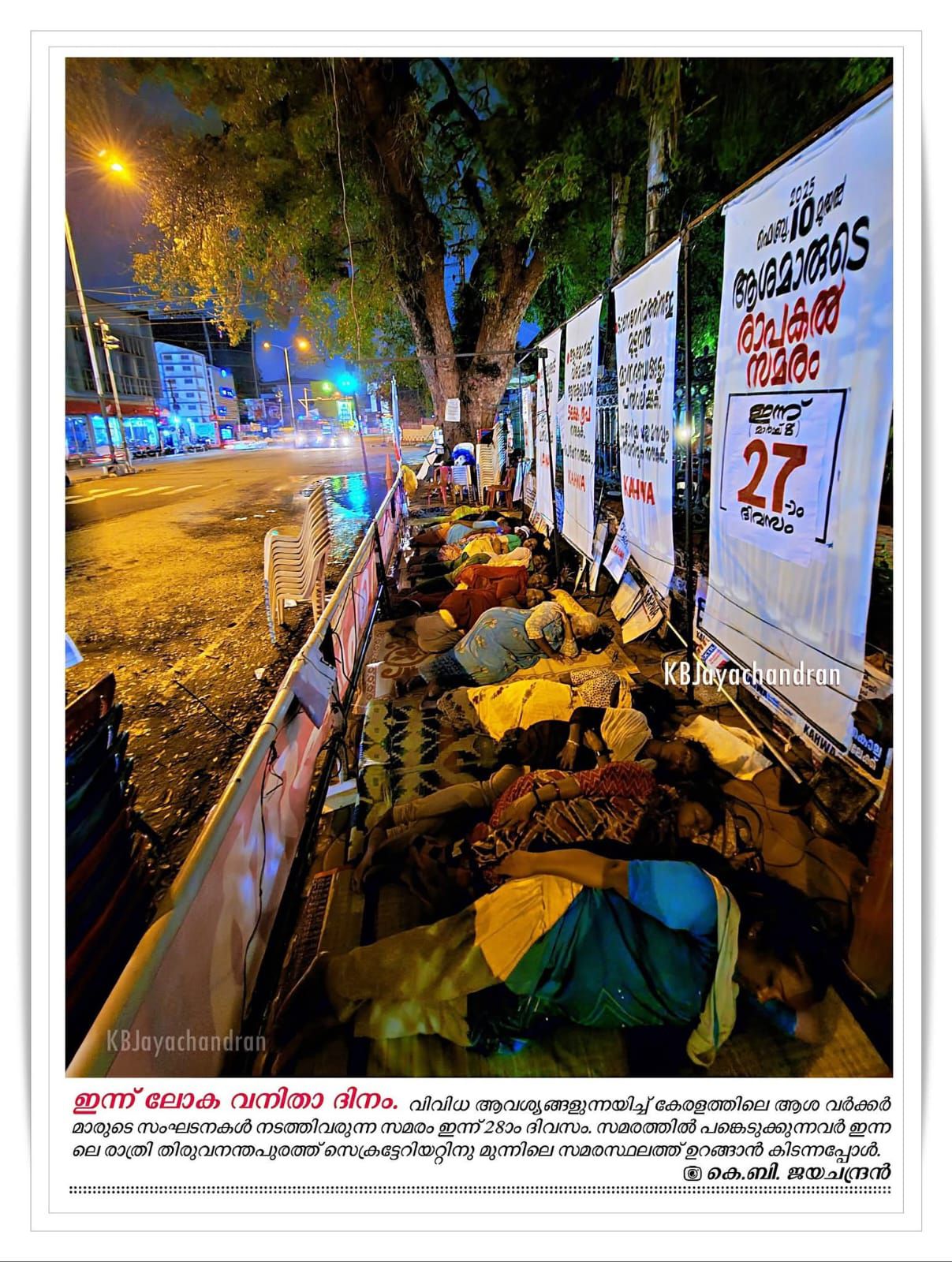
ASHA workers on strike for the twenty eighth day, sleeping in front of the State Secretariat in Thiruvananthapuram.
Happy Women’s Day from Kerala, the Land of Women’s Empowerment!!
On this day, true to the fighting spirit of the women workers who fought valiantly for their rights and who faced the tyrant’s bullets fearlessly, Kerala’s COVID-warriors, our ASHA workers, sleep on the rain-soaked pavement in front of the State Secretariat in the capital city of Kerala.
Happy Women’s Day, Pinarayi Vijayan and Veena George. You must getting ready for the day refreshed by sleep in your soft beds, in the mansions that we the citizens of Kerala have funded for the comfort of our rulers.
Happy Women’s Day, Com. Thomas Isaac. Yes, you wouldn’t have been so famous the world over, if not for ‘women’s empowerment’ and the whole local-level development jingbang! See how empowered they are now. I am sure you must be happy now.
Happy Women’s Day, all of you in the CPM who have fattened on the achievements of women development workers — T N Seema and others — and the CPM hanger-ons who have managed a ‘feminist look’. Those women have learned to resist power, what a shame! I can imagine you rolling your kohl-lined eyes, frown-lines creasing those big red bindis on your foreheads . Those who set out to empower Kerala’s poorest women are now truly EM-powered. What an interesting and convenient twist!
Happy Women’s Day to Kerala’s ‘development movement’, the Kerala Sastra Sahitya Parishat! But I did not know that a people’s science movement went into mauna vratas, en masse. There can be no other explanations for their stunning silence, for all their concern about Kerala’s local-level development and public health.
Happy Women’s Day, feminist development experts who have all got nice shares of glory, along with other resources, from the Kerala government’s propaganda upholding its commitment to women’s empowerment … you who have not bothered to utter a single word despite seeing this rank injustice unfold … Private expressions of shock are useless, you know?
The Kerala government’s mulish refusal to negotiate with the striking ASHA workers is baffling no matter what angle you may think of it. The promise of raising the ASHA workers’ daily pay to Rs 700 was an LDF election promise, part of the election manifesto — how can they call it unreasonable now? Raising the pay of ASHA workers would bring back to the well-feeling of twenty six thousand grassroots workers who are well-respected in their communities, but the CPM leadership does not bother, and the CITU studs seem determined to piss them off. In the legislative assembly, Veena George reels off breathtakingly false information, when anyone with access to the official website of the Sikkim government can read government orders that expose her.
But civil society now sees the hubris and expressions of support and anguish at the government’s apparent lack of grace and respect for life -saving labour are pouring in. I am posting here a particularly striking one, a poem by the well-known poet in Malayalam, Desamangalam Ramakrishnan. Aasha in Malayalam means a fervent wish; it also means hope. In this short poem, the poet uses the word to evoke a feeling for the crisis we Malayalis face — of hope in a system, that once swore by the values of care and social justice, intertwining it with the government’s deliberate cruelty to the striking workers. The poem is titled Aashaikku vakayundo?
Any chance of aasha?
Desamangalam Ramakrishnan
Any aasha? – is there any hope left, ask the mothers who wait with handfuls to line the pockets outside the hospital’s operation theatre.
Harassed travellers, waiting endlessly till the middle of the night ask: Any aasha left? Any hope that a bus, any bus, might come?
Any aasha, hope?
Caring-women, bringers of food, water, comfort, tell those who wait in terror, locked down at home: do not abandon hope, do not give up your aasha even if an elephant pins you on its tusk…
Any hope? Through steep and narrow paths the caring-women run, to knock on the door of a piteous scream and drive away the sickness with love. They say: abandon not your aasha; be not bereft of aasha, let the humble shoots of hope sprout.
Is there hope, is there aasha? Though it’s just a few paltry coins, when will it fill the waist-folds of one’s dignity and pride?
When it writhes its last writhing on the door step of the king of the land who tied its tongue and left it to beg, our pottan theyyams, oracles, leveller-spirits, will break their chains, swarm out of cellars, surely.
Or, has Power turned the one who once sprinted through these paths holding aloft the flag woven from the threads of our blood, into a mad brute?
I am writing to appeal to your sense of justice and support for workers’ rights especially with regard to the Kerala Asha workers struggle for timely payments, commensurate incentives and remuneration on par with other development workers.
The participation, unstinting labour and commitment of women has been central to several development initiatives in the country, including Kerala. The sad and ironic part is that these women workers are labelled as volunteers and their labour not given its due recognition, respect and remuneration commensurate with the ever-expanding portfolio of responsibilities they shoulder. To remind ourselves, during the Covid pandemic Asha workers across the country bravely, and at considerable personal risk, reached out support to their communities.
Many of us look to Kerala to take the lead to determine and protect the rights of all workers even those labelled as “volunteer workers”. And I am sure Sir, your government is all too aware that “volunteer” is a misnomer, as Ashas are doing full time work.
Once again, I appeal to you and your government to take a positive to meet the demands of the Asha workers.
As the ASHA workers’ strike continues today despite pouring rain today, they have been subjected to a new line of attack. The BJP MP, Suresh Gopi, visited the protest site the other day. Nothing earth-shaking happened. No grand announcements of benefits were made; the striking workers did not hesitate to signal to him that he was speaking from a position of power, and hence the words offered were not enough.
The COVID-19 pandemic brought home that everything of value, beginning from the very regeneration of life, is entirely dependent upon human labour in all its diverse, productive and reproductive forms. Yet, this life-making regenerative labour is pegged at the lowest level when it comes to recognition, rights, entitlements, and status in the labour market. While this is a no-brainer when it comes to governments committed to capitalism that rely on women’s unpaid/partially paid labour to drive development schemes, one wonders how the government of Kerala, committed to a more egalitarian political economy, unleashes violence of such magnitude on grassroot women workers.
The Indian Community Activists Network (ICAN) extends it unwavering support to the striking ASHA workers led by the Kerala ASHA Health Workers Association (KAHWA).
ASHA workers, at the grassroots level, are the main workforce of the public health sector. However, the succeeding governments at the Centre and states have always refused to recognise their immense value to the poor and needy in the rural India. They serve village folk and carry the health messages to the doorsteps of every household.
Despite their great service they are the lowest paid employees who are euphemistically known as volunteer-workers. Using this title, the government has abandoned its responsibility to pay them a decent salary. We are dismayed to note that the situation is no better in a state like Kerala ruled by LDF which boasts of speaking for the poor.
Friends, your demand to raise your remuneration up to Rs. 21,000 is just in view of the minimum wage Rs. 18,000 of an unskilled industrial worker approved by the government. ICAN hopes that the LDF government sees merit in all five demands raised by you and act in a reasonable manner by accepting them. We are confident of your success.
Kerala’s public health system, the pride of the state, stands on the labours of many groups of people who are neither paid well nor recognized enough. The ASHA workers form one such important group who reach out to Kerala’ those sections of the lower middle class and the poor sections who cannot afford expensive private care. They are our vital health support structure in the event of pandemics and natural disasters, too. In Kerala, in the past decade we have known at least in two moments of crisis – the floods of 2018 and the pandemic – how crucial this force is in containing disease and keeping up the morale of people even in the remotest locations. As Kerala’s public health system gears up for further challenges, the workloads of these workers will only increase; the current workloads they carry, of carrying out numerous health surveys is already huge indeed.
As a long-time advocate for the rights of women and their empowerment, we are used to comparing the situation of women in Kerala as a good model for women’s empowerment in all fields of life. The history of workers’ struggles and the fact that even women in the informal sector receive government benefits after retirement is a shining example to the rest of the world.
In the past few weeks, the CPM ministers, CITU leaders like Ilamaram Kareem and CPM cyber propagandists have been relentless in their attack against the SUCI, heaping on them insult after insult. The preferred insults have been ‘anarchists’ and ‘tin-pan fund collectors’. The SUCI is a small group of committed people who have however produced significant political impact. They have indeed been a thorn in the flesh of the local CPM for quite some time — from at least the anti-waste dumping struggle at the panchayat of Vilappilsala in 2012 to the K-Rail protests, the SUCI’s intrepid persistence was important in forcing the government to back off. These insults are not new either; we have been hearing them since back in 2012 or earlier. But the Kerala Asha Health Workers’ Association has been especially targeted for slander, as though they were just a tool of the SUCI.
We request the Kerala Government to take necessary actions to end the day/night strike of the Accredited Social Health Activist (ASHA) workers in front of the Kerala secretariat for the last 17 days by meeting their just demands. ASHA workers were the backbone of our valiant fight against the COVID-19 pandemic. However, their work is not acknowledged by our society or our government. The honorarium they receive is paltry compared to the important work they are doing.
It is distressing to read the news of the way in which the ASHA workers’ strike in Kerala is being handled. To say that ASHA workers are being misled by anarchist organisations, as one of your senior leaders did, is to deny their own agency as they agitate for their just demands. It is wilful forgetting of the long history of trade unionism and social activism in the state, which contributed to the famed Kerala model of development.
After branding the ongoing ASHA workers’ strike in Kerala, now in its third week, as ‘unnecessary’, the CPM, the leading constituent of the ruling LDF, is now proceeding to stage 2 of strike-denigrating, deploying its master-strike-denigrator — the ex-Minister and CITU leader Elamaram Kareem. This man is notorious for his anti-people stance in many earlier workers’ struggles, notably the epic struggle to end the terrible pollution of the Chaliyar river by Birla’s factory there. The full misogyny that defines the present-day CPM leadership in Kerala, as well as its reeking elitism, may be found in the ugly article that he wrote in the CPM’s organ, Deshabhimani a couple of days back. Despite the CPM’s claims about ‘women’s empowerment’, if one takes Kareem seriously, it now firmly believes that the public care work that the ASHAs do are only ‘service’ and that they are ‘not workers’.
The Tamil Nadu Textile and Common Labour Union (TTCU) stands in solidarity with the ASHA workers of Kerala, whose strike has now entered its third week. As a women’s trade union we understand how difficult it is for women workers to step away from their responsibilities and take to the streets. It is never an easy decision, but one that becomes necessary when all other avenues to have their voices heard are exhausted.



 KAFILA - COLLECTIVE EXPLORATIONS SINCE 2006