Tag Archives: Subhash Chandra Bose

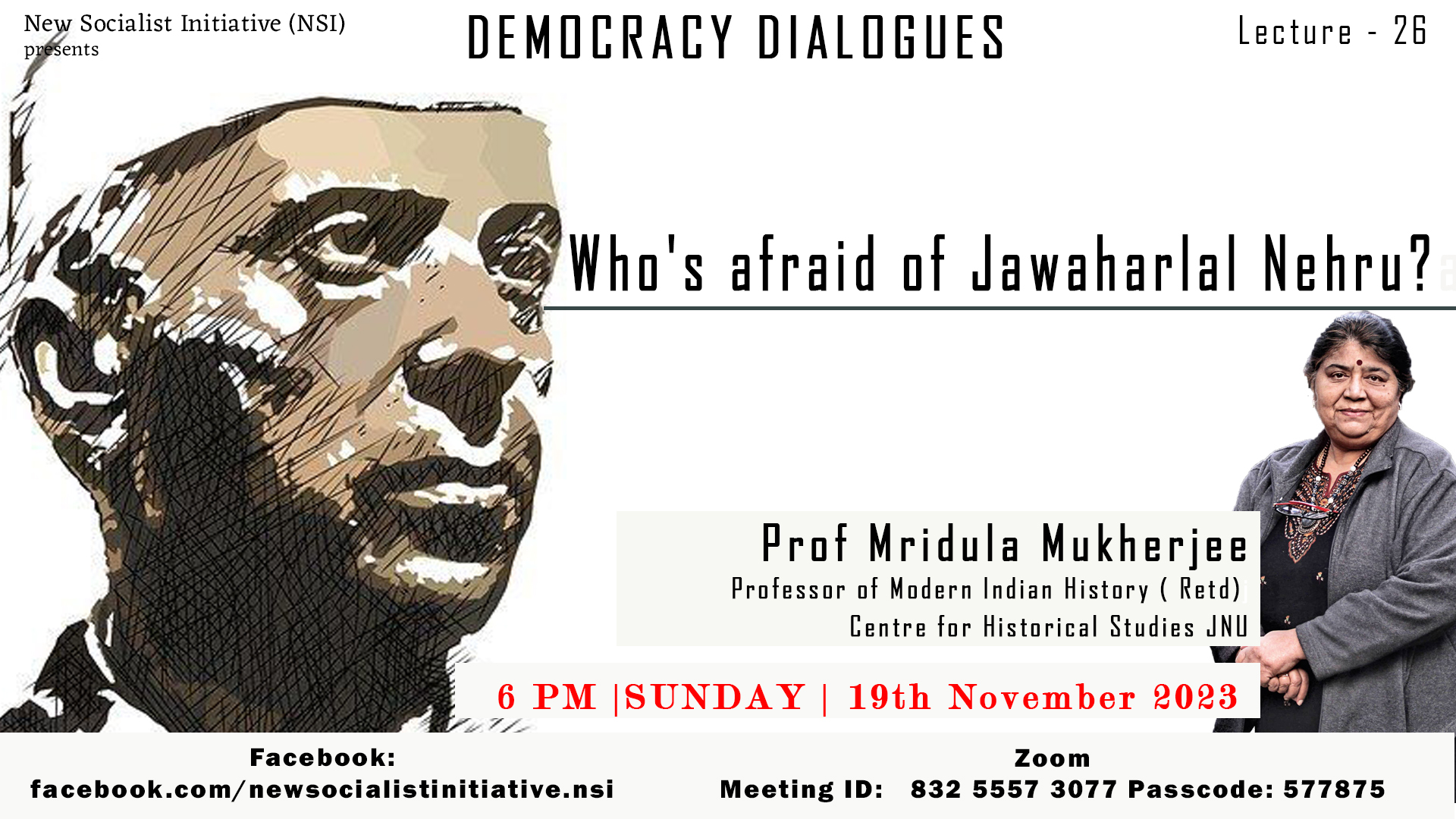
‘Who’s Afraid of Jawaharlal Nehru?’ Mridula Mukherjee – Lecture notice

Professor Mridula Mukherjee, Professor of Modern Indian History ( Retd), Centre for Historical Studies, JNU, will be delivering the 26 th Democracy Dialogues Series lecture on Sunday, 19 th November 2023 at 6 PM (IST).

Theme :
Who’s Afraid of Jawaharlal Nehru?
Time: Nov 19, 2023 06:00 PM India

Join Zoom Meeting
https://us02web.zoom.us/j/83255573077?pwd=RXdiblVjcWZaeDdqVmJaSjI3aW9Qdz09

Meeting ID: 832 5557 3077
Passcode: 577875

Also live streamed at: facebook.com/newsocialistinitiative.com
——————
Theme : 
‘Who’s Afraid of Jawaharlal Nehru?’

Summary :
In his lifetime, Jawaharlal Nehru was recognized the world over as a statesman and an Indian leader second only to Gandhiji. A foremost leader of the freedom struggle, who gave it a decided socialist orientation, he remained unrivaled as Prime Minister after independence and built the solid foundations of a sovereign, secular, democratic, and egalitarian republic. He evolved the concept of non-alignment which enabled many ex-colonial countries to avoid becoming a part of the two power blocs engaged in the Cold War.

However, he is today the favourite whipping boy of the establishment.  We are told he was responsible for the partition, for the mess in Kashmir, for the death of Subhash Bose, for delaying the integration of Hyderabad, and of Goa, for the defeat at the hands of China in 1962, for neglecting agriculture, and primary education, and much else. The reason for the defamation is of course that he stood for the exact opposite of what is valued today. His life and work present a continuous question mark to the regressive trends in fashion.

This will become evident as we focus in the talk especially on two areas of great relevance today in which we are facing a grave crisis: Democracy and Civil liberties, and Communalism/Secularism. We will also focus attention on Nehru’s evolving understanding of  Mahatma Gandhi’s vision and method of non-violent struggle, of which he became the most ardent advocate after his death.

Speaker :

Author of many books, Prof Mukherjee has been a visiting Scholar at Duke University, USA, and at the Institute of Oriental Culture, University of Tokyo and was also Director of Nehru Memorial Museum and Library, ( NMML), New Delhi.
She has published widely in the areas of agrarian history, peasant movements, social movements and the Indian national movement.

Here is a list of a few of her publications :
Colonializing Agriculture, The Myth of Punjab Exceptionalism Sage (2005) ;  Peasants in India’s Non Violent Revolution : Practice and Theory (Sage 2004).

This list also includes India’s Struggle for Independence (1999) and India After Independence 1947–2000 (2000), RSS, School Texts and the Murder of Mahatma Gandhi The Hindu Communal Project (2008) co-authored with Prof Bipan Chandra and others.
Dear Hitler

Why does Hitler’s legacy in India greatly differs from that in the West. More removed from the traumas associated with World War II and the Holocaust  

…………………………………………………………………….

..An innocent question sometimes comes up with very troubling answer(s).

J’admire ( I admire)… a simple exercise given to students to know from them whom they appreciate as a great historical figure or a hero, became a great learning experience for a teacher who taught French at a private school.

Writer and Journalist Dileep D’souza, who has authored many books, and writes on social-political causes shared the experience of his wife who posed the said question before them during a discussion. What she was expecting that they would mention Gandhi or Bhagat Singh or other luminaries of India’s struggle for freedom and progress but none of her predictions came true. There was a lone student whose choice was Mahatma Gandhi but nine out of 25 students in her class admired Hitler as hero or as a great historical figure. Continue reading Dear Hitler

The Bose Republic


The recent violent event in Mathura has  outraged many people. But more than anger, there is bewilderment. It is difficult for people to accept that right in the heart of a town like Mathura, part of the mainland, there existed and flourished  a liberated zone. Liberated zones in our imagination are created only by Naxalites or Maoists in the jungles of Chhattisgarh or Jharkhand. And they are inspired by ‘alien’ ideologies like Marxism or Maoism. This makes it easy for us to label them as ‘anti-nationals, conspirators’ who are out to dismember our nation. They have ‘collaborators’ hiding in places like JNU, masquerading as students and teachers. Continue reading The Bose Republic

भगत सिंह और आज का नौजवान: अपूर्वानंद

कभी कभी हर समाज में ऐसे क्षण  आते हैं जब उसे अपने अस्तित्व के तर्क की पड़ताल करनी पड़ती है. उस समय वह अपने किन बौद्धिक संसाधनों का प्रयोग करता है और किन स्रोतों से तर्क की सामग्री जुटाता है, यह  काफी महत्वपूर्ण है.क्या एक समाज के रूप में भारत के लिए अभी ऐसा ही कोई क्षण उपस्थित हो गया है? एक ऐसा तबका है जो भारत नामक किसी एक सामाजिक इकाई के बौद्धिक औचित्य को ही नहीं मानता. उसकी बात जाने दें.भारत अभी भी अनेकानेक लोगों के लिए एक यथार्थ है जिसकी अपनी भावनात्मक और बौद्धिक वैधता है.वे उसे बार-बार समझने और अपने लिए आयत्त करने की कोशिश करते हैं.इस क्रम में वे किनकी ओर  देखते हैं? Continue reading भगत सिंह और आज का नौजवान: अपूर्वानंद

Bhagat Singh and the Hindu Rashtra: Mahtab Alam

Guest post by MAHTAB ALAM

“The communists’ ideologues conveniently ignore the truth that the roots of Bhagat Singh’s ideology lie in the very concept of Hindu Rashtra,” claims an article by Dipin Damodharan, published on this day last year. Damodharan, as introduced at the end of the article, is a student pursuing Masters in Communication and Journalism (MCJ) at the Calicut University of Kerala. He argues: “To my knowledge, he sacrificed his precious life for a noble cause, for the liberation of Bharat from the invaders, for nationalism. Undoubtedly Bhagat’s legacy belongs to every Bharati. But for the communists (experts in transforming sheep to dog), he died for communism and not for nationalism. They are incessantly advocating Bhagat as their poster boy, for several years they have been using Goebalsian tricks to claim Bhagat’s legacy.” The author further argues, “They are injecting fake stories about Bhagat into the blood of youth who are ignorant about Bharat’s history. Discarding the historical facts, the communists become angry with the Sangh inspired organizations for propagating Bhagat’s ideals”. Continue reading Bhagat Singh and the Hindu Rashtra: Mahtab Alam