On Alleged Maoist Atrocities

While I have on several occasions expressed my disgust at the way in which the Government of India is conducting it’s ‘Operation Green Hunt’, I have to say that the news of the attacks by alleged Maoists in Chattisgarh, in which 6 villagers have been killed, and more recently a bus, with several civilians (and some special police officers)  has been bombed, is deeply disturbing.

It is a totally different matter from attacking men in uniform, (such as the CRPF jawans who were attacked not so long ago, resulting in 76 casualties). Though I do not support any war, including the Maoist initiated ‘Peoples War’ or for that matter, the Government of India’s ‘Operation Green Hunt’,  in any war, armed men in uniform in a combat zone are fair targets. The death of the 76 CRPF jawans, though regrettable, is not in any way different from the death of any guerrila soldiers in the PLGA in any combat operation. I refuse to be blackmailed into thinking of such an event as an evidence of Maoist ‘atrocities’.

Continue reading On Alleged Maoist Atrocities

Ethical violations of HPV vaccination trials in India: SAMA

This guest post has been sent by the SAMA team

On July 9, 2009, the Andhra Pradesh Minister for Health and Family Welfare in association with the Indian Council of Medical Research (ICMR) and PATH (Programme for Appropriate Technology in Health) International a non-profit organization based in USA launched what it described as a ‘demonstration project’ for vaccination against cervical cancer. The vaccine, against the Human Papillomavirus (HPV), which is one of the most common families of viruses and the source of a common sexually transmitted infection, was administered to 14,000 girls between the ages of 10 and 14 in three mandals – Bhadrachalam, Kothagudem and Thirumalayapalem – of Khammam district in Andhra Pradesh. In Andhra Pradesh, the vaccine used was Gardasil, manufactured by Merck Sharpe and Dohme, the Indian subsidiary of Merck and Co. Inc., a US-based pharmaceutical company.

In a similar project, on August 13, 2009, the Gujarat government launched a two-year ‘Demonstration Project for Cancer of the Cervix Vaccine’ in three blocks of Vadodara District – Dabhoi, Kawant and Shinor – to administer three doses of the HPV vaccine to 16,000 girls between 10 and 14 years. There were reports of deaths of four girls from Andhra Pradesh and two girls from Gujarat following the administration of the vaccine.
Continue reading Ethical violations of HPV vaccination trials in India: SAMA

‘An acceptance of Israel’s legitimacy does not imply an acceptance of all that it does’: Amitav Ghosh

Given the long discussion on an earlier post on this subject, I think it is important to post here Amitav Ghosh’s long, persuasive response to the campaign that requested him not to accept the Dan David Prize. I’m taking the liberty of copying this response from here.

May 14, 2010

Dear Signatories to the letter of May 7:

I am sorry I have been slow to respond to your letter expressing disappointment in my decision to to accept the Dan David prize. I will attempt to do so now. Continue reading ‘An acceptance of Israel’s legitimacy does not imply an acceptance of all that it does’: Amitav Ghosh

‘The Making of a Modern Indian Artist-Craftsman – Devi Prasad’: Naman Ahuja

This is a guest post by NAMAN AHUJA, who teaches in the School of Art and Aesthetics, JNU and has recently put together this fascinating exhibition that is on in Lalit Kala Academy, Delhi till 21 May

Tempera, Santiniketan / Dehradun, 1944 (painted on the artist's 23rd Birthday)
Horse in a fit
The Making of the Modern Indian Artist-Craftsman is intended to be a biographical and critical insight into the work of the potter, painter and photographer Devi Prasad. Apart from the making of his personal history and his times, it leads us to why the act of making (art) itself takes on such a fundamental philosophical significance in his life. This, I feel, derives directly from his absorption of Gandhi’s philosophy that looked at the act of making or doing as an ethical ideal, and further back to the impact of the Arts and Crafts Movement  on the ideology of ‘Swadeshi’ and on the milieu of Santiniketan.
The exhibition and the accompanying book examine Devi’s art along with his  role in political activism which, although garnered on Indian soil made him crisscross national borders and assume an important role in the international arena  of war resistance. Devi Prasad graduated from Tagore’s Santiniketan in 1944 when he joined the Hindustani Talimi Sangh (which espoused the concept of Nayee Taleem) at Gandhi’s ashram Sevagram as Art ‘Teacher’. His political consciousness saw him participate actively in the Quit India Movement in 1942, in Vinoba Bhave’s Bhoodan and later from 1962 onward as Secretary General (later Chairman) of the War Resisters’ International, the oldest world pacifist organisation based in London. From there he was able to extend his Gandhian values internationally. All of this, while continuing with his life as a prolific artist. Rather than view them as separate worlds or professions, Devi harmonises them within an ethical and conscionable whole. He has written widely on the inextricable link between peace and creativity, on child /basic education, Gandhi and Tagore, on politics and art, in English, Hindi and Bangla. In 2007 he was awarded the Lalit Kala Akademi Ratna and in 2008, the Desikottama by Visva Bharati University, Santiniketan.

Continue reading ‘The Making of a Modern Indian Artist-Craftsman – Devi Prasad’: Naman Ahuja

From Murder Mystery to Spy Thriller: Raveena Hansa

THE CONTINUING SAGA OF THE MUMBAI TERRORIST ATTACKS

This is a guest post by RAVEENA HANSA.

A great deal of new evidence concerning the 26 November 2008 terrorist attacks in Bombay has emerged over the past year. This includes the book Who Killed Karkare: The Real Face of Terrorism in India by S.M.Mushrif, a former police officer with a distinguished record, who uses news reports during and just after the attacks to question the official story; the book To the Last Bullet by Vinita Kamte (the widow of Ashok Kamte) and Vinita Deshmukh; revelations concerning Hemant Karkare’s bullet-proof jacket and post-mortem report; the David Coleman Headley trial; and the trial of Ajmal Kasab, Fahim Ansari and Sabauddin Shaikh. I do not include the Ram Pradhan Commission report on police responses to the attack, for reasons I will explain.
The Headley Affair
The Headley affair has, predictably, grabbed a great deal of publicity. The fact that the FBI had been investigating the involvement of this American in conducting reconnaisance for the 26/11 attacks seems to have come as a revelation to the Indian investigators, who had a chance to apprehend him but instead chose to detain two Indian Muslims, Fahim Ansari and Sabauddin Shaikh, for preparing maps of 26/11 targets.
It has been established that Headley was an agent of the US Drug Enforcement Administration, and his plea bargain leads us to conclude he was also a US intelligence agent: in other words, a spy. It is also known he was involved with the Lashkar-e-Taiba (LeT), and supplied information to them about targets attacked on 26/11. There are three possible explanations that would fit these facts:
1) He started off as a US intelligence agent, but was won over by the LeT, and was acting on their behalf.
2) The US intelligence agency employing him was complicit in the 26/11 attacks. Since the most likely fallout of such attacks would be increased tension and even armed clashes on the Pakistan-India border, and since it appears to be a priority of US foreign policy to reduce such tension, this would suggest that Headley was being handled by a rogue element in US intelligence.

Arms and the Maoists

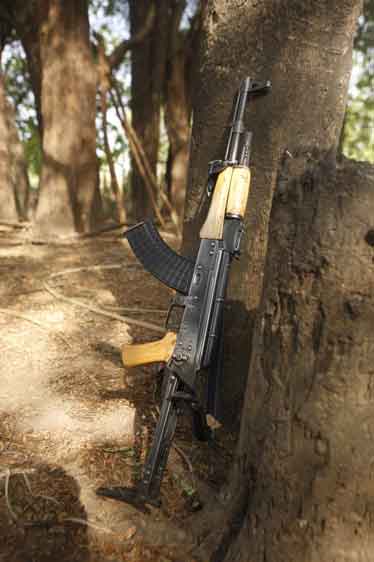
Ramana's AKS series Kalashnikov Rifle. A variant of the AK-47, the 'S' references the 'Skladnoy' or 'folding' metallic shoulder stock. Photo: Ishan Tankha/Open Magazine
In 1988, Ravula Srinivas paid Rs 100,000 for a black-market AKS series Kalashnikov rifle with a light-wood finish and a folding metal shoulder stock.  On April 6 this year, the same rifle was pressed into service in an ambush that killed 75 members of the Central Reserve Paramilitary Force and one Head Constable of the Chhattisgarh police in Chhattisgarh’s Dantewada district.
In the intervening years, Ravula has grown from a young student from Warangal into Ramana, Secretary of the South Bastar Regional Committee of the CPI (Maoist) and chief architect of the April 6 attack; unchanged by the years, the rifle has never left his side.
On April 14, The Hindu was offered access to Maoist leaders Ramana and Ganesh Ueike. in the Jagargunda forests in Dantewada.  The visit offered a rare, though by no means comprehensive, insight into how the CPI (Maoist) sources, maintains and distributes weapons among its cadres.

Tactical Retreat?

The Maoist ‘postponement’ of the general strike has drawn diverse reactions. Ruling parties have projected it as a victory of democracy, constitutionalism, and law and a massive defeat for the Maoist ‘politics of blackmail’. Sections of the media and civil society that had urged the Maoists to pull back feel it is a result of popular pressure exerted by the peace rally on Friday morning. And while some Moist leaders and cadre are reported to be confused, demoralized, and angry at the leadership for letting go, others are hopeful that this will pave the way for an agreement on peace and constitution.

The responses are naturally shaped by one’s own location on the political spectrum. But what it ignores is that there is a complex set of factors that led to the Maoist decision. The non-Maoist euphoria also glosses over the fact that the strike was not the problem; it was only a symptom of the problem. And while the strike is off for now, those underlying issues remain unresolved.

The Maoists made four miscalculations. Continue reading Tactical Retreat?

Nandini Sundar – Will counting caste reduce inequality?

Nandini Sundar’s recent Op-Ed for The Hindu on caste-enumeration in the latest round of the census. Read the entire article here.

But come back with your comments – what do you think about caste–enumeration?

Yesterday when the census enumerator visited, I asked him how he felt about the current debate on counting caste in the census: “Not comfortable at all”, he said, “I don’t even like asking whether someone is SC/ST or Other, leave alone what their caste is.” But, he added, “caste is an inescapable reality of Indian society.”

The debate on counting caste in the census has not moved on from 2001, when opinion was equally divided. Supporters of caste enumeration argue that census categories merely reflect existing classifications, and that only the census can provide the figures necessary to map inequality by caste. Opponents argue that the census does not mirror but actively produces social classifications and ways of thinking. They point to the history of mobilisation around caste in the census and the consequent dangers of both distorted data and increased social tensions. In neither case has much thought been given to how the data might be used, the different kinds of figures needed for different purposes, or alternative ways of collecting the required data. Read the rest of the article here

In Search of Brahmeshwar Singh, ‘the Absconder’

The Myth of the ‘Misuse’ of Laws Meant for the Protection of Dalits and Tribals

Are the laws meant for the protection of Dalits and tribals are put to misuse?

It is a theme which recurs regularly in the discussions engaged in by the chattering classes of the country. While nobody can deny that frivolous cases are not filed under this act the manner in which the issue gets raised creates an impression that the only ‘use’ of this law is its ‘misuse.’ Neither the polity nor the articulate sections of our society seem ready to go for a reality check. In fact, as a marker of these classes’ ‘sensitivities’ towards this delicate issue, even Ms Mayawati in her earlier incarnations as Chief Minister of UP had cautioned the police about its ‘misuse’. She is also reported to have issued G.Os (government orders) to use this law only in cases of rapes and murders of the Dalits.
Continue reading In Search of Brahmeshwar Singh, ‘the Absconder’

Rahul Gandhi and the Dalit votebank in Uttar Pradesh

This article by me has appeared (.pdf) in the Economic and Political Weekly.

On 14 April this year party general secretary Rahul Gandhi launched the Congress’ biggest campaign to revive itself since 1989. The date was carefully chosen, Ambedkar Jayanti, because he is trying to win over dalit votes in Uttar Pradesh (UP). In 1989 the Congress’ support base in UP was made up of a rainbow coalition of brahmins, Muslims and dalits. The Congress has to woo these communities again to regain power in UP.

The brahmin community took to the now ruling Bahujan Samaj Party (BSP) in small numbers in the 2007 Vidhan Sabha election primarily because there was no strong brahmin leader after Bharatiya Janata Party (BJP) leader Atal Behari Vajpayee became politically inactive. Brahmins see in Rahul Gandhi a potential “brahmin” leader. The UP Congress president, legislative leader and Youth Congress president in the state are all from the brahmin community.

Muslim support is no longer enchained to the Samajwadi Party (SP) because their bete noire, the BJP, is powerless these days in both the centre and the state. As a result the Muslim vote is being fought for, as a three-way contest between BSP, SP and Congress. BSP head and Chief Minister Mayawati’s stratagem is to therefore change her party’s core support base constructed out of the “brahmin-dalit” alliance into a Muslim-dalit alliance.

The dalits, wooed away en masse by the Kanshi Ram-Mayawati duo of the BSP for years, would be the hardest to win back for the Congress. In fact, a year ago the very idea would have sounded ludicrous. But today, Mayawati’s angry reaction to the Congress’ bid to woo dalits is indication that the Congress may be winning over dalits. How is this happening? Continue reading Rahul Gandhi and the Dalit votebank in Uttar Pradesh

A Media Simulated Ecstasy?

Amidst the blood lust evident in the mass media in the run up to and especially the aftermath of the judgement on Kasab, comes a slight relief in the form of the following story in The Telegraph, Calcutta.  Sociologist Andre Beteille, not particularly known for his radical and loony views, said “It appears that people want vengeance — not justice,” underlining that  “the media’s role is crucial in whipping up passions. I’m not really surprised”.

A photograph and some extracts:

Special public prosecutor Ujjwal Nikam outside the court after the death sentence was delivered on Thursday. (PTI)

May 6: Special public prosecutor Ujjwal Nikam was asked outside court this afternoon: “Sir, what’s your score?”
Nikam figured out the question in a split second, beamed like a gladiator and replied with a chilling echo of Ab Tak Chhappan: “Thirty-eight death penalties and over 600 life terms.”

Clap, clap, clap….

The crowd, not entirely made of journalists, could not resist the temptation to celebrate. Crackers were burst, drums beaten, cheers whooped, effigies hanged and mock funerals held in an outbreak of exultation. “Death to Kasab! Hang him! Hang him!” they cried; Nikam waved heroically and flashed more Vs — the prize fighter who’d delivered the knockout punch for India…

An election in Nottingham

This is a guest post by AMAN BHARTI on the elections in UK

I had nipped out during my lunch break to post my voting ballot. The route back took me past Nottingham’s speaker’s corner, where for the first time ever, I saw some speakers. They appeared to be two of the three main political party candidates.

Intrigued, I joined the small crowd for my first experience of local electioneering. A desi chap in his shalwaar-kameez (or is that only what women wear?), sleeveless jacket and one of those Ahmad Shah Masood caps (I know they are called something, but I forget what) was just about to ask a question. In broken, accented English, he talked about the Muslim community suffering due to anti-terror laws, and asked which party would bring in “transparency and accountability” in the exercise of anti-terror laws, and adhere to the European courts’ views on individual human rights?

The brown faces in the audience cheered loudly. The white faces were conspicuously (and a little worryingly) silent. Continue reading An election in Nottingham

The City Turns Red – Kathmandu on May Day

When Maoist Newa state in charge Hitman Sakya asked the assembled crowd at Khula Manch to silently honor martyrs, the moment turned somber. The leaders stood with their heads down on the stage, and on the ground, all one could see were thousands and thousands of fists raised up. There was pin-drop silence.

A bit later, members of the Maoist cultural wing sang and danced. The lyrics were deeply political, hitting out at the NC, UML and India, projecting the Maoists as the only people’s party, and wooing the security forces by showing uniformed personnel shaking hands with Maoists ‘to build a new Nepal’. The crowd was enthralled. Continue reading The City Turns Red – Kathmandu on May Day

Kathmandu Siege – They Are Here

Kathmandu’s elites cannot seem to understand who these people are. But talk to the cab driver, waiter, vegetable seller, small shopkeeper, slum dweller or construction worker and you will get an idea of who may dominate the streets from Saturday.
There has been coercion in the process of mobilisation. But the Maoists have essentially tapped into the three core contradictions of Nepali society – ethnicity, class, and space (Kathmandu versus the rest). They have deployed their cadres; capitalised on the rage of those on the periphery; and channelised popular discontent against inflation, power cuts, corruption and insecurity, for which Madhav Nepal has been projected as solely responsible. Continue reading Kathmandu Siege – They Are Here

The Oblique Strategies of Trickster City

It’s midnight: An aspiring model cooks up a batch of Fem Bleaching Cream; an actor rehearses his dialogues to the sounds of manic laughter, “Oh tell them all it is I who is God,”; a fourteen year old feigns sleep as his father looks on, wondering what has prompted his son to abandon his studies and look for work; a woman throws her abusive husband to the floor and whips him with his belt.
In the morning, a young man will awaken at the crack of dawn and walk down to the slaughterhouse; an empty street shall bear witness to a middle aged woman’s defiant declaration, “I will work. I don’t care what you think! I don’t care what the world thinks.” The muezzin will call the faithful to prayer.  A bulldozer will plow through the heart of this twenty five year old settlement: clearing space for the 2010 Commonwealth Games, altering these lives forever.
In February 2006, the residents of Nangla Maanchi, a working class settlement of migrants in Delhi, were confronted by a signboard: “This land is the property of the government. It should be vacated.” By August that year, Nangla was bulldozed to make way for an “athlete’s village” to house this year’s Commonwealth Games.

The ban on SIMI and Indian democracy

Dr Shahid Badar, national president of Students Islamic Movement of India, recently decided not to contest any more the ban on SIMI, his stated reason being:

“to put an end to this mindless, futile, unequal, unethical and unjust exercise in which the Government has shamelessly used the Judiciary to achieve its ends of casting a shadow of criminality on the entire muslim community.  I have therefore chosen not to contest the declaration of the central govt.”

This is the full text of the affidavit filed by him before the Unlawful Activities (Prevention) Tribunal.

Continue reading The ban on SIMI and Indian democracy

Madhuri and Zeenat

I recieved a mail today about the  deafening silence on the 24X7 newsbreakers regarding La affaire Madhuri and it got me thinking.

Is it not a bit strange that an OB van is not stationed permanently at the Vikaspuri residence of Ms Gupta? How is it that her milk man, her vegetable seller, the retired army major/ or a school principal or an old acquaintance who lives a few houses away have not been interviewed 200 times in the last two days?

How is it that archival shots of Ms Gupta driving away in her car, or recent shots of her being led away  in hand-cuffs, pan shots of her house from across the road, shots of authentic looking documents, of the schools she went to, of interviews with her old parents asking them how does it feel to be parents of a traitor? etc., etc. are not being run in a 24 hour loop? Continue reading Madhuri and Zeenat

Swami & Friends: JTSA’s response to Praveen Swami

The story so far…

Jamia Teachers Solidarity Association was  formed after the so-called “encounter” at Batla House in 2008, in which two students of Jamia Millia Islamia were killed. You may remember posts on kafila at the time, questioning the credibility of police accounts of the “encounter” and criticizing the unethical nature of media coverage:

A little less melodrama, a lot more forensics;

The Jamia Nagar encounter: Curiouser and curiouser;

Shame is a revolutionary sentiment;

Some questions about the Delhi encounter.

In April this year, JTSA, which has been demanding an independent probe into the encounter, issued a statement after the post mortem reports of Atif Ameen and Md. Sajid were made public, revealing that the two boys were not  killed in cross fire as Delhi Police claimed:

Batla House ‘Encounter’: Whom is the JP Trauma Centre Shielding?

On April 25, 2010, Countercurrents published another statement by JTSA, titled Praveen Swami’s Not so Fabulous Fables, which began thus:

“If there is one infallible indicator of what the top Indian Intelligence agencies are thinking or cooking up, it is this: Praveen Swami’s articles. Each time the security establishment wishes to push a certain angle to this bomb blast or that, Swami’s articles appear magically, faithfully reflecting the Intelligence reports. After the Batla House ‘encounter’, he launched a tirade against all those who were questioning the police account of the shootout labeling them all ‘Alices in wonderland’. He went so far as to identify ‘precisely’ how Inspector Sharma was shot by claiming that “abdomen wound was inflicted with [Atif] Amin’s weapon and the shoulder hit, by Mohammad Sajid”.

And no sir, Swami’s conclusion was not based on post mortem reports of the killed, fire arm examination report or ballistic report but on this innocent fact: “the investigators believe that…” He certainly brings in a whole new meaning to ‘investigative journalism’. Swami however felt no need to pen an article when the postmortem reports of Atif and Sajid revealed that they had been shot from close range and that neither of them sustained gunshot wounds in the frontal region of the body—an impossibility in the case of a genuine encounter. Was it because the police and the Home Ministry chose to remain quiet after the revelations—hoping that the storm would quietly blow over?
Praveen Swami wrote an injured response via a letter to Annie Zaidi, which too was published on Countercurrents.
And now read on, as JTSA responds to Swami.

Continue reading Swami & Friends: JTSA’s response to Praveen Swami