Demanding a ban on visit of Salman Rushdie to India is outrageous: PUCL

This release comes from the PEOPLE”S UNION FOR CIVIL LIBERTIES

The People’s Union for Civil Liberties (PUCL) views it with deep concern that some organizations have demanded ban on entry of Salman Rushdie in the country. The present call is illogical, preposterous and untenable as the writer has visited the country for several times after the Satanic Verses book controversy. Continue reading Demanding a ban on visit of Salman Rushdie to India is outrageous: PUCL

Nepal – The Nostalgia for 1990

Kanak Mani Dixit’s efforts to portray 1990s as blissful, and Maoists to solely blame for all of Nepal’s ills, is revisionist history, facts be damned. Dixit’s rejoinder (‘The perils of executive presidency’, Jan 5) to my column (‘A question of form’, Jan 4) reveals fundamental differences in how we see recent Nepali history. The gist of Dixit’s rather simplistic world view is that the 1990s were wonderful and the Maoists destroyed it and are all evil. Let us examine this in more detail.

The 1990s

The 1990 constitution opened up Nepali society; it guaranteed fundamental freedoms and allowed groups to organise themselves at all levels; and economic policies pursued then led to the creation of a bigger middle class.

But there were two fundamental drawbacks of that period, which is what led to its eventual breakdown. Continue reading Nepal – The Nostalgia for 1990

Invisible Censorship – How India Censors Without Being Seen: Pranesh Prakash

Guest post by PRANESH PRAKASH

The Indian government wants to censor the Internet without being seen to be censoring the Internet. This article by Pranesh Prakash shows how the government has been able to achieve this through the Information Technology Act and the Intermediary Guidelines Rules it passed in April 2011. It now wants methods of censorship that leave even fewer traces, which is why Mr. Kapil Sibal, Union Minister for Communications and Information Technology talks of Internet ‘self-regulation’, and has brought about an amendment of the Copyright Act that requires instant removal of content.

Power of the Internet and Freedom of Expression
The Internet, as anyone who has ever experienced the wonder of going online would know, is a very different communications platform from any that has existed before. It is the one medium where anybody can directly share their thoughts with billions of other people in an instant. People who would never have any chance of being published in a newspaper now have the opportunity to have a blog and provide their thoughts to the world. This also means that thoughts that many newspapers would decide not to publish can be published online since the Web does not, and more importantly cannot, have any editors to filter content. For many dictatorships, the right of people to freely express their thoughts is something that must be heavily regulated. Unfortunately, we are now faced with the situation where some democratic countries are also trying to do so by censoring the Internet. Continue reading Invisible Censorship – How India Censors Without Being Seen: Pranesh Prakash

The Regulation of Surrogacy in India – Questions and Concerns: SAMA

Guest post by SAMA, a resource group for women and health.

As the clamor dies down, of news reports celebrating the ‘miracle of science’ that made the arrival of Aamir Khan and Kiran Rao’s baby boy possible,  it would serve to look more closely at commercial surrogacy in India.  Estimated to be a multi-million dollar industry, Assisted Reproductive Technologies  (ARTs, through which surrogacies are conducted) are a recent and fast-growing addition to India’s medical market and medical tourism sector. Their unregulated proliferation over the last few years has raised serious issues of safety, ethical practice, costs, and rights. While the proposed Draft Assisted Reproductive Technologies (Regulation) Bill & Rules-2010 is a long-awaited step towards regulation, several clauses, especially concerning commercial surrogacy, leave much to be desired.

Continue reading The Regulation of Surrogacy in India – Questions and Concerns: SAMA

Bhopal, Media and a “Training Manual”: Shalini Sharma

Guest post by SHALINI SHARMA

It hardly needs any corroboration that the Bhopal Movement led by survivors of the world’s worst industrial disaster adheres to the principles of non- violence as dearly as they adhere to their demands of justice and accountability. However, on the 3rd of  December 2011, as thousands of Bhopal gas victims walked towards the city’s railway lines they had little idea that their act of civil disobedience, marking the 27th Anniversary of the disaster, would be sabotaged by the government and that they would be treated like a violent mob.

Anniversary actions are usually treated as rituals by the media. This occasion was different because even though chakka jaam (block the road) has been organised on several previous occasions, the call for blocking the trains or rail roko was an unusual decision. These survivor-led groups were asking the State government to provide the Supreme Court with the right data related to the number of deaths and actual extent of injuries due to the gas exposure.

Continue reading Bhopal, Media and a “Training Manual”: Shalini Sharma

This is the story of the monkeys of Delhi

From 2009 to early 2011, I lived in a south Delhi barsati which had an enormous terrace area. When I moved in, this open space looked sad and empty, so I spent many thousands of rupees doing it up with all kinds of plants. Then came the monkeys. A team of five to ten. On finding the kitchen locked, they would break the pots, and sometimes eat the plants. No flower was allowed to bloom.

I replaced the mud pots with heavy cement ones. The monkeys broke fewer of them but ate more shoots and leaves. They would come at night. Soon they’d come at dawn, and make such a commotion I’d wake up terrified. Mild banging on the door wouldn’t ward them off, nor would the other tactics I tried. I was afraid of them. They could be aggressive and strong and these traits were multiplied because they operated in gangs. I felt caged in the small room of my large barsati. All I could do was share my misery on Facebook. “Be careful,” a friend warned in a comment, “they once killed the deputy mayor of Delhi.” Read more…

Waiting for Guddo: Farid Alvie

Guest post by FARID ALVIE

Three miles west of nowhere, I wait atop a grassy knoll landscaped with deliberate carelessness by the authorities of this semi-dilapidated amusement park. She said she will meet me here at the appointed time but as luck would have it, neither one of us owns a watch. Ravenous crows with their wings a-stretched and eyes a-bulged circle overhead: a dark, black ring set against a grey sky. I scan my surroundings and find myself alone… as alone as the day I was born. As I shoo my mother, the doctor and his two nurses away, I wonder where she might be at this very moment: caught in a jam full of traffic or confined to her room by the elders of her household, barred from meeting the man she loves and his lustrous, well-coiffed do.

Creepily crawling ants dodge my sneakered soles as they make their way home for the day. Leaves rustle and droop as they emit whiffs of carbondioxide that make my blood pressure plunge. City lights flicker in the distance as a rickshaw throttles by on the road below, polluting my environs and coating the withering leftovers of a despondent spring with soot and non-biodegradable petrol fumes. Continue reading Waiting for Guddo: Farid Alvie

An Appeal to the Tamil Community and its Civil and Political Representatives

An Appeal Signed by Tamils on the Eviction of Northern Muslims 21 Years Ago

Since the end of the war in May 2009, it has become important for all ethnic communities of Sri Lanka to re-examine and reevaluate their past. It is through this process of self-reflection that some of the major issues that confront state and civil society today can be meaningfully reconceived and reconfigured for the future.

While the war has drawn to a decisive close, the ethnic conflict is far from over and demands solutions short- and long-term. The quest for a viable political solution from a majoritarian state is a primary concern for the Tamil community today. Continued insecurity in the face of militarisation is an urgent matter. Armed militancy and a political culture of violence have further eroded into the democratic fabric of society. Resettlement and rehabilitation remain unresolved problems. Distribution of land, access to state and social networks, language parity, devolution of power, inter-ethnic reconciliation and the continued presence of gender, class and caste stratifications are a part of the political landscape today.

It is in this regard we raise the question of the eviction of the Northern Muslims 21 years ago. In October 1990, the LTTE evicted roughly 80,000 Muslims from the north in the wake of increasing hostilities and armed conflict in the north and east. The LTTE, which was militarily dominant in the north at that time and controlled large swathes of territory, ordered an entire community to leave the province in two days. In the Jaffna peninsula they were given just two hours’ notice. Subsequent to the eviction, several attempts were made by institutional mechanisms to facilitate the return of the communities to their original lands. During the Ceasefire Agreement (CFA), there were renewed attempts, particularly through the Secretariat for Immediate Humanitarian and Rehabilitation Needs (SIHRN), to negotiate the return of the Muslims with the Sri Lankan state and the LTTE.

In the current political landscape, the eviction of Muslims from the north and their return and resettlement pose a distinct political challenge to civil and political societies of the Tamil community. Continue reading An Appeal to the Tamil Community and its Civil and Political Representatives

The inter-connected destinies of strangers across an international border

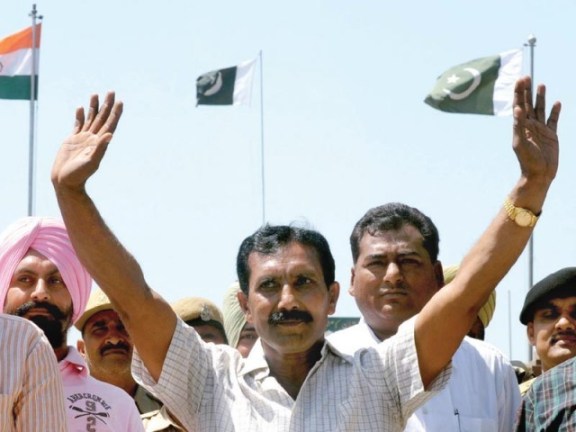
Gopal Das at Wagah border. AFP photo

The central government wants him to do it, the Rajasthan government wants him to do it, but Rajasthan’s acting Governor Shivraj Patil wouldn’t sign on a file for several months now. His obstinacy could become a major hurdle for many Indians and Pakistanis lodged in each others’ prisons.

In an unusual order, the Supreme Court of India quoted William Shakespeare and Faiz Ahmed ‘Faiz’ to directly appeal to the government of Pakistan to pardon and release Indian prisoner Gopal Das. Pakistan President Asif Ali Zardari signed the papers within 16 days, ahead of Prime Minister Yusuf Raza Gilani’s visit to Mohali to witness the cricket world cup semi-final with his Indian counterpart. On 7 April, Gopal Das crossed into India. There were those in Pakistan who had opposed his release, arguing he had a few months left to complete his sentence, and that he should not be shown mercy because he had been found guilty in 1984 by a Pakistani military court on charges of being a an Indian spy. He and his family claimed this was not true, and wanted him pardoned because now 52, he had spent the last 27 years in several Pakistani prisons. Continue reading The inter-connected destinies of strangers across an international border

On ‘gay conditionality’, imperial power and queer liberation: Rahul Rao

Guest post by RAHUL RAO

It’s not clear what (or whether) David Cameron was thinking when he suggested recently that British aid should be linked to respect for LGBT rights in recipient countries. Almost immediately, the statement evoked homophobic responses from political and religious leaders in Tanzania, Uganda, Ghana and elsewhere. Perhaps more importantly, African social justice activists (including many of the leading LGBTI activists on the continent) advanced a comprehensive critique of ‘gay conditionality’ in a letter criticising Cameron’s statement, signed by 53 organisations and 86 individuals. Warning that the refusal of aid on LGBT rights grounds could provoke a backlash against queers who would be scapegoated for reduced aid flows, the critics have pointed out the insidious ways in which such initiatives could drive a wedge between queers and a broader civil society in recipient countries, besides reinforcing perceptions of the westernness of homosexuality as well as the imperial dynamics already prevailing between donor and recipient countries.

Continue reading On ‘gay conditionality’, imperial power and queer liberation: Rahul Rao

Amitav Ghosh on Goa

Some musings here about the liberation of Goa from Portugese rule by India:

But the interaction between Portugal and India also produced vibrant cultural hybrids in architecture, music and food. Among the state’s most famous dishes is the spicy vindaloo, a curry whose name is thought to be a contraction of the Portuguese phrase “vinho de alho,” or garlic wine. Besides, as Mr. deSouza pointed out, Goa was where the influence of the Enlightenment and the Renaissance in Europe was felt much before it reached other parts of India. As a result, the practice of sati – or widows immolating themselves on their husbands’ funeral pyres – was abolished in Goa 200 years before the British banned it in the rest of India. [Naresh Fernandes]

And on Portugese language, 50 years after the Portugese were sent back to Portugal:

The popular history of the Portuguese period in Goa has largely been restricted to the gory tales of the initial conquest of the island of Goa, of the Inquisition, and the dramatization of the anti-colonial episodes in the territory’s history. To a large extent, this nationalist history dissuades Hindus from subaltern castes from studying the language. This has ensured that it is solely dominant-caste narratives that are incorporated into the histories of the territory, preventing alternative and liberatory narratives to emerge from a re-reading of the texts and narratives of the period of Portuguese sovereignty over the territory.  It is little known for example, that the knowledge of Portuguese is critical to the bahujan challenge to Hindu upper-caste groups’ monopolistic control of the Goan temples. This monopolistic control of the temples was forged in particular through these latter groups’ knowledge of Portuguese. [Jason Keith Fernandes]

Let’s march faster towards the metric system: Subhash Chandra Agrawal

Guest post by SUBHASH CHANDRA AGRAWAL

Even after half-a-century of introduction of metric measure in India, certain commodities like cloth, paper, furniture, land, time etc are being traditionally manufactured/measures in old units or their metric-converts. For example, cloth is usually manufactured in widths like 36” (91 cms), 48” (122 cms), 50” (127 cms), 54” (137 cms), 120” (305 cms) etc which should now be woven in metric-measures in multiples of 10 cms. It is time that measuring tapes may be available only in metric units after some specified date.

Continue reading Let’s march faster towards the metric system: Subhash Chandra Agrawal

Three Formidable Barriers to the Advance of Democracy: Ravi Sinha

This guest post by RAVI SINHA is the text of the key note address to the Pakistan-India People’s Forum for Peace and Democracy in Allahabad on 30 December 2011

I must begin by expressing my gratitude to the organizers of this Convention and to this Forum for the opportunity and the honor you have given me by letting me address this impressive assembly. Also, I must congratulate you for choosing a theme that articulates, perhaps, the central challenge confronting all peoples and all nations of the world and more so for the peoples and the nations on the subcontinent. We are all witness to and victims of the times characterized by monstrous brutalities of war and deep scars of deprivations, inequities and oppressions. We live under a world order wherein those who brought, for example, untold tragedy and destruction to Iraq will never be brought to justice because they are the global hegemons. They will not be questioned about the hundreds of thousands of dead and maimed Iraqi men, women and children; they will not be questioned about the thousands of dead and decapitated American soldiers; they will not be questioned about the trillions of dollars spent on the war and further trillions destroyed by the war; and they will not be questioned about the kind of Iraq they are leaving behind.

Continue reading Three Formidable Barriers to the Advance of Democracy: Ravi Sinha